In This Story
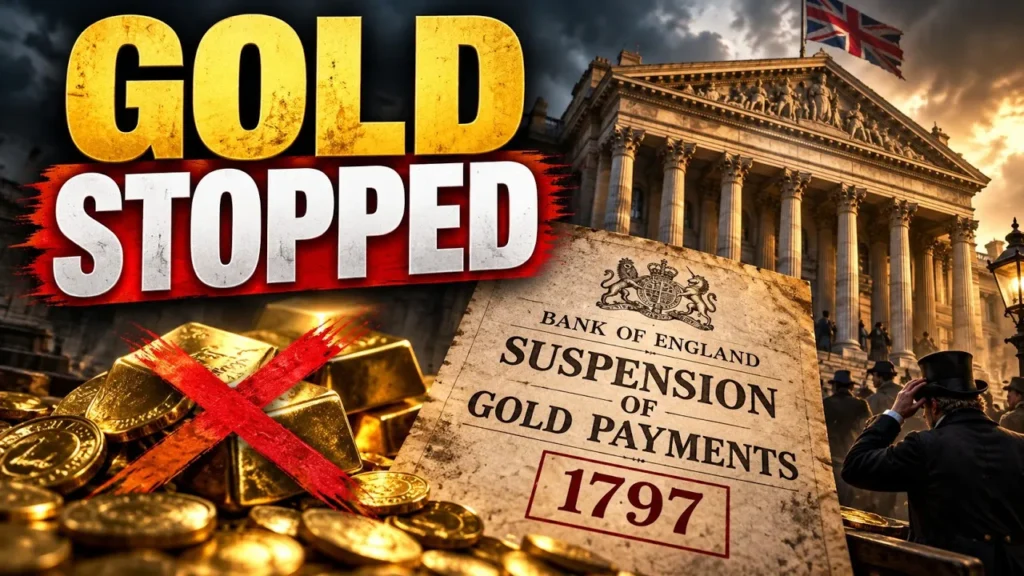
On 21 September 1931, Britain suspended the gold standard. After weeks of mounting withdrawals from London, the government released the Bank of England from its obligation to exchange pounds for gold at a fixed price. A monetary promise restored only six years earlier had become impossible to defend.
The decision shook an international financial system in which sterling had long occupied a central position. Britain was struggling with mass unemployment, a global depression, and a crisis of confidence spreading across European banks. Foreign investors wanted their money back, while the Bank of England’s ability to meet those demands was running out.
The paradox was striking: Britain abandoned gold to protect its financial system, yet the resulting fall in sterling helped create the conditions for economic recovery.
Understanding why requires going back to an earlier decision that had placed the pound under enormous pressure.
The Promise Britain Made in 1925
Before the First World War, Britain had been one of the principal anchors of the international gold standard.
Under that system, participating countries fixed the value of their currencies in terms of gold. Because those currencies were linked to the same metal, their exchange rates against one another were relatively stable.
For Britain, gold was more than a monetary arrangement. It was associated with London’s reputation as an international financial centre, the security of British investments abroad, and the country’s economic influence.
The war had disrupted the system. Governments needed enormous amounts of money, currencies became unstable, and the old relationship between gold and money could no longer operate in its previous form.
On 28 April 1925, Chancellor of the Exchequer Winston Churchill announced Britain’s return to gold at the pre-war parity.
The pound was once again fixed at approximately $4.86.
Montagu Norman, the influential Governor of the Bank of England, strongly supported the restoration. He believed that a credible gold standard would strengthen confidence in sterling and restore London’s international position.
But the return contained a serious problem.
Britain’s economy was no longer the economy of 1914. The war had changed international trade, increased government debt, and weakened some traditional British export industries.
Restoring the old exchange rate meant that British goods could be expensive relative to those produced abroad.
The economist John Maynard Keynes criticized the decision, arguing that maintaining the pre-war value of sterling would place damaging pressure on wages, employment, and industry.
There is continuing debate over how much of Britain’s economic weakness during the late 1920s resulted specifically from the chosen gold parity. Older industrial problems and changing international competition also mattered.
Nevertheless, the central difficulty was clear: defending a fixed exchange rate could require economic policies that made domestic unemployment harder to solve.
How the Gold Standard Became a Financial Trap
The gold standard worked through a promise backed by reserves.
Under the Gold Standard Act of 1925, the Bank of England was required to sell gold bullion at a fixed official price. This was not a system in which ordinary households routinely exchanged banknotes for gold coins. The legal obligation concerned large bars of gold, making it particularly relevant to substantial financial transactions.
The promise helped maintain the pound’s value against other gold-linked currencies.
But it also created a vulnerability.
Suppose an overseas bank held a large sterling balance in London. As long as it trusted sterling, it could leave that money invested in British financial assets.
If confidence deteriorated, however, the bank could sell sterling for dollars, francs, or another currency regarded as safer.
To prevent the pound from falling below its established gold value, the Bank of England had to support the exchange rate. That meant using foreign-currency reserves or allowing gold to leave.
Each withdrawal reduced the resources available to defend the next one.
The problem became particularly dangerous when international investors began to doubt whether the central bank possessed enough reserves to satisfy everyone who might seek payment.
A successful currency defence depends partly on confidence. Once people believe the defence may fail, withdrawing money becomes more attractive.
That behaviour can intensify the crisis.
The Interest Rate Dilemma
A central bank facing capital flight can raise interest rates to make holding its currency more attractive.
Higher interest rates can reward investors who keep their money in the country and discourage borrowing that finances capital outflows.
But they also make credit more expensive for domestic businesses and households.
In Britain, this was especially painful.
Traditional industries were already suffering from weak demand and fierce international competition. Unemployment remained high throughout the 1920s and worsened dramatically during the Great Depression.
The government faced an increasingly uncomfortable choice.
It could maintain tight financial conditions in defence of sterling, potentially worsening the economic downturn.
Or it could relax monetary policy and risk undermining the gold commitment.
By 1931, that conflict was becoming impossible to ignore.
The 1931 Sterling Crisis Spreads Across Europe
Britain’s final crisis did not begin in London.
In May 1931, Austria’s major bank, Creditanstalt, encountered a severe financial collapse. Its difficulties intensified fears about the stability of banks and borrowers across Central Europe.
The turmoil spread to Germany, where banking panic erupted during the summer.
International lending networks transmitted the damage beyond the countries where the immediate failures occurred.
London was particularly exposed.
British financial institutions had helped finance international trade and overseas borrowing. Some held assets connected to Germany and other European borrowers, while simultaneously owing money to foreign depositors and lenders.
This created a dangerous mismatch.
Money That Could Not Be Recovered Quickly
A London bank might owe money to an overseas creditor who was entitled to withdraw it at short notice.
But the same bank might have lent money abroad through loans that could not immediately be repaid.
When German banking restrictions and financial turmoil interfered with access to overseas assets, this mismatch became harder to manage.
Foreign creditors still wanted their sterling balances returned.
London’s ability to recover money from borrowers abroad had become less reliable.
The resulting pressure was not simply a judgement about the British government’s budget. It reflected the breakdown of an international credit system built around confidence and short-term financing.
The Great Depression magnified the danger.
Falling prices made debt repayment harder, international trade contracted, and investors became increasingly reluctant to take risks.
As concern spread, sterling began attracting the attention of creditors who feared that Britain itself might have to abandon gold.
Britain’s Budget Crisis Deepens the Panic
The financial emergency developed alongside a major political crisis.
By 1931, unemployment among insured British workers had exceeded 20 percent. The Depression had weakened tax revenues while increasing demands on unemployment assistance and other public spending.
Financial orthodoxy placed great importance on maintaining a balanced government budget.
Some policymakers feared that persistent deficits would further undermine confidence in sterling. Others argued that cutting spending during a depression would worsen hardship and weaken economic activity.
These disagreements helped divide Ramsay MacDonald’s Labour government.
In August 1931, MacDonald formed a National Government supported by politicians from different parties.
The new administration pursued emergency financial measures, including reductions in public expenditure.
Supporters regarded these measures as necessary to reassure investors. Critics questioned whether austerity could solve a crisis driven substantially by international capital movements.
The government initially hoped that its financial programme would calm the markets.
But the withdrawals continued.
The Invergordon Mutiny
Political uncertainty intensified in September when sailors in the Royal Navy protested proposed reductions in pay.
On 15–16 September 1931, unrest at Invergordon disrupted naval operations.
Reports of the episode attracted international attention and added to concerns about Britain’s internal stability.
The incident has sometimes been presented as the event that forced Britain off gold.
That interpretation gives it too much explanatory weight.
The sterling crisis had already been developing for months, and substantial withdrawals had begun before the naval protest.
The Invergordon episode damaged confidence at a particularly vulnerable moment. It was an aggravating factor, not a complete explanation for the collapse of the gold commitment.
The decisive problem remained the growing demand for foreign currency and gold.
The Weekend Britain Could No Longer Defend Sterling
By September, the Bank of England and the government had already sought emergency financial assistance from New York and Paris.
Foreign credits provided temporary resources to meet withdrawals and maintain confidence.
They did not remove the underlying pressure.
The money obtained abroad was being consumed by continuing demands from creditors seeking to move funds out of London.
The scale was extraordinary.
According to the Treasury’s contemporary statement, more than £200 million had been withdrawn from the London market since the middle of July.
That figure described the wider withdrawal of funds, not simply a £200 million loss from the Bank of England’s own gold holdings. The demands had been met through a combination of official reserves and emergency foreign borrowing.
In the final days, the pace accelerated.
Chancellor of the Exchequer Philip Snowden later told Parliament that withdrawals had reached approximately £5 million on Wednesday, £10 million on Thursday, nearly £18 million on Friday, and more than £10 million during Saturday’s shortened trading session.
These were enormous movements for the financial system of the time.
The government’s statement put the Bank of England’s gold holdings at approximately £130 million.
Even that reserve could not safely be treated as fully available. Emergency borrowing created obligations that would eventually have to be repaid, and further withdrawals remained possible.
Continuing to exchange sterling for gold might simply exhaust essential reserves without restoring confidence.
The Decision of 20 September
The decisive discussions took place over the weekend.
On Sunday, 20 September 1931, the Treasury announced that the government had decided to suspend the obligation requiring the Bank of England to sell gold at the statutory price.
Parliament would be asked to approve emergency legislation the following day.
The announcement emphasized that ordinary banking business could continue. Britain was not declaring a general suspension of bank deposits, nor was it announcing that all obligations denominated in foreign currencies would cease to be honoured.
The government was ending a particular monetary commitment: the legal requirement to provide gold at the established price.
On Monday, 21 September, Parliament passed the Gold Standard (Amendment) Act.
The measure suspended the relevant provision of the 1925 legislation and gave the Treasury temporary powers to address exchange difficulties.
The government described the suspension as temporary.
In practice, Britain did not return to its previous gold commitment.
Where Was Montagu Norman?
One of the most remarkable details of the crisis concerns the man most closely associated with Britain’s return to gold.
Montagu Norman had been a powerful defender of the gold standard and a central figure in British monetary policy for years.
Yet when Britain finally abandoned the system in September 1931, Norman was aboard a ship in the Atlantic.
He had been away recovering from illness.
The Bank of England’s archives preserve a telegram dated 20 September from Deputy Governor Ernest Harvey informing Norman of the decision to leave gold the following day.
The governor did not return to Britain in time to direct the final parliamentary and government response.
The episode illustrates the distinction between Norman’s personal commitment to the system and the institutional decisions made during its collapse.
His absence also complicates the familiar picture of a single central banker personally determining Britain’s monetary fate.
The pressure had accumulated through international markets, government policy, banking relationships, and decisions made by numerous officials.
No individual controlled all of those forces.
What Happened to the Pound After Britain Left Gold?
Once the statutory gold obligation was suspended, sterling no longer had to remain at its old fixed value.
The exchange rate could respond more freely to supply and demand in the currency market.
The pound fell sharply.
Before the suspension, its gold-linked value had been approximately $4.86. During the following months, sterling declined against the dollar, reaching around $3.25 in early December 1931.
Its value later recovered against the dollar as international monetary conditions changed.
Exchange rates against a single currency do not show the entire picture, however.
A trade-weighted exchange rate measures a currency against several trading partners, giving greater importance to countries with which it trades more extensively.
Modern economic research estimates that sterling’s effective exchange rate fell by approximately 23 percent between the second and fourth quarters of 1931.
That depreciation changed the competitive position of British producers.
Consider a British manufacturer selling machinery abroad.
Before devaluation, foreign customers needed to spend more of their own currency to obtain a given number of pounds.
After sterling fell, the same sterling price could translate into a lower foreign-currency price.
British exporters therefore gained an opportunity to compete more effectively.
The reverse applied to imports. Goods priced in foreign currencies could become more expensive in sterling terms.
But depreciation did not automatically cause a general surge in British prices. Worldwide deflation and falling international commodity prices complicated the effect on import costs.
Nor did leaving gold mean that sterling had become worthless.
The pound had lost its fixed gold value, not its usefulness as money.
Banks, businesses, households, and the government continued using sterling. The change concerned the currency’s external monetary anchor.
Did Abandoning Gold Help Britain Recover?
The departure from gold did not immediately end the Great Depression in Britain.
Unemployment remained severe, and recovery was uneven across industries and regions.
Nevertheless, the decision removed an important constraint.
The Bank of England no longer had to defend sterling’s pre-war gold parity at virtually any economic cost. Monetary policy could increasingly respond to domestic conditions.
By 1932, Britain had moved toward a policy of relatively cheap money, with Bank Rate reduced to 2 percent.
Lower interest rates helped support borrowing and investment. Residential construction became an important contributor to recovery, particularly in areas better positioned to benefit from cheaper credit.
Sterling depreciation also improved opportunities for exporters.
What Modern Research Shows
A study published in The Journal of Economic History in 2026 examined how Britain’s departure from gold affected different industries.
Researchers Jason Lennard and Meredith M. Paker compared employment outcomes in industries heavily dependent on exports with those in less export-oriented activities.
They estimated that leaving gold reduced unemployment in export-intensive industries by approximately 2.7 percentage points relative to other industries.
Using additional economic simulations, they estimated that the export channel alone lowered Britain’s aggregate unemployment rate by about 1.5 percentage points, equivalent to approximately 140,000 fewer people unemployed.
These are research estimates rather than direct historical headcounts of jobs created by devaluation.
Nevertheless, they offer quantitative support for an important conclusion: depreciation helped stimulate economic activity and was not merely a transfer of employment from one British industry to another.
The benefits were not equally distributed.
Industries tied to domestic markets responded differently from exporters. Areas already suffering long-term industrial decline could remain depressed even as newer industries and regions experienced stronger growth.
Other forces also mattered.
Britain introduced tariffs in 1932, domestic financial conditions changed, and international demand eventually began to recover.
There is consequently a distinction between saying that abandoning gold contributed importantly to recovery and claiming that it single-handedly solved Britain’s economic problems.
The evidence supports the first conclusion.
A New Way to Manage Sterling
Leaving gold created opportunities but also introduced uncertainty.
Without the old fixed exchange rate, sterling could move unpredictably in international markets.
Sharp currency fluctuations complicated international trade and financial contracts.
British authorities therefore developed mechanisms for managing the exchange rate without restoring the earlier gold commitment.
In 1932, the Treasury established the Exchange Equalisation Account.
Its purpose was to help limit excessive fluctuations in sterling’s external value.
The Bank of England acted as the Treasury’s agent in operating the account.
This arrangement represented a significant departure from the previous monetary framework.
Under the old system, authorities were committed to maintaining a specified gold price.
Under the new arrangements, officials could intervene in currency markets while allowing sterling’s value to change.
The distinction was fundamental.
Rather than sacrificing domestic monetary flexibility to preserve an unchanging exchange-rate promise, Britain had begun developing tools for managing a currency whose external value was no longer fixed to gold.
Was Britain’s Exit from Gold Inevitable?
Historians agree that Britain faced an exceptionally serious financial crisis in September 1931.
They do not all agree that abandoning gold was the only imaginable policy choice throughout the preceding months.
One interpretation emphasizes the international banking panic.
The collapse of confidence following the Central European crisis, the withdrawal of foreign funds, and the mismatch between London’s financial liabilities and assets created pressures that became extremely difficult to resist.
Another interpretation emphasizes the political and intellectual choices of policymakers.
Historian James Ashley Morrison has argued that the assumptions and strategies adopted by officials inside the Bank of England played an important role in determining the response.
This perspective challenges the idea that the final outcome was purely mechanical.
Authorities could consider higher interest rates, stronger financial controls, additional foreign credits, fiscal measures, or changes in the gold commitment.
But every option carried costs and uncertain prospects.
By the final weekend, further external assistance on the necessary scale was not forthcoming, existing credits were exhausted or nearly exhausted, and withdrawals were accelerating.
Maintaining gold convertibility risked losing more reserves without stopping the panic.
The wider question is therefore not simply whether Britain could theoretically have defended sterling for another day.
It is whether preserving the old gold parity was worth the increasingly severe economic and financial costs.
The Collapse That Changed International Money
Britain’s decision had consequences far beyond London.
Sterling remained an important currency for international trade, banking, and the financial relationships of the British Empire.
When Britain abandoned gold, other countries confronted new choices about their own monetary arrangements.
Several followed sterling away from the gold standard. Others maintained their gold commitments for years longer.
The resulting divisions helped reshape the international monetary system during the Great Depression.
The crisis also demonstrated that fixed monetary promises could become destabilizing when they conflicted with domestic economic conditions and international capital movements.
The gold standard had offered exchange-rate stability and a recognizable basis for financial confidence.
But in 1931, those benefits came with increasingly demanding obligations.
Britain’s monetary authorities were trying to defend an exchange rate in a world of collapsing banks, contracting trade, and mass unemployment.
The system that had once reinforced confidence was now helping to constrain the response to the crisis.
The suspension of gold convertibility was initially announced as an emergency measure. Its deeper significance became apparent only afterward.
Britain had begun moving toward a monetary framework in which exchange rates could adjust and policymakers possessed greater freedom to respond to domestic economic conditions.
The 1931 sterling crisis was not simply the story of a currency losing its gold backing. It was the moment Britain accepted that protecting the value of money could no longer mean defending a fixed price at any cost.
Sources & Further Reading
1. HM Treasury — “Going off Gold: Treasury Statement for the Press, 20 September 1931.”
The National Archives, document T 163/68/18, 1931. Primary government statement explaining the emergency suspension, foreign withdrawals, and remaining gold reserves.
https://www.nationalarchives.gov.uk/education/resources/thirties-britain/going-gold/
2. UK Parliament — “Gold Standard (Amendment) Bill.”
House of Commons Debates, Volume 256, columns 1289–1357, 21 September 1931. Philip Snowden’s parliamentary explanation of the financial crisis and emergency legislation.
https://api.parliament.uk/historic-hansard/commons/1931/sep/21/gold-standard-amendment-bill
3. UK Parliament — Gold Standard (Amendment) Act 1931.
United Kingdom Public General Acts, 1931, Chapter 46. The legislation suspending the Bank of England’s statutory obligation to sell gold bullion at a fixed price.
https://www.legislation.gov.uk/ukpga/Geo5/21-22/46/contents/enacted
4. Bank of England — “The Exchange Equalisation Account: Its Origins and Development.”
Bank of England Quarterly Bulletin, December 1968. Historical examination of Britain’s departure from gold, sterling depreciation, and subsequent exchange management.
https://www.bankofengland.co.uk/quarterly-bulletin/1968/q4/the-exchange-equalisation-account—its-origins-and-development
5. Bank of England — “Bank of England’s Holdings of Gold and Foreign Exchange, 1924–31.”
Bank of England Quarterly Bulletin, March 1970. Historical reserve data covering Britain’s interwar gold-standard period.
https://www.bankofengland.co.uk/quarterly-bulletin/1970/q1/bank-of-englands-holdings-of-gold-and-foreign-exchange-1924-31
6. Bank of England Archives — “Telegram to Governor Montagu Norman Concerning the Decision to Withdraw the United Kingdom from the Gold Standard.”
Archive reference 13A84/5/16, 20 September 1931. Contemporary communication from Deputy Governor Ernest Harvey to Montagu Norman.
https://www.bankofengland.co.uk/CalmView/Record.aspx?id=13A84%2F5%2F16&src=CalmView.Catalog
7. Andrew Bailey — “Revisiting the Norman Conquest of $4.86: Thoughts for the World Today.”
Bank of England, speech delivered June 2025. Historical analysis of the 1925 return to gold, the pre-war parity, and the economic consequences.
https://www.bankofengland.co.uk/speech/2025/june/andrew-bailey-opening-remarks-at-britains-return-to-the-gold-standard-in-1925-conference
8. James Ashley Morrison — “Shocking Intellectual Austerity: The Role of Ideas in the Demise of the Gold Standard in Britain.”
International Organization, Volume 70, Issue 1, Cambridge University Press, 2016, pages 175–207. Archival research on policymaking and the 1931 suspension.
https://doi.org/10.1017/S0020818315000314
9. Jason Lennard and Meredith M. Paker — “Devaluation, Exports, and Recovery from the Great Depression.”
The Journal of Economic History, Volume 86, Issue 1, Cambridge University Press, 2026, pages 258–286. Empirical analysis of sterling depreciation and British employment.
https://doi.org/10.1017/S0022050725101009
10. Gary Richardson and Patrick Van Horn — “Fetters of Debt, Deposit, or Gold during the Great Depression? The International Propagation of the Banking Crisis of 1931.”
National Bureau of Economic Research, Working Paper 12983, 2007. Research on the international transmission of the Central European banking crisis.
https://www.nber.org/papers/w12983