In This Article
The Medieval Accounting Technology That Refused to Die
On the evening of October 16, 1834, an enormous fireball erupted above the River Thames, illuminating London’s sky and drawing hundreds of thousands of spectators, including painters J.M.W. Turner and John Constable. By dawn, the medieval Palace of Westminster—home to Britain’s House of Commons and House of Lords for centuries—lay in smoking ruins. The catastrophe was caused neither by political arsonists nor foreign saboteurs, but by the disposal of obsolete accounting stationery: Exchequer tally sticks. [1]
To understand the Exchequer tally sticks 1834 fire, one must first understand why the financial heart of the world’s leading industrial empire was still storing rooms full of notched wood in the 1830s. Introduced under the Norman kings in the twelfth century and detailed in Richard FitzNeal’s Dialogus de Scaccario (c. 1180), the tally stick was an ingenious medieval solution to illiteracy and forgery. [2]
Stocks, Foils, and How Split Wood Became State Money
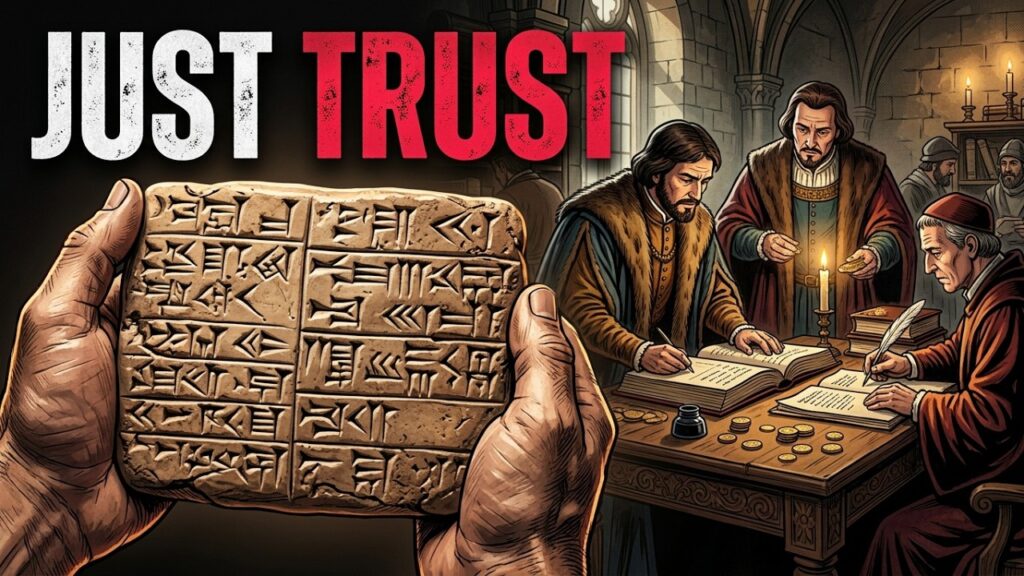
When a county sheriff or taxpayer paid money into the Royal Exchequer at Westminster, clerks carved notches of standardized widths into a squared shaft of seasoned hazel or willow wood. A notch the thickness of a man’s palm represented £1,000; the breadth of a thumb stood for £100; a little finger denoted £20; a barleycorn represented £1; and smaller cuts marked shillings and pence. After the Latin details of the payer were inked onto both sides, the stick was split lengthwise down the middle through the notches. [3]
Because no two pieces of natural wood grain split identically, the two halves formed an unforgeable cryptographic pair. The payer kept the longer half with the handle—known as the stock (from which English finance derives the word stockholder)—while the Exchequer retained the shorter half, the foil (or counter-tally). Later, under monarchs such as Charles II and William III, the Crown issued tallies of loan in anticipation of future tax revenues, turning wooden stocks into discounted, interest-bearing sovereign debt instruments traded across London’s coffee houses.
Fifty Years of Bureaucratic Inertia (1783–1834)
By the late eighteenth century, paper double-entry bookkeeping and Bank of England ledgers had rendered wooden tallies archaic. In 1783, an Act of Parliament sponsored by Edmund Burke’s economical reform movement ordered the abolition of tally sticks in favor of paper receipts. Yet the law contained a bureaucratic catch: the reform would take effect only upon the death or retirement of the hereditary Chamberlains of the Exchequer whose fees depended on cutting the tallies. [4]
Those officials lived remarkably long lives. Only in 1826—forty-three years after the Act was passed—were the last wooden tallies finally retired. When the remaining Tudor-era Offices of the Receipt of the Exchequer were abolished entirely in October 1834 to clear room for the Court of Bankruptcy, Clerk of the Works Richard Weobley received instructions to dispose of two large cartloads of ancient wooden foils stacked in the old Star Chamber. [5]
Ten Hours in the Furnaces: October 16, 1834
Rather than giving the dry timber to Westminster workers for home firewood, officials feared that burning government financial records in public might breach confidentiality. Instead, Weobley ordered two Irish laborers, Joshua Cross and Patrick Furlong, to incinerate the tallies inside the two coal-fired iron furnaces situated directly beneath the floor of the House of Lords.
Those furnaces had been engineered to burn slow-smoldering coal, not resinous, centuries-seasoned wood that burned with roaring flames. Starting at 6:00 a.m. on October 16, Cross and Furlong shoveled piles of tallies into both grates simultaneously. Copper hot-air flues running directly beneath the oak floorboards and dry wainscot paneling of the Lords’ chamber turned red-hot. [6]
By 4:00 p.m., Black Rod’s housekeeper, Mrs. Wright, repeatedly warned that the floor was scorching through her boots and smoke was filling the chamber, only to be told the workmen were nearly finished. At 5:00 p.m., the laborers swept the glowing embers into the grates, locked the cellar doors, and went home to the pub. At 6:30 p.m., the superheated flues ignited the timber stalls above. Within hours, the House of Lords, the Painted Chamber, and St. Stephen’s Chapel (the House of Commons) collapsed, along with centuries of irreplaceable House of Commons records—while firefighters heroically saved medieval Westminster Hall by drenching its hammerbeam roof.
Charles Dickens and the Lesson of Institutional Red Tape
Twenty years later, novelist Charles Dickens—who had worked as a young parliamentary reporter inside the old chamber—mocked the Exchequer tally sticks 1834 fire in an 1855 speech as the ultimate monument to British administrative obstinacy: a government that clung to medieval sticks for centuries after paper was invented, and then burned down both Houses of Parliament rather than let poor families use the wood to cook their dinner.
Theoretical & Balance-Sheet Transmission Mechanism
In the Kindleberger–Minsky taxonomy of financial instability (Kindleberger, 1978; Minsky, 1986) and Irving Fisher’s (1933) debt-deflation framework, speculative asset booms become systemic crises when credit expansion shifts balance sheets from hedge finance (cash flows covering principal and interest) to speculative and Ponzi finance (relying on rising asset prices and short-term margin roll-overs).
Once monetary tightening or an exogenous shock halts price appreciation, forced margin liquidations trigger Fisherian debt-deflation: fire-sale asset discounts erode bank collateral values, contracting credit supply across the real economy.
Sources and Further Reading
- UK Parliament — Living Heritage: ‘The Fire of 1834 and the Old Palace of Westminster’ Official / State Archive
- Caroline Shenton — The Day Parliament Burned Down (Oxford: Oxford University Press, 2012) — Archival reconstruction based on the Privy Council Inquiry of November 1834. Peer-Reviewed / Academic Research
- The National Archives (UK) — Exchequer Tally Sticks Collection (E 402) and Privy Council Report on the Causes of the Late Fire at Westminster (1834). Historical & Financial Reference
- Richard FitzNeal — Dialogus de Scaccario (The Course of the Exchequer, c. 1180) — Primary twelfth-century manual detailing tally-cutting denominations. Historical & Financial Reference
- Irving Fisher — "The Debt-Deflation Theory of Great Depressions," Econometrica 1, no. 4 (FRASER Federal Reserve Archive, 1933): 337–357 Central Bank / Monetary Authority
- Charles P. Kindleberger & Robert Z. Aliber — Manias, Panics, and Crashes: A History of Financial Crises (Palgrave Macmillan) Peer-Reviewed / Academic Research
Cite This Historical Dossier (APA / Chicago)
APA (7th ed.): Ç., S. (Ed.). (2026). The 1834 Burning of Parliament: How Exchequer Tally Sticks Destroyed the Palace of Westminster. In Forgotten Fortunes Historical Monograph Series (Forgotten Fortunes Editorial Desk). https://forgottenfortunes.net/1834-burning-of-parliament-exchequer-tally-sticks/
MLA (9th ed.): Ç., Soner, ed. "The 1834 Burning of Parliament: How Exchequer Tally Sticks Destroyed the Palace of Westminster." Forgotten Fortunes: Financial & Monetary History Archive, 2026, https://forgottenfortunes.net/1834-burning-of-parliament-exchequer-tally-sticks/.
Chicago (17th ed.): Ç., Soner, ed. "The 1834 Burning of Parliament: How Exchequer Tally Sticks Destroyed the Palace of Westminster." Forgotten Fortunes Historical Monograph Series (Forgotten Fortunes Editorial Desk), October 16, 2026. https://forgottenfortunes.net/1834-burning-of-parliament-exchequer-tally-sticks/.
Have an idea for another financial history documentary or article? Request a story →