In This Article
Across the first two centuries of the Roman Republic, the central fault line of Roman politics was not foreign conquest but domestic credit. In an agrarian economy that operated primarily on weighed bronze bullion (aes rude) rather than minted silver coinage, plebeian smallholders who were conscripted for summer military campaigns routinely returned to neglected fields, burned farmsteads, and unpaid property assessments (tributum). To buy seed grain or pay wartime levies, peasant proprietors borrowed from wealthy patrician landowners through an archaic legal transaction known as nexum. Executed with bronze scales and formal witnesses, nexum pledged the borrower’s own physical person—and often the labor of his children in his paternal power—as collateral for the loan. Until the passage of the Lex Poetelia Papiria in 326 BCE, an insolvent Roman citizen could be chained in a creditor’s private ergastulum, worked as a bondservant, or sold into slavery across the Tiber River. [1]
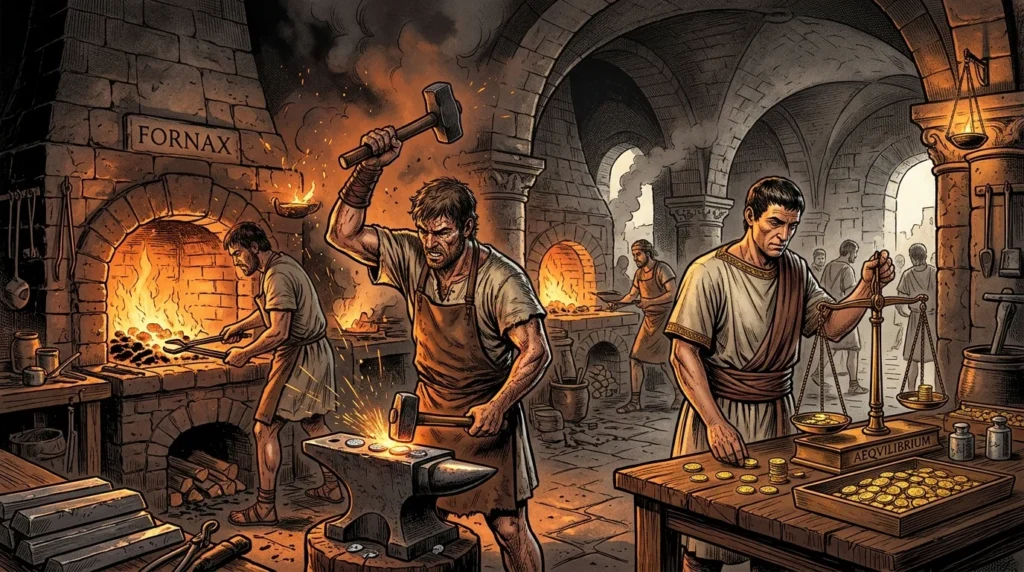
The Mechanics of Nexum: Debt Bondage per Aes et Libram
In early Roman civil law, formal transfers of ownership and obligation were conducted per aes et libram—”by bronze and balance.” Just as mancipium transferred title to land, draft animals, or slaves by weighing out uncoined bronze before five citizen witnesses and a scale-holder (libripens), nexum used the same ritual ceremony to create a self-executing personal debt obligation. The Roman jurist Gaius and the antiquarian Varro preserved the distinction between a simple loan and a nexum contract: As Varro noted in De Lingua Latina, a free man who bound his own labor in servitude for money he owed was called a nexus until he discharged the sum through work or payment.
The crucial financial feature of nexum was that it bypassed the need for a protracted trial upon default. By pronouncing a solemn formula (nuncupatio) at the time the bronze was weighed out, the borrower subjected himself directly to the creditor’s power of seizure if the principal and interest were not repaid on schedule. Unlike chattel slaves (servi), a citizen who entered into debt bondage (nexum inire) did not technically lose his Roman citizenship or legal status in census rolls. In daily life, however, the distinction vanished. Bound debtors (nexi) labored on patrician estates under physical compulsion, wore fetters at the discretion of their creditors, and suffered corporal punishment from which their theoretical civic status offered no shield.
Alongside voluntary entry into nexum to secure a loan, Roman law enforced adjudicated court debts through the procedure of manus iniectio (“laying on of hands”), leading to judicial assignment (addictio). When a debtor defaulted on a regular loan (mutuum) and could not enter a new bondage contract, the magistrate assigned him as an addictus to the creditor. Together, nexi and addicti formed a growing class of unfree citizen laborers whose military service had expanded Roman territory while their private balance sheets collapsed.
War, Tributum, and the First Secession of the Plebs (494 BCE)
The structural engine of early Roman indebtedness was the combination of uncompensated citizen military service and the war tax known as tributum. Before the introduction of military stipends during the siege of Veii at the end of the fifth century BCE, Roman legionaries supplied their own weapons, armor, and rations. While patrician estates relied on dependent clients and enslaved labor that continued cultivating the land during wartime, a plebeian smallholder called to fight the Sabines, Volscians, or Aequians left his small plot untended during peak planting or harvest weeks. If enemy raids destroyed his crops or livestock, he faced an immediate deficit precisely when the Senate levied tributum—assessed on census property valuations without deduction for outstanding private debts.
According to Livy and Dionysius of Halicarnassus, this fiscal squeeze triggered the first great constitutional crisis of the Republic in 495–494 BCE. An elderly centurion, scarred from twenty-eight battles, escaped from his creditor’s private prison into the Roman Forum in rags, displaying the fresh whip marks on his back. He testified that while serving in the Sabine war his farm had been pillaged, his house burned, and his cattle driven off; forced to borrow to pay the war tax, he had seen usurious interest compound until he lost first his ancestral fields and finally his own physical liberty. Outrage over the centurion’s plight sparked the First Secession of the Plebs to the Sacred Mount (Mons Sacer) in 494 BCE. Although the strike extracted the creation of the plebeian tribunate (tribuni plebis) and the plebeian aediles to protect citizens from arbitrary magisterial violence, patrician creditors retained their legal grip on debt contracts. [2]
Table III of the Twelve Tables and the Foenus Unciarium
When the decemvirs codified Roman customary law in the Twelve Tables (Lex Duodecim Tabularum) around 451–450 BCE, they did not abolish personal execution for debt; instead, they standardized its timetable and physical limits in Table III. Once a debtor acknowledged a monetary obligation in court or had judgment pronounced against him, the law granted thirty statutory days of grace (dies iusti). If the debt remained unpaid after thirty days, the creditor arrested the debtor by manus iniectio and brought him before the magistrate. Unless a solvent guarantor (vindex) stepped forward to contest the judgment or assume liability, the creditor took the debtor home and bound him in stocks or fetters. [3]
Table III regulated the conditions of this sixty-day private imprisonment with grim precision: the chains could weigh no more than fifteen pounds (unless the creditor wished to use lighter ones), and if the prisoner could not feed himself, the creditor was obliged to provide at least one pound of spelt grain (far) per day. During these sixty days, the creditor had to bring the debtor before the praetor in the Comitium on three successive market days (nundinae) and publicly proclaim the exact sum for which he was adjudged, giving relatives or friends a final chance to ransom him. After the third market day, the debtor suffered capital loss of status (capitis deminutio): he could be put to death or sold into foreign slavery across the Tiber River (trans Tiberim). Where multiple creditors held claims against the same insolvent man, Table III famously declared that after the third market day they might cut the body into pieces (partes secanto), adding that if they cut more or less than their proportional share, it should be no crime—a provision later Roman jurists such as Quintilian and Aulus Gellius regarded as a terrifying legal deterrent that was never known to have been literally executed.
To restrain the compounding of obligations that pushed farmers into Table III execution, Roman law introduced the foenus unciarium (“uncial interest”). Tacitus in the Annals attributed the cap to the Twelve Tables themselves (c. 450 BCE), whereas Livy recorded its formal enactment in 357 BCE by the plebeian tribunes Marcus Duilius and Lucius Menenius. Because the uncia was one-twelfth of the Roman pound (as), the nineteenth-century historian Barthold Georg Niebuhr and subsequent legal scholars demonstrated that foenus unciarium represented one-twelfth of the principal sum—8.33 percent for the archaic ten-month year, or 10 percent across a twelve-month civil year (or 1 percent per month, totaling 12 percent annually, under alternative modern reconstructions). In 347 BCE, the state cut the ceiling in half to the foenus semunciarium (one twenty-fourth of principal), and in 342 BCE the Lex Genucia attempted to outlaw lending at interest altogether, though creditors swiftly evaded the ban through Latin and Italian intermediaries. [4]
The Licinio-Sextian Debt Relief (367 BCE) and the Quinqueviri Mensarii (352 BCE)
Interest caps alone could not resolve the solvency crisis that followed the Gallic sack of Rome around 390 BCE. Rebuilding burned farmsteads and replacing lost livestock forced plebeians into a fresh wave of borrowing (versura)—taking out new loans to pay off old creditors—while patrician families monopolized the occupation of conquered public land (ager publicus). After a decade of political deadlock, the plebeian tribunes Gaius Licinius Stolo and Lucius Sextius Lateranus passed the landmark Licinio-Sextian rogations in 367 BCE. Alongside opening the consulship to plebeians and capping individual holdings of public land at 500 iugera (roughly 310 acres), their legislative package included a comprehensive debt restructuring statute: all interest already paid by a borrower was deducted directly from the original principal, and the remaining balance was amortized in three equal annual installments. [5]
Even this principal write-down failed to solve the underlying shortage of liquid bronze currency. Fifteen years later, in 352 BCE, with plebeian estates again paralyzed by debt, the consuls Publius Valerius Publicola and Gaius Marcius Rutilus innovated an extraordinary fiscal institution: the quinqueviri mensarii, a five-member commission of public bankers comprising both patricians and plebeians. Setting up public banking tables (mensae) in the Forum backed by the state treasury (aerarium), the five commissioners tackled two distinct market failures: [6]
- State Liquidity Loans: For debtors whose delay resulted from sluggish cash flow rather than true insolvency, the quinqueviri mensarii advanced public funds directly from the aerarium to pay off private creditors, taking adequate security (satisdatio) on behalf of the Roman treasury so the citizen was freed from private bondage.
- Assessed Property Valuation (Aestimatio): Because forced distress sales in an illiquid market depressed land and livestock prices, the commissioners were empowered to appraise debtors’ real property and cattle at fair pre-crisis values (iusta aestimatio) and transfer those assets directly to creditors in full satisfaction of the debt.
As Livy observed, this combination of treasury credit and state-arbitrated asset transfer liquidated an immense volume of private obligations without provoking civil violence or confiscating creditor claims.
The Lex Poetelia Papiria: From Body to Property
The decisive legal abolition of nexum arrived a generation later, during the Second Samnite War. According to the accounts preserved by Livy (who dates the law to the consulship of Gaius Poetelius Libo Visolus and Lucius Papirius Cursor in 326 BCE) and Varro (who associates it with Poetelius’s dictatorship in 313 BCE), a notorious scandal brought the archaic bondage contract to an end. A young citizen named Gaius Publilius had surrendered himself as a nexus to the moneylender Lucius Papirius to work off his father’s unpaid debts. When Publilius rejected the creditor’s sexual advances, Papirius had the youth stripped and savagely flogged. Bleeding from the lash, Publilius broke free into the street and displayed his wounds to the crowd in the Forum. [7]
Faced with a furious citizenry gathered outside the Curia, the consuls immediately convened the Senate and carried the Lex Poetelia Papiria before the popular assembly. The statute enacted three transformative rules that Livy hailed as “another beginning of liberty” (aliud initium libertatis) for the Roman plebs:
- Prohibition of Chains for Debt: No Roman citizen could henceforth be kept in fetters or stocks (in nervo aut in compedibus) except one convicted of a criminal offense (noxa) awaiting execution.
- Release of Existing Nexi: Currently bound nexi were released upon swearing an oath (bonam copiam iurare) that they possessed sufficient property to satisfy their creditors.
- Shift of Collateral from Corpus to Bona: For all future money loans (pecunia credita), only the debtor’s goods and estate (bona)—never his physical body (corpus)—could be pledged or seized as security.
While judicial addictio following a court judgment did not disappear overnight, the Lex Poetelia Papiria killed the contractual institution of nexum and forced Roman law toward property-based bankruptcy execution—culminating in the late Republican praetorian procedure of bonorum venditio (the collective sale of an insolvent debtor’s estate) and the Julian law on voluntary bankruptcy (cessio bonorum). Economically, freeing citizen smallholders from domestic debt servitude redirected Roman labor demand outward: deprived of bound plebeian workers, the Roman senatorial elite turned increasingly to the mass importation of foreign chattel slaves captured during the conquest of Italy and the Mediterranean.
Theoretical & Balance-Sheet Transmission Mechanism
In the Kindleberger–Minsky taxonomy of financial instability (Kindleberger, 1978; Minsky, 1986) and Irving Fisher’s (1933) debt-deflation framework, speculative asset booms become systemic crises when credit expansion shifts balance sheets from hedge finance (cash flows covering principal and interest) to speculative and Ponzi finance (relying on rising asset prices and short-term margin roll-overs). [8]
Once monetary tightening or an exogenous shock halts price appreciation, forced margin liquidations trigger Fisherian debt-deflation: fire-sale asset discounts erode bank collateral values, contracting credit supply across the real economy.
Sources and Further Reading
- George Long, “ Nexum,” in William Smith (ed.), A Dictionary of Greek and Roman Antiquities, John Murray, 1875 (LacusCurtius, University of Chicago). Peer-Reviewed / Academic Research
- Avalon Project, “ The Laws of the Twelve Tables (c. 450 B.C.),” Lillian Goldman Law Library, Yale Law School, 2008. Peer-Reviewed / Academic Research
- Charles Rann Kennedy, “ Fenus,” in William Smith (ed.), A Dictionary of Greek and Roman Antiquities, John Murray, 1875 (LacusCurtius, University of Chicago). Peer-Reviewed / Academic Research
- Leonhard Schmitz, “ Mensarii,” in William Smith (ed.), A Dictionary of Greek and Roman Antiquities, John Murray, 1875 (LacusCurtius, University of Chicago). Peer-Reviewed / Academic Research
- George Long, “ Bonorum Cessio,” in William Smith (ed.), A Dictionary of Greek and Roman Antiquities, John Murray, 1875 (LacusCurtius, University of Chicago). Peer-Reviewed / Academic Research
- Seth Bernard, “ The Social History of Early Roman Coinage,” Journal of Roman Studies, Vol. 108, Cambridge University Press, 2018. Peer-Reviewed / Academic Research
- Saskia Roselaar, “lex Poetelia Papiria,” Oxford Classical Dictionary, Oxford University Press, 2017 (discussion of competing ancient dates). Peer-Reviewed / Academic Research
- Irving Fisher — "The Debt-Deflation Theory of Great Depressions," Econometrica 1, no. 4 (FRASER Federal Reserve Archive, 1933): 337–357 Central Bank / Monetary Authority
- Charles P. Kindleberger & Robert Z. Aliber — Manias, Panics, and Crashes: A History of Financial Crises (Palgrave Macmillan) Peer-Reviewed / Academic Research
Cite This Historical Dossier (APA / Chicago)
APA (7th ed.): Ç., S. (Ed.). (2026). Nexum: How Ancient Rome Ended Contractual Debt Bondage. In Forgotten Fortunes Historical Monograph Series (Forgotten Fortunes Editorial Desk). https://forgottenfortunes.net/roman-nexum-debt-bondage-lex-poetelia/
MLA (9th ed.): Ç., Soner, ed. "Nexum: How Ancient Rome Ended Contractual Debt Bondage." Forgotten Fortunes: Financial & Monetary History Archive, 2026, https://forgottenfortunes.net/roman-nexum-debt-bondage-lex-poetelia/.
Chicago (17th ed.): Ç., Soner, ed. "Nexum: How Ancient Rome Ended Contractual Debt Bondage." Forgotten Fortunes Historical Monograph Series (Forgotten Fortunes Editorial Desk), September 18, 2026. https://forgottenfortunes.net/roman-nexum-debt-bondage-lex-poetelia/.
Have an idea for another financial history documentary or article? Request a story →