In This Article
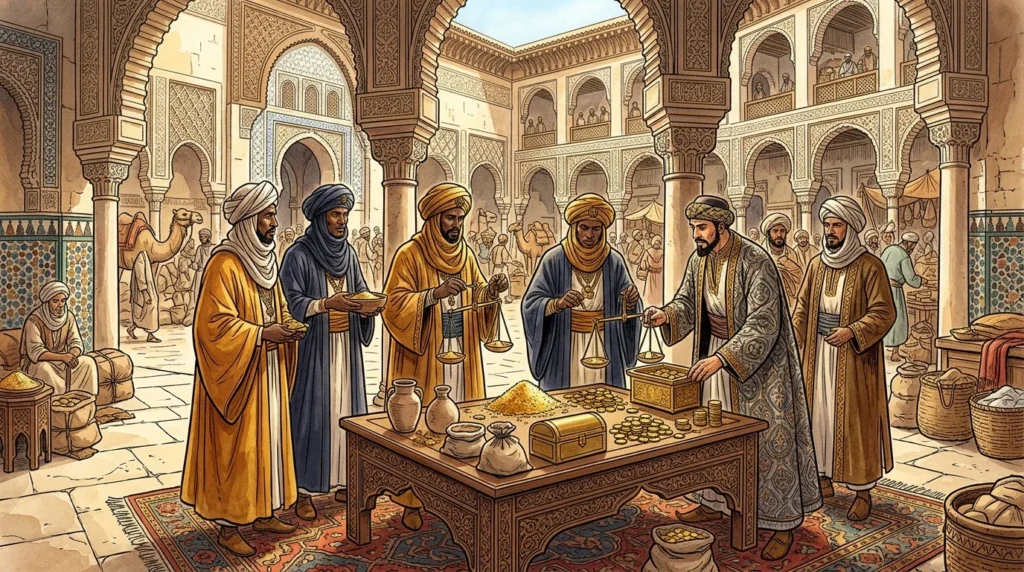
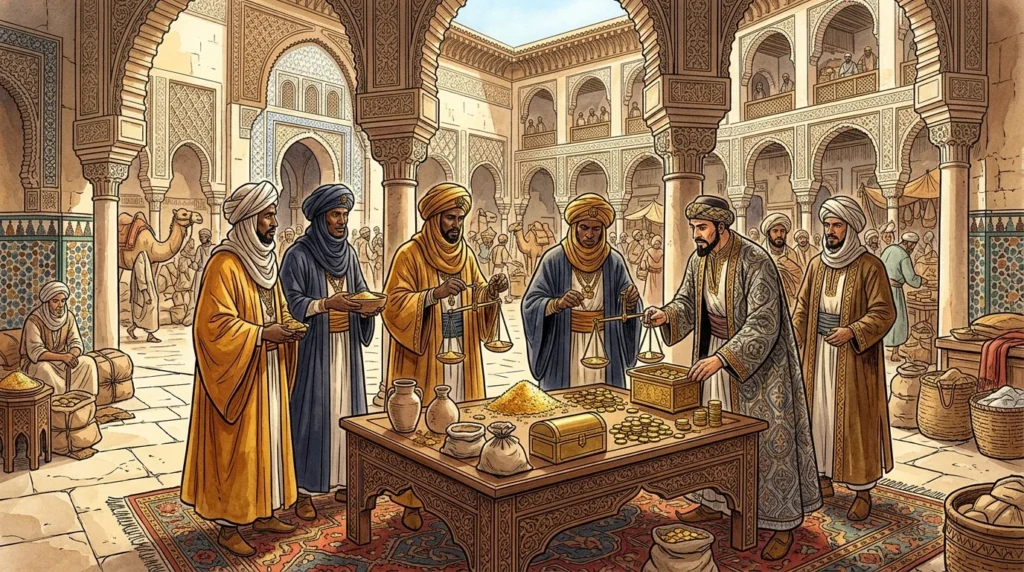
In July 1324, Emperor Mansa Musa of the Mali Empire arrived at the outskirts of Mamluk Cairo at the head of a massive trans-Saharan caravan en route to Mecca. Bringing tons of uncoined alluvial gold dust ( tibr ) extracted from the West African goldfields of Bambuk and Bure, the Malian monarch lavished gifts upon Mamluk Sultan al-Nasir Muhammad, court officials, religious endowments, and the Cairene public. Yet the most revealing financial episode of Mansa Musa’s pilgrimage occurred on his return journey through Egypt in 1325. Having exhausted his liquid reserves through generous almsgiving, diplomatic tribute, heavy purchases of luxury textiles, and overland transport losses between the Hejaz and the Nile, a famously wealthy medieval sovereign faced a sudden liquidity squeeze. To finance his caravan’s return across the Sahara to Mali, Mansa Musa turned to Cairo and Alexandria’s merchant-financiers for costly emergency loans. Medieval accounts disagree over whether these debts were fully repaid. [1]
Gold Abundance and the 1324–1325 Cairo Liquidity Squeeze
Since its founding by Sundiata Keita in the mid-thirteenth century, the Mali Empire had derived its fiscal strength from taxing and regulating the flow of gold between the savanna-forest borderlands of the Upper Senegal and Upper Niger rivers and the southern ports of the Sahara. Unlike Mediterranean and Near Eastern states that struck standardized gold coins, Mali maintained a dual monetary regime at home: gold nuggets belonged by royal prerogative to the mansa, while raw gold dust circulated by weight using standardized mithqal measures of roughly 4.25 grams. When Mansa Musa departed his realm in 1324 via Walata and the Tuat oasis, his treasury carried an unprecedented store of gold dust and raw ingots intended to project imperial prestige across the Islamic world. [2]
During his three-month stay in Cairo in 1324, the emperor and his entourage spent at a pace that overwhelmed local moneychangers in the Khan al-Khalili and Misr markets. According to accounts collected a decade later by the Mamluk chancery official Shihab al-Din al-Umari, the sudden injection of West African bullion depressed the exchange rate of the gold dinar against the silver dirham in Cairo by up to six dirhams, pulling the gold mithqal down from twenty-five dirhams to twenty-two dirhams or less for twelve years. Cairene merchants took full advantage of the West African visitors’ unfamiliarity with local retail prices, charging five dinars for garments and provisions normally valued at a single dinar. [3]
By the time Mansa Musa returned to Egypt from Mecca in 1325, a combination of unrestrained spending in the holy cities of Mecca and Medina and logistical setbacks in the Sinai desert had depleted the royal caravan’s portable gold reserves. Rather than default on his retinue’s obligations or travel with diminished ceremony, the emperor entered the Egyptian private credit market. He even sold back the Cairo palace that Sultan al-Nasir Muhammad had presented to him as a royal residence, converting real estate and future imperial revenues into immediate cash. [4]
Siraj al-Din ibn al-Kuwayk and the 700-for-300 Dinar Loan
Islamic jurists prohibited riba, or interest on money loans, but the Cairo accounts describe exceptionally expensive terms. Among Musa’s financiers was the Alexandrian merchant Siraj al-Din ibn al-Kuwayk, whose family, according to Ibn Khaldun, lent him 50,000 gold dinars. Historians cannot reconstruct the precise legal form of each advance or treat this reported amount as a verified total of loans from all Egyptian creditors. [5]
The terms of these emergency advances reflected both the extraordinary hazard of trans-Saharan debt collection and the bargaining power of Egyptian wholesale lenders during Musa’s cash shortage. Chroniclers recorded that for every 300 gold dinars advanced in Cairo, Mansa Musa pledged to repay 700 dinars—yielding a net profit of 400 dinars, or 133 percent above principal. The surviving accounts describe the extraordinary price of these advances, but do not establish exactly how the obligations were documented or structured. [6]
The fate of this debt remains disputed. Historian Michael A. Gomez compares conflicting medieval chroniclers: Ibn Hajar, al-Umari and Ibn Battuta describe repayment, while Ibn al-Dawadari and Ibn Khaldun report unpaid claims or partial recovery. Ibn Khaldun says Musa sold a Cairo palace in partial settlement and that Siraj al-Din sent agents and his son to Mali to pursue the remainder. Ibn Battuta, writing about his later travels, recounts Siraj al-Din’s own journey and death in Mali, where the traveler saw his grave in Timbuktu; his account presents the son as saying payment had been made. These narratives establish a far-reaching dispute and collection effort, not an undisputed example of full debt repayment or judicial enforcement by a Malian court.
The Five Maqqari Brothers and Trans-Saharan Family Firms
Mansa Musa’s ability to pledge future West African gold deliveries in Cairo rested on an existing architecture of trans-Saharan commercial credit linking the Maghreb, Egypt, and the Western Sudan. Crossing the desert required sixty to ninety days of arduous travel between oasis wells, making it impossible to settle wholesale trade without multi-node agency and deferred credit. In the thirteenth and fourteenth centuries, North African merchant dynasties organized permanent family partnerships that stationed brothers or cousins at every major node along the caravan trail.
The best-documented of these trans-Saharan firms was the Maqqari trading house, recorded in the historical compendium Nafh al-Tib by the seventeenth-century scholar Ahmad al-Maqqari, a direct descendant of the family. Originating in the Zayyanid commercial hub of Tlemcen in present-day Algeria, five Maqqari brothers—Abu Bakr, Muhammad, ‘Abd al-Rahman, ‘Abd al-Wahid, and ‘Ali—formed a comprehensive equal-share partnership (sharikat al-mufawada) in which each brother held full authority to bind the firm’s pooled capital. They divided operational responsibilities geographically across a 1,500-mile vertical axis: [7]
- Tlemcen (Northern Terminus): Abu Bakr and Muhammad remained in Tlemcen, procuring European woolens, Venetian glass beads, brassware, and Mediterranean coral while marketing West African gold dust, ivory, and malagueta pepper to Christian and Muslim buyers on the coast.
- Sijilmasa (Desert Port and Clearinghouse): ‘Abd al-Rahman stationed himself at the southern Moroccan oasis of Sijilmasa, acting as what the family chronicler called “the tongue of the balance.” Situated at the northern edge of the desert, he tracked price spreads between the Maghreb and the Sudan, dispatched courier letters with market intelligence, and coordinated credit lines for departing and arriving caravans.
- Walata and the Mali Court (Southern Terminus): The two youngest brothers, ‘Abd al-Wahid and ‘Ali, settled permanently inside the Mali Empire at the southern oasis port of Walata (Iwalatan) and at the imperial court. By marrying into local elites, maintaining warehouses (funduqs), and cultivating direct diplomatic ties with the mansa, they received southbound Saharan rock salt and Mediterranean manufactures on credit and remitted northbound gold dust.
When nomadic raids or succession conflicts disrupted the trails, the Maqqari brothers invested their firm’s capital to dig wells along the desert tracks and hire armed desert guides from the Massufa and Sanhaja confederations, internalizing security costs within their commercial partnership.
Wangara and Juula Lineage Credit Across the Goldfields
While North African houses like the Banu al-Kuwayk and the Maqqaris financed the desert crossing, neither Arab nor Berber merchants were permitted direct access to the southern gold-producing regions of Bambuk, Bure, or the Akan forest fringes. Internal bullion procurement and regional credit distribution inside the Mali Empire were controlled by indigenous Mande-speaking merchant lineages known in Arabic chronicles as the Wangara and within West Africa as the Juula (Dyula).
Operating under the political protection of the Malian state, Wangara/Juula clans established a network of autonomous commercial towns—including Jenne, Dia, Begho, and Kankan—stretching from the Inland Niger Delta to the tropical forest zone. Because the gold miners of Bambuk and Bure were non-Muslim communities who guarded the location of their alluvial washings and shallow shaft mines, the Wangara functioned as indispensable cultural and financial intermediaries. At the end of the rainy season, Wangara caravan leaders advanced Taghaza rock salt, copper rods, dried fish, and cotton cloth to local brokers and mining chiefs, receiving gold dust weighed against standardized glass and brass weights.
Within the Wangara diaspora, credit enforcement relied on a fusion of Maliki Islamic commercial law and Mande kinship institutions. Resident landlord-brokers (jatigi) in river ports like Jenne and Timbuktu housed visiting caravan merchants, guaranteed their debts to local counterparties, stored wholesale commodities in mud-brick warehouses, and witnessed oral and written debt acknowledgments (dhikr haqq). A merchant who defaulted on a qirad (commenda equity advance) or a credit sale faced immediate exclusion from every jatigi compound along the Niger River corridor, making reputation the primary collateral of West African commerce.
Sovereign Credit Reputation and the Legacy of 1325
Mansa Musa’s 1325 borrowing episode in Cairo illustrates the financial sophistication and structural constraints of medieval Sudanic states. Even an empire controlling the largest gold supply in the fourteenth-century world could experience an acute foreign-exchange and liquidity crisis when projecting power thousands of miles beyond its domestic monetary zone. The reported 700-for-300 dinar loan terms show the cost of borrowing abroad, while conflicting accounts of repayment reveal the limits of what the surviving records can establish. The pilgrimage nevertheless connected Malian wealth to Egyptian merchants and a wider trans-Saharan financial network. That credibility attracted North African jurists, architects like Abu Ishaq al-Sahili, and merchant capital to Timbuktu, Walata, and Gao, anchoring West Africa at the center of late medieval global finance. [8]
Theoretical & Balance-Sheet Transmission Mechanism
In the Kindleberger–Minsky taxonomy of financial instability (Kindleberger, 1978; Minsky, 1986) and Irving Fisher’s (1933) debt-deflation framework, speculative asset booms become systemic crises when credit expansion shifts balance sheets from hedge finance (cash flows covering principal and interest) to speculative and Ponzi finance (relying on rising asset prices and short-term margin roll-overs). [9]
Once monetary tightening or an exogenous shock halts price appreciation, forced margin liquidations trigger Fisherian debt-deflation: fire-sale asset discounts erode bank collateral values, contracting credit supply across the real economy.
Sources and Further Reading
- University of Oxford Global History of Capitalism Project, “Mansa Musa in Mali,” University of Oxford Faculty of History, 2021. Peer-Reviewed / Academic Research
- Block Museum of Art, “Mansa Musa’s Hajj to Mecca,” Northwestern University (Caravans of Gold, Fragments in Time), 2019. Peer-Reviewed / Academic Research
- Office of Resources for International and Area Studies (ORIAS), “The Journey to Mali, 1350–1351,” University of California, Berkeley, 2016. Peer-Reviewed / Academic Research
- Jean-Loup Amselle, “L’étranger dans le monde manding et en Afrique de l’Ouest,” Cahiers d’études africaines, 2000. Historical & Financial Reference
- Matrix Center for Digital Humanities, “Wangara and the Gold Trade of West Africa,” African Online Digital Library, Michigan State University, 2014. Historical & Financial Reference
- Richard L. Smith, “Trade and Commerce across Afro-Eurasia,” Cambridge University Press (The Cambridge World History), 2015. Peer-Reviewed / Academic Research
- Michael A. Gomez, “African Dominion: A New History of Empire in Early and Medieval West Africa (Chapter 6: Mansā Mūsā and Global Mali),” Princeton University Press, 2018. Peer-Reviewed / Academic Research
- Irving Fisher — "The Debt-Deflation Theory of Great Depressions," Econometrica 1, no. 4 (FRASER Federal Reserve Archive, 1933): 337–357 Central Bank / Monetary Authority
- Charles P. Kindleberger & Robert Z. Aliber — Manias, Panics, and Crashes: A History of Financial Crises (Palgrave Macmillan) Peer-Reviewed / Academic Research
Cite This Historical Dossier (APA / Chicago)
APA (7th ed.): Ç., S. (Ed.). (2026). Mansa Musa's 1325 Cairo Loans and the Caravan Credit Networks of the Mali Empire. In Forgotten Fortunes Historical Monograph Series (Forgotten Fortunes Editorial Desk). https://forgottenfortunes.net/mansa-musa-cairo-loans/
MLA (9th ed.): Ç., Soner, ed. "Mansa Musa's 1325 Cairo Loans and the Caravan Credit Networks of the Mali Empire." Forgotten Fortunes: Financial & Monetary History Archive, 2026, https://forgottenfortunes.net/mansa-musa-cairo-loans/.
Chicago (17th ed.): Ç., Soner, ed. "Mansa Musa's 1325 Cairo Loans and the Caravan Credit Networks of the Mali Empire." Forgotten Fortunes Historical Monograph Series (Forgotten Fortunes Editorial Desk), September 21, 2026. https://forgottenfortunes.net/mansa-musa-cairo-loans/.
Have an idea for another financial history documentary or article? Request a story →