
In This Article
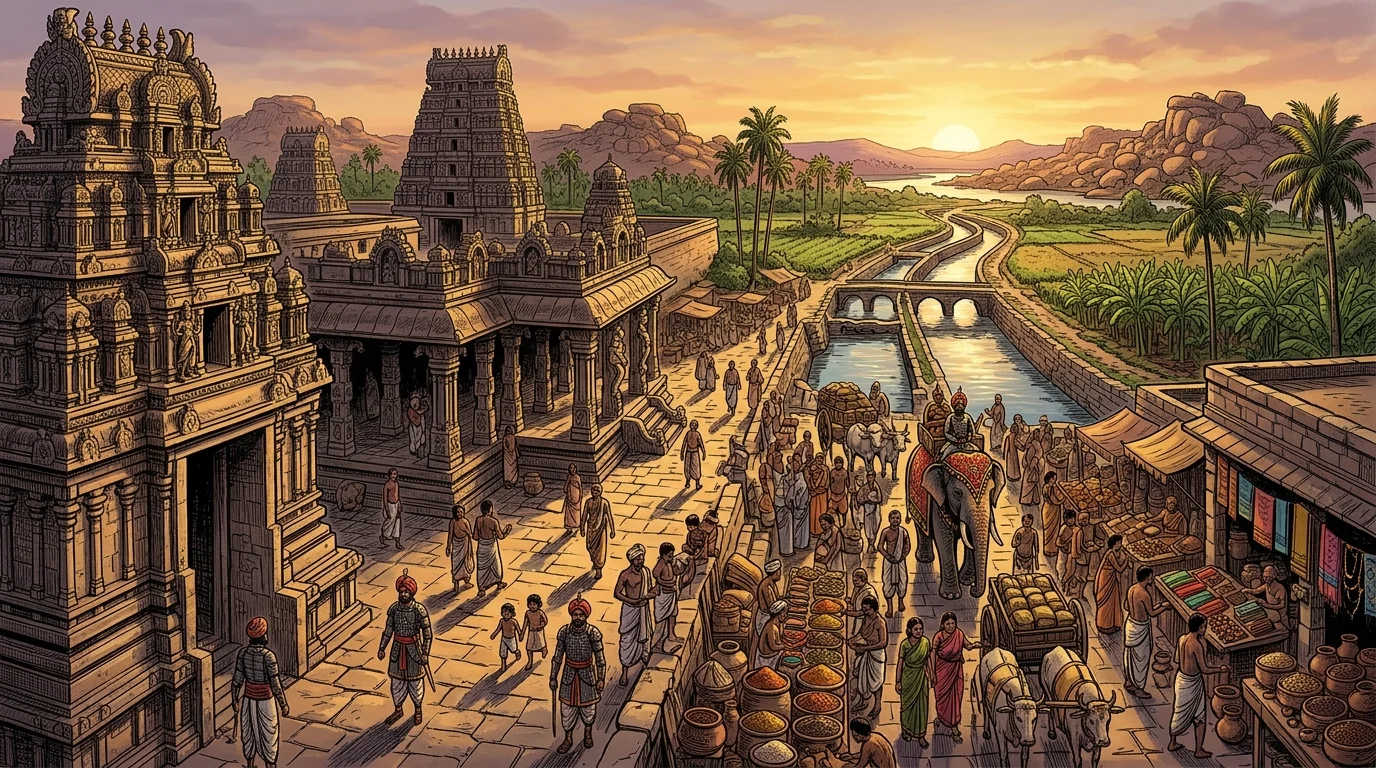
At its sixteenth-century zenith under Emperor Krishnadevaraya (r. 1509–1529), the Vijayanagara Empire commanded the southern peninsula of India through a sophisticated synthesis of hydraulic engineering, graded agrarian taxation, maritime horse-trade monopolies, and temple-centered capital redistribution [1][2][6]. Rather than relying purely on coercive tribute extraction, Vijayanagara fiscal policy—explicitly theorized in Krishnadevaraya’s Telugu treatise on statecraft, the Amuktamalyada—linked sovereign treasury receipts directly to public investment in reservoirs, canals, and concessional land leases [2][6]. Yet this vast concentration of agrarian revenue, gold coinage, and diamond wealth also made the empire’s provinces and temple treasuries an irresistible prize when central authority fractured in the seventeenth century, culminating in the early 1646 partition pact between the Sultanates of Bijapur and Golconda and the meteoric rise of the Persian merchant-general Mir Jumla [5][6].

Fiscal Philosophy of the Amuktamalyada and Tax Relief
Ascending the throne of the Tuluva dynasty in 1509, Krishnadevaraya consolidated imperial control from the Tungabhadra River basin to the Coromandel and Malabar coasts [1][6]. In his celebrated Telugu poem and political manual, the Amuktamalyada, the emperor articulated a pragmatic fiscal doctrine: because the military strength and wealth of a sovereign depend upon the extent and productivity of his countryside, a ruler must expand arable acreage by excavating irrigation tanks (cheruvus) and river canals before demanding higher revenues [2].
To bring arid scrubland and newly cleared forest parcels under the plow across the semi-arid Deccan plateau, Krishnadevaraya’s administration deployed a tiered schedule of concessional agrarian leases [2]. Farmers who agreed to clear uncultivated tracts or repair local embankments were granted low initial assessment rates—known in administrative terminology as concessional ari (cash or grain quit-rents) and koru (crop-share ratios)—that scaled upward only after the soil reached full yield [2].
Simultaneously, the crown used targeted tax abolition to prevent rural depopulation and relieve household burdens [2][6]. Across medieval South India, provincial collectors had long imposed a unpopular marriage tax (pendli sunkam or kalyana shulka) on the families of both the bride and groom [2]. Recognizing that excessive non-agrarian exactions depressed household formation and stirred peasant discontent, Krishnadevaraya issued sweeping epigraphic decrees—beginning around 1510—abolishing the marriage tax across the empire’s provinces and instructing local governors (nayakas) to remit oppressive artisan levies [2][6].
Portuguese Trade, Warhorses, and Hydraulic Engineering (1510)
While domestic tax reform stabilized the agrarian base, Vijayanagara’s military supremacy over its northern rivals—the five Deccan Sultanates that had emerged from the breakup of the Bahmani Kingdom—depended on strategic maritime trade [1][6]. Because warhorses could not be bred in sufficient numbers or quality in southern India’s climate, the imperial cavalry required continuous maritime imports of Arabian and Persian mounts through western Indian Ocean ports [1][6].
When the Portuguese governor Afonso de Albuquerque seized the port of Goa from Bijapur in 1510, Krishnadevaraya swiftly forged a mutually advantageous commercial and diplomatic partnership with the Portuguese Estado da Índia [1][6]. In exchange for recognizing Portuguese coastal trade privileges, Vijayanagara secured priority access to imported Arabian and Persian warhorses, European firearms, and specialist military engineers [1][6].
Portuguese technical expertise also contributed directly to the capital’s hydraulic and urban infrastructure [1]. As the sixteenth-century Portuguese chroniclers Domingos Paes and Fernão Nuniz recorded—in accounts later translated by historian Robert Sewell in A Forgotten Empire (1900)—Krishnadevaraya employed a Portuguese stonemason and hydraulic engineer, João de la Ponte, to construct a massive stone embankment and reservoir near the imperial capital (modern Hampi) to supply water to the new royal suburb of Nagalapuram and irrigate surrounding orchards and rice fields [1]. To encourage rapid settlement of the newly irrigated zone, the crown exempted incoming cultivators from land taxes for the first nine years [1].
Temple Endowments and Epigraphic Accounting at Tirumala
Alongside royal reservoirs and provincial military fiefs (amaram estates held by nayaka commanders), major Hindu temple complexes functioned as decentralized land banks and fiscal clearinghouses throughout the empire [3][6]. Rather than hoarding gold indefinitely in passive vaults, temples received royal and merchant endowments of gold coins and villages, invested cash deposits into local irrigation works, and redistributed grain and stipends to artisans, priests, and village laborers [2][3].
Nowhere is this fiscal and devotional nexus more thoroughly documented than at the Tirumala Venkateswara Temple in modern Andhra Pradesh [3][4]. Out of roughly 1,250 historical inscriptions preserved on the temple complex walls and compiled in the Tirumala Tirupati Devasthanams (TTD) epigraphical series, exactly 229 stone and copper-plate inscriptions date to the reign of Krishnadevaraya [3].
These epigraphic ledgers functioned as permanent, publicly audited accounting records detailing the exact weight, metallic purity, and gemstone count of every imperial gift across Krishnadevaraya’s seven personal pilgrimages to Tirumala between 1513 and 1521 [3][4]. During his first recorded visit on February 10, 1513, the emperor presented a jeweled gold crown (Ratna Kireetam) weighing 3,308 tunkhas (approximately 8.27 kilograms, at 2.5 grams per tunkha), set with 2,822 garnets, 1,339 pearls, 423 diamonds, 160 emeralds, 10 sapphires, 3 rubies, 1 cat’s-eye, and 1 agate [4]. On his fourth pilgrimage on July 6, 1514, returning from military victories in eastern campaigns, Krishnadevaraya performed a ritual bath in gold (Kanakabhishekam) for the presiding deity using 30,000 gold coins (varahalu or chakrams), before dedicating bronze portrait statues of himself and his queens, Tirumaladevi and Chinnadevi, during his sixth visit on October 16, 1518 [3][4].
Mir Jumla, Diamond Monopolies, and the 1646 Partition Treaty
Following the decisive defeat of Vijayanagara forces by a coalition of Deccan Sultanates at the Battle of Talikota in 1565, the empire’s battered Aravidu dynasty retreated southeastward into the interior of Karnataka and the Coromandel hinterland, ruling from Penukonda, Chandragiri, and Vellore while regional nayaka rulers in Madurai, Thanjavur, and Mysore asserted growing autonomy [5][6]. By the 1630s and 1640s, the weakened eastern remnants of Vijayanagara confronted aggressive territorial expansion from the Adil Shahi Sultanate of Bijapur and the Qutb Shahi Sultanate of Golconda [5].
The decisive architect of Vijayanagara’s final territorial liquidation was Muhammad Said (born c. 1591 near Isfahan), a Persian merchant-turned-statesman best known by his Golconda ministerial title, Mir Jumla [5]. Having apprenticed with an Isfahan diamond merchant connected to Golconda—then the world’s premier diamond center—Muhammad Said migrated to the Deccan between 1625 and 1630, acquired tax-farming rights over lucrative Golconda diamond mines, and built a private merchant fleet trading across the Bay of Bengal and the Persian Gulf [5]. Entering Qutb Shahi state administration to safeguard his commercial empire, he was appointed havaldar (governor) in 1635–1636 of Masulipatam, Golconda’s wealthiest port and the global export hub for hand-painted, multi-colored cotton chintz [5].
Entrusted with command of Golconda’s armies in the 1640s after Dutch-backed Vijayanagara forces briefly repelled an earlier Qutb Shahi advance in 1644, Mir Jumla exploited internal civil wars between the Vijayanagara crown and the southern Nayakas, inducing the Vijayanagara commander-in-chief Mallaiya to defect [5]. Crucially, in early 1646, Mir Jumla engineered a formal military and fiscal partition agreement between the rival courts of Bijapur and Golconda for joint operations against the remaining Vijayanagara realm [5]. Under the explicit terms of the early 1646 pact, all conquered Vijayanagara territory, war booty, commercial goods, jewels, and treasury cash were to be divided in a strict ratio of two-thirds (2/3) for Bijapur and one-third (1/3) for Golconda [5].
Plundered Treasuries and the Aftermath of Empire
Backed by European artillerymen—including British, Dutch, and French gunners—the combined armies of Bijapur and Golconda overran the remaining Vijayanagara strongholds between 1646 and 1647 [5][6]. In the wake of the conquest, Mir Jumla extracted tribute from the Dutch East India Company at Pulicat, confirmed the English East India Company’s settlement rights at Madras in exchange for annual cash payments, and carved out a virtually autonomous personal dominion in the Carnatic stretching 500 kilometers in length and between 60 and 300 kilometers in breadth [5].
According to contemporary accounts synthesized by chroniclers Jean-Baptiste Tavernier, Niccolao Manucci, and historian Jagadish Narayan Sarkar, Mir Jumla’s conquered Karnataka territories generated an annual land and customs revenue of 4.3 million rupees [5]. Beyond regular taxation and iron and saltpetre mining monopolies, Mir Jumla systematically confiscated the accumulated bullion of captured Vijayanagara forts and stripped centuries of gemstone endowments—the very class of temple treasures recorded in sixteenth-century epigraphs—from ancient South Indian shrines [4][5]. Compelling conquered populations to surrender hoarded gold and gems, he amassed an astonishing personal reserve reported at 20 maunds in weight of diamonds from his Karnataka campaigns alone, wealth that subsequently propelled his defection to the Mughal court, where Emperor Aurangzeb elevated him to Diwan-i-Kul (Prime Minister) of the Mughal Empire [5].
Theoretical & Balance-Sheet Transmission Mechanism
In the Kindleberger–Minsky taxonomy of financial instability (Kindleberger, 1978; Minsky, 1986) and Irving Fisher’s (1933) debt-deflation framework, speculative asset booms become systemic crises when credit expansion shifts balance sheets from hedge finance (cash flows covering principal and interest) to speculative and Ponzi finance (relying on rising asset prices and short-term margin roll-overs).
Once monetary tightening or an exogenous shock halts price appreciation, forced margin liquidations trigger Fisherian debt-deflation: fire-sale asset discounts erode bank collateral values, contracting credit supply across the real economy.
Sources and Further Reading
- Robert Sewell, “ A Forgotten Empire (Vijayanagar): A Contribution to the History of India,” Swan Sonnenschein & Co. (Internet Archive), 1900. Historical & Financial Reference
- Department of History, Y.K. College, “ Administration of Vijayanagar,” Y.K. College (Manipur University), 2020. Historical & Financial Reference
- Pandit V. Vijayaraghavacharya (ed.), “ Tirumalai-Tirupati Devasthanam Epigraphical Series, Vol. III: Inscriptions of Krishnaraya’s Time (From 1509 A.D. to 1531 A.D.),” Tirumalai-Tirupati Devasthanams Press (Internet Archive), 1935. Historical & Financial Reference
- The Hindu, “ Whither Krishnadevaraya’s offerings to the Lord?,” The Hindu, 2012-01-10. Historical & Financial Reference
- Parvez Mahmood, “ Persian Adventurer in India,” The Friday Times, 2019-04-12. Historical & Financial Reference
- Encyclopædia Britannica, “ India: The Vijayanagar Empire, 1336–1646,” Encyclopædia Britannica. Historical & Financial Reference
- Irving Fisher — "The Debt-Deflation Theory of Great Depressions," Econometrica 1, no. 4 (FRASER Federal Reserve Archive, 1933): 337–357 Central Bank / Monetary Authority
- Charles P. Kindleberger & Robert Z. Aliber — Manias, Panics, and Crashes: A History of Financial Crises (Palgrave Macmillan) Peer-Reviewed / Academic Research
Cite This Historical Dossier (APA / Chicago)
APA (7th ed.): Ç., S. (Ed.). (2026). Tanks, Temples, and Tribute: The Fiscal Architecture of the Vijayanagara Empire. In Forgotten Fortunes Historical Monograph Series (Forgotten Fortunes Editorial Desk). https://forgottenfortunes.net/vijayanagara-empire-fiscal-framework-vijayanagara-empire-fiscal-reforms-eco/
MLA (9th ed.): Ç., Soner, ed. "Tanks, Temples, and Tribute: The Fiscal Architecture of the Vijayanagara Empire." Forgotten Fortunes: Financial & Monetary History Archive, 2026, https://forgottenfortunes.net/vijayanagara-empire-fiscal-framework-vijayanagara-empire-fiscal-reforms-eco/.
Chicago (17th ed.): Ç., Soner, ed. "Tanks, Temples, and Tribute: The Fiscal Architecture of the Vijayanagara Empire." Forgotten Fortunes Historical Monograph Series (Forgotten Fortunes Editorial Desk), August 29, 2026. https://forgottenfortunes.net/vijayanagara-empire-fiscal-framework-vijayanagara-empire-fiscal-reforms-eco/.
Have an idea for another financial history documentary or article? Request a story →