In This Article
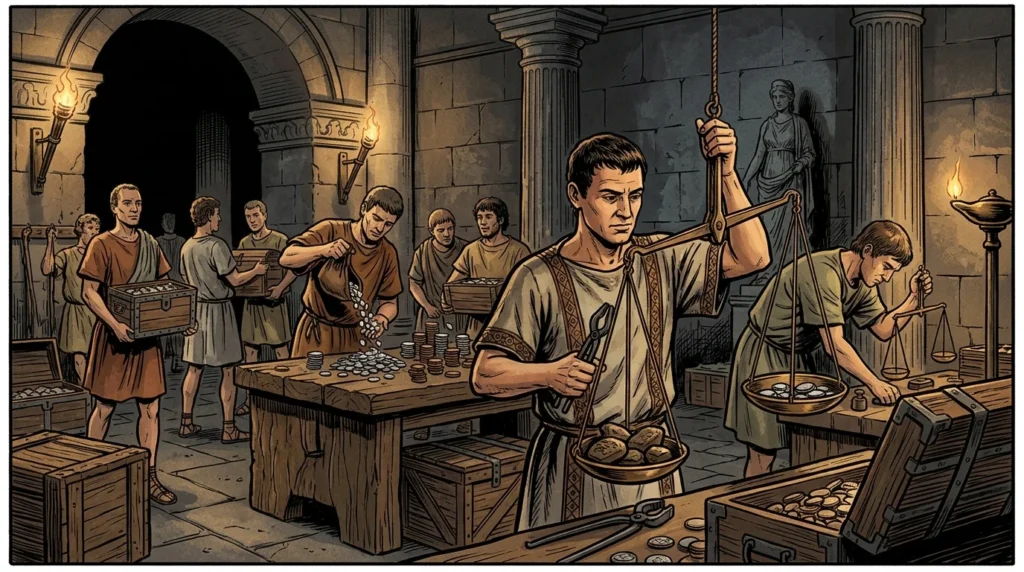
Around 211 BCE, at the height of the Second Punic War (218–201 BCE), the Roman Republic executed one of the most consequential monetary overhauls in Mediterranean history. Reeling from the Carthaginian general Hannibal Barca’s invasion of the Italian peninsula and the destruction of consecutive consular armies at the Trebia, Lake Trasimene, and Cannae, the Roman treasury faced acute insolvency. Traditional tax receipts collapsed as allied cities defected or suffered devastation, while the Republic had to keep more than twenty legions under arms across Italy, Sicily, Sardinia, Spain, and Greece. After repeatedly slashing the weight of its cast bronze coinage and debasing its Greek-style silver didrachms, the Senate seized upon fresh bullion captured from the sacks of Syracuse (212 BCE) and Capua (211 BCE) to launch a unified monetary system anchored by a brand-new silver coin: the denarius. [1]
The Pre-War Monetary Architecture: Cast Bronze and the Quadrigatus
Before the outbreak of the Second Punic War in 218 BCE, Roman currency operated on a dual track reflecting the Republic’s agrarian Italian roots and its expanding commercial ties with the Greek cities of southern Italy (Magna Graecia). For domestic valuations, census assessments, military pay calculations, and legal fines, the Roman unit of account was the bronze as. Originally cast as heavy, one-pound bars and large round coins known as aes grave on the libral standard (approximately 324 to 327 grams, corresponding to a Roman pound of twelve ounces or unciae), the bronze as derived its purchasing power directly from its intrinsic metal weight. During the First Punic War (264–241 BCE) and its aftermath, fiscal pressures had already forced Rome to reduce the cast as to a semilibral standard of roughly six ounces (about 162 grams). [2]
Alongside heavy bronze, Rome minted silver coinage modeled on the weight standards of Campanian and southern Italian Greek states to finance external commerce and military procurement. Around 225 BCE, the Republic standardized this silver output into the quadrigatus, a didrachm weighing approximately 6.8 grams (six Roman scruples) bearing a janiform head of the Dioscuri on the obverse and Jupiter with Victory in a four-horse chariot (quadriga) on the reverse. Because the silver quadrigatus and the cast bronze as belonged to separate monetary traditions and fluctuated in relative metal value, Rome lacked a single, integrated denominational ladder capable of absorbing a prolonged systemic shock. [3]
Hannibal’s Invasion and the Fiscal Crisis of 218–213 BCE
That shock arrived in late 218 BCE when Hannibal crossed the Alps and routed Roman forces at the Ticinus and the Trebia, followed by the ambush at Lake Trasimene in 217 BCE and the annihilation of up to 50,000–70,000 Roman and allied soldiers at Cannae in August 216 BCE. Beyond the demographic catastrophe, Cannae triggered a severe fiscal crisis. Capua, the second largest city in Italy, along with much of Samnium, Lucania, Bruttium, and shortly thereafter Syracuse in Sicily, defected or turned against Rome. The loss of southern Italian territory deprived the aerarium Saturni (the state treasury) of agrarian rents, customs duties, and provincial grain supplies precisely when military expenditure reached unprecedented levels. [4]
To prevent total collapse, the Roman state resorted to extraordinary credit and fiscal measures recorded by the historian Livy. In 216 BCE, following the disaster at Cannae, the Senate appointed a three-man banking commission, the triumviri mensarii—comprising Lucius Aemilius Papus, Marcus Atilius Regulus, and Lucius Scribonius Libo—to manage public liquidity and shortage of silver coin. In 215 BCE, when the propraetors in Spain threatened to withdraw their troops unless supplied with pay, clothing, and grain, the Senate confessed that the treasury lacked the cash to provision them. It appealed to nineteen wealthy tax-farming contractors (publicani) assembled in three companies to supply the Spanish armies on credit, granting them state insurance against maritime losses from enemy action or storms (periculum publicum)—an arrangement that later sparked a major war-insurance fraud scandal in 212 BCE when contractors deliberately sank decrepit hulls loaded with worthless rubble to claim state compensation. By 214 BCE, the treasury could not even pay for the maintenance of public buildings or buy oarsmen, compelling wealthy citizens to furnish slave rowers directly and allowing the property of widows and orphans to be deposited in the treasury as public loans. [5]
Debasement of the Bronze As and Emergency Gold Issues
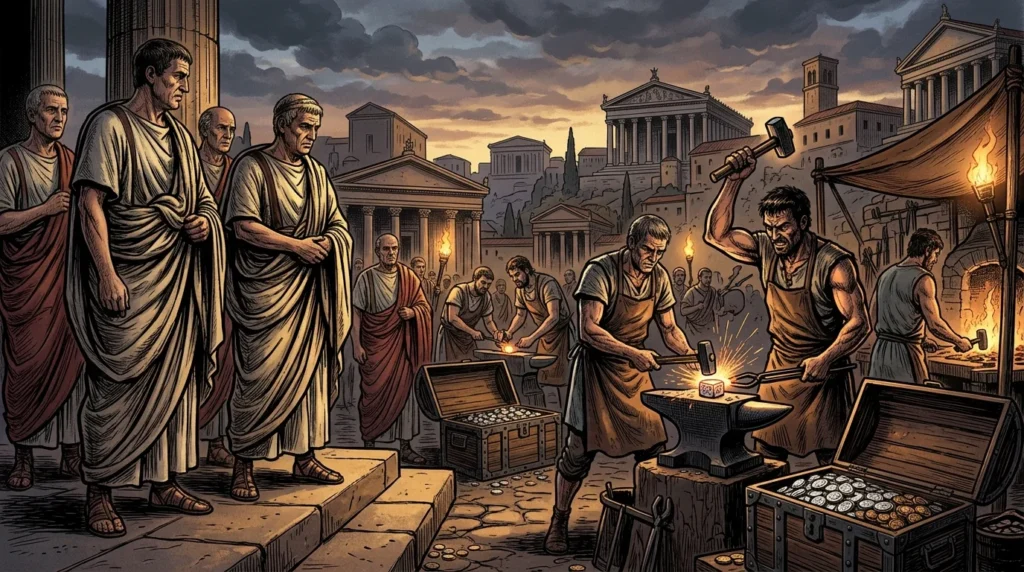
Alongside deferred payments and compulsory citizen loans (tributum doubled to meet wartime bills), the Senate turned to rapid currency debasement. As Pliny the Elder later recounted in Book 33 of his Natural History, the dictatorship of Quintus Fabius Maximus in 217 BCE initiated a sharp reduction of the bronze as under the Lex Flaminia minus solvendi. Over a span of roughly six years between 217 and 211 BCE, the bronze as plummeted from the semilibral standard (six ounces, ~162 grams) through triental (four ounces, ~108 grams) and quadrantal (three ounces, ~81 grams) stages down to the sextantal standard of just two Roman ounces (one-sixth of a pound, or roughly 54 grams). At that Reduced weight, bronze coins could now be struck with dies rather than cast in molds, transforming the as and its fractions—the semis (half), triens (third), quadrans (quarter), sextans (sixth), and uncia (twelfth)—from full-bodied commodity metal into fiduciary token coinage. [6]
Simultaneously, the silver quadrigatus suffered progressive debasement. Whereas pre-war issues exceeded 95 percent silver fineness at 6.8 grams, wartime issues struck between 215 and 212 BCE exhibited falling weights and alloy adulteration, dropping in some specimens to 80 percent or less silver content and triggering hoarding of good coin. To bridge the acute bullion deficit, Rome tapped its emergency reserve in the aerarium sanctius (accumulated from the five-percent tax on manumitted slaves, weighing 4,000 Roman pounds of gold in 209 BCE) and struck two emergency gold series: the older Oath-Scene gold staters and half-staters (~6.8 grams and ~3.4 grams) and, around 211 BCE, the Mars/Eagle gold issues denominated at 60, 40, and 20 sextantal asses. [7]
The 211 BCE Monetary Reform: Denarius, Quinarius, Sestertius, and Victoriatus
Rather than attempting to rehabilitate the discredited quadrigatus, the Senate used a massive influx of war booty—most notably the treasures stripped from Syracuse by Marcus Claudius Marcellus in 212 BCE and from Capua in 211 BCE, augmented by spontaneous voluntary contributions of private gold and silver plate urged by the consul Marcus Valerius Laevinus in 210 BCE—to demonetize the old silver currency and launch a new decimal-anchored trimetallic system around 211 BCE. [8]
At the center of the reform stood the silver denarius (meaning “containing ten”), struck at an initial standard of 72 coins to the Roman pound of pure silver (4 scruples, or approximately 4.5 grams at 96–98 percent fineness). Bearing the helmeted head of Roma and the numeral X on the obverse and the charging Dioscuri (Castor and Pollux) on the reverse, the denarius was officially tariffed at 10 sextantal bronze asses. To provide fractional silver for smaller transactions, the mint introduced two companion pieces:
- The quinarius: Weighing two scruples (~2.25 grams of silver), marked with the numeral V and valued at 5 bronze asses (half a denarius).
- The sestertius: Weighing one scruple (~1.125 grams of silver), marked IIS (two units and a half, semis-tertius) and valued at 2.5 bronze asses (one-quarter of a denarius). Despite the small size of the early silver sestertius, it replaced the bronze as as the standard unit of account for Roman public finance and elite fortunes.
Concurrently, Rome minted a separate silver denomination known as the victoriatus, showing the laureate head of Jupiter on the obverse and Victory crowning a military trophy on the reverse. Weighing three scruples (~3.4 grams, three-quarters of a denarius and exactly half the weight of an old quadrigatus) at slightly lower silver purity (around 80–90 percent) and bearing no value mark, the victoriatus was designed to match the weight of the Illyrian and Campanian drachms circulating in southern Italy, Sicily, and Cisalpine Gaul, allowing Roman paymasters to settle accounts with Greek merchants and Italian allied troops (socii) according to market bullion rates.
Long-Term Economic Legacy and the Retariffing of c. 141 BCE
The monetary system forged in the crucible of 211 BCE gave the Roman Republic a flexible, scalable fiscal instrument that financed its subsequent conquest of the Hellenistic Mediterranean. By linking a high-purity silver coin directly to overvalued sextantal bronze tokens at a fixed 10:1 ratio, the Senate stabilized legionary stipends, restored market confidence, and established a uniform Mediterranean reserve currency. Following Scipio Africanus’s capture of the silver-rich mines of Carthago Nova (Cartagena) in Spain in 209 BCE and the imposition of a 10,000-talent silver indemnity on Carthage in 201 BCE, Roman mints poured tens of millions of denarii into circulation.
Over the ensuing decades, continued military spending pushed the weight of the denarius down slightly from 1/72nd of a pound (~4.5 grams) to 1/84th of a pound (~3.9 grams), while the bronze as was further reduced to a one-ounce (uncial) standard. Around 141 BCE, to reflect the changing ratio between silver and reduced bronze and to facilitate military pay accounting, the Republic officially retariffed the denarius from 10 to 16 asses (marking the coin briefly with XVI or a monogrammed Ӿ) while valuing the sestertius at 4 asses. Born out of an existential wartime credit crunch, the denarius remained the foundational silver denomination of the Roman world until the currency collapse of the mid-third century CE.
Theoretical & Balance-Sheet Transmission Mechanism
In the Kindleberger–Minsky taxonomy of financial instability (Kindleberger, 1978; Minsky, 1986) and Irving Fisher’s (1933) debt-deflation framework, speculative asset booms become systemic crises when credit expansion shifts balance sheets from hedge finance (cash flows covering principal and interest) to speculative and Ponzi finance (relying on rising asset prices and short-term margin roll-overs).
Once monetary tightening or an exogenous shock halts price appreciation, forced margin liquidations trigger Fisherian debt-deflation: fire-sale asset discounts erode bank collateral values, contracting credit supply across the real economy.
Sources and Further Reading
- Pliny the Elder, “ Natural History, Book 33, Chapter 13 (On the Debasement of the Roman As and Origin of the Denarius),” Perseus Digital Library, Tufts University, 77 CE. Peer-Reviewed / Academic Research
- Titus Livius (Livy), “ The History of Rome, Book 23, Chapter 21 (Establishment of the Triumviri Mensarii and Wartime Financial Distress),” Perseus Digital Library, Tufts University, c. 20 BCE. Peer-Reviewed / Academic Research
- Titus Livius (Livy), “ The History of Rome, Book 26, Chapter 36 (Senatorial Voluntary Bullion Contributions of 210 BCE),” Perseus Digital Library, Tufts University, c. 20 BCE. Peer-Reviewed / Academic Research
- François Gauthier, “ Financing War in the Roman Republic 201 BCE–14 CE,” eScholarship@McGill, McGill University, 2016. Historical & Financial Reference
- James Tan, “ Political Cohesion and Fiscal Systems in the Roman Republic,” Frontiers in Political Science, 2022. Peer-Reviewed / Academic Research
- Mark Cartwright, “ Roman Coinage,” World History Encyclopedia, 2016. Historical & Financial Reference
- Irving Fisher — "The Debt-Deflation Theory of Great Depressions," Econometrica 1, no. 4 (FRASER Federal Reserve Archive, 1933): 337–357 Central Bank / Monetary Authority
- Charles P. Kindleberger & Robert Z. Aliber — Manias, Panics, and Crashes: A History of Financial Crises (Palgrave Macmillan) Peer-Reviewed / Academic Research
Cite This Historical Dossier (APA / Chicago)
APA (7th ed.): Ç., S. (Ed.). (2026). The Second Punic War Bronze Debasement and the Birth of the Roman Denarius. In Forgotten Fortunes Historical Monograph Series (Forgotten Fortunes Editorial Desk). https://forgottenfortunes.net/roman-211-bce-denarius-reform/
MLA (9th ed.): Ç., Soner, ed. "The Second Punic War Bronze Debasement and the Birth of the Roman Denarius." Forgotten Fortunes: Financial & Monetary History Archive, 2026, https://forgottenfortunes.net/roman-211-bce-denarius-reform/.
Chicago (17th ed.): Ç., Soner, ed. "The Second Punic War Bronze Debasement and the Birth of the Roman Denarius." Forgotten Fortunes Historical Monograph Series (Forgotten Fortunes Editorial Desk), September 12, 2026. https://forgottenfortunes.net/roman-211-bce-denarius-reform/.
Have an idea for another financial history documentary or article? Request a story →