In This Article
For more than eight decades after the fall of the Roman Republic, the Mediterranean world operated under one of the most stable multi-metallic currency regimes of antiquity. Consolidated by Rome’s first emperor, Augustus, between roughly 23 BCE and 19 BCE, the early Principate’s monetary architecture linked high-purity gold and silver coins to fiduciary base-metal tokens through fixed statutory exchange rates. That stability reached a structural turning point in 64 CE, when Emperor Nero lowered the weight of both the gold aureus and the silver denarius while deliberately alloying the denarius with copper. Although Nero’s reform preserved the outward tariff of the Augustan currency and established a durable bimetallic equilibrium for the next generation, it also broke the taboo against altering the intrinsic fineness of imperial silver—inaugurating a fiscal mechanism that subsequent rulers would repeatedly exploit. [1]

The Republican Legacy and the Augustan Tri-Metallic Tariff
Rome’s silver denarius had been introduced around 211 BCE during the Second Punic War, initially valued at ten bronze asses and later retariffed at sixteen asses around 140 BCE. During the late Republican civil wars of the first century BCE, military commanders—most notably Julius Caesar beginning in 46 BCE—struck large quantities of gold aurei at a standard of 1/40 of a Roman pound (libra, roughly 323 to 327 metric grams, yielding an aureus of about 8.0 grams) alongside silver denarii struck at 1/84 of a pound (roughly 3.85 to 3.90 grams) to pay their legions. [2]
Once Octavian secured sole rule and assumed the title of Augustus in 27 BCE, he transformed these emergency military issues into a permanent, empire-wide monetary hierarchy through reforms executed between 23 BCE and 19 BCE. Rather than relying on a single monetary metal, the Augustan system functioned as a tri-metallic tariff combining gold, silver, and two distinct copper-based alloys: orichalcum (a golden-colored brass alloy of copper and zinc) and pure red copper. [3]
At the apex of the tariff stood the gold aureus, struck at nearly 99 percent purity and gradually adjusted under Augustus and his Julio-Claudian successors from 1/40 to roughly 1/42 of a Roman libra (approximately 7.78 to 7.90 grams). Beneath the aureus sat the silver denarius, struck at 1/84 of a libra (about 3.85 to 3.90 grams) from bullion refined to between 97.5 and 98 percent pure silver. Augustus locked these precious-metal coins into a statutory Accounting and exchange tariff down to the smallest daily transactions: [4]
- 1 gold aureus = 2 gold quinarii = 25 silver denarii = 100 sestertii = 200 dupondii = 400 copper asses.
- 1 silver denarius = 2 silver quinarii = 4 orichalcum sestertii = 8 orichalcum dupondii = 16 copper asses.
- 1 orichalcum sestertius (approx. 25–27 grams) = 2 orichalcum dupondii = 4 copper asses (approx. 10–11 grams).
By minting the large sestertius and the dupondius in orichalcum—whose zinc content made it scarcer and roughly twice as valued by weight as plain copper—Augustus avoided having to strike unwieldy bronze coins while making the sestertius (abbreviated HS) the primary unit of account for imperial tax assessments, senatorial property qualifications, and military stipends.
| Documented Figure / Metric | Historical Significance & Archival Context |
|---|---|
| 93.5 percent | In fact, in 68 CE, toward the very end of his reign, Nero partially restored the silver fineness of the denarius toward ~90–93.5 percent, and the Flavian Emperor Domitian briefly attempted in 82 CE to return the denarius to near-Augustan purity before fiscal pressures forced him back to the Neronian standard in 85 CE. |
| 90 percent | Following the conquest of gold-rich Dacia in 106 CE, Cassius Dio records that Trajan ordered the recall of worn Republican silver coins in 107 CE, while his mint masters permanently lowered the fineness of the denarius to roughly 89–90 percent silver (keeping the Neronian weight of 1/96 of a pound). |
Julio-Claudian Bullion Discipline and Fiscal Pressures
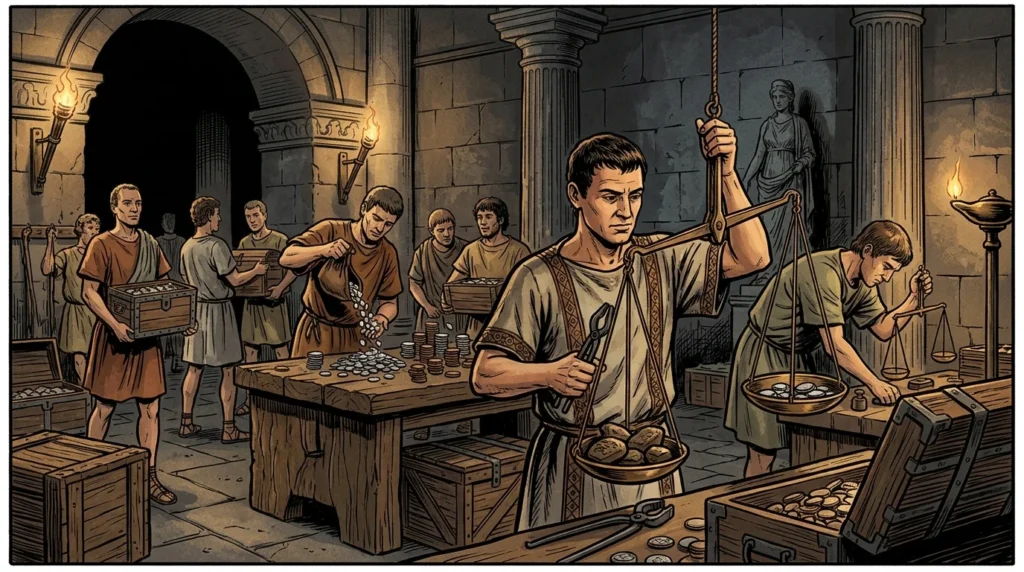
From the reign of Augustus through the early years of Nero (r. 54–68 CE), the imperial mint—whose precious-metal operations had been concentrated at Lugdunum (modern Lyon) since roughly 15 BCE—maintained strict metallurgical discipline. Metallurgical analyses conducted by numismatists Kevin Butcher and Matthew Ponting confirm that Julio-Claudian denarii struck under Tiberius, Caligula, Claudius, and Nero prior to 64 CE consistently contained virtually pure silver bullion (around 97.5 to 98 percent elemental silver, with tiny traces of gold and lead remaining from cupellation). [5]
Maintaining this full-bodied standard, however, placed growing strain on the imperial treasury (the aerarium and the emperor’s provincial fisci). The Roman state faced fixed, recurring cash obligations—above all the pay and discharge bonuses (praemia) of roughly twenty-five to twenty-eight legions established under Augustus, alongside urban grain distributions, public spectacles, and road and aqueduct maintenance. At the same time, high-purity silver and gold coins flowed outward across the empire’s eastern and northern frontiers through trade—most famously for luxury imports from India and Arabia—while older Republican denarii still in domestic circulation had lost weight through decades of physical wear.
Under Nero, these structural pressures collided with acute fiscal outlays. Costly military campaigns in Britain (following the revolt of Boudica in 60–61 CE) and against Parthia over Armenia, combined with Nero’s lavish court expenditures and public distributions (congiaria), depleted accumulated cash reserves. In July 64 CE, the Great Fire of Rome devastated ten of the capital’s fourteen districts, confronting the imperial administration with massive reconstruction expenses—including both civic infrastructure and Nero’s sprawling palace complex, the Domus Aurea—just as tax revenues from the disrupted capital faltered. [6]
Nero’s Monetary Reform of 64 CE
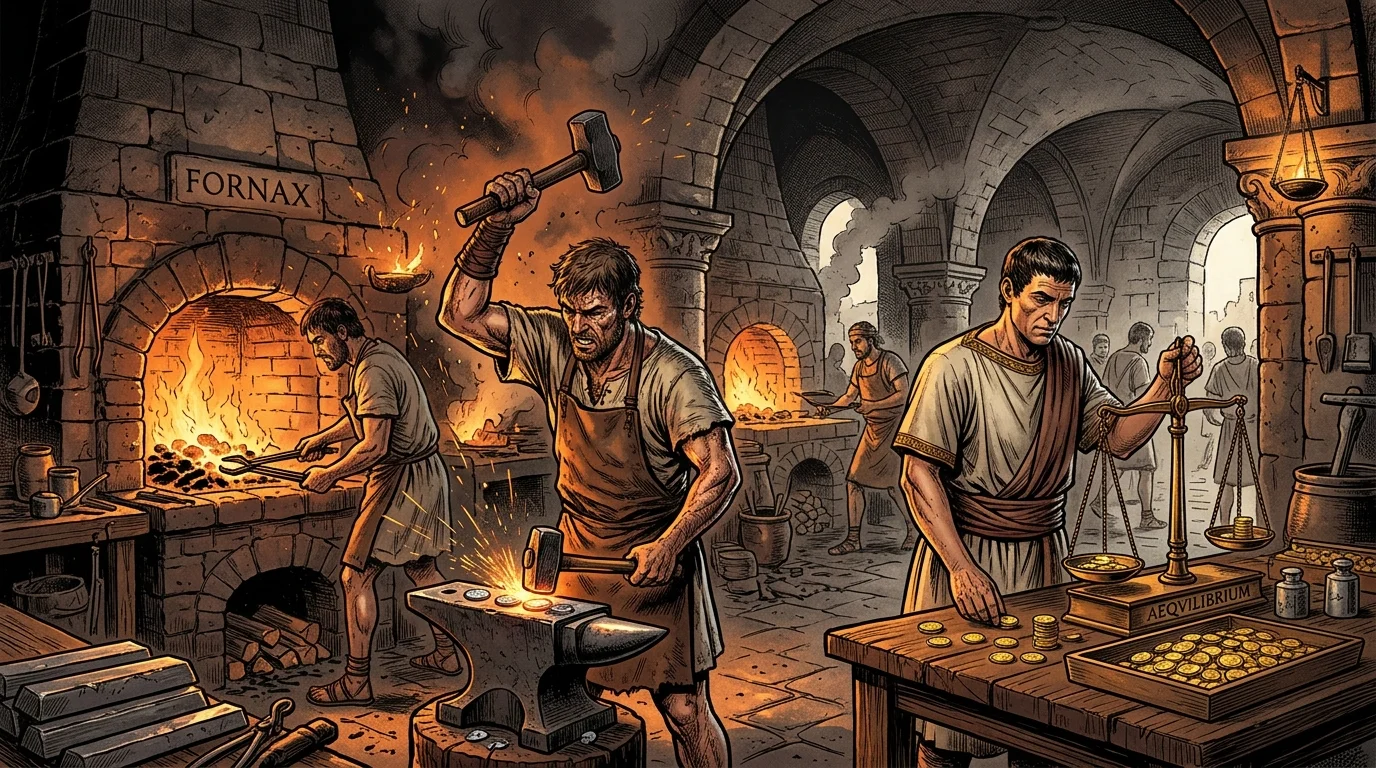
In 64 CE, concurrent with transferring primary precious-metal minting operations from Lugdunum back to the central mint in Rome, Nero enacted a comprehensive recalibration of the imperial coinage. Rather than altering the statutory face-value tariff of 25 denarii to 1 aureus or 4 sestertii to 1 denarius, the imperial administration modified the physical specifications of the precious-metal coins themselves: [7]
- Weight reduction of the gold aureus: As recorded by the contemporary Roman author Pliny the Elder in his Naturalis Historia, the minting standard of the aureus was reduced to 45 coins per Roman libra of gold (down from the 40-to-the-pound Republican baseline and ~41–42 under the early Julio-Claudians), lowering average coin weight from roughly 7.78–7.90 grams to approximately 7.25–7.30 grams while keeping gold purity near 99 percent.
- Weight reduction of the silver denarius: The number of denarii struck from a Roman libra of silver alloy was increased from 84 to 96 per pound (specifically 1/8 of a Roman ounce, or one drachm in weight), reducing the theoretical weight of each denarius from roughly 3.85 grams to 3.41 grams.
- Alloy debasement of the denarius: Breaking with three centuries of Republican and Julio-Claudian practice, the Rome mint deliberately alloyed the silver bullion with base copper, lowering the fineness of the denarius from ~98 percent to roughly 93.5 percent (and fluctuating between 80 and 93.5 percent across different Neronian phases).
Combined, the shift from 84 to 96 coins per pound and the addition of copper reduced the weight of fine silver in each denarius from approximately 3.80 grams to around 3.0–3.2 grams—an effective reduction of roughly 16 to 20 percent in intrinsic silver content. Nero also experimented with the base-metal denominations at Rome and Lugdunum, temporarily striking radiant brass asses and small denominations in orichalcum so that every coin denomination could be distinguished by size and color as well as weight. [8]
Bimetallic Rebalancing or Fiscal Seigniorage?
Why did Nero reduce the denarius more sharply than the aureus? Modern numismatic scholarship—led by Kevin Butcher and Matthew Ponting’s metallurgical investigations—identifies two interlocking motives behind the 64 CE reform. First, the reform generated immediate fiscal seigniorage: by reminting existing bullion and incoming tax revenues into lighter, copper-alloyed denarii and lighter aurei, the state could strike roughly 14 percent more gold coins and up to 20–25 percent more silver coins from the same quantity of pure metal to pay soldiers, contractors, and suppliers.
Second, the reform corrected a bimetallic distortion in the gold-to-silver ratio. Under the original Augustan standard of 40–42 aurei and 84 pure denarii per pound at a tariff of 1:25, gold was valued at roughly 12 to 12.5 times the weight of silver. By the mid-first century CE, abundant gold production from Asturia and Dalmatia, paired with the physical wear of circulating Republican silver and the Aligning of western denarii with lighter eastern Greek drachms (such as the Cappadocian and Syrian silver coinages), meant that full-weight pure denarii were overvalued as bullion relative to gold. Lowering the aureus to 1/45 of a pound (~7.27 g) and the denarius to 1/96 of a pound (~3.41 g at ~93.5% purity, or ~3.18 g fine silver) shifted the mint’s effective gold-to-silver ratio to approximately 1:10.9–1:11, discouraging the melting or hoarding of newly minted silver.
Trajan’s 107 CE Debasement and the Long-Term Precedent
In the immediate aftermath of 64 CE, Nero’s reform did not trigger runaway price inflation across the Roman Empire. Because the Roman state accepted its own coins at face value in taxation and enforced the legal equivalence of 25 denarii to the gold aureus—as documented in second-century legal writings and papyri—the denarius functioned partly as an overvalued token coin anchored to the full-bodied gold aureus. In fact, in 68 CE, toward the very end of his reign, Nero partially restored the silver fineness of the denarius toward ~90–93.5 percent, and the Flavian Emperor Domitian briefly attempted in 82 CE to return the denarius to near-Augustan purity before fiscal pressures forced him back to the Neronian standard in 85 CE.
Yet Gresham’s Law operated inexorably in the background. Because pre-64 CE Republican and Julio-Claudian denarii contained significantly more pure silver than post-64 CE Neronian coins of the same face value, merchants and citizens selectively hoarded or melted the older, purer coins, or the state itself systematically recalled them for reminting.
This dynamic culminated under Emperor Trajan (r. 98–117 CE). Following the conquest of gold-rich Dacia in 106 CE, Cassius Dio records that Trajan ordered the recall of worn Republican silver coins in 107 CE, while his mint masters permanently lowered the fineness of the denarius to roughly 89–90 percent silver (keeping the Neronian weight of 1/96 of a pound). What Nero had introduced in 64 CE as a one-time fiscal and bimetallic adjustment had become institutionalized imperial policy: whenever military emergencies or dynastic transitions strained the fiscus—under Marcus Aurelius in the 160s CE, Septimius Severus in 194 CE, and Caracalla in 215 CE—emperors turned to the Neronian lever of alloying the silver coinage, setting Rome on the long path toward the currency collapse of the third century.
Theoretical & Balance-Sheet Transmission Mechanism
In the Kindleberger–Minsky taxonomy of financial instability (Kindleberger, 1978; Minsky, 1986) and Irving Fisher’s (1933) debt-deflation framework, speculative asset booms become systemic crises when credit expansion shifts balance sheets from hedge finance (cash flows covering principal and interest) to speculative and Ponzi finance (relying on rising asset prices and short-term margin roll-overs).
Once monetary tightening or an exogenous shock halts price appreciation, forced margin liquidations trigger Fisherian debt-deflation: fire-sale asset discounts erode bank collateral values, contracting credit supply across the real economy.
Sources and Further Reading
- American Numismatic Society, “ Rome: A Thousand Years of Monetary History,” American Numismatic Society, 2020. Historical & Financial Reference
- Kevin Butcher and Matthew Ponting, “ The Reforms of Nero, AD 64–68 (Chapter 9) in The Metallurgy of Roman Silver Coinage: From the Reform of Nero to the Reform of Trajan,” Cambridge University Press, 2015. Peer-Reviewed / Academic Research
- Kevin Butcher, “ Debasement and the Decline of Rome,” University of Warwick Department of Classics and Ancient History, 2015. Peer-Reviewed / Academic Research
- Kevin Butcher and Matthew Ponting, “ The Beginning of the End? The Denarius in the Second Century,” Annali dell’Istituto Italiano di Numismatica / University of Warwick, 2012. Peer-Reviewed / Academic Research
- Merav Haklai, “ Money in the Roman Empire from Hadrian to the Severi: A Study of Attitudes and Practice,” Oxford University Research Archive (University of Oxford), 2013. Peer-Reviewed / Academic Research
- François Gauthier, “ Financing War in the Roman Republic 201 BCE–14 CE,” McGill University / eScholarship@McGill, 2016. Historical & Financial Reference
- Irving Fisher — "The Debt-Deflation Theory of Great Depressions," Econometrica 1, no. 4 (FRASER Federal Reserve Archive, 1933): 337–357 Central Bank / Monetary Authority
- Charles P. Kindleberger & Robert Z. Aliber — Manias, Panics, and Crashes: A History of Financial Crises (Palgrave Macmillan) Peer-Reviewed / Academic Research
Cite This Historical Dossier (APA / Chicago)
APA (7th ed.): Ç., S. (Ed.). (2026). Nero's 64 CE Debasement of the Roman Denarius and the Augustan Monetary System. In Forgotten Fortunes Historical Monograph Series (Forgotten Fortunes Editorial Desk). https://forgottenfortunes.net/nero-64-ce-roman-denarius-aureus-debasement/
MLA (9th ed.): Ç., Soner, ed. "Nero's 64 CE Debasement of the Roman Denarius and the Augustan Monetary System." Forgotten Fortunes: Financial & Monetary History Archive, 2026, https://forgottenfortunes.net/nero-64-ce-roman-denarius-aureus-debasement/.
Chicago (17th ed.): Ç., Soner, ed. "Nero's 64 CE Debasement of the Roman Denarius and the Augustan Monetary System." Forgotten Fortunes Historical Monograph Series (Forgotten Fortunes Editorial Desk), September 12, 2026. https://forgottenfortunes.net/nero-64-ce-roman-denarius-aureus-debasement/.
Have an idea for another financial history documentary or article? Request a story →