In This Article
Between 1700 and 1810, the Bourbon monarchy transformed the Viceroyalty of New Spain into the most productive monetary engine of the early modern world. By revoking private minting concessions, installing water- and mule-powered rolling mills and screw presses at the Casa de Moneda de México in 1732, and striking the iconic machine-milled Columnario (“Pillar Dollar”), King Philip V eliminated rampant coin clipping and turned the Mexican eight-real piece into the undisputed reserve currency of North America, European trade, and Qing China. Behind this technical triumph, however, the Spanish Crown repeatedly manipulated New Spain’s monetary and credit architecture to finance European wars—first through King Charles III’s top-secret royal order of 1771–1772 reducing the silver fineness of the new de busto coinage from 91.67 percent to 90.28 percent, and finally through King Charles IV’s catastrophic December 1804 decree of Consolidación de Vales Reales, which ordered colonial church courts (Juzgados de Capellanías) to call in and confiscate 10.5 million pesos of agricultural and mining mortgages across Mexico. [1]
Bourbon Nationalization and the 1732 Milled Columnario
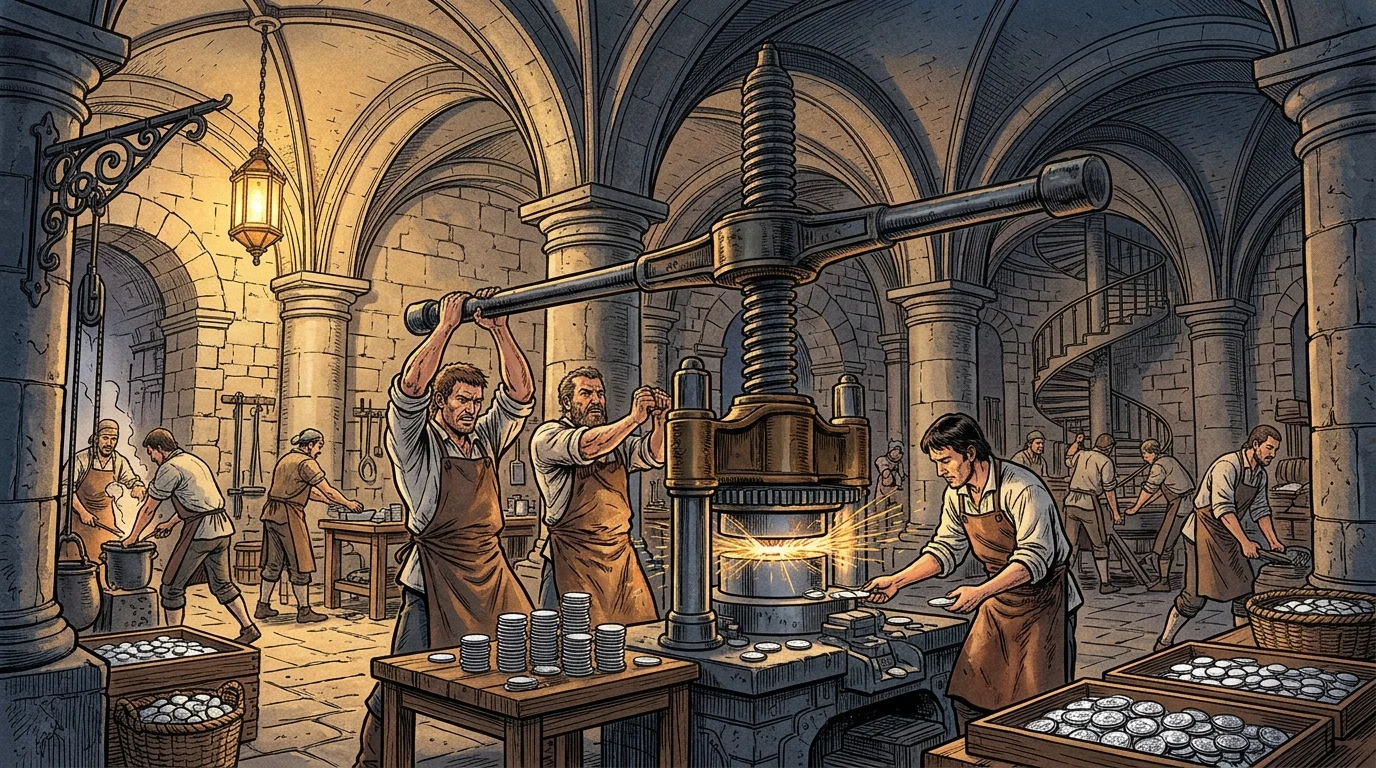
For nearly two centuries after its founding in 1535, the Mexico City Mint operated as a patrimonial concession in which private officeholders bought the hereditary posts of treasurer, assayer, and cutter from the Crown and leased silver-striking furnaces to private contractors. Using handheld hammers and heavy iron shears, workers produced irregularly shaped cob coins (macuquinas) whose ragged, unlettered edges invited systematic clipping (cercén) and sweating by merchants from Veracruz to London. Because clipped cobs varied in weight by 10 to 25 percent while full-weight coins were culled for melting, international commerce suffered constant valuation disputes. [2]
Determined to centralize imperial revenue and modernize coinage along French technical lines, the first Bourbon King of Spain, Philip V, promulgated the comprehensive Mint Ordinances of June 9, 1728 and July 16, 1730. The Crown bought back all privatized mint offices, placed the Casa de Moneda de México under a salaried royal superintendent directly answerable to the Viceroy and Madrid, and shipped heavy laminating rolling mills (molinos de laminación), circular blanking punches (cortadores), edge-milling machines (cerrillas), and towering bronze fly-wheel screw presses (volantes) from Spain to Mexico City. [3]
On March 29, 1732, the newly expanded Mexico City Mint alongside the National Palace struck the first machine-milled eight-real coins, universally known as Columnarios, Mundos y Mares (“Worlds and Seas”), or in English as “Pillar Dollars.” Designed to project global imperial sovereignty, the reverse depicted two crowned terrestrial globes representing the Old and New Worlds resting over surging ocean waves, flanked by the crowned Pillars of Hercules wrapped in banners reading Plus Ultra beneath the legend Utraque Unum (“Both Are One”). Crucially, every coin passed through a parallel-bar edging machine that impressed a raised laurel-leaf security rim (cordoncillo) around the circumference, making any attempt to shave or clip silver from the edge immediately visible. [4]
At the same time, Philip V’s 1728 ordinance quietly adjusted the Castilian monetary standard of 1497: the gross weight of the eight-real piece remained one Spanish ounce (roughly 27.07 grams at 68 reales per mark), while legal fineness was set at 11 dineros exactly—11/12ths pure silver, or 916.67 parts per thousand (91.67 percent), down slightly from the Habsburg standard of 93.06 percent to cover the heavy capital cost of machine milling. Because every Mexican Columnario came off the screw press perfectly round and uniform in weight and assay, it commanded an immediate premium across the globe. In the British North American colonies and the early United States—where Alexander Hamilton modeled the 1792 U.S. Mint Act directly on the weight of circulating Spanish milled dollars—the Mexican eight-real coin served as domestic legal tender until the Coinage Act of 1857, while in Canton and the Yangtze Delta it circulated as the trusted “double-pillar foreign dollar” (shuangzhu yangqian). [5]
Aviadores, Silver Banks, and the 1772 Secret Royal Debasement
The surge in Mexican mintage—which climbed from roughly 6 million pesos annually in the 1710s to over 24 million pesos a year by the 1790s—depended on an intricate private credit chain linking Mexico City wholesalers to remote mining camps in Guanajuato, Zacatecas, Real del Monte, and San Luis Potosí. Because the Mexico City Mint was the sole legal coinage facility in all of New Spain and took weeks to assay and coin bullion unless a depositor paid an immediate discount, provincial miners lacked working capital to buy mercury, gunpowder, iron, mules, and grain. [6]
To bridge this liquidity gap, wealthy Mexico City merchant-bankers associated with the Consulado de Comerciantes functioned as aviadores (supply and credit financiers) and established specialized private silver banks (bancos de plata). Advancing cloth, quicksilver, and coined pesos on credit to local mine operators (mineros), the aviadores received unminted silver bars (plata pasta) at a discount of two to four reales per mark below mint par, transported the bullion under armed guard to Mexico City, and exchanged it immediately for freshly struck eight-real coins using revolving liquid reserves at the Casa de Moneda. In 1783, the Crown supplemented this private network by chartering the Real Tribunal de Minería and its Mining Bank (Banco de Avío de Minas), capitalized via a compulsory levy of one real per mark of silver produced. [7]
By the early 1770s, King Charles III sought both to retire millions of worn seventeenth-century cob coins still circulating in the empire and to extract stealth seigniorage without alarming British, Dutch, or Chinese bullion merchants. Under the pragmatic sanction of May 29, 1771 and a top-secret royal instruction (Real Orden Reservada) issued on March 18, 1772, Charles III ordered all imperial mints—Mexico City, Lima, Potosí, Popayán, Santa Fe de Bogotá, Guatemala, and Santiago—to replace the beloved Columnario design with a neoclassical portrait coinage (moneda de busto or “Carolus dollar”) bearing the king’s laureate profile. [8]
Bound by strict oaths of secrecy administered to the mint superintendent and chief assayers on pain of dismissal and imprisonment, the 1772 reform secretly lowered the legal fineness of silver eight-, four-, two-, one-, and half-real coins from 11 dineros (91.67 percent) to 10 dineros and 20 granos—equivalent to 902.77 parts per thousand (90.28 percent pure silver)—representing a covert 1.52 percent reduction in intrinsic silver content. Although European and Chinese merchant guilds eventually detected the slight drop in fine silver weight from 24.81 grams to 24.44 grams through fire assays, the extraordinary volume and physical uniformity of Mexican Carolus bust dollars ensured their continued acceptance across Asia and the Atlantic.
Church Credit Courts and the 1804 Consolidación de Vales Reales
While merchant aviadores financed short-term silver circulation, long-term mortgage credit across New Spain was supplied almost entirely by the Catholic Church. Over three centuries, pious bequests by wealthy miners, landowners, and merchants had endowed thousands of chaplaincies (capellanías), convents, confraternities (cofradías), hospitals, and charitable trusts (obras pías). Rather than hoarding idle silver or purchasing rural estates directly, each cathedral diocese operated an ecclesiastical banking court—the Juzgado de Testamentos, Capellanías y Obras Pías—which lent out endowed capital to secular hacienda owners, sugar planters, silver miners, and urban merchants at a standard, moderate interest rate of 5 percent per annum.
Structured either as redeemable mortgage annuities (censos consignativos) or five-to-ten-year renewable loans secured by real estate and personal guarantors (depósitos irregulares), these ecclesiastical advances rolled over from generation to generation. By 1804, church institutions in New Spain held an estimated 44 million to 45 million pesos in active mortgage loans—functioning as the indispensable land and development bank of the viceroyalty.
In Madrid, however, King Charles IV and his chief minister Manuel de Godoy faced imminent sovereign bankruptcy. To finance consecutive wars against revolutionary France (1793–1795) and Great Britain (1796–1802 and 1804–1808), Spain had issued massive quantities of interest-bearing paper treasury bonds called Vales Reales, which had plunged to discounts of 40 to 50 percent below par while Napoleon Bonaparte simultaneously demanded monthly cash war subsidies of six million francs from Madrid under the October 1803 Neutrality Treaty.
Having already ordered the confiscation and sale of church charitable endowments inside peninsular Spain in 1798, Charles IV extended the measure to the Americas via the Royal Decree of November 28, 1804 (published via royal instruction on December 26, 1804): the Real Cédula de Consolidación de Vales Reales. Arriving in Mexico City under Viceroy José de Iturrigaray in summer 1805, the decree ordered New Spain’s Juzgados de Capellanías, convents, and indigenous community chests (cajas de comunidad) to immediately call in all outstanding mortgage loans, foreclose on and auction the estates of any debtor who could not pay cash, and hand the liquidated silver pesos over to newly created royal Consolidation Juntas. In exchange, the Crown promised to pay the church funds 3 to 5 percent annual interest backed by the bankrupt Spanish treasury.
The 10.5-Million-Peso Extraction and the Road to 1810
Because virtually no Mexican hacienda owner or silver miner kept tens of thousands of liquid silver pesos sitting in vaults to pay off decades-old rolling mortgages at once, enforcement of the Consolidación between September 1805 and 1808 triggered a systemic credit contraction across New Spain. Landowners, miners, and city councils in Mexico City, Puebla, Valladolid (Morelia), Guadalajara, and Veracruz flooded the viceroy with desperate petitions—notably the famous Representación penned for the landowners of Michoacán by Bishop-elect Manuel Abad y Queipo—warning that stripping 44 million pesos of working credit from an economy with a much smaller circulating money supply would collapse agricultural prices and ruin the silver mines.
Ignoring the protests in exchange for personal commission bonuses, Viceroy Iturrigaray and the royal Consolidation Juntas forced thousands of debtors into distress sales, Composition installments, or outright property seizures—including the small Michoacán hacienda of Dolores parish priest Miguel Hidalgo y Costilla. Before the French invasion of Spain and the September 1808 Mexico City coup against Iturrigaray finally led the Supreme Central Junta to suspend the decree in January 1809, royal officials extracted approximately 10.5 million silver pesos from New Spain (accounting for roughly two-thirds of the 15.4 million pesos collected across all of Spanish America), shipping most of the bullion directly to Europe to pay Napoleon’s war tribute and British neutral-trade middlemen. By gutting New Spain’s ecclesiastical mortgage bank and alienating creole landowners, miners, and lower clergy simultaneously, the 1804 Consolidación shattered the financial pact of colonial rule and laid the direct material fuse for the September 1810 Mexican War of Independence.
Theoretical & Balance-Sheet Transmission Mechanism
In the Kindleberger–Minsky taxonomy of financial instability (Kindleberger, 1978; Minsky, 1986) and Irving Fisher’s (1933) debt-deflation framework, speculative asset booms become systemic crises when credit expansion shifts balance sheets from hedge finance (cash flows covering principal and interest) to speculative and Ponzi finance (relying on rising asset prices and short-term margin roll-overs).
Once monetary tightening or an exogenous shock halts price appreciation, forced margin liquidations trigger Fisherian debt-deflation: fire-sale asset discounts erode bank collateral values, contracting credit supply across the real economy.
Sources and Further Reading
- Banco de México, “The History of Coins and Banknotes in México,” Banco de México, 2018. Central Bank / Monetary Authority
- Museo Nacional de Arqueología Subacuática (ARQVA), “Columnarios (Pillar Dollars): Worlds and Seas Coinage (1732–1772),” Ministerio de Cultura y Deporte (Spain), 2020. Historical & Financial Reference
- Numismática Mexicana, “Columnario (8 Reales Pillar Dollar, 1732–1772),” Numismática Mexicana Archive, 2021. Historical & Financial Reference
- Banco de México, “Acuñación de Moneda Metálica en la Época Colonial (1536–1821),” Sistema de Información Económica (Banxico), 2023. Central Bank / Monetary Authority
- Banco de España, “Real Cédula sobre la Circulación y Amortización de Vales Reales,” Repositorio Institucional del Banco de España, 2019. Historical & Financial Reference
- Gisela von Wobeser, “The Consolidación de Vales Reales as a Determining Factor in the Mexican Struggle for Independence, 1804–1808,” El Colegio de México (Historia Mexicana), 2006. Historical & Financial Reference
- Irving Fisher — "The Debt-Deflation Theory of Great Depressions," Econometrica 1, no. 4 (FRASER Federal Reserve Archive, 1933): 337–357 Central Bank / Monetary Authority
- Charles P. Kindleberger & Robert Z. Aliber — Manias, Panics, and Crashes: A History of Financial Crises (Palgrave Macmillan) Peer-Reviewed / Academic Research
Cite This Historical Dossier (APA / Chicago)
APA (7th ed.): Ç., S. (Ed.). (2026). Mexico's 1732 Columnario Dollar, the 1772 Secret Debasement, and the 1804 Credit Shock. In Forgotten Fortunes Historical Monograph Series (Forgotten Fortunes Editorial Desk). https://forgottenfortunes.net/mexico-consolidacion-vales-reales/
MLA (9th ed.): Ç., Soner, ed. "Mexico's 1732 Columnario Dollar, the 1772 Secret Debasement, and the 1804 Credit Shock." Forgotten Fortunes: Financial & Monetary History Archive, 2026, https://forgottenfortunes.net/mexico-consolidacion-vales-reales/.
Chicago (17th ed.): Ç., Soner, ed. "Mexico's 1732 Columnario Dollar, the 1772 Secret Debasement, and the 1804 Credit Shock." Forgotten Fortunes Historical Monograph Series (Forgotten Fortunes Editorial Desk), September 20, 2026. https://forgottenfortunes.net/mexico-consolidacion-vales-reales/.
Have an idea for another financial history documentary or article? Request a story →