In This Article
Across the four decades between the liberation of the Netherlands in May 1945 and the solidification of the European Monetary System (EMS) in the mid-1980s, the modern monetary identity of the Dutch guilder (gulden) was forged by three defining episodes of state intervention and central bank doctrine. The first was Finance Minister Piet Lieftinck’s audacious September 1945 currency purge (Geldzuivering), which invalidated every Nazi-era banknote in circulation, froze all bank deposits, and forced the entire Dutch population to survive for an entire week on a single ten-guilder cash allowance immortally remembered as het Tientje van Lieftinck. The second was the March 1961 Bretton Woods revaluation, when the Netherlands followed West Germany in revaluing the guilder by 5 percent to ward off imported inflation. The third—and most traumatic for central bankers at De Nederlandsche Bank (DNB)—was the “Shock of March 1983,” when Prime Minister Ruud Lubbers and Finance Minister Onno Ruding overruled DNB President Wim Duisenberg during an EMS realignment to devalue the guilder by 2 percent against the Deutsche Mark, triggering a punitive bond-market yield spread that convinced Dutch policymakers never again to deviate from the German anchor. [1]
Nazi Monetary Plunder and the 1945 Black-Market Liquidity Overhang
When Allied forces completed the liberation of the Netherlands in May 1945, the Dutch economy lay in physical and monetary ruins. During five years of German occupation (1940–1945), Reichskommissar Arthur Seyss-Inquart and DNB collaborator Meinoud Rost van Tonningen had dismantled the statutory gold and foreign-exchange backing of the guilder, abolishing the “foreign exchange barrier” with Berlin so that German war requisitions and forced bilateral clearing claims were paid for with newly printed guilders. Between May 1940 and May 1945, the volume of banknotes in circulation quadrupled from roughly 1.15 billion guilders to more than 5.5 billion guilders, while total liquid bank balances and short-term Treasury paper swelled total money supply past 11 billion guilders—even as real national output and available consumer goods shrank by more than half. [2]
Strict wartime price controls and rationing had prevented open hyperinflation, but they created an enormous “monetary overhang” of suppressed inflation and illicit cash hoards. Collaborators, bunker builders, and black-market profiteers (zwarthandelaars) held hundreds of millions of guilders in high-denomination paper notes outside the banking system to evade tax authorities and postwar tribunals. While exiled Finance Minister Gerard Huysmans and later Pieter Lieftinck—a former Rotterdam economics professor who had spent the war interned in German hostage camps at Buchenwald and Sint-Michielsgestel before joining the Schermerhorn-Drees cabinet in June 1945—secretly had new guilder banknotes printed in the United Kingdom by Thomas De La Rue & Co. and Bradbury, Wilkinson & Co., shipping delays meant a full currency replacement could not be executed until autumn 1945. [3]
September 26–October 2, 1945: The Geldzuivering and “Het Tientje van Lieftinck”
Lieftinck struck in two decisive phases. First, under the Decree on the Withdrawal of 100-Guilder Banknotes of July 9, 1945, all banknotes of 100 guilders and higher (including 500- and 1,000-guilder notes) were abruptly stripped of legal-tender status; citizens had to deposit them into blocked bank accounts where tax inspectors could investigate the lawful origin of the funds before releasing a single guilder. Anticipating the broader purge, black marketers frantically tried to spend smaller-denomination notes on luxury goods, bicycles, jewelry, and real estate, or hired proxies to deposit small sums on their behalf. [4]
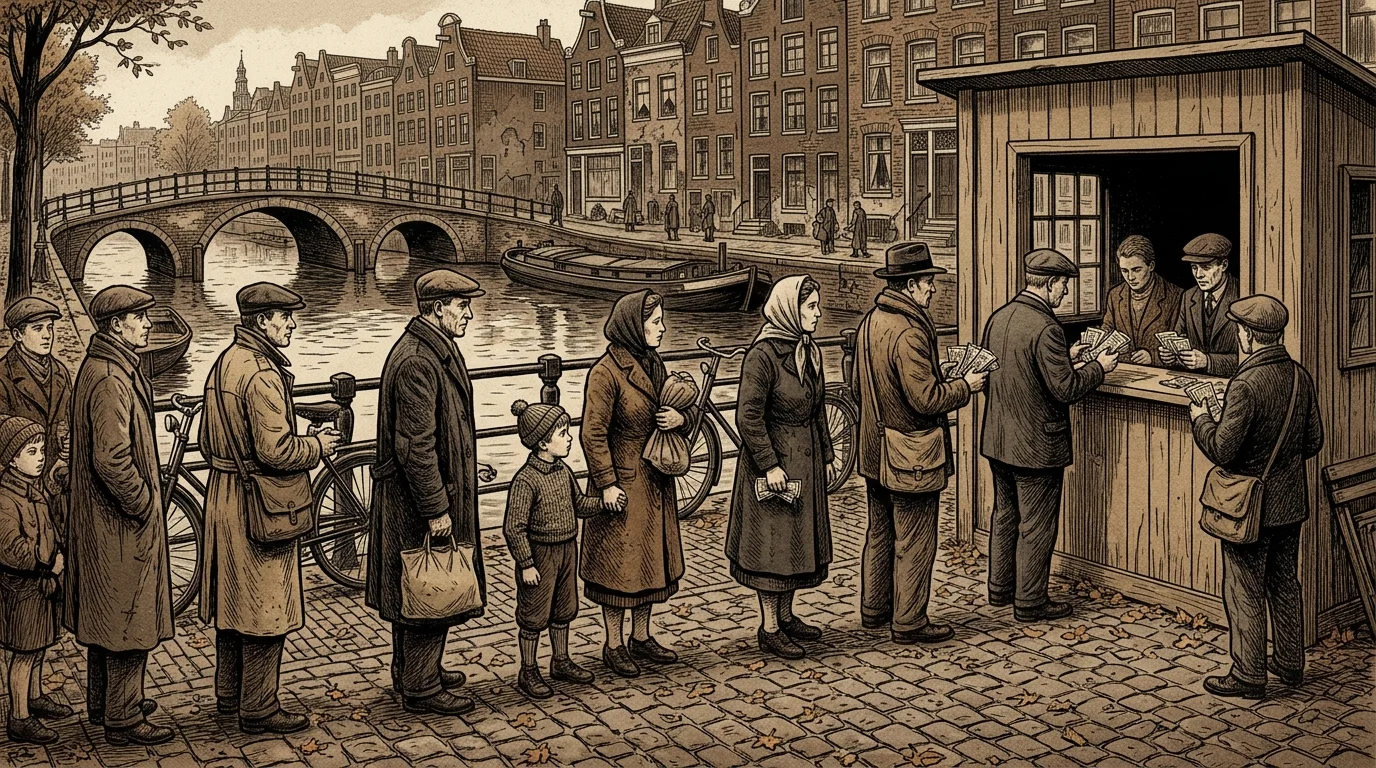
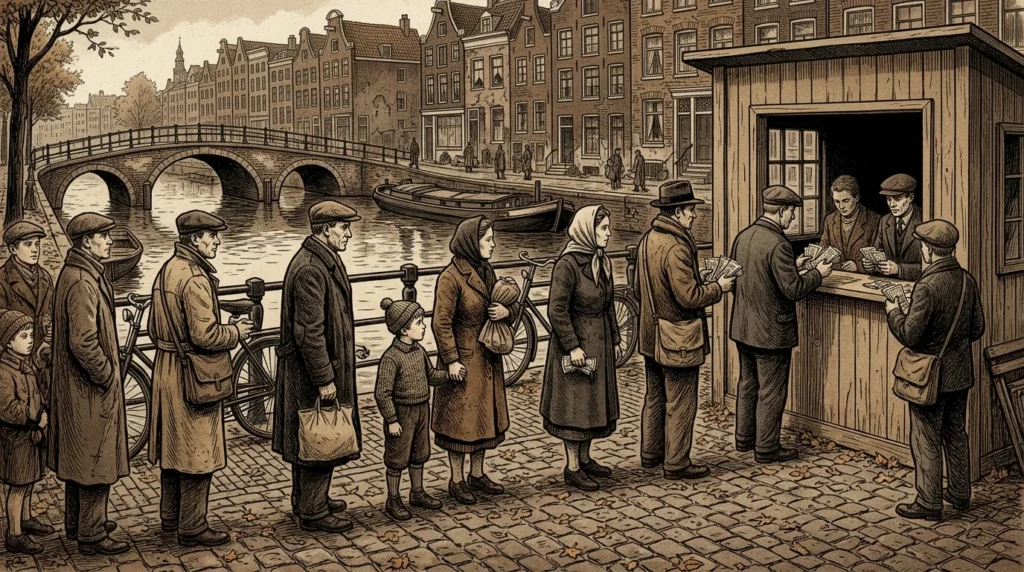
Then, in a radio broadcast on the evening of September 19, 1945, Piet Lieftinck announced the comprehensive money purge (Geldzuivering). Effective Wednesday, September 26, 1945, every existing guilder banknote and silver coin in the Netherlands became worthless, and every bank, postal giro, and savings account in the country was completely frozen. To prevent economic paralysis during the seven-day cashless freeze from September 26 to October 2, 1945, every Dutch citizen—man, woman, and child, registered via wartime ration cards—was permitted to exchange 10 old guilders in advance for precisely 10 guilders in newly minted small notes (typically composed of one 2.50-guilder note and several 1-guilder currency notes), universally dubbed het Tientje van Lieftinck (“Lieftinck’s Tenner”). [5]
For one extraordinary week, social and economic hierarchies vanished across the Netherlands: millionaires and day laborers alike possessed exactly ten guilders in spendable cash. Streetcars, cinemas, and cafés emptied; municipalities postponed gas and electricity collection; and employers were authorized to pay wages only beginning October 3, when the newly printed postwar guilder banknotes officially entered circulation. All remaining old banknotes had to be surrendered into blocked accounts (geblokkeerde rekeningen). Through strict tax audits, retroactive wartime capital-increment taxes (Vermogensaanwasbelasting) reaching up to 90 percent on illicit profits, and a one-off capital levy (Vermogensheffing ineens), Lieftinck gradually unblocked legitimate savings over the late 1940s while permanently extinguishing black-market hoards—restoring domestic price stability and laying the monetary foundation for the Dutch postwar miracle (Wederopbouw). [6]
Bretton Woods Export Boom and the March 1961 5% Guilder Revaluation
Following the September 1949 sterling-led realignment—in which the Netherlands devalued the guilder by 30.2 percent against the U.S. dollar to fix its Bretton Woods parity at 3.80 guilders per dollar—the Dutch economy embarked on fifteen years of rapid export-led industrialization. Under the corporatist “guided wage policy” (geleide loonpolitiek) overseen by the Foundation of Labor and the Social and Economic Council (SER), Dutch manufacturing wages were deliberately kept below productivity growth and below wage levels in neighboring European states. Throughout the 1950s, booming exports to West Germany’s Wirtschaftswunder generated persistent current-account surpluses and massive gold and dollar inflows into De Nederlandsche Bank under President Marius Holtrop. [7]
By early 1961, an overheated domestic labor market and relentless foreign-exchange inflows threatened to unleash imported inflation across both West Germany and the Netherlands. On Saturday, March 4, 1961, West German Economics Minister Ludwig Erhard and the Bundesbank announced a surprise 5 percent upward revaluation of the Deutsche Mark from 4.20 to 4.00 DM per U.S. dollar. Convening an emergency cabinet meeting in The Hague that same weekend with DNB President Holtrop and Finance Minister Jan de Quay’s economic team (led by Finance Minister Johan Witteveen’s predecessor Henk Hofstra and Jelle Zijlstra), the Dutch government concluded that failing to match Bonn’s move would flood the already overstrained Dutch economy with even greater German demand and speculative capital inflows. On Sunday, March 5, 1961, the Netherlands officially revalued the guilder by 5 percent against gold and the U.S. dollar, shifting its IMF parity from 3.80 to 3.62 guilders per dollar—cementing the principle that the guilder and the Deutsche Mark moved in tandem. [8]
The Shock of March 1983: Lubbers, Ruding, and the Last Devaluation Against the D-Mark
That monetary marriage with West Germany was put to its ultimate test twenty-two years later. After the collapse of the Bretton Woods system in 1971–1973 and the turbulent years of the European “Currency Snake,” the Netherlands joined the European Monetary System (EMS) Exchange Rate Mechanism (ERM) at its launch in March 1979. By 1982–1983, however, the Dutch economy was mired in severe stagflation, soaring youth unemployment, and mounting fiscal deficits as natural-gas revenues plateaued and global recession bit deep. In November 1982, a center-right coalition led by Prime Minister Ruud Lubbers and Finance Minister Onno Ruding took office on a platform of austerity and export competitiveness.
Over the weekend of March 19–21, 1983, a fierce currency crisis in the French franc forced an emergency EMS realignment meeting of European finance ministers in Brussels. West Germany demanded a 5.5 percent revaluation of the Deutsche Mark within the EMS grid. DNB President Wim Duisenberg vehemently insisted that the Dutch guilder must match the Deutsche Mark’s 5.5 percent revaluation step-for-step to preserve the guilder’s hard-currency credibility. However, Finance Minister Onno Ruding and Prime Minister Lubbers—pressured by the Ministry of Economic Affairs and Dutch agricultural and industrial exporters eager for a competitive edge in the German market—overruled the central bank under the statutory powers of the Exchange Rate Decree. On March 21, 1983, the guilder was revalued by only 3.5 percent against the ECU while the Deutsche Mark revalued by 5.5 percent—amounting to an effective 2 percent devaluation of the guilder against the Deutsche Mark.
The “Trauma of 1983” and Wim Duisenberg’s Unbreakable Hard-Guilder Peg
The financial market reaction was immediate and brutal, turning the 2 percent tweak into what Dutch monetary policymakers forever called “the trauma of March 1983” (het trauma van maart 1983). International bond investors, who had previously treated the guilder as practically indistinguishable from the Deutsche Mark, suddenly concluded that the Dutch government was willing to opportunistically devalue its currency. Capital fled Amsterdam, forcing De Nederlandsche Bank to hike short-term interest rates sharply, while Dutch long-term government bond yields jumped by 50 to 100 basis points above West German Bund yields.
As Wim Duisenberg later emphasized in speeches both as DNB President and as the first President of the European Central Bank, the minuscule short-term export gain of the 2 percent devaluation was utterly swamped by billions of guilders in higher debt-servicing costs for the Dutch state and private borrowers over the next five years. Chastened by the market punishment, Ruding, Lubbers, and Duisenberg vowed never again to break ranks with Frankfurt. From March 1983 until the irrevocable locking of euro conversion rates on January 1, 1999, the guilder maintained an unyielding de facto peg of roughly 1.126 guilders per Deutsche Mark—surviving the 1992–1993 ERM crisis unscathed and earning Duisenberg the affectionate Dutch nickname “Monsieur Cinq Minutes” for cutting or raising Dutch interest rates five minutes after every Bundesbank move.
Theoretical & Balance-Sheet Transmission Mechanism
In the Kindleberger–Minsky taxonomy of financial instability (Kindleberger, 1978; Minsky, 1986) and Irving Fisher’s (1933) debt-deflation framework, speculative asset booms become systemic crises when credit expansion shifts balance sheets from hedge finance (cash flows covering principal and interest) to speculative and Ponzi finance (relying on rising asset prices and short-term margin roll-overs).
Once monetary tightening or an exogenous shock halts price appreciation, forced margin liquidations trigger Fisherian debt-deflation: fire-sale asset discounts erode bank collateral values, contracting credit supply across the real economy.
Sources and Further Reading
- European Central Bank (Wim Duisenberg), “Speech by Dr. Willem F. Duisenberg, President of the European Central Bank: Reflections on the March 1983 Guilder–Deutsche Mark Realignment,” ECB Press / Speeches Archive, July 24, 2002. Central Bank / Monetary Authority
- International Monetary Fund (IMF), “Annual Report of the Executive Board for the Financial Year Ended April 30, 1983 (March 21, 1983 EMS Realignment),” IMF, Washington, D.C., 1983. International Financial Institution
- Vrije Universiteit Amsterdam / Dutch Monetary History Archive, “Exchange Rate Policy in the Netherlands and the March 1983 EMS Devaluation Against the Deutsche Mark,” VU Research Portal, 1991. Historical & Financial Reference
- Andere Tijden (NTR / VPRO Public History Archive), “Het Tientje van Lieftinck: De grote geldzuivering van september 1945,” Andere Tijden, 2005. Historical & Financial Reference
- World Bank Group Archives, “Economic Position and Prospects of the Netherlands (The March 1961 Guilder Revaluation),” International Bank for Reconstruction and Development (World Bank), 1963. International Financial Institution
- United Nations Reports of International Arbitral Awards, “Case Concerning the Revaluation of the German Mark and the Dutch Guilder in March 1961 (Vol. XIX, pp. 67–145),” United Nations, May 16, 1980. International Financial Institution
- Irving Fisher — "The Debt-Deflation Theory of Great Depressions," Econometrica 1, no. 4 (FRASER Federal Reserve Archive, 1933): 337–357 Central Bank / Monetary Authority
- Charles P. Kindleberger & Robert Z. Aliber — Manias, Panics, and Crashes: A History of Financial Crises (Palgrave Macmillan) Peer-Reviewed / Academic Research
Cite This Historical Dossier (APA / Chicago)
APA (7th ed.): Ç., S. (Ed.). (2026). From the 1945 'Tientje van Lieftinck' Purge to the 1983 Guilder Devaluation Shock. In Forgotten Fortunes Historical Monograph Series (Forgotten Fortunes Editorial Desk). https://forgottenfortunes.net/dutch-tientje-van-lieftinck-guilder/
MLA (9th ed.): Ç., Soner, ed. "From the 1945 'Tientje van Lieftinck' Purge to the 1983 Guilder Devaluation Shock." Forgotten Fortunes: Financial & Monetary History Archive, 2026, https://forgottenfortunes.net/dutch-tientje-van-lieftinck-guilder/.
Chicago (17th ed.): Ç., Soner, ed. "From the 1945 'Tientje van Lieftinck' Purge to the 1983 Guilder Devaluation Shock." Forgotten Fortunes Historical Monograph Series (Forgotten Fortunes Editorial Desk), September 19, 2026. https://forgottenfortunes.net/dutch-tientje-van-lieftinck-guilder/.
Have an idea for another financial history documentary or article? Request a story →