In This Article
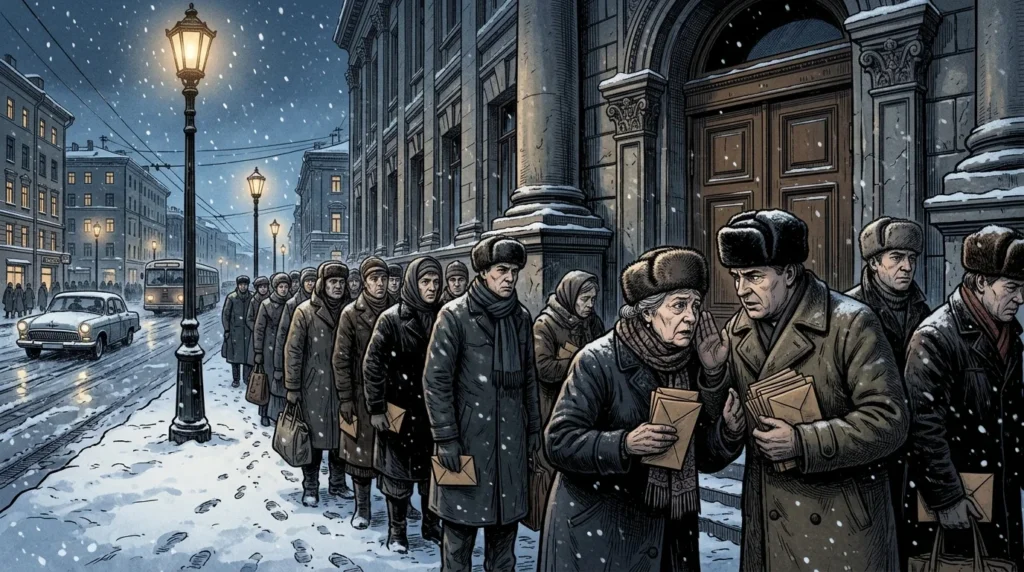
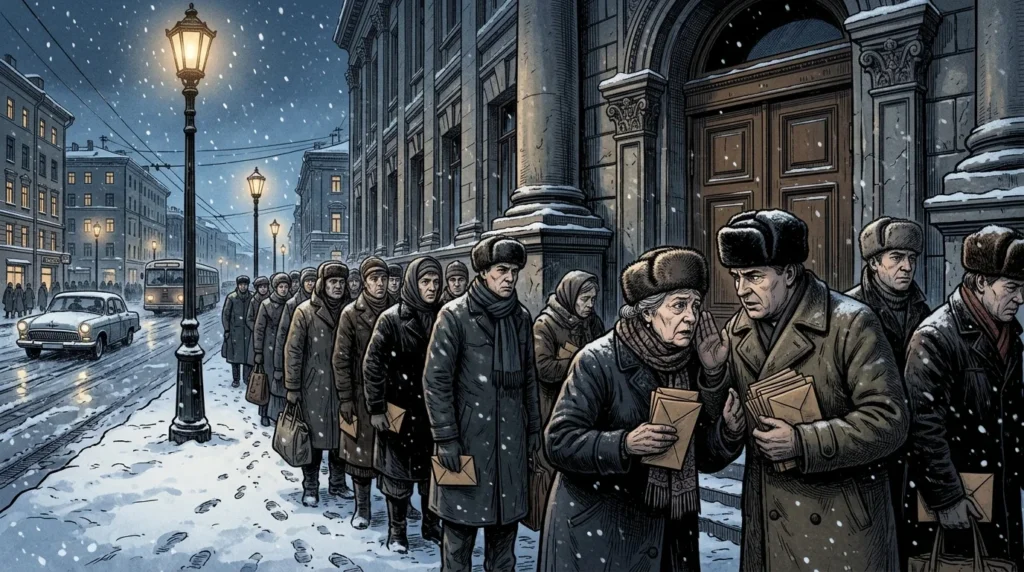
On the evening of December 14, 1947, Soviet state radio broadcast a joint decree of the Council of Ministers of the USSR and the Central Committee of the Communist Party signed by Joseph Stalin and Andrei Zhdanov. Taking effect on December 16, the resolution abolished wartime bread and consumer rationing while ordering a sweeping, confiscatory currency conversion across the Soviet Union. Citizens holding physical banknotes in their homes, collective-farm strongboxes, or informal trading networks were given one week to surrender their cash to the State Bank of the USSR (Gosbank) at a punitive rate of ten old rubles for one new 1947 ruble. By contrast, small depositors who kept up to 3,000 rubles inside the state savings bank network (Sberkassa) saw their balances revalued one-for-one. That single decree established the postwar template of Soviet monetary management: using administrative balance-sheet purges and a tightly partitioned dual-circuit currency system to suppress inflation until the late-1980s perestroika reforms ruptured the wall between enterprise credit and household cash. [1]
The Dual-Circuit Architecture: Nalichnye and Beznalichnye Money
To understand why the Soviet Union experienced chronic shortages rather than open price inflation for more than four decades, it is necessary to examine how Gosbank partitioned the national money supply into two legally non-convertible circuits. Unlike commercial banks in capitalist economies, where corporate deposits and household cash circulate interchangeably, the Soviet monobank enforced a rigid boundary between beznalichnye (non-cash accounting money) and nalichnye (physical cash held by households).
In the non-cash circuit, state industrial ministries, factories, and construction trusts settled inter-enterprise deliveries purely through book-entry transfers on the ledgers of Gosbank. This script money functioned primarily as an administrative auditing device to verify that factories were fulfilling physical output targets under the Five-Year Plan. An enterprise manager who held millions of beznalichnye rubles in a Gosbank settlement account could not freely withdraw those funds as paper banknotes or spend them on unallocated raw materials. Conversions of book money into physical currency were strictly rationed through the central Wage Fund, which authorized Gosbank branches to release paper banknotes only in exact accordance with approved payroll schedules.
Physical currency—nalichnye—belonged to the household circuit. Workers received their wages in paper rubles and kopeck coins and returned that cash to the state treasury by purchasing food, clothing, and consumer services at state retail stores, where prices were fixed by the State Committee on Prices (Goskomtsen). As long as the total wage bill paid out to workers matched the aggregate retail value of consumer goods supplied by state factories and collective farms, cash flowed smoothly back into Gosbank’s vaults. Whenever war spending, heavy-industrial wage bonuses, or agricultural subsidies injected more nalichnye rubles into household pockets than state shops could absorb at fixed official prices, excess cash pooled in the hands of the population—a structural distortion Western economists termed repressed inflation or a “monetary overhang.”
Stalin’s December 1947 Confiscatory Reform
World War II shattered the internal balance of the Soviet cash circuit. Between 1941 and 1945, the Red Army payroll and defense production expanded the volume of currency in circulation roughly fourfold while civilian consumer output collapsed. Although the state kept official ration-store prices frozen near prewar levels, acute scarcity drove urban residents toward collective-farm markets (kolkhoznye rynki) and illicit bazaar networks, where market-clearing food prices soared to ten or fifteen times official ration levels. Millions of paper rubles migrated from urban wage earners to rural peasants and wartime black-market traders (spekulyanty), who hoarded banknotes in jars and mattresses rather than depositing them in state banks where large balances invited police scrutiny. [2]
Stalin’s December 14, 1947 decree was engineered to liquidate this wartime cash overhang at the expense of rural currency hoarders while rewarding urban workers who relied on official wages and state savings accounts. Conducted between December 16 and December 22, 1947 (with a brief extension to December 29 in remote Arctic and Far Eastern districts), the conversion imposed sharply differentiated exchange ratios across asset classes: [3]
- Physical Cash (Nalichnye): All paper banknotes in the hands of citizens, cooperatives, and collective farms were exchanged at 10 old rubles for 1 new 1947 ruble, wiping out 90 percent of nominal cash wealth overnight. Metallic coins (kopecks) were exempted and remained legal tender at face value.
- State Savings Bank Deposits (Sberkassa): Individual passbook accounts up to 3,000 rubles—which encompassed the vast majority of ordinary urban depositors—were converted at a privileged 1-to-1 ratio. For larger balances, the first 3,000 rubles were exchanged at 1:1, the portion between 3,000 and 10,000 rubles at 3 old rubles for 2 new rubles, and all amounts above 10,000 rubles at 2 old rubles for 1 new ruble.
- Collective-Farm and Cooperative Bank Accounts: Clearing and current accounts belonging to collective farms (kolkhozy) and cooperative enterprises at Gosbank were revalued at 5 old rubles for 4 new rubles, preserving 80 percent of their institutional balances.
- State War Bonds: Compulsory mass-subscription war loans issued between 1936 and 1946 were consolidated into a single 1948 conversion bond carrying a 2 percent interest rate at a punitive rate of 3 old bond rubles for 1 new bond ruble, cutting the state’s internal debt burden by two-thirds.
Because wage rates, pensions, and state retail prices were left unchanged in nominal terms—or modestly lowered from wartime commercial store prices—a worker whose fortnightly pay packet was paid out in mid-December 1947 suffered no cut in ongoing income. By contrast, peasant households and informal traders holding tens of thousands of rubles in paper currency lost nine-tenths of their accumulated purchasing power. Within two weeks, Gosbank contracted the physical money supply to a fraction of its wartime peak, allowing the Soviet government to abolish ration cards and restore unified state retail pricing. [4]
The 1950 Gold Peg and Khrushchev’s 1961 Redenomination
Two years after the domestic cash purge, Stalin moved to sever the Soviet currency’s external accounting link to the US dollar, which had been fixed at 5.30 rubles per dollar since 1937. By a decree effective March 1, 1950, the Council of Ministers placed the ruble on an official gold basis defined at 0.222168 grams of fine gold, arbitrarily appreciating the official exchange rate to 4.00 rubles per US dollar. Because the ruble was non-convertible and foreign trade was monopolized by state trading corporations that neutralized price gaps through fiscal equalization taxes, the 4-to-1 rate was wildly overvalued relative to domestic purchasing power. [5]
By the late 1950s, rapid post-Stalin industrial expansion, higher agricultural procurement prices paid to collective farms under Nikita Khrushchev, and rising urban wages had swollen the nominal scale of Soviet transactions. First announced in May 1960 and implemented on January 1, 1961, Khrushchev’s monetary reform executed a 10-for-1 redenomination—officially styled a “change in the scale of prices.” Unlike Stalin’s 1947 surprise confiscation, the 1961 conversion treated domestic cash and bank deposits symmetrically: all 1947-series banknotes, coins, wages, pensions, retail prices, enterprise ledgers, and Sberkassa savings accounts were divided by ten across the first quarter of 1961. [6]
Beneath this seemingly neutral domestic redenomination, however, lay two major structural adjustments. First, while state retail store prices dropped exactly tenfold, collective-farm market prices for fresh produce often rounded upward in new kopecks, provoking quiet resentment among urban consumers and inspiring popular jokes that a kopeck could no longer buy a box of matches. Second, the Soviet government used the January 1, 1961 reform to carry out a disguised 55.6 percent external devaluation of the ruble. Had the 1950 gold parity been scaled up by the full 10-to-1 ratio, the new ruble would have contained 2.22168 grams of gold and traded at 0.40 rubles per US dollar. Instead, Gosbank fixed the theoretical gold content of the 1961 ruble at 0.987412 grams of fine gold—an increase of only 4.444 times—establishing a new official exchange rate of 0.90 rubles (90 kopecks) per US dollar. This 0.987412-gram gold standard also became the benchmark for the “transferable ruble” introduced in 1964 to clear multilateral trade across the Council for Mutual Economic Assistance (COMECON). [7]
Perestroika and the 1987 Law on State Enterprises
For a quarter-century after 1961, Gosbank’s strict Wage Fund controls kept the dual monetary circuits mostly intact, even as household savings in Sberkassa climbed steadily due to the chronic scarcity of automobiles, apartments, and quality consumer goods. The decisive breakdown of Soviet monetary stability arrived under Mikhail Gorbachev’s perestroika reforms between 1986 and 1989.
Early fiscal shocks—including the 1985 anti-alcohol campaign, which wiped out billions of rubles in state vodka turnover taxes, and the 1986 collapse in world oil prices—opened a widening deficit in the Soviet state budget, which Gosbank financed through direct credit creation. The fatal blow to the dual-circuit firewall came with the Law on State Enterprises, enacted in June 1987 and put into full effect in January 1988, alongside the 1988 Law on Cooperatives. Intended to make state factories self-financing and responsive to incentives, the 1987 law dismantled central ministry line-item caps on enterprise wage funds and permitted managers to retain a larger share of profits in discretionary incentive accounts.
Operating under soft budget constraints with no threat of bankruptcy, enterprise directors responded to worker pressure by granting double-digit wage and bonus increases without producing a corresponding rise in consumer goods. Even more damaging, newly legalized cooperatives contracted with state enterprises, accepted payments in non-cash beznalichnye bank transfers, and withdrew those balances as physical nalichnye cash from Gosbank branches. The fifty-year dike separating enterprise ledger money from household cash disintegrated.
The 500-Billion-Ruble Overhang and the Collapse of the Command Economy
Between 1987 and 1990, nominal household money incomes surged by 9 to 15 percent annually while the Soviet fiscal deficit exceeded 9 percent of gross domestic product. Because the Politburo feared the political backlash of raising official state food and retail prices, millions of newly printed rubles poured into stores whose shelves were rapidly stripped bare. By 1990, joint diagnostic studies conducted by the International Monetary Fund, the World Bank, the OECD, and the European Bank for Reconstruction and Development estimated that Soviet households and enterprises had accumulated roughly 500 billion rubles in liquid financial assets—including more than 380 billion rubles in state savings deposits and over 130 billion rubles in physical banknotes—of which roughly half represented an unspendable monetary overhang with no real goods backing it.
As the ruble lost its function as a reliable medium of exchange inside state shops, regions across the USSR reintroduced ration coupons, factory barter, and local residency cards to prevent outsiders from buying up scarce supplies. Desperate to drain excess cash without freeing prices, Prime Minister Valentin Pavlov launched a last confiscatory gambit in January 1991, giving citizens three days to exchange 50- and 100-ruble banknotes under tight withdrawal limits. The Pavlov reform destroyed what remained of public trust in Gosbank while failing to halt runaway money emission. When the Russian Federation finally lifted retail price controls on January 2, 1992, days after the dissolution of the USSR, the pent-up monetary overhang erupted into open hyperinflation of more than 2,500 percent in a single year—wiping out in months the nominal Sberkassa savings accumulated across four postwar decades.
Theoretical & Balance-Sheet Transmission Mechanism
In the Kindleberger–Minsky taxonomy of financial instability (Kindleberger, 1978; Minsky, 1986) and Irving Fisher’s (1933) debt-deflation framework, speculative asset booms become systemic crises when credit expansion shifts balance sheets from hedge finance (cash flows covering principal and interest) to speculative and Ponzi finance (relying on rising asset prices and short-term margin roll-overs).
Once monetary tightening or an exogenous shock halts price appreciation, forced margin liquidations trigger Fisherian debt-deflation: fire-sale asset discounts erode bank collateral values, contracting credit supply across the real economy.
Sources and Further Reading
- Council of Ministers of the USSR and Central Committee of the CPSU, “Currency Reform and the End of Rationing (December 14, 1947),” Seventeen Moments in Soviet History, Michigan State University, 1947-12-14. Peer-Reviewed / Academic Research
- George Garvy, “Money, Financial Flows, and Credit in the Soviet Union,” National Bureau of Economic Research, 1977. Peer-Reviewed / Academic Research
- Gur Ofer, “Macroeconomic Issues of Soviet Reforms,” NBER Macroeconomics Annual 1990, Vol. 5, National Bureau of Economic Research, 1990. Peer-Reviewed / Academic Research
- Stanley Fischer, “Russia and the Soviet Union Then and Now,” The Transition in Eastern Europe, Vol. 1, National Bureau of Economic Research / University of Chicago Press, 1994. Peer-Reviewed / Academic Research
- International Monetary Fund, World Bank, OECD, and EBRD, “A Study of the Soviet Economy, Volume 1: Monetary and Exchange Rate Policy,” International Monetary Fund / OECD, 1991. International Financial Institution
- Irving Fisher — "The Debt-Deflation Theory of Great Depressions," Econometrica 1, no. 4 (FRASER Federal Reserve Archive, 1933): 337–357 Central Bank / Monetary Authority
- Charles P. Kindleberger & Robert Z. Aliber — Manias, Panics, and Crashes: A History of Financial Crises (Palgrave Macmillan) Peer-Reviewed / Academic Research
Cite This Historical Dossier (APA / Chicago)
APA (7th ed.): Ç., S. (Ed.). (2026). Stalin's 1947 Ruble Purge, Khrushchev's 1961 Redenomination, and the Soviet Overhang. In Forgotten Fortunes Historical Monograph Series (Forgotten Fortunes Editorial Desk). https://forgottenfortunes.net/soviet-ruble-reforms-1947-1961/
MLA (9th ed.): Ç., Soner, ed. "Stalin's 1947 Ruble Purge, Khrushchev's 1961 Redenomination, and the Soviet Overhang." Forgotten Fortunes: Financial & Monetary History Archive, 2026, https://forgottenfortunes.net/soviet-ruble-reforms-1947-1961/.
Chicago (17th ed.): Ç., Soner, ed. "Stalin's 1947 Ruble Purge, Khrushchev's 1961 Redenomination, and the Soviet Overhang." Forgotten Fortunes Historical Monograph Series (Forgotten Fortunes Editorial Desk), September 13, 2026. https://forgottenfortunes.net/soviet-ruble-reforms-1947-1961/.
Have an idea for another financial history documentary or article? Request a story →