In This Article
On December 20, 1892, an Italian parliamentarian challenged what appeared to be an ordinary proposal to extend the banking system’s privileges. Instead of discussing routine monetary legislation, he exposed evidence that one of the country’s authorized banks had been issuing money beyond legal limits, concealing enormous losses, and maintaining troubling relationships with powerful politicians. [1]

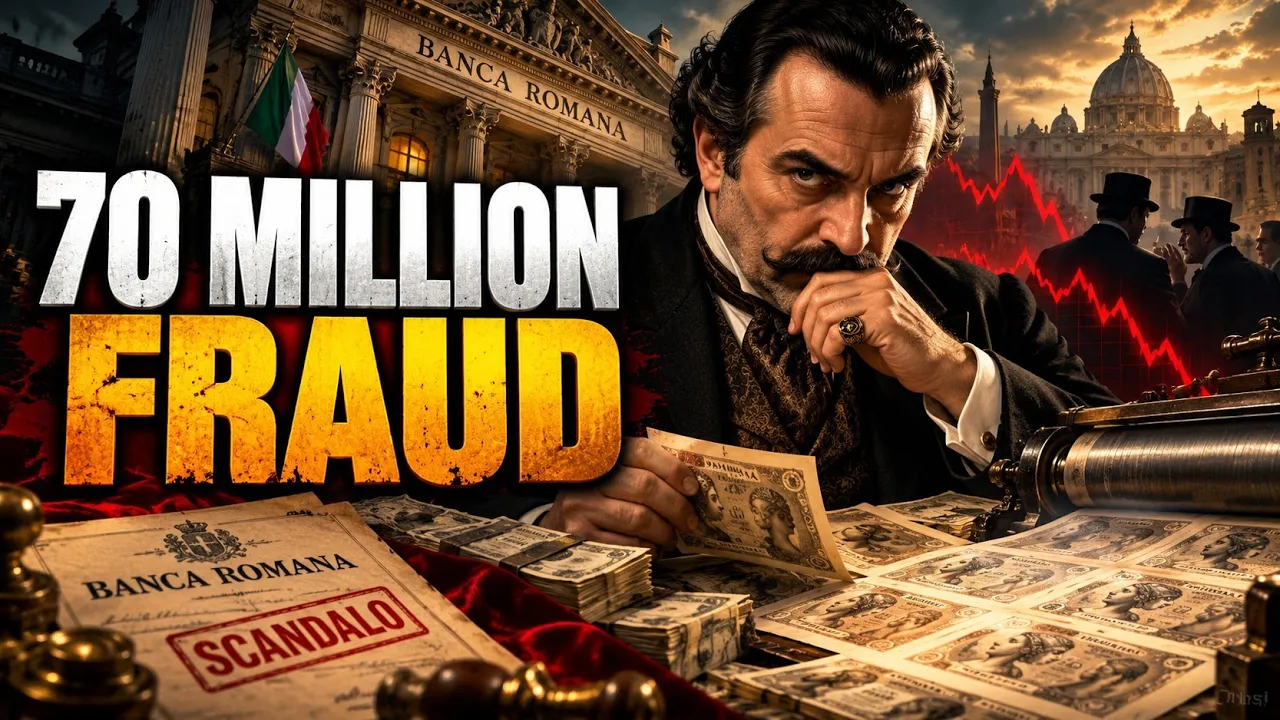
The institution was Banca Romana. Its governor, Bernardo Tanlongo, had presided over a system of questionable loans, manipulated accounts, and unauthorized banknotes. Even more disturbing, government investigators had uncovered serious irregularities three years earlier. Their findings had been withheld from the public.
The Banca Romana scandal became much more than a case of financial misconduct. It revealed how speculative property investment, weak banking supervision, and political influence could threaten a country’s monetary system.
The crisis would help bring down a government, destroy a bank, and accelerate the creation of the Bank of Italy.
Italy Had One Currency but Six Banks Printing It
Italy became a unified kingdom in 1861, but political unification did not immediately produce a unified banking system. [2]
The Italian lira became the national currency in 1862. Yet several institutions inherited from the country’s former states retained the right to issue their own banknotes. [3]
By 1874, legislation formally recognized six authorized issuing banks. These included the Banca Nazionale nel Regno d’Italia, two Tuscan institutions, Banco di Napoli, Banco di Sicilia, and Banca Romana. [4]
Each could issue banknotes under government-defined conditions.
This arrangement reflected the political difficulties of unification. Regional interests resisted transferring monetary power to a single institution, while the government lacked the political support needed for a complete restructuring.
The arrangement also created a significant financial vulnerability.
A banknote was not simply a piece of printed paper. It represented a liability of the institution issuing it. The bank could use its notes to provide credit, but it was supposed to maintain sufficient reserves and observe legal limits on circulation.
Consider a bank that lent a merchant 10,000 lire by issuing banknotes. The merchant could spend those notes, and other people might accept them because they trusted the issuing institution. The bank had effectively supplied purchasing power to the economy. But it had also created a financial obligation. If the bank issued excessive notes while accumulating loans that borrowers could not repay, its apparent prosperity could conceal serious weakness. [5]
Italy’s system depended on government supervision, adequate reserves, and public confidence. Those protections were particularly important because the convertibility of paper notes into metallic money had repeatedly been suspended or weakened.
Banca Romana would demonstrate what happened when these safeguards failed simultaneously.
| Documented Figure / Metric | Historical Significance & Archival Context |
|---|---|
| 137 million lire | A later investigation reported in March 1893 that Banca Romana had issued approximately 137 million lire in notes, exceeding the applicable regulatory limit by about 65 million lire. |
| 28.6 million lire | Its cash shortfall had increased to approximately 28.6 million lire. |
| 41 million lire | The attempted duplication involved approximately 41 million lire in notes. |
| 40 percent | The reform also imposed stricter conditions on banknote issuance, including limits on circulation and reserve requirements covering 40 percent of notes. |
Rome’s Property Boom Created the Conditions for Disaster
The roots of the crisis lay partly in Rome’s transformation into Italy’s capital.
After Rome was incorporated into the kingdom in 1870, the city experienced considerable development. Government offices, public buildings, residential districts, and infrastructure created opportunities for investors and construction businesses. [6]
During the 1880s, foreign investment and expanding credit helped support a broader Italian economic boom. Banks financed developers who expected urban property prices and demand to continue rising. This encouraged a dangerous financial pattern. A construction company could borrow money to purchase land or begin a development. Its ability to repay might depend on selling the finished property at a favorable price.
As long as buyers remained confident, lenders could expect repayment and developers could obtain further financing. But if property demand weakened, projects could remain unfinished, collateral values could fall, and borrowers could struggle to repay. Banca Romana became deeply exposed to this environment. Rather than concentrating on relatively liquid, short-term commercial credit, it increasingly held loans and investments connected to longer-term activities, including property speculation.
These assets could not necessarily be converted into cash quickly.
When the property boom weakened in the late 1880s, the bank faced an uncomfortable reality: many of its borrowers were unable to repay, while the institution still had obligations to people holding its banknotes and deposits.
Other Italian banks suffered from the same broader economic reversal. Banca Romana’s distinctive problem was that its management also concealed the severity of its financial position through serious accounting and monetary irregularities.
How the Banca Romana Scandal Worked
Bernardo Tanlongo had become the dominant figure at Banca Romana. Investigations eventually revealed that important operating decisions were concentrated in his hands, while internal controls were inadequate. The bank’s problems involved several connected mechanisms. First, it issued banknotes beyond the amount legally authorized.
Second, it maintained loans of questionable value, including unsecured advances to influential individuals and financing arrangements that disguised long-term or nonperforming debts. Third, its accounting records did not accurately represent its financial condition. A loan that was repeatedly renewed rather than repaid could remain on the books as an asset even when there was little realistic prospect of collecting the money. Such practices made the balance sheet appear healthier than the underlying business.
The unauthorized banknotes
The 1889 investigation identified approximately 25 million lire in banknotes circulating beyond the permitted limit. [7]
It also discovered a cash shortage of approximately 9 million lire, concealed through illegally produced notes that had not been properly recorded. [8]
These were separate findings, not figures that should automatically be added together.
The problem grew rather than disappeared.
A later investigation reported in March 1893 that Banca Romana had issued approximately 137 million lire in notes, exceeding the applicable regulatory limit by about 65 million lire.
Its cash shortfall had increased to approximately 28.6 million lire.
These figures showed an institution whose liabilities had expanded dramatically while its underlying financial resources had deteriorated.
The attempted duplication of banknotes
The investigation also uncovered a particularly extraordinary episode.
Beginning around 1890, Tanlongo and associates had attempted to produce banknotes using serial numbers associated with an earlier period of the bank’s history.
The attempted duplication involved approximately 41 million lire in notes.
According to historical reconstructions, the notes were printed in London and subsequently signed using unauthorized procedures. However, an important distinction is frequently lost in simplified accounts of the scandal. The attempted duplication was discovered, and the defective notes were destroyed before they could enter circulation. The scandal therefore did not involve 41 million lire of successfully circulated duplicate notes.
Its actual monetary damage came from the wider combination of excessive banknote issuance, concealed shortages, and deteriorating assets.
The attempted forgery nevertheless revealed how far the management was prepared to go to evade established financial controls.
The 1889 Inspection That Authorities Kept Secret
Perhaps the most troubling aspect of the Banca Romana scandal was that the authorities had received substantial warnings long before the crisis became public. In April 1889, the government ordered an investigation into Italy’s six issuing banks. The inquiry was led by Senator Giacomo Giuseppe Alvisi, assisted by Treasury official Gustavo Biagini. Their findings were serious.
The inspectors discovered inadequate verification of cash reserves, weak protection of banknote-printing materials, questionable loans, excessive circulation, and an extraordinary concentration of authority within the bank’s management.
These were not minor bookkeeping mistakes. They raised fundamental questions about whether Banca Romana could meet its obligations and whether public money was being administered lawfully. Yet the findings were not fully disclosed. Tanlongo denied wrongdoing. Historical research also describes how the bank temporarily obtained funds to disguise a cash shortage during a subsequent inspection.
Meanwhile, official Antonio Monzilli produced an alternative, more reassuring assessment. The government did not publish the damaging original report. In 1891, under Prime Minister Antonio di Rudinì, the report was even treated as a state secret, with concern for public confidence offered as a justification. This created a revealing contradiction.
Officials feared that acknowledging the bank’s weaknesses might destabilize the financial system. But concealing those weaknesses allowed them to deepen.
Government leaders were also operating within a political environment in which banks provided credit and financial favors to influential individuals.
The precise motives behind every decision to suppress the investigation remain open to historical interpretation. Protecting financial stability, avoiding political embarrassment, and preserving established relationships may all have played roles.
What is clear is that the public was denied information that government investigators already possessed.
The eventual scandal was not simply a failure to discover the truth. It was also a failure to act upon it.
December 1892: The Scandal Finally Erupts
The secrecy began to unravel late in 1892. After Senator Alvisi’s death, information from his investigation reached members of the political opposition. One of them was Napoleone Colajanni, a radical deputy who opposed the government’s handling of the banking system. On December 20, 1892, Colajanni raised the findings in the Chamber of Deputies during a debate concerning the continuation of issuing banks’ privileges.
His intervention transformed the issue. What might otherwise have remained a technical disagreement over banking legislation became a public confrontation over financial misconduct and government accountability. The government was forced to abandon its proposed long extension of existing arrangements and accept a much shorter temporary measure. A fresh investigation followed.
Led by Senator Gaspare Finali, the inquiry confirmed that Banca Romana’s problems were substantially worse than the earlier warnings had suggested. The authorities moved against the bank’s management. Tanlongo and chief cashier Cesare Lazzaroni were arrested in January 1893. Further investigations implicated other individuals in the banking system. The Finali report, presented in March, established the scale of the excessive note circulation, cash shortages, and questionable assets.
The revelations also created an immediate practical problem.
What would happen to the ordinary people and businesses holding Banca Romana’s notes?
A banknote could circulate through many transactions before reaching its final holder. A worker receiving wages or a merchant accepting payment might have no knowledge of the issuing bank’s condition.
If the notes suddenly lost their accepted value, innocent holders could face serious losses. The government therefore took steps to maintain acceptance of Banca Romana’s notes while the institution’s future was determined. The financial emergency could not be separated from the political scandal.
Political Connections Made the Crisis More Dangerous
Banca Romana was not merely a failing financial institution. It was also part of an extensive network connecting bankers, politicians, administrators, and sections of the press. Investigators uncovered loans and financial accommodations involving people with considerable political influence. Some recipients occupied positions that allowed them to shape banking legislation or supervise the institutions from which they borrowed. This created obvious conflicts of interest.
A politician indebted to a bank might face pressure when considering tighter regulation. A public official responsible for supervision could have a personal reason to avoid exposing questionable practices.
Financial assistance to journalists and politically connected individuals also complicated the public’s ability to receive reliable information. In March 1893, the Chamber established a parliamentary investigative committee chaired by Antonio Mordini. Its report, presented in November, documented troubling relationships between financial institutions and public figures. The affair drew Giovanni Giolitti and Francesco Crispi into a bitter political confrontation.
Giolitti, who became prime minister in 1892, had previously served as Treasury minister during the period when the original investigation was suppressed. Crispi had been prime minister when that investigation was conducted. Both faced questions about their knowledge of the irregularities and their handling of the evidence.
Historical accounts also record financial dealings involving these political figures, although the existence of a loan or financial relationship does not by itself establish every allegation of corruption made during the controversy.
Giolitti had supported Tanlongo’s proposed appointment to the Italian Senate in 1892, an especially damaging political detail once the scandal became public. The appointment was never finalized.
As the parliamentary inquiry exposed further connections, Giolitti’s political position became unsustainable. His government fell in late 1893, and Crispi returned to power. The judicial outcome was more complicated. On July 29, 1894, Tanlongo and the other defendants were acquitted.
The proceedings had been affected by intense political controversy and the disappearance or removal of important documentation.
The acquittals did not erase the irregularities established by the official banking investigations. They demonstrated the distinction between documenting institutional misconduct and proving particular criminal charges in court.
The scandal continued to generate political accusations even after the trial.
The Bank of Italy Emerges from the Crisis
While investigations continued, the Italian government confronted a broader problem. Could the country’s monetary system remain organized around several competing issuing banks, each with its own financial interests and weaknesses? This question had been debated since national unification. The Banca Romana scandal made reform much more urgent.
On August 10, 1893, Italy enacted Law No. 449, establishing the legal foundation for the Banca d’Italia, or Bank of Italy.
The new institution resulted from the merger of three existing banks:
- Banca Nazionale nel Regno d’Italia
- Banca Nazionale Toscana
- Banca Toscana di Credito
Banca Romana was excluded from the merger and placed into liquidation. The new Bank of Italy assumed responsibility for important aspects of the failed institution’s financial settlement. The reform also imposed stricter conditions on banknote issuance, including limits on circulation and reserve requirements covering 40 percent of notes. Government approval became necessary for important decisions concerning management and discount rates.
The objective was to bring the issuance of money more closely under public oversight. However, the reform did not immediately create a single institution with exclusive control over all Italian banknotes. Banco di Napoli and Banco di Sicilia retained their issuing privileges under tighter restrictions.
Only in 1926 did the Bank of Italy become the sole authorized issuer of Italian banknotes.
Nor was the institution immediately a modern central bank in every respect. It began as a privately owned issuing bank whose public responsibilities expanded over subsequent decades.
Who paid for Banca Romana’s failure?
The bank’s disappearance did not make its losses disappear.
Someone had to absorb the gap between its obligations and the value of the assets that could actually be recovered.
Historical economic research suggests that the total losses attributable to Banca Romana were substantial. One retrospective estimate places them in a broad range of approximately 52 million to 82 million lire, depending on assumptions about recoverable assets.
These are reconstructed estimates, not a single precisely established contemporary loss figure. Banca Romana’s shareholders suffered losses, while the new Bank of Italy assumed significant costs connected with liquidation. Government tax concessions and other arrangements helped offset part of the financial burden. That meant some costs were borne indirectly by public finances. Holders of the bank’s notes and other creditors received important protections rather than simply absorbing the full collapse.
The liquidation required years of financial adjustments and asset recovery.
The result exposed a lasting dilemma of banking crises: protecting confidence in money can require spreading losses beyond the shareholders and managers of the failed institution.
What the Banca Romana Scandal Changed—and What It Did Not
The scandal became an important turning point in Italian monetary history, but it did not single-handedly cause every financial difficulty Italy experienced during the 1890s. The country was already suffering from the consequences of excessive credit expansion, declining property values, economic uncertainty, and pressure on its currency. The international financial environment was also unsettled following the Barings crisis of 1890. In late 1893, Italy experienced further capital flight and major commercial bank failures, including those of Credito Mobiliare and Banca Generale.
These developments reflected weaknesses extending beyond Banca Romana. The scandal’s historical importance lies partly in how clearly it exposed those weaknesses. The bank’s management had used privileged access to money creation while accumulating assets that could not reliably support its liabilities. Supervisors had discovered major warning signs but failed to secure timely intervention.
Political relationships weakened accountability. And the eventual rescue required financial compromises because ordinary people depended on the credibility of circulating banknotes. The creation of the Bank of Italy was therefore both a response to an immediate emergency and a step in an institutional reform process that had been discussed for decades. Some contemporary economists questioned whether greater concentration of banknote issuance would provide better discipline than competition among issuing banks.
That debate matters because the central problem was not simply the number of banks allowed to print money.
It was whether those institutions could be monitored effectively, prevented from abusing their privileges, and held accountable when they failed.
The Lasting Lesson of Banca Romana
The Banca Romana scandal revealed how a financial institution could become dangerous when monetary privilege, speculative lending, and political protection operated together. Its collapse was not caused by one forged note or one dishonest loan. It resulted from a broader system in which weak assets were concealed, unauthorized liabilities accumulated, and officials delayed confronting problems they already knew existed. The scandal accelerated Italy’s movement toward a more centralized monetary framework. Yet the new institutional structure took decades to develop into a modern central bank.
Its deeper lesson remains remarkably clear.
A financial system can survive mistakes that are discovered and corrected. It becomes much more vulnerable when the people responsible for oversight have reasons to keep those mistakes hidden.
Banca Romana failed as a bank. The consequences helped reshape the institutions responsible for Italy’s money.
Theoretical & Balance-Sheet Transmission Mechanism
In the Kindleberger–Minsky taxonomy of financial instability (Kindleberger, 1978; Minsky, 1986) and Irving Fisher’s (1933) debt-deflation framework, speculative asset booms become systemic crises when credit expansion shifts balance sheets from hedge finance (cash flows covering principal and interest) to speculative and Ponzi finance (relying on rising asset prices and short-term margin roll-overs).
Once monetary tightening or an exogenous shock halts price appreciation, forced margin liquidations trigger Fisherian debt-deflation: fire-sale asset discounts erode bank collateral values, contracting credit supply across the real economy.
Sources & Further Reading
- 1. Marco Pani — Crisis and Reform: The 1893 Demise of Banca Romana. International Monetary Fund, Working Paper WP/17/274, 2017. Detailed economic-historical analysis of the bank’s lending, unlawful note issuance, political connections, investigations, resolution, and financial costs. — https://www.imf.org/-/media/files/publications/wp/2017/wp17274.pdf International Financial Institution
- 2. Banca d’Italia — Origins. Bank of Italy, institutional history, 2012. Explains Italy’s post-unification monetary system, the six issuing banks, the construction boom, and the circumstances leading to the 1893 reform. — https://www.bancaditalia.it/chi-siamo/storia/origini/index.html?com.dotmarketing.htmlpage.language=1 Historical & Financial Reference
- 3. Banca d’Italia — Banca d’Italia from Its Inception to the 1936 Banking Law. Bank of Italy, institutional history. Explains the 1893 law, reserve and circulation requirements, government oversight, and the development of central banking. — https://www.bancaditalia.it/chi-siamo/storia/istituzione/index.html?com.dotmarketing.htmlpage.language=1 Historical & Financial Reference
- 4. Enrico Galanti, Raffaele D’Ambrosio and Alessandro V. Guccione — Storia della legislazione bancaria, finanziaria e assicurativa dall’Unità d’Italia al 2011. Collana Storica della Banca d’Italia, 2012. Especially relevant for the suppressed 1889 investigation, Tanlongo’s position, the 1893 political crisis, and subsequent legislation. — https://www.bancaditalia.it/pubblicazioni/collana-storica/contributi/contributi-11/CSBI-contributi-11.pdf Historical & Financial Reference
- 5. Guglielmo Negri, editor — Giolitti e la nascita della Banca d’Italia nel 1893. Collana Storica della Banca d’Italia, Documenti, Vol. III, 1989. Historical documents covering banking reform, parliamentary debates, institutional negotiations, and Banca Romana’s liquidation. — https://www.bancaditalia.it/pubblicazioni/collana-storica/documenti/documenti-03/CSBI-documenti-03.pdf Official / State Archive
- 6. Istituto della Enciclopedia Italiana — Banca Romana. Treccani, Enciclopedia on line. Concise institutional history of Banca Romana, its role in Italy’s issuing-bank system, investigations, and liquidation. — https://www.treccani.it/enciclopedia/banca-romana Historical & Financial Reference
- Irving Fisher — "The Debt-Deflation Theory of Great Depressions," Econometrica 1, no. 4 (FRASER Federal Reserve Archive, 1933): 337–357 Central Bank / Monetary Authority
- Charles P. Kindleberger & Robert Z. Aliber — Manias, Panics, and Crashes: A History of Financial Crises (Palgrave Macmillan) Peer-Reviewed / Academic Research
Cite This Historical Dossier (APA / Chicago)
APA (7th ed.): Ç., S. (Ed.). (2026). The Banca Romana Scandal: How a Banking Fraud Reshaped Italy. In Forgotten Fortunes Historical Monograph Series (Forgotten Fortunes Editorial Desk). https://forgottenfortunes.net/banca-romana-scandal-1893/
MLA (9th ed.): Ç., Soner, ed. "The Banca Romana Scandal: How a Banking Fraud Reshaped Italy." Forgotten Fortunes: Financial & Monetary History Archive, 2026, https://forgottenfortunes.net/banca-romana-scandal-1893/.
Chicago (17th ed.): Ç., Soner, ed. "The Banca Romana Scandal: How a Banking Fraud Reshaped Italy." Forgotten Fortunes Historical Monograph Series (Forgotten Fortunes Editorial Desk), August 21, 2026. https://forgottenfortunes.net/banca-romana-scandal-1893/.
Have an idea for another financial history documentary or article? Request a story →