In This Article
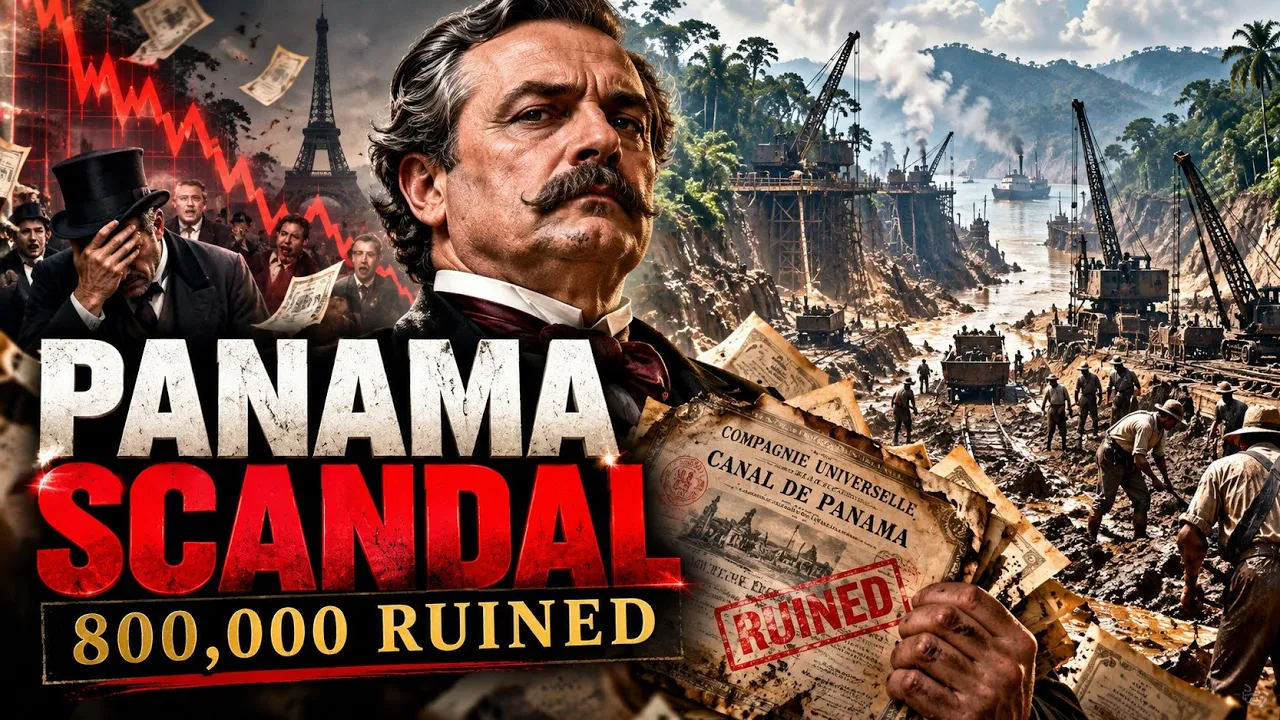
In February 1889, one of Europe’s most celebrated engineering ventures collapsed without completing the canal it had promised to build. The French Panama Canal Company had raised enormous sums from investors who trusted Ferdinand de Lesseps, the man associated with the successful Suez Canal. Instead, they inherited a bankrupt enterprise, an unfinished waterway, and years of financial uncertainty. [1]
The disaster did not end with the bankruptcy. Investigations uncovered payments to politicians and journalists, while the company’s attempts to secure fresh financing became the center of a national corruption scandal.
The Panama Canal Scandal was not simply a story of failed engineering. It showed how prestige, expensive borrowing, misleading publicity, and political influence could sustain an increasingly troubled business long after its original promises had become unrealistic.
Ferdinand de Lesseps and the Dangerous Legacy of Suez
When the Suez Canal opened in 1869, Ferdinand de Lesseps became an international celebrity.
The waterway connected the Mediterranean and Red Seas, transforming maritime trade by allowing ships to avoid the long voyage around southern Africa. Its completion appeared to demonstrate that private capital, engineering expertise, and political determination could reshape global commerce.
De Lesseps wanted another achievement of comparable importance. A canal across the Isthmus of Panama could connect the Atlantic and Pacific Oceans, shortening major shipping routes and creating a potentially lucrative source of toll revenue. The commercial logic was compelling. The engineering assumptions were far more questionable. In 1878, Lucien Napoléon Bonaparte Wyse obtained a concession from Colombia, which then governed Panama. The agreement provided the basis for a French-led canal enterprise. [2]
At an international congress in Paris in 1879, de Lesseps promoted a sea-level canal. Ships would pass between the oceans without navigating a major system of locks. [3]
The proposal borrowed its appeal from Suez. But Panama presented very different physical conditions.
Some experienced engineers supported alternatives involving dams, artificial lakes, and locks. Among them was Godin de Lépinay, who proposed a design that would reduce excavation and help control the Chagres River.
His approach received insufficient support. The congress endorsed a sea-level route, although the technical decision was considerably less unanimous than its public presentation suggested. The Compagnie Universelle du Canal Interocéanique de Panama was established in 1880, and substantial construction activity began in 1881. De Lesseps brought something exceptionally valuable to the enterprise: credibility. [4]
He was not a trained engineer. His greatest contribution was the ability to persuade governments, financiers, and ordinary investors that a seemingly impossible project could succeed.
In Panama, that reputation would become a dangerous substitute for realistic estimates.
| Documented Figure / Metric | Historical Significance & Archival Context |
|---|---|
| 80 million francs | It also estimated annual financial and administrative charges of approximately 80 million francs, excluding construction expenditure. |
| 600 million francs | In June 1888, French legislation permitted the company to undertake a major lottery-bond operation, including a principal issue of up to 600 million francs and provisions for a related reserve fund. |
| 360 francs | The company offered two million lottery bonds at 360 francs each. |
| 220 million francs | One historical accounting places public subscriptions at approximately 220 million francs against the much larger amount the company hoped to secure. |
Why Panama Was Not Another Suez Canal
The difficulty of the French undertaking becomes clearer when the geography is examined. Suez crossed comparatively flat terrain. Panama required excavation through tropical hills, unstable ground, and river systems that could change dramatically during the rainy season. The Culebra Cut, where engineers attempted to excavate through the continental divide, became a particularly serious obstacle. Heavy rainfall weakened exposed slopes. Earth and rock could slide back into previously excavated sections, creating additional work and increasing costs.
Excavation was therefore not simply a matter of removing a fixed quantity of material. Every landslide could enlarge the amount of earth that had to be removed. The Chagres River presented another problem. Its seasonal flooding complicated the proposed route and required extensive engineering measures. Meanwhile, the machinery and transportation systems frequently proved inadequate.
The French enterprise acquired control of the Panama Railroad in 1881, but at considerable expense. The railway was never used as effectively as it might have been for transporting excavated material. [5]
Equipment broke down, contractors changed, and logistical problems slowed construction. Disease compounded the difficulties. Yellow fever and malaria devastated the workforce. The connection between mosquitoes and the transmission of these diseases was not yet understood by the French canal authorities. Some medical precautions even created additional mosquito-breeding sites.
Workers recruited from the Caribbean, particularly Jamaica and other West Indian communities, faced dangerous conditions alongside European engineers and administrators. The commonly cited death toll for the French construction effort is approximately 20,000, although the precise number remains uncertain because mortality records were incomplete. This human cost cannot be reduced to a financial entry. Yet the deaths and repeated illness also weakened the company’s capacity to operate, forced costly recruitment and replacement, and disrupted experienced engineering teams. [6]
Panama was consuming money faster than the original construction model had anticipated.
By the middle of the 1880s, it was increasingly clear that the company’s initial timetable and cost estimates were unreliable.
How the Panama Canal Scandal Was Financed
The French Panama company initially attracted investors through shares. Its original share capital was 300 million francs, divided into 600,000 shares with a nominal value of 500 francs each. But the initial capital was insufficient to complete the project. The company turned repeatedly to the bond market. [7]
A bond is essentially a loan from an investor to an issuer. The investor provides money in exchange for promised interest payments and eventual repayment under specified terms. For a construction project, this creates an important distinction. Shareholders expect returns if the business succeeds. Bondholders create contractual payment obligations even when the underlying project remains unfinished. The Panama company issued successive rounds of bonds during the 1880s, including increasingly attractive repayment terms.
Some securities promised repayment substantially above their original selling price. One 1886 issue, for example, offered bonds at 450 francs that were scheduled to be repaid at 1,000 francs over a long period, while also paying annual interest. For investors, such terms appeared attractive. For the company, they created future financial obligations that exceeded the immediate cash received. [8]
This was not automatically fraudulent. Issuing bonds below their repayment value was a recognized financing technique. The problem was the company’s worsening underlying economics. Its capacity to honor those promises depended on eventually completing a profitable canal. Until ships could use the waterway, the enterprise had no operating canal-toll revenue to cover its growing obligations.
The financial pressure was visible before the final collapse.
In December 1886, an American diplomatic representative circulated a highly pessimistic assessment of the company’s finances. Based on figures assembled from company accounts and other information, the assessment estimated that the enterprise had already raised roughly 915 million francs while assuming much larger repayment commitments. [9]
It also estimated annual financial and administrative charges of approximately 80 million francs, excluding construction expenditure. The figures were a contemporary outside assessment rather than a final audited liquidation account. Nevertheless, they illustrate how serious the financing problem had become. The company’s financial structure increasingly depended on raising new money to sustain an unfinished project and service its existing commitments. That made confidence almost as important as excavation. [10]
The Hidden Cost of Raising More Money
The Panama enterprise’s troubles were not confined to engineering expenditure and interest payments. Raising capital itself had become expensive. Banks and financial intermediaries organized securities issues, connected the company with investors, and received commissions for their services. In ordinary circumstances, underwriting and distribution fees compensate intermediaries for their work and risks.
But the weaker a borrower becomes, the more costly access to capital can be.
Historical financial research cited in the Larousse encyclopedia placed commissions received by banks and intermediaries in the Panama operation at approximately 5.67%, compared with a customary rate of no more than about 2% for comparable services. [11]
Those fees mattered because money collected from investors did not all reach the construction site. A portion was absorbed by issuance expenses, financial intermediaries, existing obligations, and administration. The arrangement created conflicting incentives.
The company needed funds to continue construction. Financial institutions could earn substantial compensation from arranging new issues even when the ultimate success of the canal remained doubtful.
This does not mean that every banker involved committed a crime. It does mean that the interests of the company, its intermediaries, and its investors were not necessarily aligned. The project’s prestige helped attract savings, while its increasingly expensive financial structure weakened the possibility of delivering the promised returns. An engineering problem had become a capital-allocation problem.
And the company was running out of acceptable solutions.
The 1888 Lottery Bonds: Financing by Hope
By 1887, senior engineers had concluded that a high-level canal using locks offered a more workable route than the original sea-level design. De Lesseps reluctantly accepted a change. Work on the revised lock-canal project began in January 1888, with Gustave Eiffel contracted to undertake the lock construction. But changing the engineering design did not restore the company’s finances. [12]
The new approach still required enormous expenditure, while investors were becoming increasingly reluctant to provide additional funds.
Management therefore pursued a different type of security: lottery bonds, known in France as obligations à lots.
These securities combined conventional bond characteristics with the possibility of winning prizes through drawings. For an ordinary saver, the attraction was straightforward. The investment appeared to offer financial payments alongside a chance of receiving an additional reward. For the company, the lottery element provided another way to stimulate demand when conventional borrowing was becoming difficult.
However, issuing these securities required parliamentary authorization.
In June 1888, French legislation permitted the company to undertake a major lottery-bond operation, including a principal issue of up to 600 million francs and provisions for a related reserve fund.
The company offered two million lottery bonds at 360 francs each.
The securities promised annual interest and eventual repayment or prize-based redemption under a complicated long-term structure.
An especially important detail appeared in the contemporary security documentation: the issue carried no guarantee or liability from the French state.
Parliamentary authorization did not mean that taxpayers guaranteed the company’s debts. The distinction was legally significant, even if the parliamentary debate could make the undertaking appear more politically credible. The financing effort nevertheless failed to produce the necessary funds. One historical accounting places public subscriptions at approximately 220 million francs against the much larger amount the company hoped to secure.
A subsequent attempt to obtain funding was similarly unsuccessful. By this point, the problem was no longer simply how to finance the next stage of construction. It was whether the company could survive at all.
Buying Influence and Manufacturing Confidence
The political authorization for lottery bonds became central to the later scandal. The company and its associates had sought influence over politicians and journalists while trying to preserve confidence in the enterprise. Two prominent financial intermediaries, Baron Jacques de Reinach and Cornelius Herz, became closely associated with the payments and influence networks that investigators later examined. The objective was not limited to favorable legislation.
Public opinion also mattered. A company dependent on subscriptions needed potential investors to believe that its prospects remained strong. Favorable newspaper coverage could encourage subscriptions, while evidence of serious difficulties could discourage them.
Research published in the European Review of Economic History in 2024 examined misleading positive news placed in French newspapers during the spring of 1888.
The study found that this publicity increased volatility in the Panama company’s shares, without demonstrating that investors generally accepted the optimistic messages at face value. Its results also suggested that some market participants may have benefited from advance knowledge of forthcoming publicity. That distinction matters. The deception campaign did not necessarily convince the entire market. Skeptical investors and potentially better-informed traders could respond differently to the same information.
The scandal therefore involved more than exaggerated promotional language. It exposed how paid publicity, political access, and unequal information could operate together within a securities market. Investors were being asked to evaluate an engineering venture whose real financial condition was increasingly difficult to separate from the promotional claims surrounding it.
Bankruptcy in 1889: The Financial Disaster Becomes Real
The company’s final funding efforts were insufficient. At the beginning of 1889, shareholders moved toward dissolution. Formal liquidation followed in February. Work in Panama continued briefly in some areas, but by May 1889 construction activity under the original company had ceased. A vast project remained unfinished.
The company’s physical assets included excavations, machinery, railway interests, buildings, engineering studies, and other infrastructure. But these assets could not readily be converted into enough cash to satisfy investors’ financial claims. The scale of investor exposure was extraordinary. Some historical accounts describe approximately 800,000 subscribers or affected savers across the company’s successive financing operations.
Other studies identify roughly 80,000 to 85,000 shareholders or especially heavily affected investors. These figures should not be treated as interchangeable. They reflect different investor categories and methods of counting. Nor should the larger number be interpreted as proof that every investor lost their entire fortune. What is clear is that the failure affected a very large population of French households, including people who had committed substantial personal savings.
The financial consequences were distributed unequally. Investors lost money, creditors faced uncertain recoveries, and workers lost employment. Meanwhile, some intermediaries had already collected fees from earlier fundraising operations. The original company entered a long liquidation process that was not completed until 1894.
For thousands of investors, the dream of owning a small piece of a great international trade route had become a claim against an insolvent business. Yet the bankruptcy itself was only the first great public reckoning. The political consequences would explode several years later.
The 1892–1893 Scandal That Shook the French Republic
Although the company’s failure occurred in 1889, the major political scandal unfolded in 1892 and 1893.
Judicial inquiries had begun earlier, but press investigations and political accusations brought the suspected corruption into public view.
In September 1892, the newspaper La Libre Parole, founded by Édouard Drumont, published revelations concerning the Panama affair.
Other newspapers and political opponents amplified the accusations.
In November, the sudden death of Jacques de Reinach intensified public attention. Parliamentary investigations followed, while allegations spread concerning politicians who had received company-related payments.
The affair exposed genuine misconduct, but it also became a weapon in a deeply polarized political environment. Nationalist and antisemitic newspapers exploited the Jewish origins of some financial intermediaries to promote broader prejudices. The existence of corruption did not justify these attacks, which attempted to assign collective responsibility to Jewish financiers and communities. The scandal helped strengthen anti-parliamentary sentiment and contributed to the atmosphere of antisemitism that would become especially visible during the Dreyfus Affair.
The courts produced a complicated outcome.
Ferdinand de Lesseps and his son Charles received five-year prison sentences in proceedings concerning the management of the failed enterprise. Their convictions were subsequently set aside on legal grounds.
Ferdinand, elderly and in declining health, did not serve the sentence. Gustave Eiffel also faced prosecution and an initial conviction connected with his participation in the undertaking, but that judgment was later overturned. The most clearly established political bribery conviction involved former Public Works Minister Charles Baïhaut. He had accepted 375,000 francs in connection with efforts to secure authorization for lottery bonds.
In 1893, he was sentenced to five years’ detention and substantial financial penalties. Many other politicians who had been publicly accused did not receive comparable criminal convictions. The distinction between suspicion and established wrongdoing is essential. The scandal damaged reputations more broadly than the courts established individual criminal liability. The political consequences extended into the 1893 parliamentary elections.
Several established politicians lost influence or their seats, and public distrust of the political establishment deepened.
The scandal did not single-handedly transform the French Third Republic, but it reinforced existing criticism of political patronage, financial privilege, and parliamentary integrity.
What Happened to the French Canal?
The bankruptcy did not mean that all French engineering work disappeared. A successor company, the Compagnie Nouvelle du Canal de Panama, was organized in 1894. It resumed limited construction and examined more practical canal designs. But investors had lost confidence, and the new company lacked sufficient resources to complete the undertaking independently.
American interest eventually provided another path.
The United States acquired the French company’s canal-related rights and assets in 1904 for 40 million US dollars.
This was a purchase of property and rights, not a full repayment of the original French investors’ losses.
Panama had declared independence from Colombia in November 1903, amid decisive American diplomatic and naval involvement. The subsequent canal arrangements placed extensive powers in American hands, introducing a different political controversy concerning Panamanian sovereignty.
American construction began in 1904 and ultimately adopted a lock-based approach. Better organization, more effective excavation systems, and mosquito-control measures contributed to the project’s success. The Panama Canal officially opened in August 1914. It transformed international shipping and demonstrated that an interoceanic route through Panama was indeed possible.
But the completed waterway was not the sea-level canal originally promised to French shareholders.
The achievement required different engineering choices, renewed financing, and a different political and administrative framework.
Why the Panama Canal Scandal Still Matters
The French Panama failure is often remembered as a story of corruption or an overconfident engineer defeated by tropical geography.
Both elements matter, but neither fully explains the financial disaster.
The original engineering assumptions underestimated a difficult environment. Repeated borrowing converted cost overruns into expanding financial obligations. Intermediaries extracted substantial fees. Political influence and favorable publicity helped keep fundraising alive despite mounting evidence of trouble.
Each problem reinforced the others.
A costly engineering mistake encouraged additional borrowing. Additional borrowing made continued optimism financially necessary. The need for optimism created incentives to influence public information and political decisions.
By the time the enterprise adopted a more workable technical design, its financing had become too fragile to support completion. The episode also illustrates why a project’s eventual usefulness does not prove that its original investment was sound. The Panama Canal became one of the world’s most important transport routes. That did not make the French company’s early financial promises realistic or rescue its shareholders. Its commercial potential was genuine. Its initial execution and financing model were deeply flawed.
The lasting lesson of the Panama Canal Scandal is that an attractive idea, a celebrated leader, and abundant investor enthusiasm cannot substitute for credible budgets, independent scrutiny, and transparent financial information.
The canal eventually succeeded.
The company that first promised to build it did not.
Theoretical & Balance-Sheet Transmission Mechanism
In the Kindleberger–Minsky taxonomy of financial instability (Kindleberger, 1978; Minsky, 1986) and Irving Fisher’s (1933) debt-deflation framework, speculative asset booms become systemic crises when credit expansion shifts balance sheets from hedge finance (cash flows covering principal and interest) to speculative and Ponzi finance (relying on rising asset prices and short-term margin roll-overs).
Once monetary tightening or an exogenous shock halts price appreciation, forced margin liquidations trigger Fisherian debt-deflation: fire-sale asset discounts erode bank collateral values, contracting credit supply across the real economy.
Sources & Further Reading
- Panama Canal Authority. “The French Canal Construction.” Official historical account of the French engineering effort, financing difficulties, disease, bankruptcy, and successor company. Panama Canal Authority, undated. https://pancanal.com/en/the-french-canal-construction/ Historical & Financial Reference
- Library of Congress. Canal de Panama, actes de concession. Historical concession documents and accompanying institutional description of the French canal enterprise. Library of Congress, historical collection. https://www.loc.gov/item/ltf91029421/ Official / State Archive
- United States Department of State. “Mr. Hall to Mr. Bayard,” December 7, 1886. Papers Relating to the Foreign Relations of the United States, 1887, No. 68. Contemporary diplomatic assessment of the Panama company’s financial condition. https://history.state.gov/historicaldocuments/frus1887/d68 Official / State Archive
- Data for Financial History (DFIH). “Compagnie Universelle du Canal Interocéanique de Panama.” Historical Paris Stock Exchange yearbook documentation covering the company’s securities and lottery-bond terms. DFIH historical financial database. https://dfih.fr/issuers/2563/yearbook-ocr?source=annuaire_cac_1888 Historical & Financial Reference
- Ortiz-Serrano, Miguel Ángel, and Germán Forero-Laverde. “Can Managers Successfully Deceive Investors? Media Attention and Market Manipulation During the Panama Scandal.” European Review of Economic History, volume 28, issue 4, 2024, pp. 589–619. Oxford University Press. https://doi.org/10.1093/ereh/heae009 Peer-Reviewed / Academic Research
- Larousse. “Panamá (les scandales de).” Grande Encyclopédie Larousse, 1971–1976. Historical analysis of the financial, banking, and political dimensions of the affair. https://www.larousse.fr/archives/grande-encyclopedie/page/10165 Historical & Financial Reference
- Assemblée nationale, France. “Charles Baïhaut.” Historical parliamentary biography, including details of his role in the Panama affair, prosecution, and conviction. French National Assembly parliamentary archives. https://www2.assemblee-nationale.fr/sycomore/fiche?num_dept=337 Official / State Archive
- Ebersold, Julien. “Panama : l’escroquerie qui a fait trembler la République.” RetroNews, Bibliothèque nationale de France, published November 22, 2024, updated June 4, 2025. Historical press analysis of the Panama scandal and its political consequences. https://www.retronews.fr/justice/long-format/2018/04/17/le-scandale-de-panama-1889-1893 Historical & Financial Reference
- United States Department of State, Office of the Historian. “Building the Panama Canal, 1903–1914.” Milestones in the History of U.S. Foreign Relations. Institutional overview of the canal’s later political and construction history. https://history.state.gov/milestones/1899-1913/panama-canal Official / State Archive
- United States Department of State. “Mr. Vignaud to Mr. Hay,” May 2, 1904. Papers Relating to the Foreign Relations of the United States, 1904. Primary diplomatic documentation concerning the 40-million-dollar purchase of the French canal company’s property. https://history.state.gov/historicaldocuments/frus1904/d266 Official / State Archive
- Irving Fisher — "The Debt-Deflation Theory of Great Depressions," Econometrica 1, no. 4 (FRASER Federal Reserve Archive, 1933): 337–357 Central Bank / Monetary Authority
- Charles P. Kindleberger & Robert Z. Aliber — Manias, Panics, and Crashes: A History of Financial Crises (Palgrave Macmillan) Peer-Reviewed / Academic Research
Cite This Historical Dossier (APA / Chicago)
APA (7th ed.): Ç., S. (Ed.). (2026). The Panama Canal Scandal: The Failed Dream That Shook France. In Forgotten Fortunes Historical Monograph Series (Forgotten Fortunes Editorial Desk). https://forgottenfortunes.net/panama-canal-scandal/
MLA (9th ed.): Ç., Soner, ed. "The Panama Canal Scandal: The Failed Dream That Shook France." Forgotten Fortunes: Financial & Monetary History Archive, 2026, https://forgottenfortunes.net/panama-canal-scandal/.
Chicago (17th ed.): Ç., Soner, ed. "The Panama Canal Scandal: The Failed Dream That Shook France." Forgotten Fortunes Historical Monograph Series (Forgotten Fortunes Editorial Desk), August 21, 2026. https://forgottenfortunes.net/panama-canal-scandal/.
Have an idea for another financial history documentary or article? Request a story →