In This Article
In November 1872, some of America’s wealthiest investors discovered that a diamond mine they believed was worth millions of dollars contained no natural diamond deposit at all.
The precious stones were real. The mine was a fraud.
Two prospectors from Kentucky, Philip Arnold and John Slack, had convinced powerful California financiers that they had discovered an extraordinary field of diamonds, rubies, and sapphires in the American West.
The investors had paid substantial sums to secure their interests. The famous jeweler Charles Lewis Tiffany had examined samples, while respected mining engineer Henry Janin had inspected the supposed discovery and declared it valuable.
A company was preparing to offer 100,000 shares at $100 each. Then geologist Clarence King investigated the property. His findings destroyed the venture before its planned public stock sale could proceed.
The Great Diamond Hoax of 1872 became one of the most remarkable investment frauds of nineteenth-century America, demonstrating how genuine assets, respected experts, and wealthy investors could combine to create confidence in something that did not exist.
A Country Searching for Its Next Fortune
In the decades following the California Gold Rush of 1848, Americans became accustomed to stories of extraordinary mineral discoveries. Gold had transformed California. Silver deposits in Nevada’s Comstock Lode had created enormous fortunes. Railroad construction made previously remote areas of the American West increasingly accessible to prospectors and investors.
By 1870, San Francisco had grown into a major financial center with approximately 150,000 residents. Bankers and wealthy merchants were constantly searching for the next profitable mining opportunity. Meanwhile, the discovery of rich diamond deposits in South Africa had captured international attention. If diamonds could be found in such extraordinary quantities there, why not somewhere in the American West?
The idea was tempting. A successful diamond discovery could create enormous profits for whoever controlled the property before the wider investment community learned about it. This environment provided the perfect opportunity for Philip Arnold and John Slack. They did not need to convince investors that diamonds existed.
They needed to convince them that they knew where an undiscovered supply could be found. [1][2]
| Documented Figure / Metric | Historical Significance & Archival Context |
|---|---|
| $10 million | That represented a potential offering value of $10 million. |
| $2,500 | His fee was approximately $2,500, along with an opportunity to purchase shares in the proposed company. |
| $10 | According to a later reconstruction published by Smithsonian, Janin purchased 1,000 shares at $10 each and subsequently sold them at $40, earning approximately $30,000 before his fee. |
| $550,000 | Smithsonian's reconstruction places Arnold's receipts at approximately $550,000 before expenses, including a $300,000 stock transaction involving Harpending. |
The Two Prospectors With a Bag of Diamonds
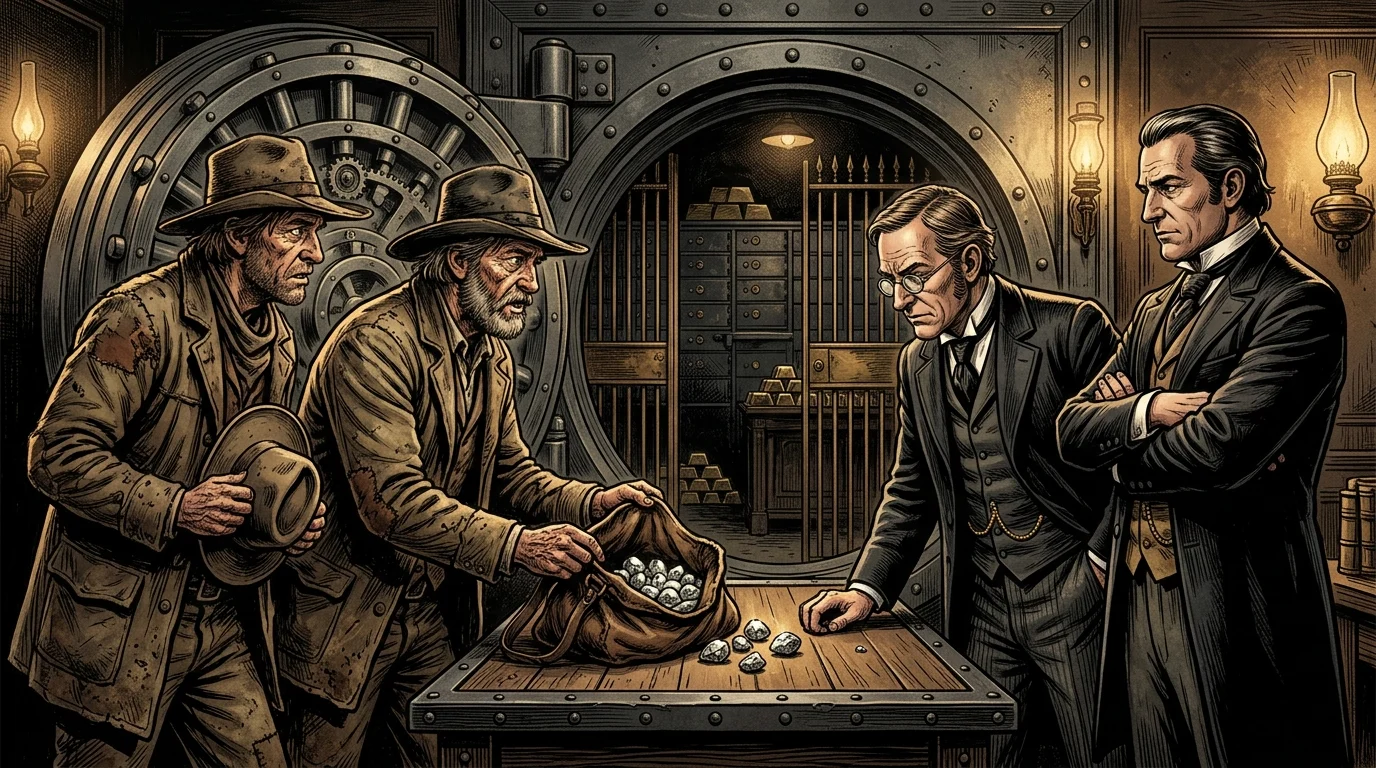
Philip Arnold was an experienced prospector from Kentucky who had spent years working in western mining districts. In 1870, he was employed by a San Francisco manufacturer of diamond-tipped drilling equipment. That work gave him access to industrial diamonds and familiarity with the appearance of uncut stones. His accomplice, John Slack, was an older relative and fellow veteran of the Mexican-American War.
In late 1870, the two approached San Francisco businessman George D. Roberts. They carried a leather bag containing rough diamonds and other gemstones. The men appeared reluctant to discuss their discovery. Eventually, they suggested that they had found the stones somewhere in the American West.
But they refused to reveal the location. This secrecy was central to their strategy. Roberts was asked to keep the supposed discovery confidential. Instead, he shared the information with prominent associates, including William C. Ralston, founder of the Bank of California.
Ralston had already made substantial investments in mining and infrastructure. He understood the enormous financial opportunities that could arise from controlling a valuable mineral deposit. Another interested financier was Asbury Harpending, a businessman with experience in western mining ventures. Soon, a small circle of wealthy investors believed that Arnold and Slack possessed knowledge of a potentially spectacular diamond field.
The prospectors had created the first essential ingredient of their fraud: a convincing story supported by genuine precious stones. [1][4]
The Secret Purchase of Diamonds in London
The supposed diamond discovery had a fundamental problem. Arnold and Slack did not possess a productive diamond mine. To persuade investors otherwise, they needed to manufacture evidence. In July 1871, the two traveled to London using assumed names.
There, they purchased approximately $20,000 worth of rough diamonds and rubies from gemstone dealer Leopold Keller.
The purchase included thousands of stones. These were genuine gems, but many were relatively low-grade specimens. The distinction was crucial. A cheap diamond is still a diamond.
A jeweler examining an individual stone might correctly identify it as genuine without establishing that it came from the location claimed by its owner. Arnold and Slack intended to exploit that difference. Some of their purchased stones would be presented to investors as samples from an extraordinarily rich deposit. Others would be scattered across a remote piece of land.
This practice was known as salting.
Mining fraudsters could make worthless property appear valuable by introducing minerals that were not naturally present. Gold prospectors sometimes placed gold dust or nuggets in a mine to deceive potential buyers. Arnold and Slack used real diamonds and other gemstones. The purchased stones were not the ultimate source of the expected profits.
They were props designed to persuade investors that an entire field of valuable minerals existed beneath the ground. [1][2]
How the Fake Diamond Field Worked
The scheme operated through a simple but powerful deception. First, Arnold and Slack obtained inexpensive gemstones. Next, they deposited selected stones on a remote tract of land near the Colorado-Wyoming border. They then brought potential investors to the location, presenting the planted gemstones as natural discoveries.
The visitors could dig into the soil and find real precious stones. That physical experience was far more convincing than an unsupported claim. Imagine a businessman arriving at a supposedly undiscovered mining property. He begins digging.
Within minutes, he finds a diamond. Another person discovers a ruby. More stones appear nearby. Every discovery seems to confirm that the ground contains extraordinary wealth.
But the visitors are unknowingly collecting stones that have already been placed there. The fraud is especially effective because the evidence appears tangible. The diamonds are not counterfeit. The financial deception lies in their supposed geological origin.
Arnold and Slack also carefully protected the location of the property. They described the mine as a secret and later led visitors on an unnecessarily complicated journey across difficult terrain. This prevented investors from independently identifying and inspecting the property before the fraudsters had prepared it. The secrecy also strengthened the impression that the discovery was too valuable to reveal publicly.
What should have been a warning sign became part of the attraction.
Tiffany’s Appraisal Gives the Venture Credibility
By the second half of 1871, the investors wanted stronger evidence before committing additional money. They decided to have part of the gemstone collection examined by Charles Lewis Tiffany, founder of Tiffany & Co. Approximately one-tenth of a large batch of stones was taken to New York. In October 1871, investors and prominent guests gathered at the home of attorney Samuel Barlow.
Among those associated with the gathering were Civil War generals George B. McClellan and Benjamin Butler, along with newspaper editor Horace Greeley.
Tiffany inspected the gemstones.
He confirmed that they were genuine precious stones and subsequently reported an estimated value of approximately $150,000 for the examined sample.
The investors interpreted this result as evidence of an enormous opportunity. If a small fraction of the collection was worth that much, the complete supply might be worth millions. But the appraisal contained a critical weakness. Tiffany and his associates were not specialists in valuing rough, uncut diamonds.
Later examinations suggested that the sample had been substantially overvalued. More importantly, even a perfectly accurate gemstone appraisal could not establish the existence of a productive mine. The investors had confused two different questions.
Were the stones genuine?
Yes.
Had they naturally come from the property Arnold and Slack claimed to have discovered?
That had not been established. The distinction allowed the fraud to advance. The famous Tiffany name gave the venture an appearance of credibility that far exceeded the actual evidence. [1][3]
The Investors Begin Building a Mining Company
As confidence increased, the financiers developed plans for a formal mining company. The venture became associated with the San Francisco and New York Mining and Commercial Company. Its backers included prominent investors such as Ralston, Harpending, William Lent, and George S. Dodge. The company would acquire interests in the supposed diamond field and eventually sell shares to investors.
A proposed public offering involved 100,000 shares priced at $100 each.
That represented a potential offering value of $10 million. But this was a planned share sale, not $10 million already received. The distinction matters because the fraud was exposed before the proposed public offering could proceed. The organizers nevertheless committed substantial money to the venture before discovering the truth.
Arnold and Slack received payments in exchange for transferring interests in the supposed mining property. The payments were justified by the expectation that the company would eventually own an asset far more valuable than the purchase price. The basic investment calculation appeared attractive. If the property contained millions of dollars in diamonds, paying several hundred thousand dollars to secure it might seem like a bargain.
But the valuation depended entirely on the existence of a genuine mineral deposit. Without one, the property rights were effectively worthless. The investors had begun converting an unverified discovery into a financial asset that could be sold to others. Before proceeding further, however, they decided to obtain an independent mining assessment.
That decision brought Henry Janin into the story.
June 1872: The Mining Engineer Who Was Fooled
Henry Janin was a respected mining engineer with extensive experience evaluating mineral properties. The investors hired him to inspect the alleged diamond field. His fee was approximately $2,500, along with an opportunity to purchase shares in the proposed company. The arrangement gave him a financial interest in the project’s success, although it does not by itself prove that he knowingly participated in the fraud.
In June 1872, Janin joined Arnold, Slack, Harpending, Dodge, and Alfred Rubery on an expedition toward the site. The party traveled by train to Rawlins in Wyoming Territory. From there, the prospectors led them on a confusing horseback journey. Although the destination was far closer than their wandering route suggested, the group spent several days crossing difficult country.
On June 4, 1872, they finally reached the supposed diamond field.
The site was a rocky mesa near what is now known as Diamond Peak, in northwestern Colorado close to the Wyoming border. The visitors began searching. Diamonds and other precious stones appeared almost immediately. For the investors, the discoveries seemed extraordinary.
They were collecting gems with their own hands. Janin was impressed. After examining the property, he concluded that it represented a valuable mineral discovery. His favorable report gave the venture another powerful endorsement.
The investors now had both a famous jeweler’s appraisal and a respected mining engineer’s assessment. But Janin had examined land that Arnold and Slack had already salted. His report confirmed the presence of gemstones without establishing that they had formed naturally in the ground. The financial consequences were substantial.
According to a later reconstruction published by Smithsonian, Janin purchased 1,000 shares at $10 each and subsequently sold them at $40, earning approximately $30,000 before his fee. The report also helped strengthen confidence in the company’s prospects. [1][2] The most important evidence in the entire investment decision remained unverified.
How Much Money Did the Swindlers Collect?
The fraud involved several different forms of payment. Arnold and Slack received advances, payments for property interests, and proceeds associated with transfers of shares. Historical accounts do not always present these transactions in exactly the same way.
Smithsonian’s reconstruction places Arnold’s receipts at approximately $550,000 before expenses, including a $300,000 stock transaction involving Harpending.
Other historical accounts report somewhat different totals for the proceeds received by the two men together. [1][4] The safest conclusion is that the fraudsters obtained several hundred thousand dollars through the scheme. That was an extraordinary sum in the early 1870s. The money was received in exchange for something that did not exist: a naturally productive diamond deposit.
Their initial expenditures on purchased gemstones were far smaller than the payments they persuaded investors to make. This difference formed the financial heart of the deception. The gemstones were not valuable enough to justify the investment. But the expectation of future diamond production made investors willing to pay far more than the stones themselves were worth.
In effect, Arnold and Slack sold the promise of an enormous future revenue stream without possessing the asset that could generate it. By the summer of 1872, they had obtained substantial payments. The next independent investigation would expose the fraud.
Clarence King Begins Asking Questions
Clarence King was a respected American geologist responsible for the federal Geological Exploration of the Fortieth Parallel. His survey had examined large areas of the American West. In October 1872, members of his team encountered Henry Janin and learned more about the alleged diamond discovery. The information attracted their attention because the reported location appeared to fall within territory their geological survey had already examined.
A major diamond field discovered in that area would raise serious questions about why the government survey had overlooked it. King and his colleagues therefore decided to investigate. This was not simply an official inspection specially ordered by the Department of the Interior to examine Arnold and Slack’s property. King’s team initiated the investigation after learning that the supposed discovery lay within or near their survey area. [1][2]
The geologists assembled an expedition and traveled toward the reported site. Using geographical descriptions and information from earlier visitors, they identified the probable location. They eventually reached the mesa in early November 1872. At first, even King’s party found gemstones.
The sight was surprising. But unlike the earlier investors, the geologists did not stop at confirming that the stones were genuine. They examined how the stones were distributed through the ground. What they discovered soon changed everything.
The Geological Evidence That Exposed the Fraud
King and his colleagues noticed several suspicious details. Diamonds and rubies appeared together in unusual concentrations. The distribution did not fit the geological processes that would normally explain such deposits. Gemstones also appeared disproportionately in disturbed areas near the surface.
Some were found around anthills showing evidence of interference. Undisturbed areas did not produce comparable discoveries. These observations suggested that someone had deliberately placed stones in selected locations. The geologists then tested the ground more carefully.
They examined the distribution of gemstones and searched beneath the surface where genuine mineral deposits should have left further evidence. In one test, the team excavated a trench approximately ten feet deep. They found no continuation of the supposed diamond deposit. The results were decisive.
There was no convincing geological evidence that the property contained a natural diamond field. The precious stones had been introduced artificially. Arnold and Slack had created the appearance of mineral wealth by scattering purchased gemstones across the landscape. The field had been salted.
King’s investigation revealed the weakness in the earlier appraisals. Tiffany had examined the gemstones. Janin had examined a site containing those gemstones. But neither had adequately established the geological relationship between the stones and the surrounding land.
King’s team investigated that relationship.
November 1872: The $10 Million Dream Collapses
King hurried back to San Francisco to warn the investors. He met Henry Janin and explained the evidence. The next morning, King presented his findings to company directors at William Ralston’s office in the Bank of California. The revelation shocked the financiers.
Their supposed diamond mine had no meaningful mining value. The diamonds were real, but the investment proposition was false. King’s findings stopped the planned public offering of 100,000 shares at $100 each. The directors initially sought further confirmation.
A second expedition visited the site with representatives of the company. It supported King’s conclusion that the gemstones had been deliberately planted. On November 25, 1872, the directors received the additional findings and moved to dissolve the venture. The following day, San Francisco newspapers publicized the deception.
The scandal became national news. [1] Investors who had believed themselves on the verge of extraordinary profits now faced losses and public embarrassment. The collapse also demonstrated how close the company had come to spreading its losses to a much wider investing public. Had the planned stock offering proceeded before the fraud was exposed, additional investors might have purchased shares in a company whose principal asset was worthless.
Instead, the scandal destroyed the venture before that offering could be completed.
Who Lost Money—and What Happened to Arnold and Slack?
The financial aftermath was complicated. Some backers had already paid substantial sums for interests in the supposed mine. According to reports discussed by Smithsonian, William Lent claimed losses of approximately $350,000, while William Ralston was widely reported to have lost around $250,000. These figures reflect reported or claimed losses and should not be treated as a complete audited statement of every investor’s final financial position. [1]
Ralston subsequently worked to compensate some people affected by the venture. Arnold had already returned to Kentucky. Investigations followed, and legal efforts were made to recover money. Arnold eventually reached an out-of-court settlement with Lent involving approximately $150,000.
He was not ultimately subjected to a successful criminal prosecution for the diamond fraud. Arnold later became involved in banking in Elizabethtown, Kentucky. In 1878, he was wounded during a dispute involving another banker. He recovered from the immediate injury but later developed pneumonia and died in 1879.
Slack largely disappeared from public attention after the scandal. Later historical research placed him in New Mexico, where he reportedly worked as an undertaker and died in 1896. [1][3] Asbury Harpending spent years defending his reputation. In his later memoir, he portrayed himself as an investor deceived by the prospectors rather than a participant in the fraud.
His account provides valuable details about the events, but it is also a personal defense written decades afterward. It should therefore be read alongside independent accounts rather than accepted as a neutral record of every disputed action. [5] The precise distribution of all the money obtained through the fraud remains difficult to reconstruct. But the central financial result is beyond doubt.
Substantial sums changed hands for supposed mining rights that could not generate the promised returns.
Why So Many Experienced Investors Believed the Story
The Great Diamond Hoax worked because the fraudsters combined several convincing elements. They possessed genuine gemstones. They controlled information about the location of the supposed mine. They exploited the excitement surrounding earlier mining fortunes.
And they allowed prominent financiers and respected experts to reinforce one another’s confidence. Each stage made the next stage easier. The initial gemstone samples attracted attention. The involvement of wealthy bankers increased the venture’s apparent credibility.
Tiffany’s appraisal made the gemstones seem extraordinarily valuable. Janin’s favorable inspection appeared to confirm that the value extended to the land itself. Together, these endorsements created the impression of a carefully investigated investment. Yet the central claim had still not been independently established.
The company had never demonstrated that the stones were naturally present in a commercially productive deposit. There was also a powerful financial incentive for the investors to believe the story. If the discovery were genuine, those who controlled the property early could become extraordinarily wealthy. The possibility of securing that advantage encouraged speed, secrecy, and confidence.
This is a recurring feature of financial fraud. An apparent opportunity offers such exceptional returns that investors begin treating warning signs as reasons to act more quickly. The unusually secretive location seems like protection against competitors. The extraordinary richness of the samples seems like proof of a once-in-a-lifetime discovery.
And the participation of famous people seems to substitute for independent verification.
The Financial Lesson of the Great Diamond Hoax
The Great Diamond Hoax was not simply a story about two prospectors deceiving wealthy businessmen. It was a demonstration of how financial value can be created around an unverified claim. The gemstones had some genuine value. But the investors were not primarily purchasing those individual stones.
They were purchasing rights to an alleged deposit expected to produce wealth for years. The fraudsters convinced them to value the property according to hypothetical future production rather than proven mineral reserves. That distinction made the deception so profitable. The company was preparing to sell shares based on the belief that it controlled an extraordinarily valuable natural resource.
But the asset supporting that valuation did not exist. Clarence King’s investigation prevented the fraudulent claim from becoming the foundation of a much larger public investment. His work also revealed why independent verification matters. A prestigious name does not guarantee that an assessment answers the correct question.
Tiffany could identify real gemstones without proving their origin. Janin could find stones on the property without proving that they formed naturally there. Only a geological investigation that challenged the underlying assumptions established the truth. The enduring lesson extends beyond mining.
Whether investors are evaluating mineral deposits, businesses, financial statements, or new technologies, the same principle applies.
An investment is only as sound as the evidence supporting the asset from which its promised returns are supposed to come.
In 1872, America’s most sophisticated financiers learned that lesson from a diamond mine that never existed.
Theoretical & Balance-Sheet Transmission Mechanism
In the Kindleberger–Minsky taxonomy of financial instability (Kindleberger, 1978; Minsky, 1986) and Irving Fisher’s (1933) debt-deflation framework, speculative asset booms become systemic crises when credit expansion shifts balance sheets from hedge finance (cash flows covering principal and interest) to speculative and Ponzi finance (relying on rising asset prices and short-term margin roll-overs).
Once monetary tightening or an exogenous shock halts price appreciation, forced margin liquidations trigger Fisherian debt-deflation: fire-sale asset discounts erode bank collateral values, contracting credit supply across the real economy.
Sources and Further Reading
- [1] Robert Wilson, The Great Diamond Hoax of 1872. Smithsonian Magazine, June 2004. Detailed reconstruction of the fraud, financial transactions, Clarence King’s investigation, and subsequent proceedings. — https://www.smithsonianmag.com/history/the-great-diamond-hoax-of-1872-2630188 Historical & Financial Reference
- [2] Dick Blust Jr., The Diamond Hoax: A Bonanza That Never Was. WyoHistory.org, March 9, 2020. Regional historical research covering the fake diamond field, the inspection party, and its geological exposure. — https://www.wyohistory.org/encyclopedia/diamond-hoax-bonanza-never-was Historical & Financial Reference
- [3] Chris Root, Yesterday’s News Vol. III: The Great Diamond Swindle. Denver Public Library Special Collections and Archives, July 23, 2019. — https://history.denverlibrary.org/news/yesterdays-news-vol-iii-great-diamond-swindle-and-much-lesser-diamond-swindle Historical & Financial Reference
- [4] John Koster, The Great Diamond Hoax of 1872. HistoryNet, June 14, 2017. Historical account of the investor syndicate, diamond appraisals, and venture financing. Historical & Financial Reference
- Irving Fisher — "The Debt-Deflation Theory of Great Depressions," Econometrica 1, no. 4 (FRASER Federal Reserve Archive, 1933): 337–357 Central Bank / Monetary Authority
- Charles P. Kindleberger & Robert Z. Aliber — Manias, Panics, and Crashes: A History of Financial Crises (Palgrave Macmillan) Peer-Reviewed / Academic Research
[5] Asbury Harpending, The Great Diamond Hoax and Other Stirring Incidents in the Life of Asbury Harpending. Historical first-person memoir, available through Project Gutenberg. Used with caution because Harpending was personally involved in the venture and defended his conduct.
https://www.gutenberg.org/files/48834/48834-h/48834-h.htm
Cite This Historical Dossier (APA / Chicago)
APA (7th ed.): Ç., S. (Ed.). (2026). The Great Diamond Hoax and the California Investors. In Forgotten Fortunes Historical Monograph Series (Forgotten Fortunes Editorial Desk). https://forgottenfortunes.net/great-diamond-hoax-california-investors/
MLA (9th ed.): Ç., Soner, ed. "The Great Diamond Hoax and the California Investors." Forgotten Fortunes: Financial & Monetary History Archive, 2026, https://forgottenfortunes.net/great-diamond-hoax-california-investors/.
Chicago (17th ed.): Ç., Soner, ed. "The Great Diamond Hoax and the California Investors." Forgotten Fortunes Historical Monograph Series (Forgotten Fortunes Editorial Desk), August 26, 2026. https://forgottenfortunes.net/great-diamond-hoax-california-investors/.
Have an idea for another financial history documentary or article? Request a story →