In This Article
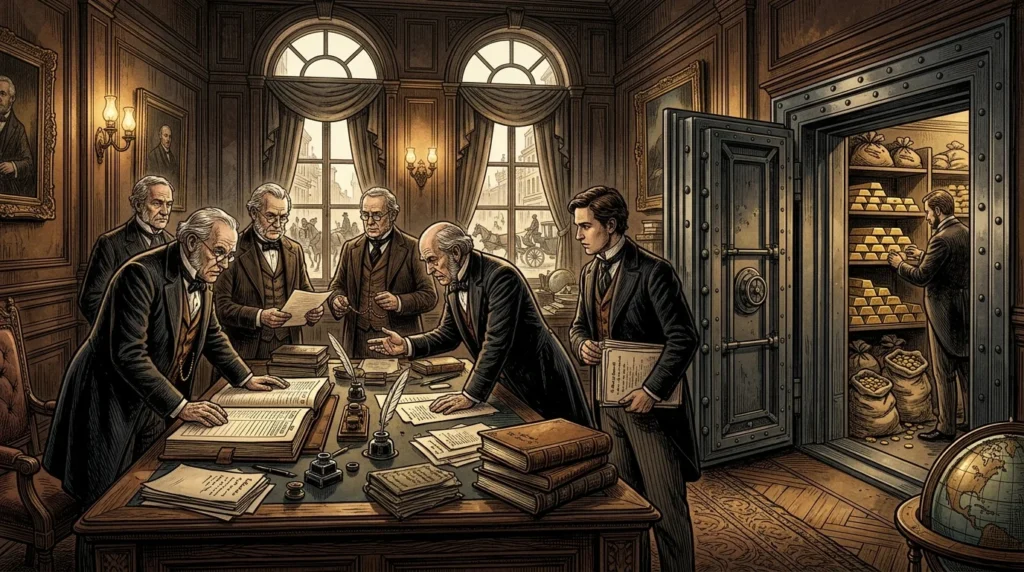
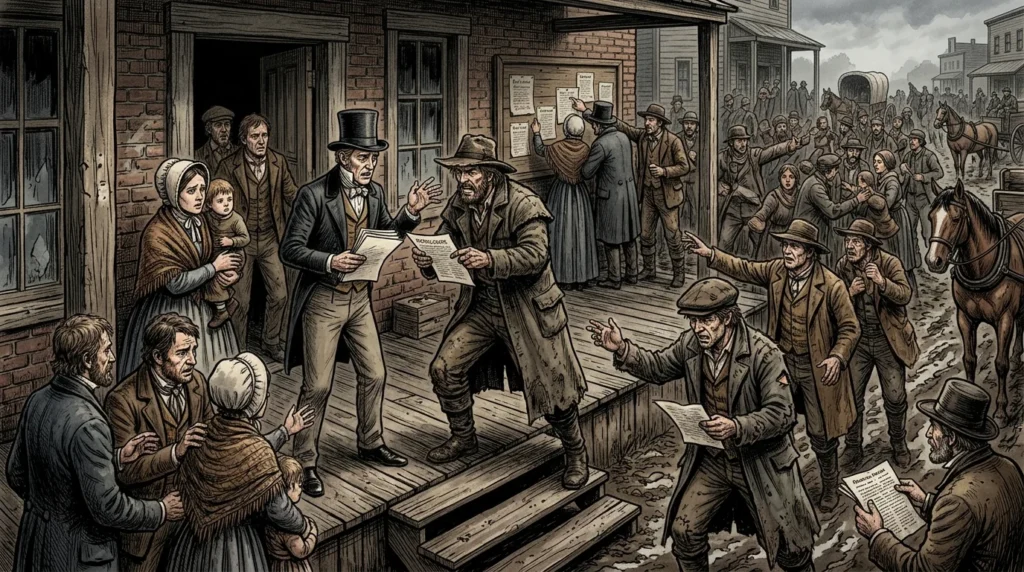
Building a railroad across the subarctic wilderness of Alaska has long tested the boundary between private capital markets and sovereign public finance. In the early twentieth century, private syndicates repeatedly ran out of money while trying to push tracks northward from the Gulf of Alaska into the interior coalfields and gold districts [3][4]. Concluding that private bond markets could not bear the construction costs and sparse traffic of the northern frontier, the United States Congress intervened on March 12, 1914, enacting the Alaska Railroad Act with an initial appropriation ceiling of $35 million [1][3]. For the next seven decades, the railroad operated as a direct federal undertaking—absorbing roughly $60 million in initial construction outlays and more than $95 million in post-World War II rehabilitation before being sold to the State of Alaska for $22.3 million in 1985 [1][3]. Three decades later, the limits of speculative private rail financing re-emerged when the proposed multi-billion-dollar Alaska-to-Alberta Railway (A2A Rail) collapsed into receivership in 2021 amid securities investigations into its private lender [6][7].
Bankrupt Predecessors and the Failure of Early Private Capital (1903–1913)
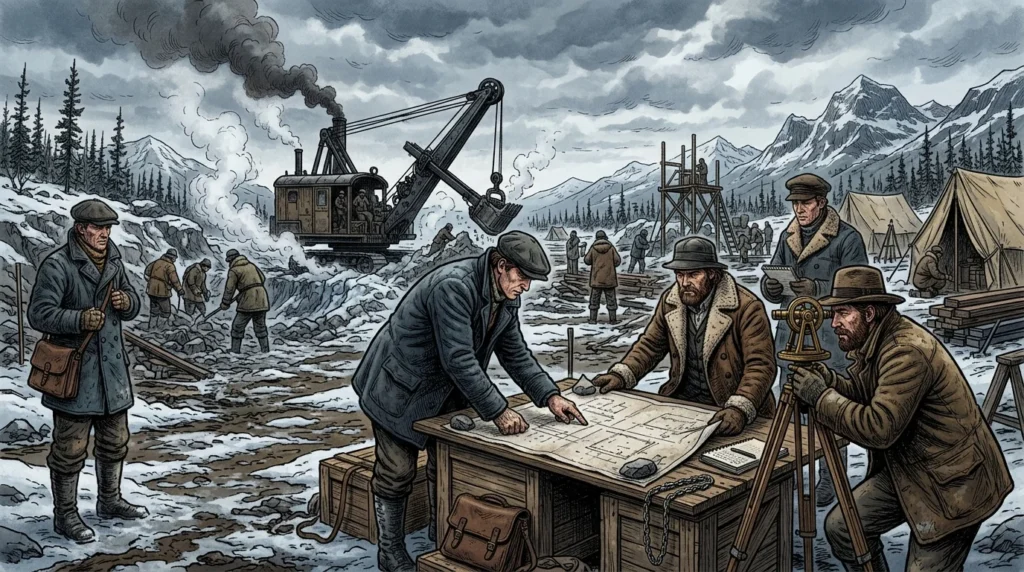
Before the federal government assumed control of Alaskan rail development, more than twenty small private railroads operated across the territory, serving localized mining booms in gold, copper, and coal [3]. Most disappeared once local ore veins were exhausted, and efforts to finance a permanent trunk line connecting an ice-free southern port to the interior repeatedly collapsed under the weight of engineering difficulties and thin commercial revenues [3][4].
The first major attempt along the modern railbelt corridor began in 1903 and 1904, when the privately financed Alaska Central Railway started laying track northward from the port of Seward toward the coal deposits of the Matanuska Valley [3][4]. After four years of costly grading and tunneling, the company had completed barely 50 to 51 miles of track before falling into bankruptcy [3][4]. Reorganized in 1908–1910 as the Alaska Northern Railway Company, the venture pushed the line another 21 miles north to Kern Creek, reaching roughly 71 to 72 miles from Seward [3][4]. Deprived of steady freight revenue and unable to raise fresh capital to cross the Chugach Mountains or reach interior waterways, the Alaska Northern stalled as well, leaving its bondholders with a deteriorating coastal spur [3].
| Documented Figure / Metric | Historical Significance & Archival Context |
|---|---|
| $22.3 million | Under the terms of the divestment, the State of Alaska purchased the railroad—including 481 miles of mainline track and roughly 38,000 acres of land—from the federal government for $22.3 million, supplemented by an $11 million state contribution for initial working capital and capital improvements. |
| $13 billion | Cost estimates for the cross-border megaproject ranged from $13 billion USD ($17 billion CAD) in 2019 legislative presentations to $22 billion CAD by 2021. |
| $149 million | In June 2021, PwC called a $149 million loan made by Bridging Finance to A2A Rail, prompting the railway company to strip McCoshen of his role and file for creditor protection. |
The Alaska Railroad Act of 1914 and the Alaska Engineering Commission
With private railroad syndicates unable to finance a complete route to the interior, federal policymakers stepped in. On March 12, 1914, Congress passed the Alaska Railroad Act (38 Stat. 305), authorizing the President to locate, purchase, construct, and operate a rail system of up to 1,000 miles connecting an ice-free Pacific harbor with Alaska’s interior navigable waterways and mineral deposits [1][3]. Rather than issuing land grants or guaranteeing corporate bonds—the mechanisms used to subsidize nineteenth-century transcontinental railroads in the western United States—Congress chose direct public ownership financed by statutory appropriations, setting an initial funding authorization of $35 million [1][3][4].
To execute the project without relying on private concessionaires, the statute directed President Woodrow Wilson to appoint the Alaska Engineering Commission (AEC) to supervise surveying and construction [1]. On January 26, 1915, Executive Order 2129 placed the commission under the administrative jurisdiction of the Department of the Interior [1][2]. Evaluating two competing corridors—the Copper River and Northwestern route from Cordova and the Alaska Northern route from Seward—the federal government selected the Seward-to-Fairbanks alignment, purchasing the 71 to 72 miles of existing Alaska Northern track as the southern foundation of the federal network [3][4]. In 1915, the commission established its main construction headquarters at Ship Creek, spawning a railroad tent settlement that grew into the city of Anchorage [1][4].
Building through permafrost, mountain passes, and bridged river gorges during World War I inflation pushed capital requirements far beyond the original estimate. When President Warren G. Harding drove the ceremonial golden spike at Nenana on July 15, 1923, completing the 470-to-481-mile main line between Seward and Fairbanks, total federal construction expenditures had reached approximately $60 million—nearly double the initial $35 million authorization [1][3][4]. Earlier that summer, on June 8, 1923, Executive Order 3861 had authorized the Department of the Interior to operate the line, vesting operational control in the Alaska Railroad Commission and formally redesignating the enterprise as The Alaska Railroad [1].
Federal Stewardship, Wartime Rehabilitation, and Departmental Transfers (1924–1977)
Shielded from commercial bond defaults by sovereign ownership, the completed railroad nonetheless struggled with the harsh operating economics of a sparsely populated territory. At the time of completion, Seward, Anchorage, and Fairbanks had a combined population of roughly 5,400 residents—far too small to generate commercial freight volume capable of covering maintenance and operating costs [4]. Between 1924 and 1945, Congress provided no new capital or operating appropriations, and the lack of commercial traffic prevented the railroad from financing internal upgrades [3]. Physical deterioration grew so severe during the interwar period that some federal officials advocated abandoning the line altogether, though management under Colonel Otto F. Ohlson eventually achieved the railroad’s first annual operating profit late in the prewar era [3][4].
Administratively, the railroad remained within the Department of the Interior for more than four decades, shifting across internal bureaus: to the Division of Territories and Island Possessions under Secretary’s Order 1040 on February 13, 1936; to the Office of Territories under Administrative Order 2577 on July 28, 1950; and to independent bureau status within Interior on December 16, 1959 [1].
World War II fundamentally altered the railroad’s strategic and financial position. Heavy military freight movements generated substantial operating surpluses and prompted the 1943 completion of 3.5 miles of tunnels through the Chugach Mountains to a new military port and fuel depot at Whittier, shortening the rail haul from ice-free tidewater to Anchorage by 51 miles [3][4]. Because wartime traffic left tracks and rolling stock exhausted, the federal government rejected postwar abandonment and instead funded a comprehensive rehabilitation program completed in the early 1950s at a cost exceeding $95 million [3]. In March 1964, the magnitude 9.2 Good Friday Earthquake inflicted an estimated $30 million in damage to tracks, bridges, and port facilities, requiring rapid federal restoration [4].
When Congress consolidated national transport agencies under the Department of Transportation Act of October 15, 1966 (80 Stat. 931), oversight of The Alaska Railroad transferred from Interior to the newly created Federal Railroad Administration (FRA), effective April 1, 1967 [1][2]. Throughout the 1970s, as the FRA managed national rail financial assistance programs under the Emergency Rail Services Act of 1970 and the Emergency Rail Facilities Restoration Act of 1973, the Alaska Railroad experienced a major revenue boom hauling pipe and materials for the construction of the Trans-Alaska Pipeline between 1974 and 1977, expanding its workforce past 1,000 employees [2][3][4].
The 1985 State Transfer and Quasi-Public Capitalization
Federal officials had discussed divesting the Alaska Railroad since 1968, and as the pipeline boom subsided, federal capital investment slowed while transition options were debated [3][4]. On January 14, 1983, President Ronald Reagan signed the Alaska Railroad Transfer Act of 1982 (96 Stat. 2556), establishing the statutory mechanism to convey the federal system to state ownership [1][4].
The transfer was finalized on January 5, 1985, ending seventy years of direct federal responsibility [1][3]. Under the terms of the divestment, the State of Alaska purchased the railroad—including 481 miles of mainline track and roughly 38,000 acres of land—from the federal government for $22.3 million, supplemented by an $11 million state contribution for initial working capital and capital improvements [3]. State legislation signed by Governor Bill Sheffield chartered the quasi-public Alaska Railroad Corporation (ARRC), governed by a seven-member board and mandated to operate as a self-sustaining enterprise through freight haulage, passenger tourism, and real estate leasing without ongoing operating subsidies from the state treasury [3][4].
The A2A Cross-Border Venture and Speculative Debt Collapse (2019–2021)
While the state-owned corporation maintained financial stability along its existing domestic corridor, the century-old ambition of linking Alaska’s tracks to the North American continental rail network revived the hazards of speculative private infrastructure finance. In June 2019, the ARRC board approved a preliminary cooperation agreement with the private Alaska-to-Alberta Railroad Development Corporation—known as A2A Rail—founded by businessman Sean McCoshen [5][6]. The agreement granted A2A Rail exclusive rights to connect a proposed 1,600-mile (2,570-kilometer) cross-border railway from Fort McMurray, Alberta, to Delta Junction, Alaska, and to interface with the existing ARRC network, while explicitly shielding the state-owned railroad from any obligation to fund the project [5][6][7].
Cost estimates for the cross-border megaproject ranged from $13 billion USD ($17 billion CAD) in 2019 legislative presentations to $22 billion CAD by 2021 [5][6][7]. A2A Rail’s financing model relied on obtaining a federal presidential permit—which President Donald Trump issued in September 2020—and using that regulatory clearance to sign binding shipping agreements with Alberta oil-sands producers and mineral exporters, which in turn would be pledged to raise private project debt [5][6]. From the outset, energy analysts questioned the underlying freight economics: a 2015 study cited by Alaska policy analyst Larry Persily estimated that moving one million barrels of crude oil per day by rail from Alberta to Alaska would require tariffs of $15.44 to $21.41 CAD per barrel, consuming up to a third of the oil’s value and struggling to compete with pipeline expansion [5].
Before construction or commercial shipping contracts could materialize, the venture’s early-stage debt financing imploded. Rather than raising capital through public markets or sovereign guarantees, A2A Rail had relied heavily on high-interest private loans from Toronto-based Bridging Finance Inc. [6][7]. In April 2021, Canadian regulators placed Bridging Finance into court-ordered receivership under PricewaterhouseCoopers (PwC) following an Ontario Securities Commission (OSC) investigation into widespread financial irregularities [6][7]. According to OSC findings reported by CBC News and the Globe and Mail, one of McCoshen’s companies had transferred $19.5 million in undisclosed kickbacks into the personal checking account of Bridging Finance CEO David Sharpe during the same period that Bridging extended more than $100 million in loans to McCoshen’s entities, while millions of dollars earmarked for the railway were diverted into McCoshen’s personal accounts [6][7].
In June 2021, PwC called a $149 million loan made by Bridging Finance to A2A Rail, prompting the railway company to strip McCoshen of his role and file for creditor protection [6]. The effort to reorganize failed the following month, when an Alberta judge appointed an interim receiver to seize control of A2A Rail’s remaining assets and operations [7]. Contrasting sharply with the enduring 1914 federal railroad built through direct congressional appropriations, the collapse of A2A Rail demonstrated how vulnerable unsubsidized frontier megaprojects remain to freight-cost bottlenecks, speculative private credit, and corporate governance failures [1][5][6].
Theoretical & Balance-Sheet Transmission Mechanism
In the Kindleberger–Minsky taxonomy of financial instability (Kindleberger, 1978; Minsky, 1986) and Irving Fisher’s (1933) debt-deflation framework, speculative asset booms become systemic crises when credit expansion shifts balance sheets from hedge finance (cash flows covering principal and interest) to speculative and Ponzi finance (relying on rising asset prices and short-term margin roll-overs).
Once monetary tightening or an exogenous shock halts price appreciation, forced margin liquidations trigger Fisherian debt-deflation: fire-sale asset discounts erode bank collateral values, contracting credit supply across the real economy.
Sources and Further Reading
- U.S. National Archives and Records Administration, “ Records of the Alaska Railroad [RG 322],” Guide to Federal Records, 1995. Official / State Archive
- U.S. National Archives and Records Administration, “ Records of the Federal Railroad Administration [RG 399],” Guide to Federal Records, 1995. Official / State Archive
- Greg Huff, “ Rail Transportation in Alaska,” Alaska Economic Trends (Alaska Department of Labor), 1988. Official / State Archive
- Alaska Railroad Corporation, “ Learn More About Our History,” Alaska Railroad Corporation. Historical & Financial Reference
- James Brooks, “ Alaska Railroad Signs Initial Deal for Link to Canada and the Rest of the Country,” Anchorage Daily News, 2019-06-28. Historical & Financial Reference
- Sarah Rieger, “ Alberta to Alaska Rail Project Files for Creditor Protection After Lender Goes into Receivership,” CBC News, 2021-06-23. Historical & Financial Reference
- Dan Bross, “ ‘Boondoggle’: Financial Woes May Jeopardize Proposed Alaska-Canada Railroad Project,” KTOO / KUAC, 2021-07-14. Historical & Financial Reference
- Irving Fisher — "The Debt-Deflation Theory of Great Depressions," Econometrica 1, no. 4 (FRASER Federal Reserve Archive, 1933): 337–357 Central Bank / Monetary Authority
- Charles P. Kindleberger & Robert Z. Aliber — Manias, Panics, and Crashes: A History of Financial Crises (Palgrave Macmillan) Peer-Reviewed / Academic Research
Cite This Historical Dossier (APA / Chicago)
APA (7th ed.): Ç., S. (Ed.). (2026). Financing the Alaska Railroad: From Federal Appropriations to Speculative Expansion. In Forgotten Fortunes Historical Monograph Series (Forgotten Fortunes Editorial Desk). https://forgottenfortunes.net/alaska-railroad-financing-history/
MLA (9th ed.): Ç., Soner, ed. "Financing the Alaska Railroad: From Federal Appropriations to Speculative Expansion." Forgotten Fortunes: Financial & Monetary History Archive, 2026, https://forgottenfortunes.net/alaska-railroad-financing-history/.
Chicago (17th ed.): Ç., Soner, ed. "Financing the Alaska Railroad: From Federal Appropriations to Speculative Expansion." Forgotten Fortunes Historical Monograph Series (Forgotten Fortunes Editorial Desk), August 27, 2026. https://forgottenfortunes.net/alaska-railroad-financing-history/.
Have an idea for another financial history documentary or article? Request a story →