In This Article
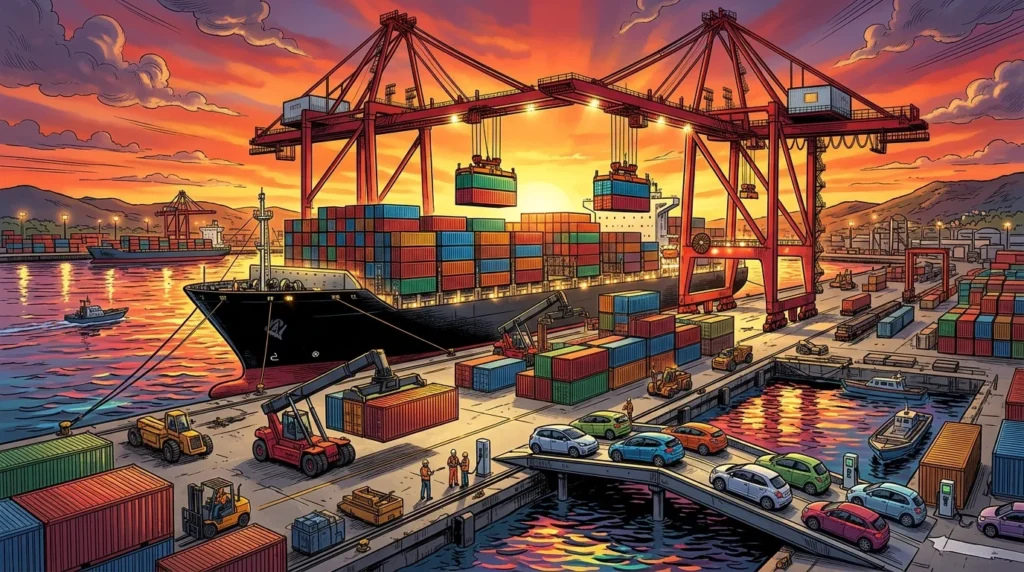
In the summer of 1818 the United States looked like a country that had found the secret of easy prosperity. Cotton fetched high prices in Liverpool, European buyers wanted American wheat, and settlers and speculators were pouring into the new lands of the West, buying public acreage on credit and financing improvements with banknotes from a fast-multiplying crowd of local banks. Eighteen months later the boom was gone. Banks had failed, land had lost much of its value, eastern cities were opening soup kitchens, and debtors were filling the jails. The Panic of 1819 was the young republic’s first great peacetime financial crisis, and it began a long American argument about banks, paper money and who should bear the cost when credit runs out [1][4].
A War, a Debt and a Flood of Paper (1812–1816)
The roots of the crisis lay in the War of 1812. The federal government borrowed heavily to fight Britain, and payments on the debt from the Louisiana Purchase were also falling due [1]. The First Bank of the United States had closed when its charter lapsed in 1811, leaving the country without a national bank. State-chartered banks filled the gap, each issuing its own paper notes. In 1814 they suspended specie payments, meaning they stopped converting notes into gold or silver coin on demand [1].
Freed from that obligation, many banks, especially in the West, issued notes far beyond any realistic ability to redeem them. Supervision was weak, and banknotes from different issuers traded at different discounts, producing what the New York Fed calls a “chaotic money situation” [1][3]. In Ohio alone, according to the historian Thomas Greer, the number of state-chartered banks rose from eight to twenty-five during the boom years [5].
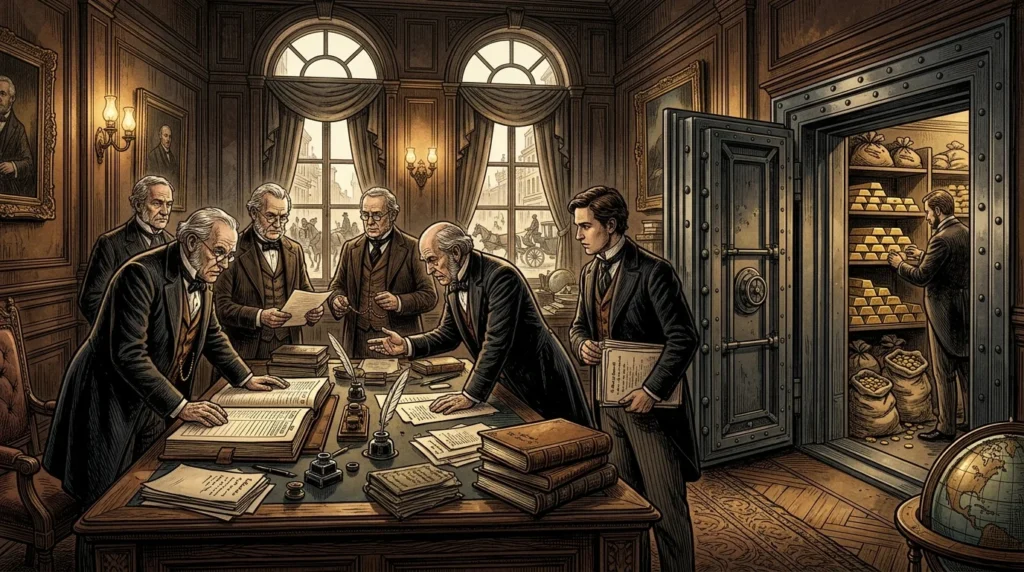
The answer, many in Washington believed, was a new national bank. On April 10, 1816, President James Madison signed the act creating the Second Bank of the United States [3]. It opened in Philadelphia in January 1817 with a twenty-year charter and capital of $35 million, far larger than the First Bank’s $10 million. It was to act as the government’s fiscal agent, issue a sound, specie-convertible currency and keep state banks’ note issues in check [2].
| Documented Figure / Metric | Historical Significance & Archival Context |
|---|---|
| $150 | According to Digital History, land in Pennsylvania that had sold for $150 an acre in 1815 fetched $35 in 1819. |
| $21 million | By 1820 settlers owed the federal government more than $21 million for public land, most of it on land in the Old Northwest; Greer estimates that perhaps half the men in the region were in debt to the government. |
| $1.64 | To soften the change, it cut the minimum price from $1.64 to $1.25 an acre and the minimum purchase from 160 to 80 acres. |
How Land Credit Fuelled the Boom
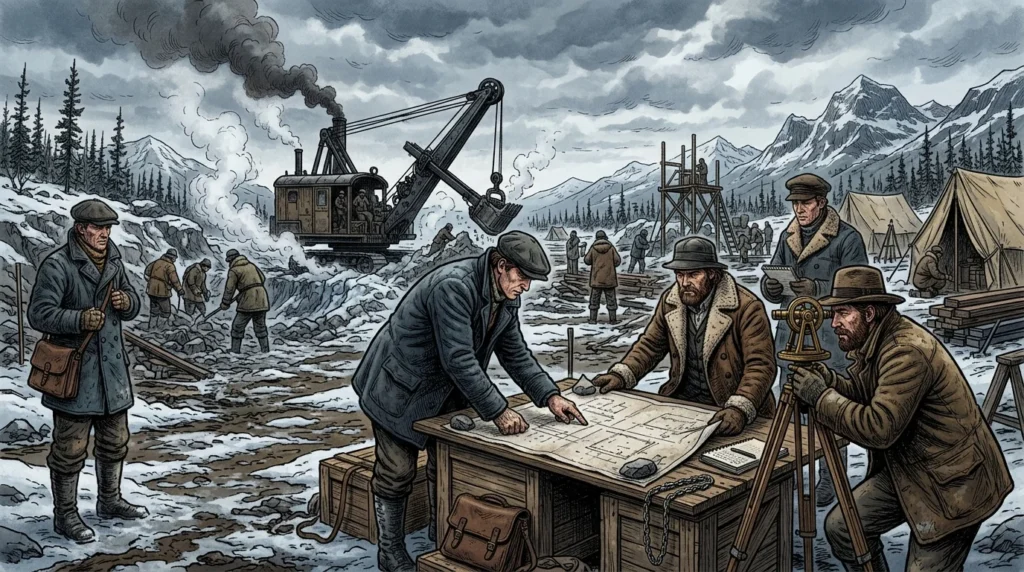
The boom had a distinctive engine: federal land sold on credit. Under the land laws of the period, the government sold public land in the West on an installment basis. A buyer made an initial payment and owed the rest to the land office over the following years, so a modest sum could control a large tract [5]. Speculators competed with genuine settlers, and both often financed their down payments and improvements with loans and notes from the new local banks [5].
The figures grew quickly. Greer, drawing on Treasury reports, puts the debt owed to the government on public-land purchases at about $3.0 million in 1815 and $16.8 million in 1819 [5]. High crop prices made the bet look sensible: British mills wanted cotton, Europe needed wheat after years of war and poor harvests, and the products had to be shipped, so money also flowed into turnpikes and shipbuilding [1]. The economist Edward Glaeser, quoted by the New York Fed, identifies Huntsville, Alabama, with its cotton soil and river access, as the epicentre of the land boom [1][6].
The mechanism was fragile. A frontier farmer’s ability to meet his next land installment depended on export prices staying high and on the local bank continuing to renew his notes. The banks’ notes depended in turn on nobody demanding too much coin at once. Each link assumed the others would hold.
The National Bank Joins the Expansion (1817–1818)
The Second Bank was supposed to impose discipline. Instead, under its first president, William Jones, a former secretary of the Navy and political appointee, it added to the expansion [2]. The Bank weakened its own credibility by accepting IOUs from subscribers in place of capital, did little to restrain state banks and extended credit liberally, particularly through its western branches [1]. Specie payments resumed by 1817, but, as the New York Fed puts it, often “only on a nominal basis” [1].
By 1818 the Bank was dangerously stretched. Beginning that year it reversed course, contracting its loans and pressing state banks to redeem the notes it held in specie [2][3]. The Federal Reserve’s history of the Bank sums up the Jones era bluntly: the Bank “first extended too much credit and then reversed that trend too quickly,” producing a panic and a steep recession [2].
The Bust of 1819
The squeeze at home coincided with a shock from abroad. In January 1819 U.S. cotton prices plummeted as British buyers switched to Indian cotton, while improving European harvests reduced demand for American farm goods [1]. Farmers and speculators who had borrowed against future crops now faced falling prices at exactly the moment banks were calling in loans.
The chain reaction worked through the banking system. To restore convertibility, the national bank pressed state banks to redeem their notes; the state banks in turn called in loans and stopped new lending [5]. When Jones resigned in 1819, shareholders replaced him with Langdon Cheves of South Carolina, a former Speaker of the House. Cheves cut the Bank’s note circulation in half, made fewer loans, foreclosed on mortgages and presented state banknotes for redemption in specie, driving many state banks without enough coin into bankruptcy [2]. Greer reports that total banknote circulation fell to less than 40 percent of its 1816 level and that some 85 of 392 banks closed during the crisis year [5].
Asset prices collapsed. According to Digital History, land in Pennsylvania that had sold for $150 an acre in 1815 fetched $35 in 1819 [4]. In Alabama, the centre of the cotton-land boom, values plummeted [1].
Who Paid the Price
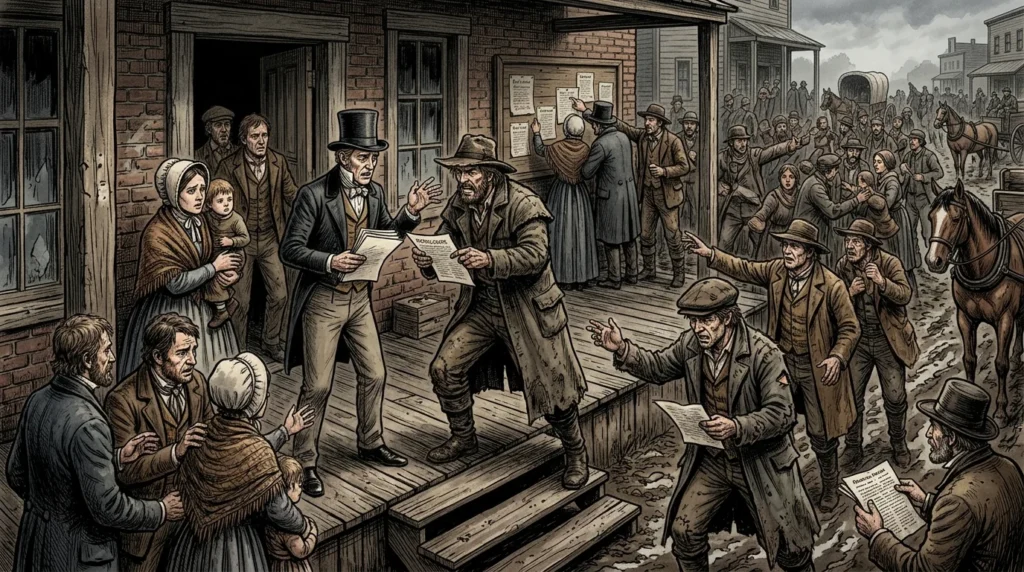
The damage reached far beyond speculators. In the eastern cities, urban poverty became a pressing public issue for the first time; unemployment rose, and charities and municipal authorities distributed food and clothing and opened soup kitchens [4]. Debt itself became a route to jail: Digital History records 1,808 people committed to debtors’ prison in Philadelphia and 3,500 in Boston [4].
In the West the crisis was above all a debt crisis. By 1820 settlers owed the federal government more than $21 million for public land, most of it on land in the Old Northwest; Greer estimates that perhaps half the men in the region were in debt to the government [5]. Money became so scarce that much trade reverted to barter, with grain serving as the main medium of exchange in the backcountry and many workmen paid in kind [5]. Government itself felt the strain: federal revenue, close to $50 million in 1816, fell to about $15 million in 1821, and Congress authorised the Treasury to borrow up to $8 million [5].
Relief, Reform and Political Backlash
Debtors demanded relief, and governments responded unevenly. Across the country there were calls for stay laws to delay foreclosures, for an end to imprisonment for debt and, from manufacturers, for protective tariffs [4]. Illinois and several other western states passed replevin laws allowing debtors to postpone the seizure of property by signing a bond to pay later; some chartered state-owned banks to lend notes on mortgage security [5]. Bills to abolish imprisonment for debt in federal cases failed in Congress, but Ohio ended the practice for debtors who surrendered their property [5].
Washington’s biggest response concerned land. In April 1820 Congress passed a new Land Act requiring full cash payment for all future purchases, abolishing the credit system that had fed speculation. To soften the change, it cut the minimum price from $1.64 to $1.25 an acre and the minimum purchase from 160 to 80 acres [5]. In March 1821 a relief act allowed existing debtors to apply payments already made toward full ownership of part of their holdings while relinquishing the rest, extended time for others, waived accrued interest and offered a 37 percent discount for prompt settlement. Further relief acts followed; by 1832 Congress had passed eleven [5].
The political fallout lasted far longer. The national bank was attacked both by those who wanted more paper money and by hard-money critics who distrusted its power over credit. Andrew Jackson formed his anti-Bank views in Tennessee during these years, and Thomas Hart Benton, later his hard-money ally in the Senate, did the same in Missouri; both states were among the hardest hit [1]. In 1832 President Jackson vetoed the bill to renew the Second Bank’s charter, and it lost its federal charter in 1836 [3].
Legacy: The First Boom-and-Bust
Recovery was slow. Greer dates a true revival of purchasing power and commerce in the Old Northwest to about 1825, helped by recovering exports and new internal trade [5]. The Federal Reserve’s history notes that the slump was part of a worldwide downturn, but that the Second Bank’s policies magnified the contraction in the United States [2]. How much blame belongs to the Bank, to the state banks’ over-issue or to international markets is still debated, but the basic sequence is not: credit expanded rapidly on the promise of rising land and crop prices, and when prices fell and the banks demanded coin, the losses landed on borrowers who had treated that credit as permanent.
The Panic of 1819 left a durable mark. It ended federal land sales on credit, made debtor relief a central issue in state politics, and gave a generation of western politicians a lasting suspicion of paper money and a national bank. Two centuries later, as the New York Fed observed, the debate over central banking, inflation and deflation that the crisis set off is still with us [1].
Theoretical & Balance-Sheet Transmission Mechanism
In the Kindleberger–Minsky taxonomy of financial instability (Kindleberger, 1978; Minsky, 1986) and Irving Fisher’s (1933) debt-deflation framework, speculative asset booms become systemic crises when credit expansion shifts balance sheets from hedge finance (cash flows covering principal and interest) to speculative and Ponzi finance (relying on rising asset prices and short-term margin roll-overs).
Once monetary tightening or an exogenous shock halts price appreciation, forced margin liquidations trigger Fisherian debt-deflation: fire-sale asset discounts erode bank collateral values, contracting credit supply across the real economy.
Sources and Further Reading
- James Narron, David R. Skeie and Donald P. Morgan, “ Crisis Chronicles: The Panic of 1819—America’s First Great Economic Crisis,” Federal Reserve Bank of New York, Liberty Street Economics, 2014. Central Bank / Monetary Authority
- “ The Second Bank of the United States,” Federal Reserve History (Federal Reserve System). Central Bank / Monetary Authority
- “ FDIC History: 1800–1849,” Federal Deposit Insurance Corporation. Official / State Archive
- “ The Panic of 1819,” Digital History, University of Houston. Peer-Reviewed / Academic Research
- Thomas H. Greer, “ Economic and Social Effects of the Depression of 1819 in the Old Northwest,” Indiana Magazine of History, vol. 44 no. 3, 1948. Peer-Reviewed / Academic Research
- Edward L. Glaeser, “ A Nation of Gamblers: Real Estate Speculation and American History,” National Bureau of Economic Research, Working Paper 18825, 2013. Peer-Reviewed / Academic Research
- Irving Fisher — "The Debt-Deflation Theory of Great Depressions," Econometrica 1, no. 4 (FRASER Federal Reserve Archive, 1933): 337–357 Central Bank / Monetary Authority
- Charles P. Kindleberger & Robert Z. Aliber — Manias, Panics, and Crashes: A History of Financial Crises (Palgrave Macmillan) Peer-Reviewed / Academic Research
Cite This Historical Dossier (APA / Chicago)
APA (7th ed.): Ç., S. (Ed.). (2026). The Panic of 1819: Land Credit, Bank Notes and America's First Great Depression. In Forgotten Fortunes Historical Monograph Series (Forgotten Fortunes Editorial Desk). https://forgottenfortunes.net/american-panic-of-1819-land-credit/
MLA (9th ed.): Ç., Soner, ed. "The Panic of 1819: Land Credit, Bank Notes and America's First Great Depression." Forgotten Fortunes: Financial & Monetary History Archive, 2026, https://forgottenfortunes.net/american-panic-of-1819-land-credit/.
Chicago (17th ed.): Ç., Soner, ed. "The Panic of 1819: Land Credit, Bank Notes and America's First Great Depression." Forgotten Fortunes Historical Monograph Series (Forgotten Fortunes Editorial Desk), August 27, 2026. https://forgottenfortunes.net/american-panic-of-1819-land-credit/.
Have an idea for another financial history documentary or article? Request a story →