In This Article
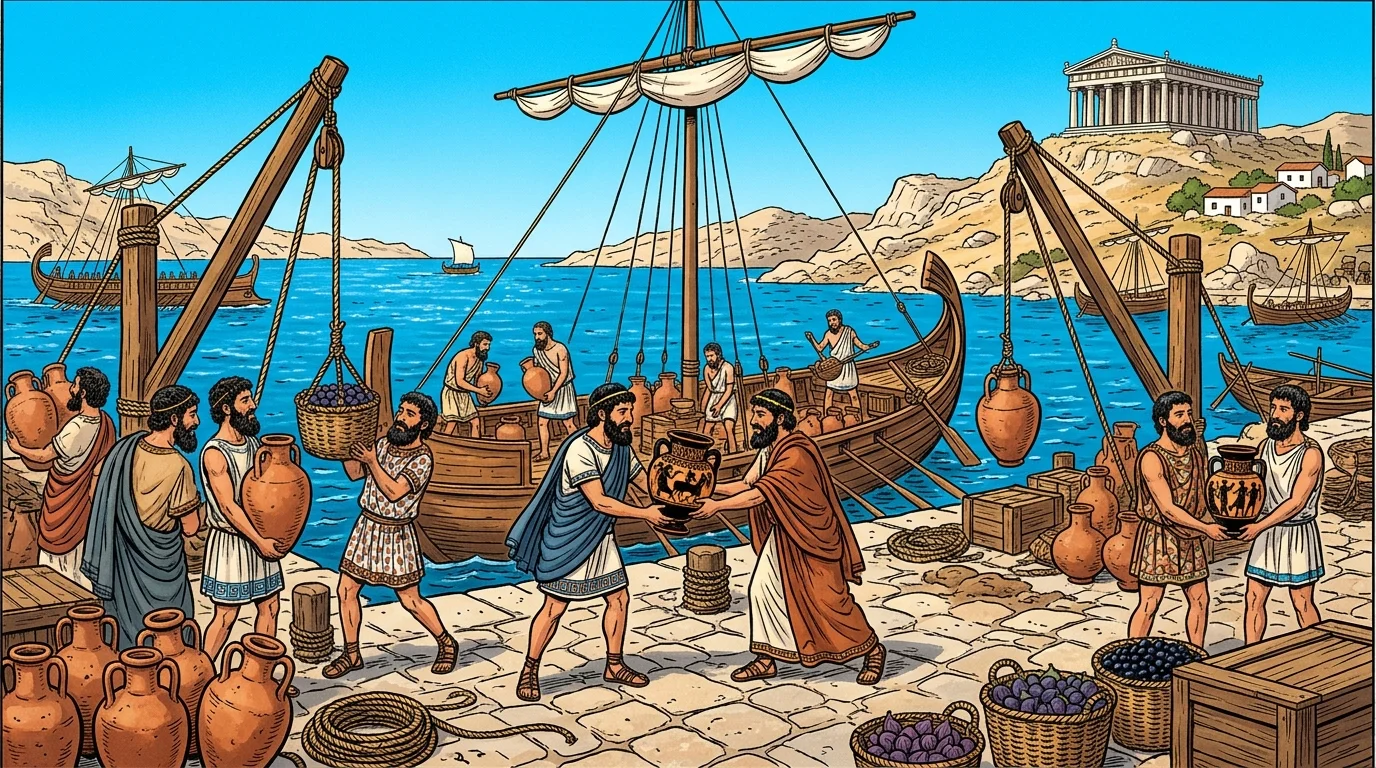
Between the reforms of Solon (594/593 BCE) and the Persian invasion of 480 BCE, Archaic Athens executed a remarkable commercial and monetary ascent across the Mediterranean basin. At the opening of the sixth century BCE, maritime trade in painted ceramics, perfumes, and bulk commodities was dominated by Corinth, Aegina, and the Ionian cities of Asia Minor, while Attica struggled with rocky soil and agrarian debt crises. Within three generations, however, Athenian potters in the Kerameikos quarter captured the lucrative luxury vase market in Etruria—shipping tens of thousands of black-figure and red-figure vessels to the Etruscan necropolises of Vulci, Tarquinia, and Caere alongside Attic olive oil in characteristic SOS storage amphorae. Simultaneously, under the Peisistratid regime (c. 561–510 BCE) and the young Cleisthenic democracy, Athens transitioned from regionally circulating heraldic silver coins (Wappenmünzen) to the heavy 17.2-gram Attic-standard Owl tetradrachm around 515–510 BCE, while establishing armed outposts at Sigeion and the Thracian Chersonese to secure the Hellespontine corridor for Pontic wheat. [1]

From Solonian Olive-Oil Specialization to the SOS Amphora Network
The structural foundation of Athenian export trade began with a deliberate shift in Attic agriculture. Because Attica’s thin limestone soils could not produce enough barley and wheat to feed a growing population without exhausting the land, early sixth-century laws attributed to Solon banned the export of all Attic agricultural produce except olive oil. While protecting domestic grain supplies, this rule incentivized hillside terracing and commercial oleiculture across Attica.
Long before Athenian fine painted tableware achieved Mediterranean supremacy, Attic olive oil traveled overseas in sturdy, bulbous transport jars known to archaeologists as SOS amphorae—named after the distinctive three-symbol motif of concentric circles (O) flanked by wavy vertical zigzags (S) painted in dark slip around their necks. Produced in Attica from the late eighth century through the mid-sixth century BCE with capacities of roughly 35 to 45 liters, SOS amphorae have been excavated at ports and elite settlements stretching from Al Mina in the Levant and Naukratis in the Nile Delta to Sicily, southern Italy, Carthage, Tartessos in southern Spain, and the coastal emporia of Etruria. Scratched owner inscriptions and commercial marks on these jars demonstrate that Attic olive oil had already become an internationally recognized bulk commodity carried by Euboean, Aeginetan, and Athenian shipmasters. [2]
Capturing the Corinthian Pottery Market in Etruria: Vulci and Sostratos
In the fine ceramics trade, Corinth had held a near-monopoly across the western Mediterranean during the seventh and early sixth centuries BCE, exporting mass-produced aryballoi (perfume flasks) and animal-frieze banquet vessels. Beginning around 575–550 BCE, however, Athenian workshops in the Kerameikos—exploiting iron-rich Attic clay that fired to a brilliant orange-red and a glossy, velvety black slip—systematically displaced Corinthian wares. Master potters and painters such as Ergotimos and Kleitias (creators of the famous François Vase found at Chiusi, c. 570 BCE), Exekias, Amasis, and later the pioneers of the red-figure technique invented around 530 BCE, tailored their shapes and mythological scenes directly to overseas buyers. [3]
Nowhere was this commercial triumph more visible than in Etruria, whose mineral-rich city-states—led by Vulci, Tarquinia, Cerveteri (Caere), Orvieto, and later the Adriatic port of Spina—traded iron ore from Elba, copper, and agricultural surpluses for Greek luxury goods. More than 30,000 complete or near-complete Attic black-figure and red-figure vases have been recovered from the rock-cut chamber tombs of Vulci and neighboring Etruscan centers alone. Athenian workshops went so far as to manufacture specialized shapes—such as the Nikosthenic amphora, modeled on indigenous Etruscan dark-burnished bucchero metalwork by the Athenian potter Nikosthenes (active c. 545–510 BCE)—specifically for export to Caere and Vulci. [4]
Because Athens did not yet possess a dominant merchant marine in the mid-sixth century BCE, much of this ceramic cargo was distributed by professional Ionian and Aeginetan merchant middlemen who marked the undersides of Attic vase feet with incised or painted mercantile trademarks (dipinti and graffiti) recording batch prices, shapes, and consignment sizes. The most famous of these traders was Sostratos of Aegina, son of Laodamas, whom Herodotus (Histories 4.152) singled out as having made the greatest commercial profits of any Greek merchant in history. In 1970, archaeologists excavating the Greek sanctuary at Gravisca—the maritime port serving Etruscan Tarquinia, just south of Vulci—unearthed a marble stone anchor dedicated to Aeginetan Apollo by Sostratos himself, while dozens of late sixth-century Attic vases found at Vulci and Cerveteri bear the two-letter trademark SO, linking Herodotus’s tycoon directly to the wholesale shipment of Athenian ceramics into Etruria. [5]
Wappenmünzen vs. the 17.2-Gram Athenian Owl Tetradrachm (c. 515 BCE)
As Attic exports expanded, Athens overhauled its monetary system. Throughout the Aegean, sixth-century maritime commerce had been dominated by the silver “Turtle” stater of Aegina, struck on the heavy Aeginetan weight standard of roughly 12.2 grams per didrachm (6.1 grams per drachma). Around 545–515 BCE, during the tyranny of Peisistratos and his sons Hippias and Hipparchos, Athens began striking its earliest silver coins, known to numismatists as Wappenmünzen (“heraldic” or “coat-of-arms” coins). Struck primarily as didrachms weighing roughly 8.6 grams on the lighter Attic-Euboic standard (4.3 grams per drachma), the Wappenmünzen carried a simple diagonal incuse punch on the reverse and a changing series of fourteen different emblems on the obverse—including an amphora, a four-spoked chariot wheel, a horse, a gorgon’s head (gorgoneion), a triskeles, an astragalos, and an owl. [6]
Recent lead-isotope and trace-element analyses of Wappenmünzen show that these early coins were minted largely from imported silver bullion—including Thracian and Siphnian silver—rather than exclusively from local Attic mines, and that they circulated mainly within Attica and nearby central Greece for domestic payments, mercenary wages, and civic festivals. Because their changing emblems lacked an unmistakable civic badge outside Attica, they rarely traveled in long-distance Mediterranean trade hoards.
Between 520 and 510 BCE, after miners struck a rich, deep contact vein of argentiferous galena ore (Maroneia and surrounding shafts) in the state-owned district of Laurion in southeastern Attica, Athens executed a decisive monetary reform. Abandoning the diverse Wappenmünzen didrachms, the mint introduced a double-sized denomination—the four-drachma piece or tetradrachm weighing 17.2 grams of 98–99 percent pure Laurion silver—stamped with an unchanging two-sided civic design: the helmeted head of Athena on the obverse, and her sacred owl standing beside an olive-oil sprig and crescent moon with the three-letter ethnic inscription ΑΘΕ (“of the Athenians”) on the reverse. Unlike domestic fractional coins, the heavy 17.2-gram Owl tetradrachm was engineered specifically as an international bullion-coin export commodity. Hoards buried across Egypt, the Levant, Anatolia, Sicily, and southern Italy before 480 BCE show that foreign merchants eagerly accepted Athenian Owls at a premium over raw silver hacksilber because their weight and fineness were guaranteed by the Athenian state. [7]
Guarding the Hellespont Grain Corridor: Sigeion and the Chersonese
The third pillar of Archaic Athens’s commercial strategy was securing the maritime narrows through which Black Sea grain, timber, and dried fish entered the Aegean. As Attica’s urban artisans, miners, and olive growers multiplied, Athens grew increasingly dependent on wheat shipped from the Pontic steppes and the Hellespontine region. A hostile power controlling the Dardanelles (Hellespont) could choke off Athens’s food supply before a single grain ship reached Phaleron or Piraeus.
Recognizing this vulnerability, Peisistratos recaptured the fortified promontory of Sigeion at the southern entrance to the Hellespont from Mytilene and installed his son Hegesistratos as governor (Herodotus 5.94–95). Directly across the narrows on the European shore, the elder Miltiades (son of Kypselos), head of the rival Philaid aristocratic clan, led a group of Athenian settlers around 555 BCE to fortify the Thracian Chersonese (the Gallipoli peninsula), building a defensive wall across its isthmus and founding port settlements overlooking the strait (Herodotus 6.34–37). His nephew, the younger Miltiades, subsequently seized the island of Lemnos around 500 BCE, creating a stepping-stone chain of Athenian-held harbors from Attica to the mouth of the Hellespont. By 480 BCE—when the newly discovered Laurion silver strike funded Themistocles’ fleet of 200 triremes—Athens had already assembled the commercial trinity of olive-oil and ceramic exports, globally trusted silver Owl tetradrachms, and fortified Hellespontine sea-lanes that would underpin its fifth-century empire.
Theoretical & Balance-Sheet Transmission Mechanism
In the Kindleberger–Minsky taxonomy of financial instability (Kindleberger, 1978; Minsky, 1986) and Irving Fisher’s (1933) debt-deflation framework, speculative asset booms become systemic crises when credit expansion shifts balance sheets from hedge finance (cash flows covering principal and interest) to speculative and Ponzi finance (relying on rising asset prices and short-term margin roll-overs).
Once monetary tightening or an exogenous shock halts price appreciation, forced margin liquidations trigger Fisherian debt-deflation: fire-sale asset discounts erode bank collateral values, contracting credit supply across the real economy.
Sources and Further Reading
- Albarède, F., et al., “ Identifying Silver Ore Sources for the Earliest Coins of Athens,” Communications Chemistry / PubMed Central, 2025. Official / State Archive
- Bryn Mawr Classical Review, “ Review of Athens, Etruria, and the Many Lives of Greek Figured Pottery,” Bryn Mawr College, 2019. Peer-Reviewed / Academic Research
- Bryn Mawr Classical Review, “ Review of Christoph Reusser, Vasen für Etrurien: Verbreitung und Funktionen attischer Keramik im Etrurien des 6. und 5. Jahrhunderts v. Chr.,” Bryn Mawr College, 2003. Peer-Reviewed / Academic Research
- Herodotus, “ The Histories (Books 4.152, 5.94–95, and 6.34–40 on Sostratos of Aegina, Sigeion, and Miltiades in the Thracian Chersonese),” ToposText / Aikaterini Laskaridis Foundation. Historical & Financial Reference
- Aristotle, “ Constitution of the Athenians (Chapters 10–16 on Solonian Metrology and Peisistratid Economic Policy),” ToposText / Aikaterini Laskaridis Foundation. Historical & Financial Reference
- Irving Fisher — "The Debt-Deflation Theory of Great Depressions," Econometrica 1, no. 4 (FRASER Federal Reserve Archive, 1933): 337–357 Central Bank / Monetary Authority
- Charles P. Kindleberger & Robert Z. Aliber — Manias, Panics, and Crashes: A History of Financial Crises (Palgrave Macmillan) Peer-Reviewed / Academic Research
Cite This Historical Dossier (APA / Chicago)
APA (7th ed.): Ç., S. (Ed.). (2026). Archaic Athens's Conquest of Etruscan Pottery Markets and the Owl Tetradrachm. In Forgotten Fortunes Historical Monograph Series (Forgotten Fortunes Editorial Desk). https://forgottenfortunes.net/archaic-athens-trade-silver-coins/
MLA (9th ed.): Ç., Soner, ed. "Archaic Athens's Conquest of Etruscan Pottery Markets and the Owl Tetradrachm." Forgotten Fortunes: Financial & Monetary History Archive, 2026, https://forgottenfortunes.net/archaic-athens-trade-silver-coins/.
Chicago (17th ed.): Ç., Soner, ed. "Archaic Athens's Conquest of Etruscan Pottery Markets and the Owl Tetradrachm." Forgotten Fortunes Historical Monograph Series (Forgotten Fortunes Editorial Desk), September 15, 2026. https://forgottenfortunes.net/archaic-athens-trade-silver-coins/.
Have an idea for another financial history documentary or article? Request a story →

