In This Article
For four decades after the Second World War, Japan financed its physical reconstruction and high-speed industrial expansion through an off-budget financial architecture that insulated state infrastructure monopolies from commercial credit discipline. At the center of this system stood the Fiscal Investment and Loan Program (Zaisei Toyushi, or Zaito), commonly known as Japan’s “Second Budget.” Powered by compulsory deposits of household postal savings (Yucho) and public pension reserves into the Finance Ministry’s Trust Fund Bureau, Zaito funneled tens of trillions of yen into state-owned public corporations (tokushu hojin), most notably the Japanese National Railways (JNR) and the Japan Highway Public Corporation (Nihon Doro Kodan). When politically mandated construction and compounding interest pushed those corporations toward insolvency, policymakers spent nearly two decades—from the April 1987 breakup of JNR through the October 1998 absorption of ¥28.3 trillion in stranded railway liabilities, the April 2001 dismantling of the Trust Fund Bureau, and the October 2005 highway privatization—unwinding the vast hidden balance sheet of the postwar Japanese developmental state. [1]
The 1987 Breakup of Japanese National Railways and the ¥37.1 Trillion Liability
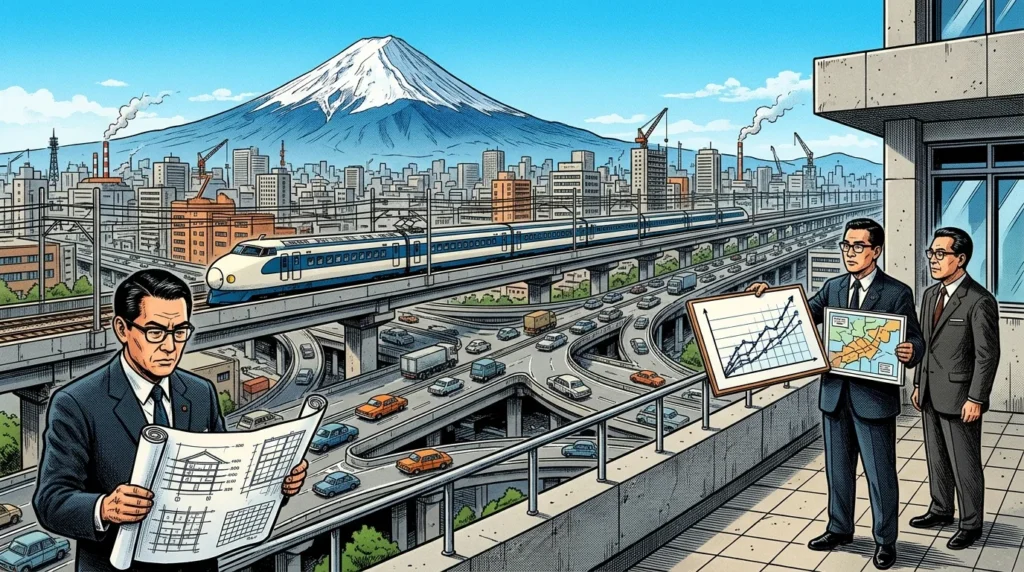
Established as a public corporation in 1949, Japanese National Railways spearheaded the construction of the Tokaido Shinkansen in 1964 and operated the arteries of Japan’s commuter and intercity transport. Yet by the mid-1970s, rising automobile and aviation competition, rigid labor relations, and persistent parliamentary pressure to build and operate heavily loss-making rural branch lines had plunged JNR into chronic fiscal deficits. To cover operating shortfalls and capital expenditure on new bullet train corridors, JNR borrowed relentlessly from the Fiscal Investment and Loan Program and issued government-guaranteed bonds. By the time Prime Minister Yasuhiro Nakasone pushed the JNR Reform Act through the Diet in November 1986, JNR’s accumulated long-term liabilities had reached ¥37.1 trillion. [2]
On April 1, 1987, JNR was formally dissolved and divided into six regional passenger railway companies—JR East, JR Central, JR West, JR Hokkaido, JR Shikoku, and JR Kyushu—alongside one nationwide freight operator, JR Freight. To ensure that the newly incorporated JR companies could operate profitably and eventually list their shares on the Tokyo Stock Exchange, reform architects shielded them from the bulk of the legacy debt. The three lucrative mainland Honshu operators (JR East, JR Central, and JR West), JR Freight, and the Shinkansen Holding Corporation assumed a combined ¥11.6 trillion in liabilities tied directly to active railway assets. The remainingthree island passenger companies in Hokkaido, Shikoku, and Kyushu were exempted from legacy debt altogether and endowed with a ¥1.3 trillion stabilization fund whose investment returns were meant to offset their structural operating losses. [3]
That division left ¥25.5 trillion in orphaned obligations—comprising historic JNR operating debt, capital construction burdens from the Seikan Tunnel and Honshu-Shikoku bridges, and unfunded employee pension liabilities. Rather than recognizing this sum immediately on the central government’s general account budget, the Ministry of Finance parked the entire ¥25.5 trillion inside a newly created state workout vehicle: the Japanese National Railways Settlement Corporation (Kokutetsu Seisan Jigyodan, or JNRSC). [4]
| Documented Figure / Metric | Historical Significance & Archival Context |
|---|---|
| ¥7.7 trillion | Officials estimated that real estate sales would raise ¥7.7 trillion and JR stock offerings would yield ¥1.2 trillion, leaving roughly ¥13.8 trillion to be shouldered by taxpayers once the asset liquidation concluded. |
| 50 percent | In 1987 and 1988, commercial land prices in metropolitan Tokyo were surging by more than 50 percent annually. |
| ¥1 trillion | Although the JNRSC eventually sold off large portions of its portfolio and floated initial tranches of JR East, JR West, and JR Central shares during the 1990s, depressed asset prices fell far short of covering the corporation's annual interest bill, which exceeded ¥1 trillion per year. |
| ¥4.2 trillion | The remaining ¥4.2 trillion in future pension obligations and asset disposition duties was transferred to the Japan Railway Construction Public Corporation (later integrated into the Japan Railway Construction, Transport and Technology Agency, or JRTT). |
The Bubble Land-Sale Gamble and the 1998 ¥28.3 Trillion Taxpayer Bailout
Under the 1987 privatization blueprint, the JNR Settlement Corporation was projected to extinguish the majority of its ¥25.5 trillion debt by liquidating 8,800 hectares of surplus railway freight yards, marshaling depots, and prime urban real estate—including vast tracts at Shiodome and Shinagawa in central Tokyo and Umeda in Osaka—along with equity shares in the new JR companies. Officials estimated that real estate sales would raise ¥7.7 trillion and JR stock offerings would yield ¥1.2 trillion, leaving roughly ¥13.8 trillion to be shouldered by taxpayers once the asset liquidation concluded. [5]
This repayment mechanism collided immediately with the macroeconomic distortions of Japan’s late-1980s asset price bubble. In 1987 and 1988, commercial land prices in metropolitan Tokyo were surging by more than 50 percent annually. Fearful that open competitive auctions of massive former JNR rail yards would set record benchmark prices and further inflame urban land speculation, the Cabinet passed a resolution freezing public competitive bidding for JNRSC properties in major metropolitan areas. For several critical years at the peak of the real estate market, the Settlement Corporation was barred from selling its most valuable land through open auctions, forced instead to rely on opaque negotiated transfers to local municipalities or complex land-trust schemes. [6]
By the time the Ministry of Transport relaxed the auction freeze following the collapse of the Nikkei stock index in 1990 and the onset of urban land deflation in 1991, commercial property demand had evaporated. Although the JNRSC eventually sold off large portions of its portfolio and floated initial tranches of JR East, JR West, and JR Central shares during the 1990s, depressed asset prices fell far short of covering the corporation’s annual interest bill, which exceeded ¥1 trillion per year. Because the agency was borrowing simply to pay interest on non-performing legacy liabilities, its principal compounded steadily throughout Japan’s “Lost Decade.” [7]
By 1998, after eleven years of land disposals and equity sales, the JNR Settlement Corporation’s debt had not declined from its 1987 starting point of ¥25.5 trillion—it had expanded to ¥28.3 trillion. Recognizing that the workout vehicle was mathematically insolvent, the Diet enacted the Law for Disposal of Debts and Liabilities of the Japanese National Railways Settlement Corporation in October 1998. When the JNRSC was dissolved on October 22, 1998, the central government absorbed ¥24.1 trillion of interest-bearing debt and interest-free loans directly into the national General Account budget, converting off-balance-sheet railway obligations into sovereign debt to be amortized over sixty years via tobacco excise tax hikes and general tax revenues. The remaining ¥4.2 trillion in future pension obligations and asset disposition duties was transferred to the Japan Railway Construction Public Corporation (later integrated into the Japan Railway Construction, Transport and Technology Agency, or JRTT). [8]
Zaito: Inside the ¥400 Trillion Fiscal Investment and Loan Program
The JNR Settlement Corporation debacle exposed a deeper institutional flaw in Japanese public finance: the automatic funding pipeline of the Fiscal Investment and Loan Program (Zaito). Established in 1953 under the leadership of the Ministry of Finance, Zaito operated as a state-run financial intermediation loop outside the scrutiny of the regular tax-funded budget. Under the Trust Fund Bureau Fund Act, every yen collected by Japan’s 24,000 post offices through the postal savings system (Yucho), along with national welfare and employee pension reserves, had to be deposited by law into the Finance Ministry’s Trust Fund Bureau (Shikin Un’yobu). Supplemental funds flowed from Postal Life Insurance (Kampo) and government-guaranteed bond accounts.
During the high-growth era of the 1950s and 1960s, this mechanism successfully channeled household savings into basic industrial capacity, electric power, shipping, and trunk infrastructure at low, administered interest rates. By the 1990s, however, Japan suffered from a chronic private-sector savings surplus rather than a capital shortage. Yet higher interest rates and structural convenience continued to draw household deposits into the state-guaranteed postal savings system. By fiscal year 2000, the total outstanding balance of the Fiscal Investment and Loan Program had reached roughly ¥400 trillion—equivalent to nearly 80 percent of Japan’s gross domestic product—while the Trust Fund Bureau alone managed over ¥430 trillion in liabilities, including ¥247 trillion in postal savings deposits and ¥139 trillion in public pension reserves.
Because the Trust Fund Bureau was legally obligated to receive and pay interest on this flood of compulsory deposits, Ministry of Finance bureaucrats had to find borrowers among Japan’s network of special public corporations (tokushu hojin). Agencies such as the Housing Loan Corporation, the Japan Highway Public Corporation, the Honshu-Shikoku Bridge Authority, and regional development corporations received automatic, multi-decade loans regardless of whether their projects could generate sufficient cash flow to service the debt. Hidden subsidies and rollover lending masked mounting economic losses until the projects failed on a scale similar to JNR.
The April 2001 Abolition of Compulsory Postal-Savings Deposits
Pressure from academic economists, private commercial banks complaining of unfair state competition, and administrative reformers inside the Hashimoto and Mori administrations finally produced a legislative overhaul in May 2000. Taking effect on April 1, 2001, the Fundamental Reform of the Fiscal Investment and Loan Program dismantled the automatic funding circuit that had sustained Japan’s second budget for nearly half a century.
First, the reform abolished the Trust Fund Bureau entirely and repealed the statutory requirement that postal savings and public pension reserves be deposited with the Ministry of Finance. From April 2001 onward, the Postal Savings System and public pension funds were mandated to manage their newly incoming funds independently in the financial markets. Second, to prevent public corporations from borrowing without market discipline, the reform required FILP recipient agencies to raise capital directly from institutional investors by issuing non-guaranteed “FILP Agency Bonds” (Zaito Kikan債), backed by their own standalone credit ratings and project cash flows. Only when an agency could not fund itself in the private market and passed a formal, published “policy cost analysis” quantifying the future taxpayer subsidy burden could it receive funding raised through newly instituted “FILP Bonds” (Zaito債), which functioned as regular Japanese Government Bonds (JGBs).
The April 2001 reform dramatically shrank the scale of state financial intermediation. Annual new FILP disbursements, which had peaked above ¥40 trillion in the late 1990s, fell by more than half within five years, cutting off the automatic liquidity that had long sheltered debt-laden infrastructure corporations.
Koizumi and the 2005 Privatization of the Japan Highway Public Corporation
Upon taking office as Prime Minister in April 2001—the exact month the FILP reform went into effect—Junichiro Koizumi made the dismantling of the road-construction complex and the full privatization of Japan Post the twin pillars of his “reform without sanctuaries” agenda. His primary infrastructure target was the four highway-related public corporations: the Japan Highway Public Corporation (Nihon Doro Kodan, or JH), the Metropolitan Expressway Public Corporation, the Hanshin Expressway Public Corporation, and the Honshu-Shikoku Bridge Authority.
Established in 1956, the Japan Highway Public Corporation had financed Japan’s national expressway network through a nationwide “toll pool system” introduced in 1972. Under this cross-subsidization formula, toll surpluses collected on heavily traveled urban corridors—such as the Tomei and Meishin expressways linking Tokyo, Nagoya, and Osaka—were pooled to fund new expressway extensions into sparsely populated rural prefectures favored by the Liberal Democratic Party’s powerful “road tribe” (doro zoku) lawmakers. By the early 2000s, the four highway corporations had accumulated roughly ¥40 trillion in interest-bearing debt (with theHonshu-Shikoku Bridge Authority already technically insolvent, requiring national debt assumptions of its own), while the parliamentary road lobby continued to demand completion of a 9,342-kilometer national network.
After fierce battles with LDP faction leaders and the resignation of two members from his independent Highway Privatization Committee, Koizumi passed the Highway Public Corporation Privatization Act in June 2004. On October 1, 2005, the Japan Highway Public Corporation and its three sister road authorities were dissolved and reorganized under a two-tier asset-and-operation separation model designed to prevent a repeat of the JNR Settlement Corporation fiasco:
- Regional Private Operating Companies (NEXCO): The Japan Highway Public Corporation was split geographically into three joint-stock operating companies—East Nippon Expressway Company (NEXCO East), Central Nippon Expressway Company (NEXCO Central), and West Nippon Expressway Company (NEXCO West)—alongside the newly incorporated Metropolitan Expressway Company, Hanshin Expressway Company, and Honshu-Shikoku Bridge Expressway Company. These six operators assumed responsibility for toll collection, maintenance, rest-area retail operations, and new road construction.
- The Japan Expressway Holding and Debt Repayment Agency (JEHDRA): Rather than leaving the operating companies crushed under legacy liabilities or gambling on speculative land sales, the government created an independent administrative agency, JEHDRA, which took legal title to both the physical expressway assets and approximately ¥37 trillion to ¥40 trillion in consolidated highway debt.
Under the 2005 framework, the NEXCO operating companies lease the highway network from JEHDRA, paying fixed lease fees derived from motorist tolls that JEHDRA uses to amortize the legacy debt under a strict statutory mandate to retire all obligations within forty-five years (originally by 2050, later extended under subsequent renewal legislation). That same October 2005, Koizumi won a landslide snap general election to pass the Postal Privatization Bills, completing the institutional severance between Japanese household savings and politically directed public works.
Financial and Institutional Legacy
The arc from the 1987 JNR breakup to the 2005 highway privatization fundamentally altered how the Japanese state accounts for infrastructure finance. The failure of the JNR Settlement Corporation—where delaying asset sales during the bubble and rolling over compound interest turned a ¥25.5 trillion workout balance into a ¥28.3 trillion taxpayer bill—demonstrated that parking sovereign liabilities in off-budget vehicles without dedicated cash flows only magnifies fiscal losses. By abolishing compulsory Zaito deposits in 2001 and binding the ¥40 trillion highway debt to ring-fenced toll lease revenues inside JEHDRA in 2005, Japan brought its “Second Budget” out of the shadows, even as the absorbed railway and bridge obligations permanently elevated the nation’s headline sovereign debt-to-GDP ratio.
Theoretical & Balance-Sheet Transmission Mechanism
In the Kindleberger–Minsky taxonomy of financial instability (Kindleberger, 1978; Minsky, 1986) and Irving Fisher’s (1933) debt-deflation framework, speculative asset booms become systemic crises when credit expansion shifts balance sheets from hedge finance (cash flows covering principal and interest) to speculative and Ponzi finance (relying on rising asset prices and short-term margin roll-overs).
Once monetary tightening or an exogenous shock halts price appreciation, forced margin liquidations trigger Fisherian debt-deflation: fire-sale asset discounts erode bank collateral values, contracting credit supply across the real economy.
Sources and Further Reading
- East Japan Railway Culture Foundation, “ Work of JNR Settlement Headquarters (JNRSH),” Japan Railway & Transport Review, 2007. Peer-Reviewed / Academic Research
- Ministry of Transport of Japan, “ Settlement of Debt of Japanese National Railways Settlement Corporation (JNRSC),” Annual Report on the Transport Economy (White Paper), 1998. Historical & Financial Reference
- Ministry of Finance of Japan, “ Framework of the Fundamental Reform of the Fiscal Investment and Loan Program (FILP),” Ministry of Finance, 2000. Historical & Financial Reference
- Financial Bureau, Ministry of Finance of Japan, “ Fiscal Investment and Loan Program (FILP) Overview,” Ministry of Finance, 2020. Historical & Financial Reference
- Yasushi Iwamoto, “ The Walk from the Sanctuary: The Reform of the Fiscal Investment and Loan Program in Japan,” National Bureau of Economic Research (NBER), 2001. Peer-Reviewed / Academic Research
- Eiji Ohno and Ryosuke Ando, “ Economic Evaluation of the Privatization of Highway Public Corporations in Japan,” European Regional Science Association (ERSA), 2006. Historical & Financial Reference
- Irving Fisher — "The Debt-Deflation Theory of Great Depressions," Econometrica 1, no. 4 (FRASER Federal Reserve Archive, 1933): 337–357 Central Bank / Monetary Authority
- Charles P. Kindleberger & Robert Z. Aliber — Manias, Panics, and Crashes: A History of Financial Crises (Palgrave Macmillan) Peer-Reviewed / Academic Research
Cite This Historical Dossier (APA / Chicago)
APA (7th ed.): Ç., S. (Ed.). (2026). Japan's Hidden Debt State: JNR's ¥28.3 Trillion Collapse, Zaito Reform, and NEXCO. In Forgotten Fortunes Historical Monograph Series (Forgotten Fortunes Editorial Desk). https://forgottenfortunes.net/jnr-debt-japan-rail-privatization/
MLA (9th ed.): Ç., Soner, ed. "Japan's Hidden Debt State: JNR's ¥28.3 Trillion Collapse, Zaito Reform, and NEXCO." Forgotten Fortunes: Financial & Monetary History Archive, 2026, https://forgottenfortunes.net/jnr-debt-japan-rail-privatization/.
Chicago (17th ed.): Ç., Soner, ed. "Japan's Hidden Debt State: JNR's ¥28.3 Trillion Collapse, Zaito Reform, and NEXCO." Forgotten Fortunes Historical Monograph Series (Forgotten Fortunes Editorial Desk), September 15, 2026. https://forgottenfortunes.net/jnr-debt-japan-rail-privatization/.
Have an idea for another financial history documentary or article? Request a story →