In This Article
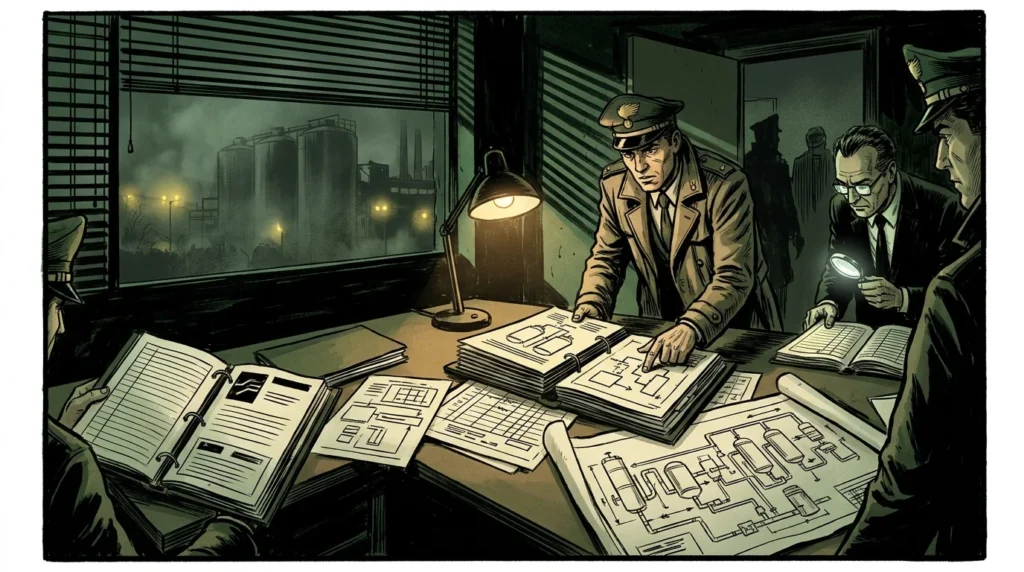
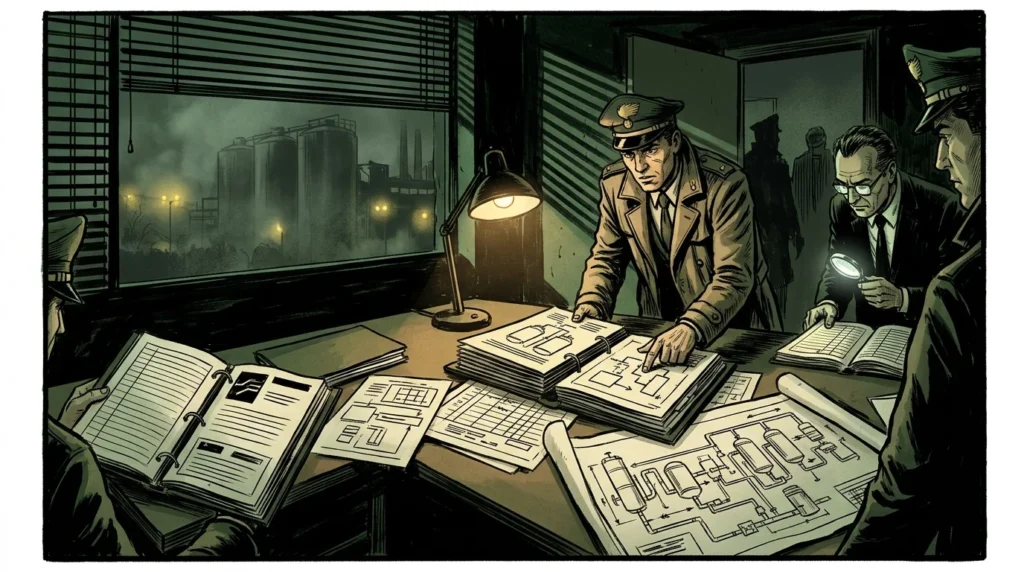
For a quarter-century between 1968 and 1993, the Italian petrochemical industry served as the financial crucible of Italy’s First Republic—a political-industrial system in which state energy holdings, subsidized credit banks, and private corporate dynasties fought for control of chemical plants while channeling billions of lire into ruling-party coffers. The arc of Italy’s “chemical wars” (guerre della chimica) unfolded in three dramatic acts: state oil boss Eugenio Cefis’s covert 1968–1971 stock-market takeover of private chemical giant Montecatini-Edison (Montedison); Sardinian petrochemical tycoon Nino Rovelli’s extraction of trillions of lire in state-subsidized loans from the public lender Istituto Mobiliare Italiano (IMI) before his Società Italiana Resine (SIR) empire collapsed in 1979; and agribusiness magnate Raul Gardini’s doomed 1988–1990 Enimont joint venture with state-owned ENI, whose buyout produced the notorious 150-billion-lire “mother of all bribes” and brought down an entire political class during the 1993 Mani Pulite (“Clean Hands”) corruption trials in Milan. [1]
The 1966 Montecatini-Edison Merger and Eugenio Cefis’s Secret Raid (1968–1971)
The financial vulnerability of Italian big business in the late 1960s traced directly to the December 1962 nationalization of the electric power industry and the creation of the state utility ENEL. Rather than paying cash to the shareholders of private electric utilities such as Milan’s powerful Edison company, the Italian state paid roughly 1,500 billion lire in ten-year compensation installments directly to the former power companies so they could redeploy the capital into manufacturing. In 1966, under the auspices of Enrico Cuccia’s merchant bank Mediobanca, cash-rich Edison merged with the heavily indebted chemical and mining group Montecatini to form Montecatini-Edison (shortened to Montedison in 1969)—instantly creating one of Europe’s largest private industrial conglomerates. [2]
Instead of modernizing Italian chemistry, the 1966 merger stalled amid boardroom paralysis under aging former Edison chief Giorgio Valerio and severe technological duplication. Observing Montedison’s depressed share price on the Milan Stock Exchange was Eugenio Cefis—a former anti-fascist partisan commander and trusted lieutenant of Enrico Mattei who had succeeded to the chairmanship of the state hydrocarbon agency Ente Nazionale Idrocarburi (ENI) in 1967. Because ENI operated its own expanding petrochemical subsidiary, ANIC, Cefis viewed Montedison both as an unruly rival and as a strategic prize. [3]
Beginning in the summer and autumn of 1968, without prior authorization from Parliament or the formal cabinet committee on economic planning, Cefis secretly deployed ENI’s abundant liquid oil and gas cash flows—working in tandem with state holding company IRI and coordinated by Mediobanca—to buy up tens of millions of Montedison shares on the Milan Bourse through nominee accounts and fiduciary intermediaries. By late 1968, the public-private voting syndicate assembled by Cefis and Cuccia controlled the decisive governing block of Montedison despite holding only a minority of total share capital, while hundreds of thousands of small retail shareholders were sidelined. [4]
In April 1971, having completed the stealthy state-backed conquest, Cefis stepped down as chairman of ENI and installed himself as chairman and chief executive of Montedison (1971–1977). In their landmark 1974 book Razza padrona (“The Master Breed”), financial journalists Eugenio Scalfari and Giuseppe Turani coined a famous term to describe Cefis’s hybrid empire: a managerial caste that used untaxed, unmonitored public money from state monopolies to annex private corporations, buy up deficit-ridden newspapers for political leverage, and distribute off-book slush funds (fondi neri) across the factions of the governing Christian Democracy (DC) and Italian Socialist Party (PSI). [5]
Nino Rovelli, State Lender IMI, and the 1979 Collapse of SIR
No sooner had Cefis taken the helm of Montedison in 1971 than he found himself locked in a ferocious war of reciprocal stock raids and duplicated refinery construction with Angelo “Nino” Rovelli, a former Italian bobsled champion and mechanical engineer who had acquired a modest phenolic resin company in Lombardy, the Società Italiana Resine (SIR), in 1948. During the 1960s and early 1970s, Rovelli discovered how to turn Italy’s southern development legislation (intervento straordinario nel Mezzogiorno) into an industrial money machine. [6]
To industrialize Sardinia, the Italian government and regional authorities offered non-repayable capital grants covering up to 20–40 percent of plant costs alongside long-term loans at heavily subsidized interest rates (credito agevolato) covering another 50–70 percent. Beginning in the early 1960s at Porto Torres in northern Sardinia and expanding later to Ottana and Calabria, Rovelli built a vast complex of ethylene crackers, oil refineries, and synthetic-fiber plants. To comply with statutory rules that capped the subsidy available to any single firm, Rovelli incorporated dozens of separate paper companies—one for each individual boiler, pipeline, or processing unit inside the Porto Torres perimeter—and inflated engineering and construction invoices executed by his own captive contracting firms so that state grants and subsidized loans exceeded 100 percent of actual physical construction costs. [7]
The principal conduit for Rovelli’s subsidized borrowing was the Istituto Mobiliare Italiano (IMI), Italy’s premier public-law industrial credit institute. Backed by influential Christian Democratic patrons and optimistic technical appraisals issued by ministerial committees (pareri di conformità), Rovelli’s SIR—alongside the rival Liquichimica group of Raffaele Ursini—borrowed trillions of lire from IMI and other special credit institutes. Using a portion of this liquidity, as well as financial backing from Cefis’s political rivals inside the ruling coalition, Rovelli secretly bought up roughly 10 to 12 percent of Montedison’s stock in the mid-1970s to challenge Cefis’s control. [8]
The 1973–1974 OPEC oil shock and the subsequent slump in European plastics and synthetic-fiber demand punctured the economics of Sardinia’s overbuilt petrochemical complexes. Crushed by soaring interest expenses on more than 3,000 billion lire (3 trillion lire) in consolidated debt, SIR defaulted on its obligations in the late 1970s. After Cefis resigned from Montedison in 1977, the Italian government and creditor banks forced Rovelli out of SIR in 1979–1980, transferring its viable chemical plants to state-owned ENI while leaving IMI and the Italian treasury to absorb massive loan write-offs. The fallout triggered both the March 1979 judicial assault on Bank of Italy Governor Paolo Baffi and Deputy Director General Mario Sarcinelli—who had ordered bank examiners to investigate the irregular SIR loans—and a decades-long civil lawsuit in which Rovelli’s heirs later won a nearly 1-billion-lire (roughly €500 million) damages award against IMI’s successor in 1990–2006, a judgment that Italy’s courts subsequently found had been procured through the bribery of Roman judges in the IMI-SIR judicial corruption scandal.
Raul Gardini and the 1988–1990 Enimont Joint Venture War
Throughout the 1980s, Italian chemistry remained split between two giant poles: ENI’s state-owned EniChem (which had absorbed the remnants of ANIC, SIR, and Liquichimica) and privatized Montedison, which by 1987 had been acquired through a leveraged market raid by Ravenna grain and agribusiness billionaire Raul Gardini, head of the Ferruzzi family group and known across Italy as Il Contadino (“The Peasant”) and skipper of the Il Moro di Venezia America’s Cup yacht. Burdened by heavy acquisition debt at Montedison, Gardini proposed merging Montedison’s basic chemical factories with ENI’s EniChem to create a unified national champion capable of competing on global markets.
In 1988–1989, ENI (led by Franco Reviglio and after late 1989 by Socialist appointee Gabriele Cagliari) and Gardini’s Montedison established the joint venture Enimont. Under the shareholding structure completed in autumn 1989, ENI held 40 percent of Enimont, Montedison held 40 percent, and the remaining 20 percent was floated on the Milan Stock Exchange. Almost immediately, the public-private partnership degenerated into open corporate warfare. Aided by substantial tax exemptions negotiated with the government on Montedison’s capital gains, Gardini quietly had allies—including French financier Jean-Marc Vernes, Tunisian businessman Ghaith Pharaon, and Italian real-estate developer Giuseppe Garofano’s associates—buy up roughly half of the 20 percent public float, giving Gardini a 51 percent de facto majority on Enimont’s board in early 1990.
Outraged that a private industrialist was seizing control of a state-backed chemical giant with public tax subsidies, the five-party governing coalition (Pentapartito) led by Prime Minister Giulio Andreotti, Socialist leader Bettino Craxi, and State Holdings Minister Franco Piga blocked Gardini’s management. In the autumn of 1990, ENI invoked a “Cowboy” shotgun buy-sell clause: Gardini had to either buy ENI’s 40 percent stake at an inflated valuation he could not afford or sell Montedison’s 40 percent stake back to ENI at that same high price. On November 22, 1990, Gardini chose to exit, selling Montedison’s 40 percent stake to ENI for a staggering 2,805 billion lire (2.8 trillion lire)—leaving the Italian state holding a loss-making chemical colossus at peak valuation.
The 150-Billion-Lire “Mother of All Bribes” and the 1993 Tangentopoli Trial
When the Milan prosecutors of the Mani Pulite (“Clean Hands”) pool—led by Antonio Di Pietro, Gerardo D’Ambrosio, Piercamillo Davigo, and Gherardo Colombo—investigated the Enimont buyout in 1992–1993, they uncovered the financial price that Gardini and Ferruzzi-Montedison executives Carlo Sama and Sergio Cusani had paid to secure the initial tax breaks and the 2,805-billion-lire state bailout. Using off-book foreign slush accounts and Vatican bank (IOR) bearer government bonds (CCTs) laundered to conceal the paper trail, Montedison had distributed 150 billion lire in illegal cash bribes—dubbed by the Italian press “the mother of all bribes” (la madre di tutte le tangenti)—to the treasurers and leaders of Italy’s political parties, including the PSI, DC, Republicans, Social Democrats, and Liberals.
In the summer of 1993, the Enimont investigation shattered the remnants of the First Republic’s leadership. On July 20, 1993, jailed former ENI chairman Gabriele Cagliari died by suicide in Milan’s San Vittore prison. Three days later, on the morning of July 23, 1993—hours before he was expected to be arrested by Milan prosecutors following Carlo Sama’s confession detailing the 150-billion-lire payoff—Raul Gardini fatally shot himself at his eighteenth-century Palazzo Belgioioso residence in Milan. Later in 1993 and early 1994, the televised Milan courtroom trial of financial intermediary Sergio Cusani brought former Prime Minister Arnaldo Forlani, former Prime Minister Bettino Craxi, and Northern League leader Umberto Bossi to the witness stand under Prosecutor Di Pietro’s cross-examination, turning the Enimont chemical scandal into the defining judicial epitaph of Italy’s post-war political order.
Theoretical & Balance-Sheet Transmission Mechanism
In the Kindleberger–Minsky taxonomy of financial instability (Kindleberger, 1978; Minsky, 1986) and Irving Fisher’s (1933) debt-deflation framework, speculative asset booms become systemic crises when credit expansion shifts balance sheets from hedge finance (cash flows covering principal and interest) to speculative and Ponzi finance (relying on rising asset prices and short-term margin roll-overs).
Once monetary tightening or an exogenous shock halts price appreciation, forced margin liquidations trigger Fisherian debt-deflation: fire-sale asset discounts erode bank collateral values, contracting credit supply across the real economy.
Sources and Further Reading
- Franco Amatori, “ Cefis, Eugenio,” Dizionario Biografico degli Italiani (Treccani), 2013. Historical & Financial Reference
- Sandro Ruju, “ Rovelli, Angelo (detto Nino) Vittorio,” Dizionario Biografico degli Italiani (Treccani), 2017. Historical & Financial Reference
- Salvatore Califano and Luigi Cerruti, “ La chimica tra scienza e tecnologia: Montedison, SIR ed Enimont,” Il Contributo italiano alla storia del Pensiero (Treccani), 2013. Historical & Financial Reference
- Istituto della Enciclopedia Italiana, “ Montedison,” Enciclopedia Treccani, 2012. Historical & Financial Reference
- Istituto della Enciclopedia Italiana, “ Enimont,” Dizionario di Storia (Treccani), 2010. Historical & Financial Reference
- Luciano Segreto, “ Gardini, Raul,” Dizionario Biografico degli Italiani (Treccani), 2015. Historical & Financial Reference
- Irving Fisher — "The Debt-Deflation Theory of Great Depressions," Econometrica 1, no. 4 (FRASER Federal Reserve Archive, 1933): 337–357 Central Bank / Monetary Authority
- Charles P. Kindleberger & Robert Z. Aliber — Manias, Panics, and Crashes: A History of Financial Crises (Palgrave Macmillan) Peer-Reviewed / Academic Research
Cite This Historical Dossier (APA / Chicago)
APA (7th ed.): Ç., S. (Ed.). (2026). Italy’s Chemical Empires: Montedison, SIR and Enimont. In Forgotten Fortunes Historical Monograph Series (Forgotten Fortunes Editorial Desk). https://forgottenfortunes.net/italy-montedison-enimont-scandal/
MLA (9th ed.): Ç., Soner, ed. "Italy’s Chemical Empires: Montedison, SIR and Enimont." Forgotten Fortunes: Financial & Monetary History Archive, 2026, https://forgottenfortunes.net/italy-montedison-enimont-scandal/.
Chicago (17th ed.): Ç., Soner, ed. "Italy’s Chemical Empires: Montedison, SIR and Enimont." Forgotten Fortunes Historical Monograph Series (Forgotten Fortunes Editorial Desk), September 17, 2026. https://forgottenfortunes.net/italy-montedison-enimont-scandal/.
Have an idea for another financial history documentary or article? Request a story →