In This Article
On February 8, 1982, the West German news magazine Der Spiegel published an investigative cover story titled “Neue Heimat: Die dunklen Geschäfte von Vietor und Genossen” (“Neue Heimat: The Dark Business Deals of Vietor and Comrades”) that shook the foundations of postwar German corporatism. Headquartered in Hamburg and owned by the German Trade Union Confederation (Deutscher Gewerkschaftsbund, or DGB), Neue Heimat had grown over three decades into the largest non-state housing and urban development conglomerate in Europe. At its peak, the group employed nearly 6,000 workers, generated annual turnover of roughly DM 6.4 billion to DM 6.5 billion across more than 100 domestic and international subsidiaries, and managed a portfolio of more than 320,000 apartments—having built or administered roughly 400,000 units since 1950. [1]
Beneath its social-democratic mandate of providing affordable housing for working families, however, Neue Heimat had accumulated a crushing debt burden of DM 17 billion while its top executives secretly enriched themselves at the expense of social-housing tenants and the company itself. Supplied with internal files copied by dismissed press spokesman John Siegfried Mehnert, Der Spiegel revealed that long-serving chief executive Albert Vietor and fellow board members had operated covert front companies that billed Neue Heimat tenants inflated fees for heating and cable television antennas. Over the next four years, the disclosures triggered a devastating financial and political crisis that forced the DGB to sell the debt-laden empire in September 1986 for a symbolic DM 1 to Berlin industrial baker Horst Schiesser, before creditor banks revolted and forced a state-mediated breakup. [2]
Postwar Reconstruction and the Rise of Union-Owned Housing
Neue Heimat’s origins lay in the acute housing shortage of bombed-out postwar West Germany and the trade-union movement’s philosophy of Gemeinwirtschaft—a common-good economy in which union-owned enterprises in banking (Bank für Gemeinwirtschaft), insurance (Volksfürsorge), retail (Co op), and social housing operated alongside private capitalism to serve workers’ welfare. Consolidated under the umbrella of the DGB in Hamburg during the early 1950s, Neue Heimat operated under West Germany’s Law on Non-Profit Housing (Wohnungsgemeinnützigkeitsgesetz), which exempted certified housing associations from corporate, trade, and wealth taxes in exchange for capping shareholder dividends at 4 percent and reinvesting surpluses into affordable housing construction. [3]
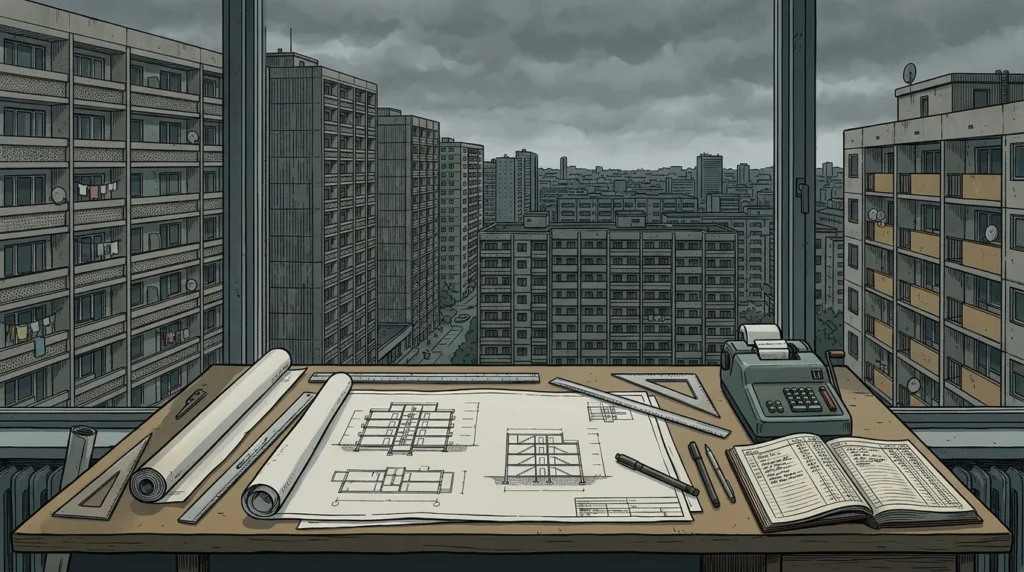
Throughout the Wirtschaftswunder of the 1950s and 1960s, Neue Heimat became the primary instrument of West German municipal social housing policy. Operating under the corporate motto “Wir machen alles” (“We do everything”), the conglomerate designed and built vast modernist satellite estates that reshaped West German cities, including Neu-Altona and Mümmelmannsberg in Hamburg, the Neue Vahr in Bremen (featuring an iconic residential high-rise by Finnish architect Alvar Aalto), Emmertsgrund in Heidelberg, and the massive Neuperlach relief town in Munich, planned for 80,000 residents. According to the federal government’s May 1986 parliamentary accounting to the Bundestag, Neue Heimat received approximately DM 10 billion in public housing subsidies and state loans over its history to construct social apartments across the Federal Republic. [4]
Commercial Overexpansion and the DM 17 Billion Debt Mountain
Under Albert Vietor, who rose to become chairman of the management board in 1963 and ruled the Hamburg headquarters with autocratic authority that earned him the nickname “King Albert,” Neue Heimat outgrew the legal and financial boundaries of regulated social housing. Because non-profit housing companies were legally restricted to residential construction and management, Vietor established a parallel network of taxable commercial subsidiaries—most notably Neue Heimat Städtebau (NH Städtebau) and Neue Heimat International—to pursue large-scale municipal, commercial, and foreign real estate projects. [5]
During the late 1960s and 1970s, NH Städtebau and its sister entities embarked on an aggressive, debt-financed expansion into prestige civic architecture and speculative commercial developments. The group constructed shopping centers, town halls, school complexes, the giant University Hospital in Aachen, and the monumental International Congress Center (ICC) in West Berlin, while purchasing vast tracts of unbuilt land across West Germany on credit in anticipation of rising property values. Internationally, Neue Heimat built luxury hotels in Monaco, office complexes in France, and vacation apartments and land speculations in Venezuela, Brazil, and Mexico.
This global expansion rested on a fatally thin capital base. As the Federal Ministry for Regional Planning, Building and Urban Development documented in Bundestag Drucksache 10/5452 in May 1986, the individual trade unions and the DGB holding company—the Beteiligungsgesellschaft für Gemeinwirtschaft (BGAG)—failed to equip Neue Heimat with adequate equity capital. Instead, the conglomerate financed long-term land stockpiles and commercial construction almost entirely through bank borrowing, frequently using short-term loans to fund long-term illiquid projects. When the oil shocks of the 1970s slowed urban growth and the West German Bundesbank tightened monetary policy at the turn of the 1980s, interest rates spiked and property markets stagnated. Unsold commercial properties, vacant high-cost apartments, and speculative land holdings generated hundreds of millions of marks in annual interest charges, pushing Neue Heimat’s consolidated liabilities to roughly DM 17 billion by the mid-1980s. [6]
The February 1982 Der Spiegel Exposé and Front-Company Self-Dealing
While Neue Heimat’s balance sheet deteriorated behind closed doors, its senior executives were covertly diverting cash flows into their private pockets. The mechanism was exposed by John Siegfried Mehnert, a former journalist in his early forties whom Vietor had hired—and subsequently fired—as Neue Heimat’s press spokesman. Before leaving the Hamburg headquarters, Mehnert photocopied internal trust agreements and accounting records documenting systematic self-dealing by Vietor and fellow board members. After the magazine Stern hesitated to publish the material, Mehnert handed the dossier to Der Spiegel, which broke the story on February 8, 1982. [7]
The leaked documents revealed three interlocking patterns of executive abuse:
- Heating and Antenna Front Companies: Vietor and other top managers secretly held private equity stakes—concealed behind trustees and strawmen (Strohmänner)—in service companies that held lucrative long-term contracts with Neue Heimat estates. One prominent vehicle, the district-heating supplier Teletherm, sold heat to thousands of Neue Heimat social-housing apartments, while other front firms installed and maintained communal television antenna and cable systems. While Neue Heimat collected regulated rents and struggled with mounting deficits, its executives skimmed guaranteed private profits from the tenants’ utility and ancillary charges.
- Insider Real Estate Transactions: Board members exploited advance insider knowledge of Neue Heimat’s urban development plans to acquire land and stakes in construction suppliers through private investment vehicles, steering profitable contracts and tax-write-off partnerships toward firms in which they held hidden beneficial ownership.
- Supervisory Breakdown: The supervisory board, packed with prominent West German trade-union leaders headed by DGB chairman Heinz-Oskar Vetter, had rubber-stamped Vietor’s expansion for nearly two decades without auditing the web of subsidiary companies or enforcing conflict-of-interest rules.
Initially, DGB chairman Vetter reacted defensively, declaring that the unions were “man enough to deal with the abuses in our own ranks ourselves” and would not fall into “self-destructive convulsions” over press reports. Within days, however, the scale of the documentary evidence forced the supervisory board to dismiss Albert Vietor (who died in November 1984 before criminal proceedings concluded) and several fellow executives. [8]
Horst Schiesser’s DM 1 Purchase and the 1986 Creditor Revolt
Vietor’s dismissal exposed the full depth of Neue Heimat’s financial hole. Between 1982 and 1986, the DGB and its holding company BGAG injected hundreds of millions of marks in union funds, sold off tens of thousands of apartments, and sought state assistance to keep the conglomerate afloat. In May 1986, Federal Construction Minister Oscar Schneider (CSU) reported to the Bundestag that Neue Heimat’s crisis stemmed directly from equity undercapitalization, speculative land purchases, unhedged interest-rate exposure, and heavy losses in NH Städtebau and international subsidiaries, warning that employees, tenants, creditor banks, and taxpayers were all affected.
Facing relentless financial bleeding and devastating political damage ahead of the January 1987 federal election, the DGB leadership under Vetter’s successor, Ernst Breit, and BGAG chief Hans Matthöfer looked for an immediate exit. On September 18, 1986, the DGB stunned the West German public and Neue Heimat’s 150 creditor banks by announcing that it had sold the core Neue Heimat housing group—still burdened with roughly DM 17 billion in debt—for the symbolic price of exactly DM 1 to Horst Schiesser, a largely unknown West Berlin industrial baker and real estate investor. At a turbulent press conference, DGB chairman Breit admitted that he did not know Schiesser personally and had left the negotiations entirely to BGAG’s management board.
The DM 1 sale collapsed within weeks. Neue Heimat’s creditor banks, led by major West German commercial and mortgage institutions, refused to roll over billions in credit lines to an undercapitalized bakery entrepreneur who lacked banking backing and housing-sector expertise. Confronted with threats by the banks to call in loans and force a disorderly bankruptcy—which would have wiped out the DGB’s own union bank, Bank für Gemeinwirtschaft, and triggered chaos for hundreds of thousands of tenants—theBGAG was forced to buy Neue Heimat back from Schiesser in November 1986 and accept a state-and-bank-supervised liquidation.
Breakup, Parliamentary Inquiry, and the End of Wohnungsgemeinnützigkeit
Following the aborted Schiesser transaction, the DGB appointed trustee Heinz Sippel to dismantle Neue Heimat through regional transfers. Between 1987 and 1990, the bulk of the apartments were taken over by state-backed housing companies and municipal consortia in federal states such as Hamburg, Bremen, Hesse, North Rhine-Westphalia, and Lower Saxony, while profitable regional portfolios—such as Neue Heimat Bayern with 33,000 apartments and 900,000 square meters of land, sold in May 1990 for DM 960 million to Munich property investor Alfons Doblinger—were auctioned off to private buyers.
The political and institutional consequences reshaped German housing policy for decades. Both the Hamburg state parliament and the German Bundestag established formal parliamentary committees of inquiry (Untersuchungsausschüsse) into the Neue Heimat affair. Disillusioned by how Europe’s largest non-profit housing group had abused tax-exempt status to mask commercial speculation and executive self-enrichment, Chancellor Helmut Kohl’s Christian Democratic–Free Democratic coalition passed the Tax Reform Act of 1990 (enacted in 1988), which abolished the Wohnungsgemeinnützigkeitsgesetz effective January 1, 1990. For the West German labor movement, the collapse of Neue Heimat permanently discredited the postwar ideal of union-owned Gemeinwirtschaft, forcing the DGB to liquidate or privatize virtually its entire commercial empire by the 1990s.
Theoretical & Balance-Sheet Transmission Mechanism
In the Kindleberger–Minsky taxonomy of financial instability (Kindleberger, 1978; Minsky, 1986) and Irving Fisher’s (1933) debt-deflation framework, speculative asset booms become systemic crises when credit expansion shifts balance sheets from hedge finance (cash flows covering principal and interest) to speculative and Ponzi finance (relying on rising asset prices and short-term margin roll-overs).
Once monetary tightening or an exogenous shock halts price appreciation, forced margin liquidations trigger Fisherian debt-deflation: fire-sale asset discounts erode bank collateral values, contracting credit supply across the real economy.
Sources and Further Reading
- Deutscher Bundestag, “ Antwort der Bundesregierung auf die Große Anfrage: Neue Heimat (Drucksache 10/5452),” Deutscher Bundestag, 1986-05-09. Historical & Financial Reference
- Stiftung Historische Museen Hamburg and Architekturmuseum der TUM, “ Die Neue Heimat (1950–1982): Eine sozialdemokratische Utopie und ihre Bauten,” Museum für Hamburgische Geschichte, 2019. Historical & Financial Reference
- Otto Langels, “ Vor 30 Jahren: DGB muss Wohnungsbaukonzern Neue Heimat verkaufen,” Deutschlandfunk, 2016-09-18. Historical & Financial Reference
- Deutschlandfunk, “ Geschichte aktuell: Eigennutz statt Gemeinnutz,” Deutschlandfunk, 2007-02-07. Historical & Financial Reference
- Der Spiegel, “ Unschöne Sachen gelaufen,” Der Spiegel, 1990-05-13. Historical & Financial Reference
- Die Welt, “ Als die Neue Heimat plötzlich ganz alt aussah,” Die Welt, 2017-02-04. Historical & Financial Reference
- Irving Fisher — "The Debt-Deflation Theory of Great Depressions," Econometrica 1, no. 4 (FRASER Federal Reserve Archive, 1933): 337–357 Central Bank / Monetary Authority
- Charles P. Kindleberger & Robert Z. Aliber — Manias, Panics, and Crashes: A History of Financial Crises (Palgrave Macmillan) Peer-Reviewed / Academic Research
Cite This Historical Dossier (APA / Chicago)
APA (7th ed.): Ç., S. (Ed.). (2026). The Neue Heimat Scandal: How Corruption Toppled Europe's Largest Union Housing Empire. In Forgotten Fortunes Historical Monograph Series (Forgotten Fortunes Editorial Desk). https://forgottenfortunes.net/neue-heimat-union-housing-scandal-collapse/
MLA (9th ed.): Ç., Soner, ed. "The Neue Heimat Scandal: How Corruption Toppled Europe's Largest Union Housing Empire." Forgotten Fortunes: Financial & Monetary History Archive, 2026, https://forgottenfortunes.net/neue-heimat-union-housing-scandal-collapse/.
Chicago (17th ed.): Ç., Soner, ed. "The Neue Heimat Scandal: How Corruption Toppled Europe's Largest Union Housing Empire." Forgotten Fortunes Historical Monograph Series (Forgotten Fortunes Editorial Desk), September 9, 2026. https://forgottenfortunes.net/neue-heimat-union-housing-scandal-collapse/.
Have an idea for another financial history documentary or article? Request a story →