In This Article
Across the five centuries of Egypt’s New Kingdom (c. 1570–1069 BCE), long-distance commerce across the Eastern Mediterranean rested on a shifting balance between military coercion, royal diplomatic gift-exchange, and weight-denominated bullion accounting [1][2][4]. After Pharaoh Ahmose I expelled the Hyksos rulers of Lower Egypt around 1570 BCE and Thutmose III consolidated Egyptian hegemony over Canaan and Syria in the fifteenth century BCE, Egyptian state procurement drew heavily on vassal tribute and reciprocal royal shipments documented in the Amarna Letters and the archaeological cargo of the Uluburun shipwreck [1][2][3]. By the end of the Twentieth Dynasty around 1070 BCE, however, the collapse of unified pharaonic authority transformed Levantine procurement: as portrayed in the ancient literary Report of Wenamun, a ruler in Byblos insisted on payment and consulted ancestral accounts rather than simply obeying the visiting Egyptian envoy [4]. The text was once treated as an official voyage report; scholars now generally read it as literature reflecting contemporary conditions, not an audited record of individual transactions [4].

Imperial Foundations and Levantine Vassalage (c. 1570–1425 BCE)
The territorial expansion of the Eighteenth Dynasty began under Ahmose I (r. c. 1570–1544 BCE), whose victory over the Hyksos inaugurated the Egyptian Empire [1]. Every succeeding monarch of the dynasty maintained or enlarged those frontiers, transforming the Nile state into the dominant military and commercial power of the Eastern Mediterranean [1].
Following the prosperous regency and reign of Queen Hatshepsut (r. 1479–1458 BCE), a coalition of Canaanite and Syrian rulers led by the kings of Megiddo and Kadesh rebelled against her successor, Thutmose III (sole reign 1458–1425 BCE) [1]. Over twenty years, Thutmose III conducted seventeen military campaigns—inscribed on the walls of the Temple of Amun at Karnak—beginning with his decisive victory at the Battle of Megiddo [1]. Although Egyptian troops initially delayed the capture of the city by pausing on the battlefield to plunder the enemy’s abandoned camp, Thutmose III constructed a surrounding moat and wooden stockade that forced Megiddo to surrender after a siege of seven to eight months [1].
Rather than executing the defeated Canaanite and Syrian rulers or razing their cities, Thutmose III instituted a calculated system of imperial governance: rebel kings were spared on oath of loyalty, while their children were taken to Egypt as well-cared-for royal hostages and educated at the Theban court [1]. This hostage mechanism secured the Levantine coastal corridors and inland trade routes, ensuring that timber, copper, wine, and luxury goods flowed reliably into Egyptian state and temple storehouses as tribute and regulated trade [1].
The Amarna Diplomatic System and the Uluburun Cargo (14th Century BCE)
By the fourteenth century BCE, during the reigns of Amenhotep III and Akhenaten, Egypt’s commercial and diplomatic relations with the great powers of the Near East—Babylon, Hatti (the Hittites), Mitanni, and Assyria—as well as Levantine vassal states were coordinated through an elaborate international system preserved in the Amarna Letters [2]. Discovered at Tell el-Amarna (ancient Akhetaten) beginning in 1887 CE and comprising 382 known cuneiform clay tablets (350 diplomatic letters alongside scribal training texts), the archive records both lettres d’envoi (inventories of gifts dispatched) and lettres d’injonction (requests for reciprocal commodities and strategic materials) [2].
The physical scale and multi-ethnic organization of this fourteenth-century BCE maritime trade were revealed in 1984 CE when marine archaeologists from the Institute of Nautical Archaeology excavated the Uluburun shipwreck off the coast of Kaş, Turkey [3]. Dated between 1330 and 1300 BCE and constructed of Lebanese cedar planking with oak tenons, the 15-meter Syro-Canaanite merchant vessel carried more than 17 tons of high-value raw materials and elite manufactures that closely match the royal gift inventories of the Amarna tablets [2][3]:
- Copper and tin bullion: The bulk cargo consisted of 348 Cypriot copper “oxhide” and bun ingots totaling 10 tons—stowed in four herringbone rows along the hold—paired with 120 tin ingots weighing over 1 ton sourced from the Taurus Mountains and Central Asia, sufficient to cast roughly 11 tons of bronze [3].
- Resin, glass, and African exotica: The hold contained roughly 150 Canaanite amphorae filled with terebinth resin, approximately 175 raw glass disk ingots (weighing 350 kilograms in cobalt blue, turquoise, purple, and yellow), 24 African ebony logs, an elephant tusk, and 14 hippopotamus teeth [3].
- Bullion weights and merchant balances: Personal effects and commercial tools aboard indicate the presence of four Canaanite or Phoenician merchants—equipped with four sets of balance-pan weights, including an zoomorphic master set, alongside scrap gold and silver jewelry used for fractional bullion payments—and at least two Mycenaean Greek passengers [3].
Standardized Silver-Deben Accounting in Phoenician Ports
Because the Bronze Age Mediterranean operated without minted coinage, international clearing between Egyptian institutions and Levantine ports relied on weighing precious metals against standardized units, principally the Egyptian deben (approximately 91 grams of metal) [3][4]. Foreign princes in timber-exporting hubs such as Byblos and Sidon did not merely ship cedar logs out of religious deference to the Egyptian god Amun; they maintained multi-generational palace daybooks recording the exact quantities of silver and manufactured cargoes delivered by previous pharaohs [4].
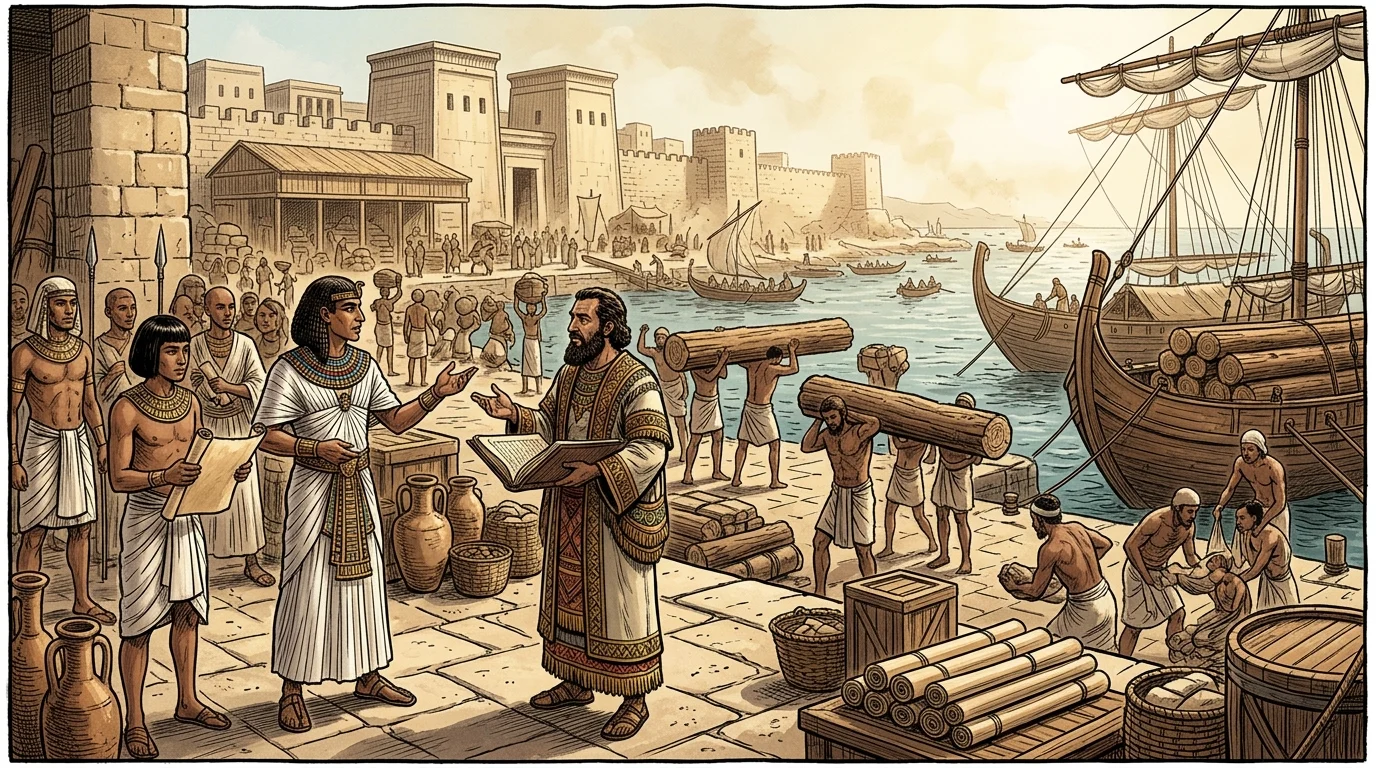
Even as Egyptian political unity fractured at the close of the Twentieth Dynasty (c. 1070 BCE)—when the High Priest of Amun, Herihor, ruled Upper Egypt from Thebes while Smendes (Nesbanebdjed) and Tentamun governed Lower Egypt from Tanis—commercial fleets continued plying the Levantine coast [4]. In the Report of Wenamun (preserved on Moscow Papyrus 120), the prince of Byblos describes twenty merchant ships in his harbor maintained active commercial partnerships with Smendes at Tanis, while another fifty ships at Sidon traded in consortium with the merchant Werekter [4].
The Report of Wenamun: Bullion Theft, Daybooks, and Cash Settlement
The literary story illustrates the fragility of relying on imperial prestige without adequate means of payment. In that narrative, Herihor dispatches the temple official Wenamun (“Elder of the Portal of the Temple of Amun”) from Karnak via Tanis to Byblos to procure cedar timber for the sacred river-bark of Amen-Re [4]. Departing with a portable cult image (“Amun-of-the-Road”) and a modest purchase fund consisting of one gold vessel worth 5 deben, four silver jars worth 20 deben, and a sack containing 11 deben of silver—a total of 5 deben of gold and 31 deben of silver—Wenamun moored first at the Tjeker port of Dor [4].
While docked at Dor, a crewman from Wenamun’s own vessel absconded with the entire 5 deben of gold and 31 deben of silver [4]. When Wenamun demanded that Beder, the local prince of Dor, reimburse the stolen treasure from his own storehouse because the money belonged to Amen-Re, Smendes, Herihor, and the prince of Byblos, Beder dryly rejected the claim: had a local resident of Dor boarded the ship and stolen the silver, Beder explained, he would have advanced restitution from his treasury until the culprit was caught, but because the thief belonged to Wenamun’s own crew, the port owed no indemnity [4]. After waiting nine days in vain, Wenamun sailed north toward Tyre and Byblos, seizing 30 deben of silver from a Tjeker ship en route as unilateral collateral for his lost funds [4].
Upon reaching Byblos without adequate payment or formal credentials, Wenamun discovered that the city’s ruler, Tjekerbaal (Zakar-Baal), refused to grant him an audience for twenty-nine days, ordering him out of the harbor daily until a courtier fell into an ecstatic prophetic trance demanding that the envoy of Amun be heard [4]. When Wenamun appealed to Tjekerbaal to supply cedar timber just as his father and grandfather had done for earlier pharaohs, the Phoenician ruler repudiated the notion of unpaid tributary obligation [4]. Tjekerbaal ordered the ancestral palace daybooks brought out and read aloud before Wenamun, and claimed that previous Egyptian rulers had sent six ships of goods and 1,000 deben of silver. These are figures in a literary narrative, not independently verified invoices [4].
Declaring that he was neither Wenamun’s servant nor the servant of the ruler who sent him, Tjekerbaal agreed only to fell the first seven cedar logs as an advance and ship them to Egypt with Wenamun’s messenger so that Smendes and Tentamun could remit real commercial payment [4]. Only when the messenger returned from Egypt in the first month of winter carrying jars of gold and silver, fine royal linen, 500 fine-linen cloth pieces, 500 ox-hides, 500 ropes, 20 sacks of lentils, and 30 baskets of fish did Tjekerbaal command 300 men and 300 oxen to fell and haul the full consignment of cedar down to the shore [4].
In the narrative, eleven Tjeker warships subsequently arrive outside Byblos demanding Wenamun’s arrest for the 30 deben of silver he had seized at sea, Tjekerbaal consoled the anxious envoy with two jugs of wine, a sheep, and the Egyptian songstress Tentne, then upheld sovereign harbor immunity: declaring “I cannot arrest the envoy of Amun in my country,” the prince put Wenamun aboard a swift vessel and allowed the Tjeker fleet to pursue him only after he cleared territorial waters [4]. Blown by gale winds to Alashiya (Cyprus), where the narrative papyrus breaks off, the literary account dramatizes a decline in Egypt’s ability to rely on imperial authority alone. It is valuable evidence of contemporary attitudes toward diplomacy and payment, but not proof that every named voyage, ruler’s demand, or payment actually occurred [4].
Theoretical & Balance-Sheet Transmission Mechanism
In the Kindleberger–Minsky taxonomy of financial instability (Kindleberger, 1978; Minsky, 1986) and Irving Fisher’s (1933) debt-deflation framework, speculative asset booms become systemic crises when credit expansion shifts balance sheets from hedge finance (cash flows covering principal and interest) to speculative and Ponzi finance (relying on rising asset prices and short-term margin roll-overs).
Once monetary tightening or an exogenous shock halts price appreciation, forced margin liquidations trigger Fisherian debt-deflation: fire-sale asset discounts erode bank collateral values, contracting credit supply across the real economy.
Sources and Further Reading
- Joshua J. Mark, “ Thutmose III at The Battle of Megiddo,” World History Encyclopedia, 2017-07-24. Historical & Financial Reference
- Priscila Scoville, “ Amarna Letters,” World History Encyclopedia, 2015-11-06. Historical & Financial Reference
- Mark Cartwright, “ Uluburun Shipwreck,” World History Encyclopedia, 2017-06-16. Historical & Financial Reference
- Joshua J. Mark, “ The Report of Wenamun: Text & Commentary,” World History Encyclopedia, 2017-06-30. Historical & Financial Reference
- Irving Fisher — "The Debt-Deflation Theory of Great Depressions," Econometrica 1, no. 4 (FRASER Federal Reserve Archive, 1933): 337–357 Central Bank / Monetary Authority
- Charles P. Kindleberger & Robert Z. Aliber — Manias, Panics, and Crashes: A History of Financial Crises (Palgrave Macmillan) Peer-Reviewed / Academic Research
Cite This Historical Dossier (APA / Chicago)
APA (7th ed.): Ç., S. (Ed.). (2026). New Kingdom Egypt: Imperial Trade Networks, Silver Accounting, and Wenamun. In Forgotten Fortunes Historical Monograph Series (Forgotten Fortunes Editorial Desk). https://forgottenfortunes.net/new-kingdom-egypt-trade-imperial-networks/
MLA (9th ed.): Ç., Soner, ed. "New Kingdom Egypt: Imperial Trade Networks, Silver Accounting, and Wenamun." Forgotten Fortunes: Financial & Monetary History Archive, 2026, https://forgottenfortunes.net/new-kingdom-egypt-trade-imperial-networks/.
Chicago (17th ed.): Ç., Soner, ed. "New Kingdom Egypt: Imperial Trade Networks, Silver Accounting, and Wenamun." Forgotten Fortunes Historical Monograph Series (Forgotten Fortunes Editorial Desk), August 29, 2026. https://forgottenfortunes.net/new-kingdom-egypt-trade-imperial-networks/.
Have an idea for another financial history documentary or article? Request a story →