In This Article
At its sixteenth-century zenith, the Songhai Empire commanded the largest territorial and commercial state in West African history, stretching from the Senegal-Gambia basin near the Atlantic coast eastward to the Hausa city-states of Kano, Katsina, and Zaria in modern Nigeria, and northward into the Sahara to the rock-salt mines of Taghaza [1][2]. Anchored along the great bend of the Niger River—West Africa’s primary commercial artery—the empire linked forest-zone goldfields and savannah agriculture to trans-Saharan caravan routes bound for Morocco, Tripoli, and Egypt [1][2][4].

Between 1550 and 1591, however, the very wealth generated by Songhai’s riverine and desert trade corridors exposed the empire to converging internal and external fiscal shocks [1][2][4]. While recurring succession wars among the descendants of Askia Muhammad I fractured central authority after 1582, a severe treasury crisis in neighboring Morocco prompted the Saadi Sultanate—armed with English-supplied artillery and muskets—to launch an audacious cross-desert invasion [1][2][5]. On March 13, 1591, at the Battle of Tondibi near the imperial capital of Gao, Moroccan gunpowder forces shattered the Songhai army, seizing the royal treasury and permanently dismantling the unified fiscal and regulatory architecture of the western Sudan [1][2][5].
Imperial Treasury Administration and the Askia Bureaucracy
Although King Sunni Ali (r. 1464–1492) forged the empire’s territorial core through armored cavalry and a specialized fleet of Niger River war canoes—conquering the famed trading and scholarly cities of Timbuktu in 1468 and Djenné shortly thereafter—it was his successor, Askia Muhammad I (Muhammad Ture, known as Askia the Great, r. 1493–1528), who institutionalized Songhai’s fiscal and bureaucratic state [1][2][4]. Replacing Sunni Ali’s ad-hoc military levies with a permanent professional army and provincial governorships, Askia Muhammad surrounded the throne with a specialized executive staff composed of counselors, secretaries, treasurers, stewards, and auditors [1][2].
These treasury officers audited provincial tribute, managed royal estates worked by enslaved laborers, and oversaw customs collections across river ports and desert caravan terminals [1][2][4]. During his celebrated pilgrimage (hajj) to Mecca in the late 1490s, Askia Muhammad advertised the liquidity of the Songhai treasury by distributing roughly 100,000 gold pieces in charity and almsgiving, receiving the honorary title of Caliph of the Sudan while appointing Islamic judges (qadis) to enforce commercial contract law in Timbuktu, Djenné, and Gao without forcibly converting the predominantly non-Muslim rural peasantry [1][2].
The resilience of this administrative bureaucracy was tested in 1528, when Askia Muhammad’s sons revolted, deposed their aging father, and installed his son Askia Musa on the throne [1]. Musa’s accession ignited a bloody dynastic civil war in which dozens of royal kinsmen were killed before Musa himself was assassinated by his brothers in 1531 [1]. Yet because day-to-day tax assessment, customs accounting, and judicial administration were handled by career secretaries, treasurers, and urban qadis, the empire’s fiscal machinery survived two decades of palace coups and returned to stability during the long reign of Askia Daoud (r. 1549–1582) [2][4].
The Niger River Superhighway and Market Governance in Gao, Timbuktu, and Djenné
During the mid-sixteenth century (c. 1550–1582), Songhai’s prosperity rested on its unified control over the middle Niger River and the intersecting trans-Saharan caravan trails [2][4]. Integrating diverse linguistic and ethnic communities—including Songhai, Mande, Fulbe, Mossi, and Tuareg populations—the river corridor allowed bulk agricultural goods, dried fish, kola nuts, dates, ivory, leather, and enslaved captives to move cheaply by boat between the inland delta hub of Djenné, the caravan entrepôt of Timbuktu, and the administrative capital of Gao [1][2][3].
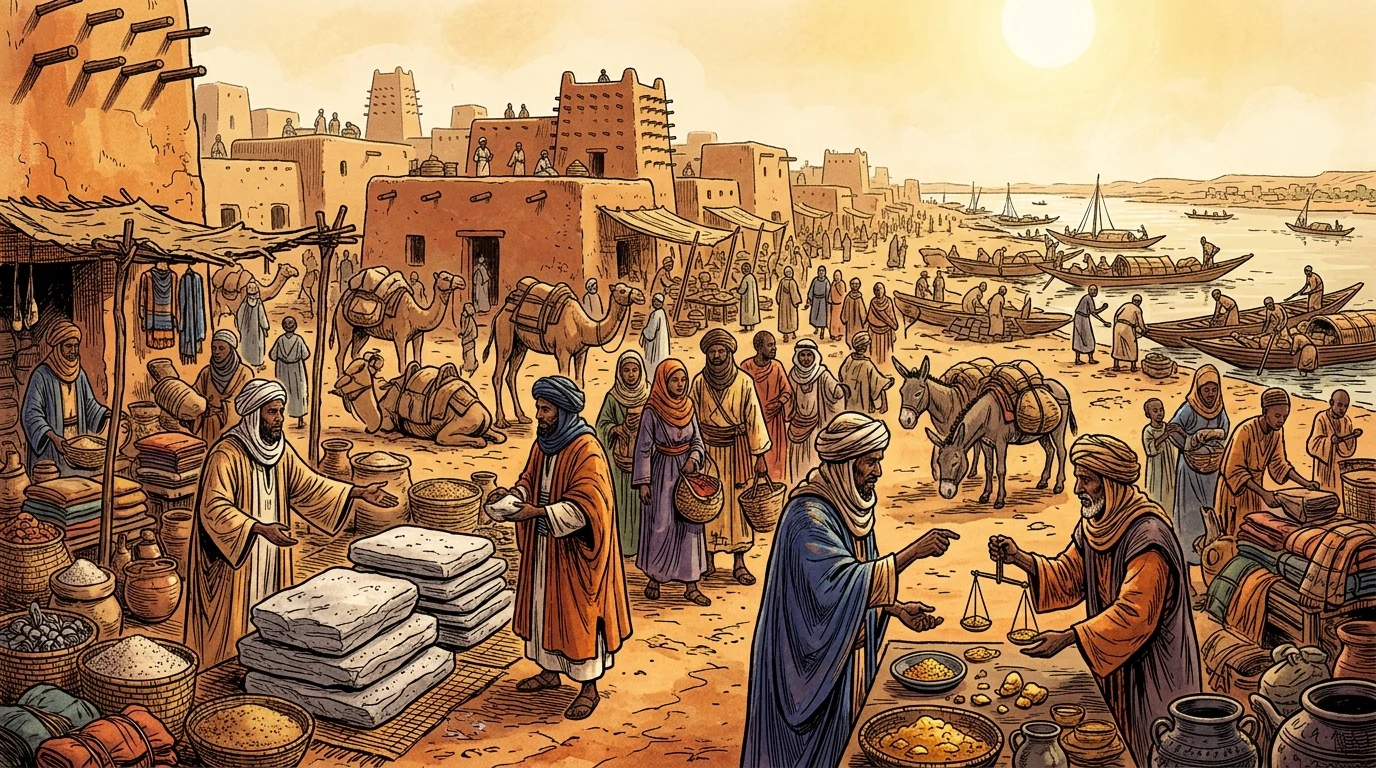
At its sixteenth-century peak, Gao housed roughly 100,000 inhabitants and operated as a bustling clearinghouse where North African textiles, horses, copperware, and Saharan rock salt were exchanged for West African gold and captives [1][2]. In a contemporary firsthand account quoted by historians, the sixteenth-century Moroccan diplomat and traveler Leo Africanus (al-Hasan ibn Muhammad al-Wazzan) noted that while the Songhai king personally supervised state affairs alongside his treasurers and auditors, Gao’s merchant assemblies conducted high-volume trade priced in gold coinage—recording that a fifteen-year-old enslaved person sold in the Gao market for six gold ducats [1].
To maintain merchant confidence across such vast distances, Songhai municipal authorities enforced strict market regulations [2]. Local market inspectors policed trading plazas and verified the accuracy of official weights and measures to prevent fraud in gold-dust and salt transactions, working alongside the heads of urban craft guilds [2]. Simultaneously, local tax collectors levied progressive assessments in physical goods—requiring wealthy merchants and landowners to pay substantially more than poorer subjects—and channeled those commodity revenues to provision the standing army, sustain the royal court, and fund urban poor relief [2].
The Salt–Gold Chokepoints and Mid-Century Geopolitical Pressures
Songhai’s fiscal model depended above all on controlling the bilateral terms of trade between two strategic commodities: southern gold and northern desert salt [1][2][3]. Far to the southwest, the ancient city of Djenné—settled since 250 BCE—functioned as the primary inland collection hub for gold arriving from the southern forest mines and for agricultural surpluses heading north to Timbuktu [3]. Far to the north in the hyper-arid Sahara, Songhai sovereignty encompassed the salt mines of Taghaza, where slabs of rock salt were quarried and loaded onto camel caravans heading south to the Niger bend [1][2].
By the mid-1500s, this trans-Saharan circuit faced growing external pressure from both the Atlantic coast and North Africa [1][2][4]. Along the West African littoral, Portuguese maritime traders had established fortified coastal trading posts that diverted a growing slice of West African gold away from inland caravan routes—a shift that had already prompted Songhai rulers to push eastward into the commercial cities of Hausaland (attacking Gobir, Katsina, and Zaria and exacting heavy tribute from Kano) to diversify imperial revenues [1][2]. Meanwhile, to the north, the rising Saadi Sultanate of Morocco coveted direct control over the Taghaza salt mines and the gold taxes of Timbuktu, sparking recurring border clashes and temporary closures of the Taghaza mines during the 1550s and 1570s [4].
Saadi Fiscal Crisis, English Gunpowder, and the Battle of Tondibi (1591)
The decisive crisis that destroyed the Songhai Empire originated in the fiscal exhaustion of Morocco [1]. In 1578, the Saadi Sultanate defeated a major Portuguese invasion at the Battle of Alcácer Quibir (Wadi al-Makhazin), elevating Sultan Ahmad I al-Mansur (“the Golden Conqueror,” r. 1578–1603) to power [1][2]. Yet the war and subsequent military expenditures drained the Moroccan imperial coffers, leaving the sultanate on the brink of bankruptcy [1]. Determined to replenish his treasury at the source, Ahmad al-Mansur resolved to bypass Saharan middlemen and conquer the gold-and-salt arteries of the Songhai Empire outright [1][2].
Morocco’s financial ambition converged with the anti-Spanish diplomacy of Queen Elizabeth I of England [1]. Seeking a North African ally against King Philip II of Spain, Elizabeth I supplied the Saadi Sultanate with English firearms, gunpowder ammunition, and artillery cannon [1]. Simultaneously, Ahmad al-Mansur recruited thousands of exiled Spanish Muslims (Andalusians) and European mercenaries trained in arquebus and artillery warfare [1][5].
In Songhai, meanwhile, the death of Askia Daoud in 1582 had plunged the court at Gao back into destructive fratricidal warfare [2][4]. A bitter civil war in 1586 between Askia Muhammad IV Bano and his brothers effectively split the empire in two, and when Askia Ishaq II ascended the throne in 1588, the state had barely begun to recover its administrative cohesion [1][2]. In late 1590, Ahmad al-Mansur dispatched an elite expeditionary force of roughly 4,000 musketeers and artillerymen under the Spanish-born commander Judar Pasha across the Sahara [2][5].
On March 13, 1591, Judar Pasha’s column met the main Songhai imperial army at Tondibi, just north of Gao [1][5]. Although Askia Ishaq II fielded a vastly larger host estimated at roughly 30,000 infantry and 10,000 cavalry, his soldiers were armed only with lances, sabers, and bows [1][2][5]. Moroccan volleys of musket and cannon fire panicked the cattle herds driven ahead of the Songhai lines and decimated the charging cavalry [2][5]. Outmatched by European-supplied gunpowder technology, the Songhai army was routed, Askia Ishaq II was later deposed and killed, and Moroccan forces sacked Gao, Timbuktu, and Djenné, seizing the imperial treasury [1][2][5].
Fragmentation of the Western Sudan and Urban Resilience
Ironically, the 1591 conquest proved a fiscal mirage for the Saadi dynasty in the long run [2][4][5]. Governing a territory separated from Marrakesh by a perilous multi-month desert crossing proved prohibitively expensive, and guerrilla resistance by Songhai remnants downstream in the Dendi region, combined with Tuareg and Fulbe raids, disrupted the very caravan security on which trans-Saharan customs revenues depended [2][4]. By the early seventeenth century, Moroccan governors in Timbuktu (the Arma pashalik) operated largely independently of Marrakesh, while West African gold increasingly flowed southward to European ships on the Atlantic coast rather than northward across the Sahara [2][4].
Even after the collapse of Songhai’s central fiscal state, however, the urban and artisanal institutions of the Niger bend endured [2][3]. In commercial centers such as Djenné, Moroccan administrative presence blended with indigenous traditions, introducing distinctive two-story earthen house facades punctuated by vertical buttresses and intricate monumental entrances [3]. The physical and economic continuity of these market cities was sustained across centuries by local craft organizations such as the Barey, Djenné’s hereditary guild of master masons who passed earthen construction techniques from father to son—preserving the urban fabric of the Niger trade corridor long after the Askia imperial treasury had vanished [3].
Theoretical & Balance-Sheet Transmission Mechanism
In the Kindleberger–Minsky taxonomy of financial instability (Kindleberger, 1978; Minsky, 1986) and Irving Fisher’s (1933) debt-deflation framework, speculative asset booms become systemic crises when credit expansion shifts balance sheets from hedge finance (cash flows covering principal and interest) to speculative and Ponzi finance (relying on rising asset prices and short-term margin roll-overs).
Once monetary tightening or an exogenous shock halts price appreciation, forced margin liquidations trigger Fisherian debt-deflation: fire-sale asset discounts erode bank collateral values, contracting credit supply across the real economy.
Sources and Further Reading
- Ann Kordas, Ryan J. Lynch, Brooke Nelson, and Julie Tatlock, “ 3.2 The Songhai Empire – World History Volume 2, from 1400,” OpenStax / Rice University, 2022-12-21. Historical & Financial Reference
- Mark Cartwright, “ Songhai Empire,” World History Encyclopedia, 2019-03-08. Historical & Financial Reference
- UNESCO World Heritage Centre, “ Old Towns of Djenné,” UNESCO. Historical & Financial Reference
- Encyclopaedia Britannica, “ Songhai empire (” Encyclopaedia Britannica),” Encyclopaedia Britannica. Historical & Financial Reference
- Mathew Lyons, “ Fall of Africa’s Greatest Empire,” History Today (Vol. 71, Issue 3), 2021-03. Historical & Financial Reference
- Irving Fisher — "The Debt-Deflation Theory of Great Depressions," Econometrica 1, no. 4 (FRASER Federal Reserve Archive, 1933): 337–357 Central Bank / Monetary Authority
- Charles P. Kindleberger & Robert Z. Aliber — Manias, Panics, and Crashes: A History of Financial Crises (Palgrave Macmillan) Peer-Reviewed / Academic Research
Cite This Historical Dossier (APA / Chicago)
APA (7th ed.): Ç., S. (Ed.). (2026). Songhai Empire (1550–1591): Trans-Saharan Trade and the Fiscal Collapse at Tondibi. In Forgotten Fortunes Historical Monograph Series (Forgotten Fortunes Editorial Desk). https://forgottenfortunes.net/songhai-empire-trade-fiscal-collapse-1591/
MLA (9th ed.): Ç., Soner, ed. "Songhai Empire (1550–1591): Trans-Saharan Trade and the Fiscal Collapse at Tondibi." Forgotten Fortunes: Financial & Monetary History Archive, 2026, https://forgottenfortunes.net/songhai-empire-trade-fiscal-collapse-1591/.
Chicago (17th ed.): Ç., Soner, ed. "Songhai Empire (1550–1591): Trans-Saharan Trade and the Fiscal Collapse at Tondibi." Forgotten Fortunes Historical Monograph Series (Forgotten Fortunes Editorial Desk), August 29, 2026. https://forgottenfortunes.net/songhai-empire-trade-fiscal-collapse-1591/.
Have an idea for another financial history documentary or article? Request a story →