In This Article
On March 20, 1602, the States-General of the Dutch Republic granted a twenty-one-year monopoly charter to the Vereenigde Oostindische Compagnie (VOC, or United East India Company), forging an institutional structure that reshaped both global maritime trade and modern corporate finance. Born out of destructive competition among rival Dutch municipal syndicates known as the voorcompagnieën, the VOC raised an unprecedented 6,424,588 guilders across six municipal Chambers (Kamers) and locked in investor capital for an initial ten-year accounting period that soon became permanent. Because subscribers could recover their principal only by selling their shares to third parties in the company’s transfer ledgers, the 1602 charter inadvertently created the world’s first liquid secondary stock market, culminating in Isaac Le Maire’s 1609 short-selling bear raid in Amsterdam while Governor-General Jan Pieterszoon Coen constructed a self-financing intra-Asian trade network (inlandse handel) in the East Indies. [1]

From the Lisbon Embargo to the 65 Voyages of the Voorcompagnieën (1595–1601)
Throughout the sixteenth century, merchants of the Low Countries had served as northern Europe’s primary distributors of Asian spices—not by sailing to the Indian Ocean themselves, but by purchasing pepper, cloves, nutmeg, and mace imported into Lisbon by the Portuguese royal monopoly (Estado da Índia) and reselling them from Antwerp and Amsterdam. That commercial equilibrium shattered after the 1580 Iberian Union placed the Portuguese crown under Philip II of Spain, against whom the rebellious Dutch provinces were waging the Eighty Years’ War. Beginning in 1585 and culminating in rigorous embargoes during the 1590s, Spanish authorities seized Dutch merchantmen in Lisbon and Cadiz, cutting off the Republic’s supply of Asian spices while simultaneously motivating Dutch cartographers and financiers to seek direct oceanic access to the Indonesian archipelago. [2]
In April 1595, nine Amsterdam merchants organized the Compagnie van Verre (Company of Distant Lands), investing 290,000 guilders to outfit four ships under Cornelis de Houtman for an expedition to Banten in western Java. Although the voyage suffered heavy crew losses and returned only modest financial surpluses in 1597, it proved that the Portuguese maritime monopoly could be breached. When Jacob van Neck’s subsequent 1598 fleet of eight vessels returned to Amsterdam with cargoes of pepper, cloves, nutmeg, and mace yielding investors a nearly 400 percent return, a speculative frenzy swept the maritime cities of Holland and Zeeland. [3]
Between 1595 and 1601, at least twelve rival syndicates—retrospectively known as the voorcompagnieën (pre-companies)—operated across Amsterdam, Middelburg, Rotterdam, Delft, Hoorn, and Enkhuizen, dispatching 65 ships in fifteen separate fleets to the East Indies. Organized as traditional single-voyage partnerships, each voorcompagnie raised capital for a single expedition and liquidated its assets upon the fleet’s return. In Asian ports such as Banten, Aceh, and Ternate, competing Dutch captains bid fiercely against one another, driving up local purchase prices for pepper and spices by more than 100 percent while flooding Amsterdam warehouses and depressing European wholesale prices. Moreover, fragmented single-voyage partnerships lacked the permanent capital required to build stone fortresses, maintain standing naval squadrons, or wage sustained warfare against Hispano-Portuguese fleets. [4]
| Documented Figure / Metric | Historical Significance & Archival Context |
|---|---|
| 6.42 million guilders | By locking in the 6.42 million guilders indefinitely and paying periodic dividends in spices and cash once surpluses accumulated, the VOC became the world's first permanently capitalized joint-stock corporation with limited shareholder liability. |
| 200 percent | By 1606–1607, optimism over early naval captures pushed VOC share prices past 200 percent of par value (meaning 100 guilders of original paid-in capital traded for more than 200 guilders). |
| 212 percent | Under the weight of these forward sales, VOC stock tumbled from roughly 180–212 percent down to 126 percent of par value by mid-1609. |
Johan van Oldenbarnevelt and the March 20, 1602 Charter of 6,424,588 Guilders
Recognizing that unbridled competition threatened both merchant profits and the Republic’s war effort against Spain, Landsadvocaat (Grand Pensionary) Johan van Oldenbarnevelt and Prince Maurits of Nassau pressured the competing municipal syndicates into prolonged negotiations between 1600 and early 1602. Over the resistance of Zeeland merchants who feared domination by Amsterdam, Oldenbarnevelt engineered a federal compromise enshrined in the charter issued by the States-General on March 20, 1602. [5]
The charter granted the newly formed VOC a twenty-one-year national monopoly over all Dutch navigation and trade east of the Cape of Good Hope and west of the Straits of Magellan, together with quasi-sovereign powers to sign treaties with Asian rulers, construct fortresses, appoint governors, mint coinage, and wage defensive and offensive war. To preserve regional representation, operations were divided among six municipal Chambers (Kamers) overseen by a central board of seventeen directors, the Heeren XVII (Lords Seventeen), comprising eight delegates from Amsterdam, four from Zeeland (Middelburg), and one each from Delft, Rotterdam, Hoorn, and Enkhuizen, plus a seventeenth seat rotating among the non-Amsterdam chambers.
Crucially, Article 7 of the charter required that the company’s initial capital remain locked in for ten full years (1602–1612) rather than being distributed after each voyage, and Article 10 opened the subscription books to every resident of the United Provinces until August 31, 1602. Across all six chambers, thousands of investors—including wealthy immigrant merchants from Antwerp, local magistrates, artisans, and domestic servants—subscribed a grand total of 6,424,588 guilders: [6]
- Amsterdam Chamber: 3,679,915 guilders (57.3 percent of total capital, subscribed by 1,143 investors)
- Zeeland (Middelburg) Chamber: 1,300,405 guilders (20.2 percent)
- Enkhuizen Chamber: 540,000 guilders (8.4 percent)
- Delft Chamber: 469,400 guilders (7.3 percent)
- Hoorn Chamber: 266,868 guilders (4.2 percent)
- Rotterdam Chamber: 173,000 guilders (2.7 percent)
When the ten-year liquidation date arrived in 1612, the Heeren XVII—backed by the States-General—refused to wind up the company and return the capital, arguing that its Asian fortresses, warships, and inventories could not be dismantled without handing the East Indies trade back to Spain and England. By locking in the 6.42 million guilders indefinitely and paying periodic dividends in spices and cash once surpluses accumulated, the VOC became the world’s first permanently capitalized joint-stock corporation with limited shareholder liability. [7]
Share Transferability and Isaac Le Maire’s 1609 Bear Raid
As economic historians Oscar Gelderblom, Abe de Jong, Joost Jonker, and Lodewijk Petram have shown, locking in investor capital for a decade (and then permanently) was only politically and financially feasible because the VOC charter allowed any shareholder to sell all or part of a share (actie) to another person at any time. For a nominal transfer fee recorded by a bookkeeper in the capital ledger at the East India House (Oost-Indisch Huis), legal ownership passed immediately. Within weeks of the subscription closing in August 1602, an active secondary market emerged on the Warmoesstraat and the New Bridge in Amsterdam (and after 1611 inside Hendrick de Keyser’s purpose-built Amsterdam Beurs), where merchants traded both spot shares and forward contracts settling months or years in the future. [8]
By 1606–1607, optimism over early naval captures pushed VOC share prices past 200 percent of par value (meaning 100 guilders of original paid-in capital traded for more than 200 guilders). Yet delays in dividend distributions (the first distribution did not occur until 1610, paid partly in mace and pepper) and growing competition created disillusionment among former insiders—none more formidable than Isaac Le Maire. Born in Tournai and formerly one of Antwerp’s leading merchants, Le Maire had subscribed 85,000 guilders to the Amsterdam Chamber in 1602, making him the VOC’s single largest individual shareholder and a founding director. Forced to resign from the board in 1605 amid disputes over expedition accounts and barred from competing in the East Indies, Le Maire turned his financial acumen against the company.
In February 1609, Le Maire organized a secret syndicate of ten prominent traders—the Groote Compagnie—to execute the first documented short-selling bear raid in financial history. Anticipating that the imminent Twelve Years’ Truce with Spain and potential French charter negotiations would erode the VOC’s monopoly premium, the syndicate sold vast quantities of VOC shares via forward contracts for future delivery in one or two years, including substantial uncovered forward sales of shares the members did not own, while simultaneously spreading bearish rumors about the company’s Asian fleets. Under the weight of these forward sales, VOC stock tumbled from roughly 180–212 percent down to 126 percent of par value by mid-1609.
Outraged, the Heeren XVII petitioned the States of Holland and the States-General in the summer of 1609, blaming Le Maire’s syndicate for defrauding widows, orphans, and long-term shareholders. On February 27, 1610, the authorities issued the world’s first statutory ban on uncovered short selling, decreeing that all sellers of VOC shares must actually own the shares registered in the company’s ledger at the moment of the contract or register the transfer within one month. Although private forward trading persisted beneath the surface via non-enforceable honor contracts, a subsequent rally in VOC shares when rich Asian cargoes arrived in 1610–1611 caught Le Maire’s syndicate in a painful short squeeze, forcing him into exile in the village of Egmond.
Jan Pieterszoon Coen and the Intra-Asian Country Trade (Inlandse Handel)
While financial markets evolved in Amsterdam, the VOC confronted a severe structural bottleneck in Asia: European woolens, hardware, and broadcloth had virtually no buyers in tropical Indian and Southeast Asian ports, forcing the Chambers to ship millions of guilders in Spanish-American silver coin (realen van achten) around the Cape of Good Hope—draining European reserves and straining mercantilist tolerances. The architect who solved this bullion constraint was Jan Pieterszoon Coen, an Hoorn-born accountant trained inside the VOC’s administrative offices who served twice as Governor-General of the Dutch East Indies (1619–1623 and 1627–1629).
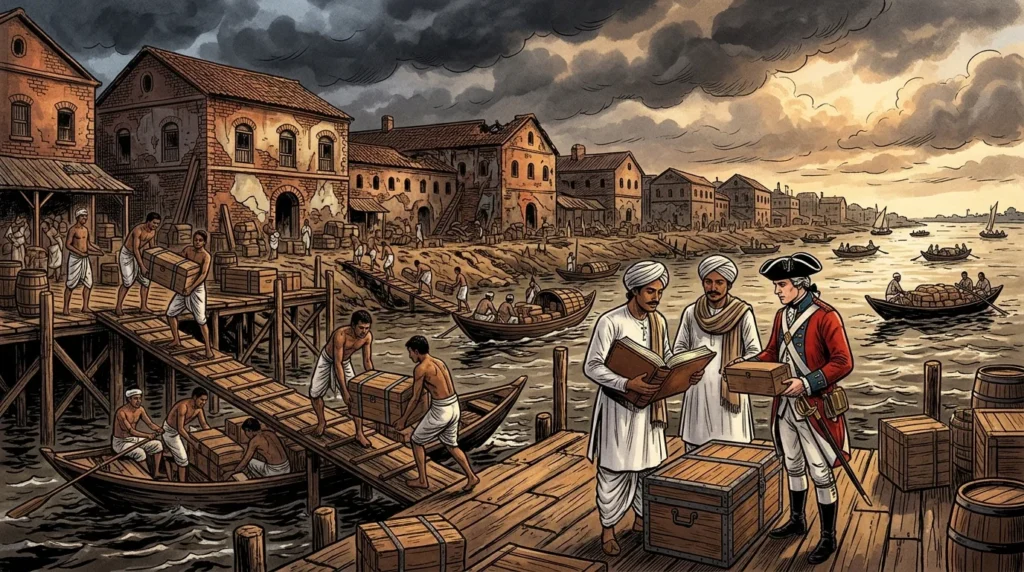
In 1619, Coen conquered the Javanese port of Jayakarta and established Batavia (modern Jakarta) as the VOC’s fortified Asian headquarters, complete with a central counting house that compiled consolidated Asian balance sheets separate from Europe. In a famous August 1619 treatise sent to the Heeren XVII, Coen outlined a comprehensive multi-lateral trading circuit—known as the intra-Asian country trade (inlandse handel)—designed to make the Asian operations self-financing so that return cargoes for Europe could eventually be purchased without continuous bullion shipments from the Netherlands.
Coen’s closed-loop commercial system linked three distinct Asian economic zones through armed maritime monopoly and strategic factories:
- The Spice Monopoly in Maluku and Banda: Indonesians in the Moluccas and the Banda Islands (then the world’s sole source of nutmeg and mace) refused European silver or goods, demanding instead painted and dyed cotton textiles from India. In 1621, Coen led a ruthless military expedition that depopulated the Banda Islands, killing or enslaving the indigenous Bandanese elite and parceling the nutmeg groves into 68 slave-worked plantations (perken) leased to Dutch perkeniers who delivered nutmeg and mace to the VOC at fixed below-market prices.
- Indian Coromandel and Gujarati Textiles: Through factories established along India’s Coromandel Coast (Pulicat and Masulipatnam) and at Surat in Gujarat, the VOC purchased thousands of bales of cotton cloth and indigo, shipping them to Batavia and the Spice Islands to pay for pepper, cloves, nutmeg, and mace at substantial markups.
- Chinese Silk and Japanese Silver and Copper: To acquire the precious metals needed to buy Indian textiles without draining Amsterdam, the VOC leveraged its factory in Japan (founded at Hirado in 1609 and moved to Dejima in Nagasaki Bay in 1641, where the Dutch became the sole Europeans permitted to trade under Tokugawa seclusion) alongside its fortress at Zeelandia on Taiwan (1624). By exchanging Southeast Asian deerskins, spices, and Chinese raw silk for vast quantities of Tokugawa silver bullion (and later Japanese copper after the 1668 silver export ban) and shipping that bullion to Bengal, Coromandel, and Surat, the VOC generated massive intra-Asian trading profits that financed both its Asian military establishment and its annual European return fleets until the late seventeenth century.
Theoretical & Balance-Sheet Transmission Mechanism
In the Kindleberger–Minsky taxonomy of financial instability (Kindleberger, 1978; Minsky, 1986) and Irving Fisher’s (1933) debt-deflation framework, speculative asset booms become systemic crises when credit expansion shifts balance sheets from hedge finance (cash flows covering principal and interest) to speculative and Ponzi finance (relying on rising asset prices and short-term margin roll-overs).
Once monetary tightening or an exogenous shock halts price appreciation, forced margin liquidations trigger Fisherian debt-deflation: fire-sale asset discounts erode bank collateral values, contracting credit supply across the real economy.
Sources and Further Reading
- Oscar Gelderblom, Abe de Jong, and Joost Jonker, “ The Formative Years of the Modern Corporation: The Dutch East India Company VOC, 1602–1623,” The Journal of Economic History, 2013. Peer-Reviewed / Academic Research
- Lodewijk Petram, “ The World’s First Stock Exchange,” Columbia University Press, 2014. Peer-Reviewed / Academic Research
- Om Prakash, “ Intra-Asian Trade (I): Japan,” Princeton University Press, 1985. Peer-Reviewed / Academic Research
- Ryuto Shimada, “ The Intra-Asian Trade in Japanese Copper by the Dutch East India Company during the Eighteenth Century,” Brill, 2006. Peer-Reviewed / Academic Research
- John Landwehr, C. R. Boxer, and Günter Schilder, “ VOC: A Bibliography of Publications Relating to the Dutch East India Company, 1602–1800,” Brill, 1991. Peer-Reviewed / Academic Research
- P. A. Leupe, “ Jan Pieterszoon Coen, 1623–1627,” Bijdragen tot de Taal-, Land- en Volkenkunde, 1859. Peer-Reviewed / Academic Research
- Irving Fisher — "The Debt-Deflation Theory of Great Depressions," Econometrica 1, no. 4 (FRASER Federal Reserve Archive, 1933): 337–357 Central Bank / Monetary Authority
- Charles P. Kindleberger & Robert Z. Aliber — Manias, Panics, and Crashes: A History of Financial Crises (Palgrave Macmillan) Peer-Reviewed / Academic Research
Cite This Historical Dossier (APA / Chicago)
APA (7th ed.): Ç., S. (Ed.). (2026). The 1602 VOC Charter, Isaac Le Maire's 1609 Bear Raid, and Intra-Asian Trade. In Forgotten Fortunes Historical Monograph Series (Forgotten Fortunes Editorial Desk). https://forgottenfortunes.net/1602-voc-charter-dutch-shares/
MLA (9th ed.): Ç., Soner, ed. "The 1602 VOC Charter, Isaac Le Maire's 1609 Bear Raid, and Intra-Asian Trade." Forgotten Fortunes: Financial & Monetary History Archive, 2026, https://forgottenfortunes.net/1602-voc-charter-dutch-shares/.
Chicago (17th ed.): Ç., Soner, ed. "The 1602 VOC Charter, Isaac Le Maire's 1609 Bear Raid, and Intra-Asian Trade." Forgotten Fortunes Historical Monograph Series (Forgotten Fortunes Editorial Desk), September 16, 2026. https://forgottenfortunes.net/1602-voc-charter-dutch-shares/.
Have an idea for another financial history documentary or article? Request a story →