In This Article
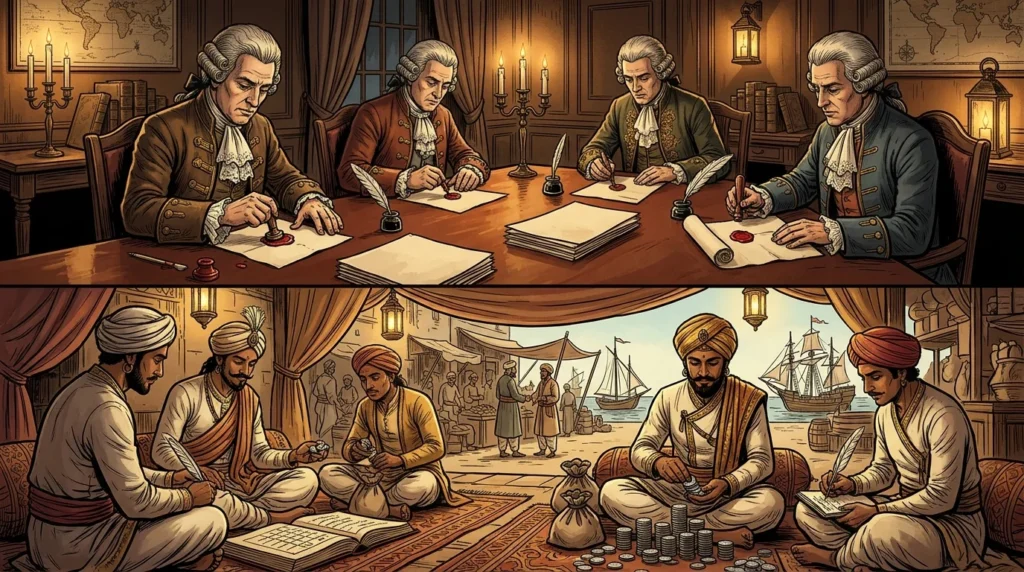
At the Peace of Münster in 1648, the Dutch Republic stood at the zenith of its commercial hegemony, with Amsterdam functioning as Europe’s indispensable physical entrepôt (stapelmarkt) where Baltic grain, Scandinavian timber, Iberian silver, and Moluccan spices were warehoused, graded, and re-exported. Over the ensuing century and a half (1650–1795), however, aggressive mercantilist exclusion by England and France eroded the Dutch carrying monopoly and forced a profound structural transformation. In Europe, Amsterdam merchant houses pivoted from trading on their own account (eigenhandel) to international commission trading and bill-of-exchange acceptance credit (acceptkrediet). In Asia, the Dutch East India Company (VOC) shifted from high-margin fine spices toward capital-intensive bulk commodities—Bengal textiles, Java coffee and sugar, and Canton tea—while funding generous dividends through short-term Amsterdam anticipation loans (anticipatiepenningen) until the Fourth Anglo-Dutch War (1780–1784) triggered a liquidity collapse and the company’s eventual liquidation in 1799 under more than 119 million guilders in debt. [1]

Mercantilist Siege: The Navigation Acts (1651, 1660) and Colbert’s Tariffs (1664–1667)
During the first half of the seventeenth century, the Dutch merchant fleet—numbering more than 2,000 ocean-going fluyt cargo vessels—dominated European cabotage because low domestic interest rates (2.5 to 3.5 percent in Holland compared with 6 percent or more in England and France), standardized wind-powered sawmills in the Zaanstreek, and efficient crew provisioning allowed Dutch captains to undercut foreign freight rates by 30 to 50 percent. Once the Eighty Years’ War ended in 1648, rival states moved systematically to dismantle this physical intermediation. [2]
In October 1651, Oliver Cromwell’s Rump Parliament passed the first English Navigation Act, barring foreign vessels from importing Asian, African, or American goods into the British Isles and decreeing that European commodities could enter England only aboard English ships or vessels of the country where the goods originally grew or were manufactured. Reinforced after the Stuart Restoration by the Navigation Act of 1660 and the Staple Act of 1663—which enumerated colonial sugar, tobacco, cotton, and indigo for exclusive routing through English ports—London directly targeted Amsterdam’s role as a re-export warehouse, sparking the First (1652–1654), Second (1665–1667), and Third (1672–1674) Anglo-Dutch Wars. [3]
Simultaneously, Jean-Baptiste Colbert, Controller-General of Finances under King Louis XIV of France, waged a tariff war against the Dutch stapelmarkt. Following a already restrictive 1659 tonnage duty of 50 sols per ton on foreign shipping in French ports, Colbert introduced his protectionist tariff of 1664 and then doubled duties on Dutch refined sugar, woolen cloth, herring, and colonial re-exports in the punitive tariff of 1667. When French armies invaded the Netherlands in the Rampjaar (Disaster Year) of 1672, the Republic survived only by flooding its polders and borrowing heavily across the provinces. By the early eighteenth century, Hamburg, Bremen, London, and Bordeaux increasingly bypassed Amsterdam, sailing directly between producer regions in the Baltic, the Mediterranean, and the Americas. [4]
From Eigenhandel to Commission Trade and Acceptkrediet Finance
As business historians Joost Jonker, Keetie Sluyterman, Jan de Vries, and Ad van der Woude have demonstrated, Amsterdam’s merchant elite responded to the relative decline of physical transshipment by reinventing the city as Europe’s clearinghouse for commercial credit. In the seventeenth century, classical Dutch wholesalers had practiced eigenhandel—purchasing bulk cargoes with their own capital, shipping them to Amsterdam warehouses, and waiting for favorable price swings. In the eighteenth century, leading merchant-bankers such as Hope & Co., Pels & Sons, Clifford & Sons, and Muilman & Sons shifted decisively toward commission trading (commissiehandel) and acceptance credit (acceptkrediet).
Under the commission system, foreign producers and colonial planters consigned cargoes of West Indian sugar, Chesapeake tobacco, Spanish wool, or Silesian linen to an Amsterdam house in exchange for a 2 percent sales commission and a 0.5 percent del credere guarantee fee. Crucially, to attract these consignments—and even to finance shipments travelling directly between two foreign ports such as St. Petersburg and Cadiz or Bordeaux and Hamburg without ever touching a Dutch quay—Amsterdam houses allowed foreign merchants to draw three- to six-month bills of exchange on them for up to two-thirds or three-quarters of the cargo’s estimated value the moment the goods were loaded. [5]
Because every bill payable at Amsterdam above 300 guilders had to be settled in stable bank money (bankgeld) through the Bank of Amsterdam (Wisselbank), an acceptance signature from a premier Amsterdam merchant-banker turned an illiquid commercial bill into a prime international liquid asset that could be discounted across Europe at 2.5 to 3 percent per annum. By the 1760s and 1770s, Amsterdam acceptance credit financed a vast share of European maritime commerce, generating steady commission and interest income while exposing Amsterdam houses to systemic contagion whenever credit chains snapped—most famously during the post-Seven Years’ War bill-of-exchange panics of 1763 and 1772–1773. [6]
The Eighteenth-Century VOC: Bengal Textiles, Java Coffee, and Canton Tea
A parallel structural shift transformed the Dutch East India Company (VOC) between 1680 and 1780. Ironically, the company’s physical shipping volume reached its all-time peak in the eighteenth century: whereas the VOC dispatched 541 ships to Asia during the first half of the seventeenth century, it sent more than 1,600 vessels during the eighteenth century, employing tens of thousands of sailors and soldiers. Yet the composition and profitability of its cargoes changed fundamentally. [7]
In the seventeenth century, the VOC had earned extraordinary gross margins on Moluccan cloves and Banda nutmeg and mace—commodities over which it held an absolute military monopoly and which could be purchased via Jan Pieterszoon Coen’s intra-Asian country trade without draining European silver. After 1668, however, the Tokugawa shogunate prohibited silver exports from Japan and successively rationed copper exports at Nagasaki, starving the VOC’s intra-Asian network of its primary source of cheap bullion. At the same time, European consumer tastes shifted rapidly toward three new mass-market Asian goods: Indian cotton calicoes and muslins from Bengal and Coromandel, plantation coffee and cane sugar from Java, and Chinese tea from Canton (Guangzhou). [8]
To capture these expanding markets, the VOC introduced coffee shrubs to the Priangan highlands of western Java in the early 1700s—compelling Javanese regents (bupati) to deliver millions of pounds of coffee beans at fixed quotas—and after 1729 dispatched heavy East Indiamen directly from Amsterdam to Canton to purchase Bohea and Congou tea. Unlike fine spices, however, Bengal textiles and Canton tea were fiercely contested markets where the English East India Company, the French Compagnie des Indes, and the Ostend and Swedish East India companies bid up Asian purchase prices while driving down European auction prices. Furthermore, because Chinese and Bengali merchants demanded payment in silver coin, the VOC’s shipments of precious metal from the Netherlands surged from roughly 1.2 million guilders per year in the mid-seventeenth century to more than 4 to 6 million guilders annually by the 1720s–1770s.
Anticipatiepenningen Debt and the Collapse of 1780–1799
As gross profit margins compressed and the administrative and military overhead of governing territorial possessions in Java, Ceylon, and the Cape escalated, the VOC’s accounting and dividend policies concealed a widening structural deficit. Because the six municipal Chambers maintained separate cash books and did not consolidate Asian territorial losses with European auction proceeds into a single modern balance sheet, the Heeren XVII continued paying generous cash dividends—ranging from 12.5 percent to 40 percent of the original 1602 par capital of 6.42 million guilders—throughout the eighteenth century.
To finance the eighteen- to twenty-four-month working-capital gap between outfitting outward fleets in the spring and collecting proceeds at the autumn commodity auctions, the Chambers relied on short-term interest-bearing notes called anticipatiepenningen (anticipation loans), backed by the Bank of Amsterdam and wealthy Dutch rentiers. Nominally designed to be retired each autumn out of auction revenues, these anticipation loans were instead systematically rolled over year after year, converting short-term working credit into a permanent, unamortized floating debt that exceeded 20 million guilders by the late 1770s.
The fatal shock arrived in December 1780, when Great Britain declared the Fourth Anglo-Dutch War (1780–1784) over Dutch illicit trade with the American revolutionaries. Royal Navy squadrons seized dozens of richly laden VOC East Indiamen, occupied Dutch factories in India and Sumatra, and trapped the remaining Asian fleets in port. With virtually no tea, coffee, or spices reaching Amsterdam for three years, auction revenues collapsed from more than 20 million guilders per year to near zero. Unable to roll over its anticipatiepenningen, the VOC suspended payments on its short-term notes in February 1781 and begged the States of Holland and the States-General for emergency state guarantees and direct treasury loans.
Despite receiving more than 80 million guilders in public bailouts over the next fourteen years, the company never recovered its commercial footing. Following the French revolutionary invasion of January 1795 and the proclamation of the Batavian Republic, the new regime replaced the aristocratic Heeren XVII with a state Committee for East Indian Trade and Possessions on March 1, 1796. When the VOC’s final charter expired at midnight on December 31, 1799, the company—mocked across the Netherlands by its own initials as Vergaan Onder Corruptie (Perished Under Corruption)—was formally liquidated, transferring its colonial territories and a staggering accumulated debt of 119 to 134 million guilders directly onto the balance sheet of the Dutch state.
Theoretical & Balance-Sheet Transmission Mechanism
In the Kindleberger–Minsky taxonomy of financial instability (Kindleberger, 1978; Minsky, 1986) and Irving Fisher’s (1933) debt-deflation framework, speculative asset booms become systemic crises when credit expansion shifts balance sheets from hedge finance (cash flows covering principal and interest) to speculative and Ponzi finance (relying on rising asset prices and short-term margin roll-overs).
Once monetary tightening or an exogenous shock halts price appreciation, forced margin liquidations trigger Fisherian debt-deflation: fire-sale asset discounts erode bank collateral values, contracting credit supply across the real economy.
Sources and Further Reading
- Joost Jonker and Keetie Sluyterman, “ At Home on the World Markets: Dutch International Trading Companies from the 16th Century Until the Present,” McGill-Queen’s University Press, 2001. Peer-Reviewed / Academic Research
- M. M. G. Fase, “ J. Jonker, K. Sluyterman, Thuis op de wereldmarkt. Nederlandse handelshuizen door de eeuwen heen,” BMGN – Low Countries Historical Review, 2002. Peer-Reviewed / Academic Research
- Jan de Vries and Ad van der Woude, “ The First Modern Economy: Success, Failure, and Perseverance of the Dutch Economy, 1500–1815,” Cambridge University Press, 1997. Peer-Reviewed / Academic Research
- N. J. G. Pounds, “ The First Modern Economy: Success, Failure, and Perseverance of the Dutch Economy, 1500–1815 (” The American Historical Review, 1999),” The American Historical Review, 1999. Peer-Reviewed / Academic Research
- Femme S. Gaastra, “ The Dutch East India Company and its Intra-Asiatic Trade in Precious Metals,” Routledge, 2020. Peer-Reviewed / Academic Research
- Geoffrey Jones and Keetie E. Sluyterman, “ British and Dutch Business History,” Cambridge University Press, 2003. Peer-Reviewed / Academic Research
- Irving Fisher — "The Debt-Deflation Theory of Great Depressions," Econometrica 1, no. 4 (FRASER Federal Reserve Archive, 1933): 337–357 Central Bank / Monetary Authority
- Charles P. Kindleberger & Robert Z. Aliber — Manias, Panics, and Crashes: A History of Financial Crises (Palgrave Macmillan) Peer-Reviewed / Academic Research
Cite This Historical Dossier (APA / Chicago)
APA (7th ed.): Ç., S. (Ed.). (2026). Amsterdam's Acceptkrediet Pivot, the VOC Tea Boom, and the 1799 Liquidation. In Forgotten Fortunes Historical Monograph Series (Forgotten Fortunes Editorial Desk). https://forgottenfortunes.net/acceptkrediet-amsterdam-trade-finance/
MLA (9th ed.): Ç., Soner, ed. "Amsterdam's Acceptkrediet Pivot, the VOC Tea Boom, and the 1799 Liquidation." Forgotten Fortunes: Financial & Monetary History Archive, 2026, https://forgottenfortunes.net/acceptkrediet-amsterdam-trade-finance/.
Chicago (17th ed.): Ç., Soner, ed. "Amsterdam's Acceptkrediet Pivot, the VOC Tea Boom, and the 1799 Liquidation." Forgotten Fortunes Historical Monograph Series (Forgotten Fortunes Editorial Desk), September 16, 2026. https://forgottenfortunes.net/acceptkrediet-amsterdam-trade-finance/.
Have an idea for another financial history documentary or article? Request a story →