In This Article
Between the mid-thirteenth and mid-fourteenth centuries, the Mali Empire (Manden Kurufaba)—founded around 1235 CE by the warrior-king Sundiata Keita after his victory over the Sosso king Soumaoro Kanté at the Battle of Kirina—presided over the single largest supply ofmonetary gold in the medieval Afro-Eurasian world. Contemporary Arab geographers and modern economic historians estimate that prior to the European invasion of the Americas in 1492, West Africa supplied up to two-thirds of the gold circulating across North Africa, the Middle East, and Christian Europe, providing the raw bullion that mints from Cairo and Tunis to Florence, Venice, and Genoa struck into Islamic dinars, florins (1252), and ducats (1284). [1]
Yet the sovereigns of Mali (the Mansas)—most famously Mansa Musa I (r. c. 1312–1337), whose 1324–1325 pilgrimage to Mecca injected so many tons of gold into Cairo and Medina that it depressed the Egyptian gold-to-silver exchange rate for more than twelve years—never operated state mines or stationed imperial garrisons inside the goldfields themselves. Instead, Mali’s fiscal prosperity rested on a delicate institutional separation: autonomous animist miners extracted alluvial and reef gold in the southern savanna and forest zones of Bambuk, Bure, and later the Akan fields; Mande-speaking Muslim merchant guilds known as the Wangara (or Juula / Dyula) brokered the bullion along riverine and overland trails; and the Mansa‘s imperial customs collectors (farba) taxed every camel load of Saharan rock salt, copper, textiles, and cavalry horses entering the northern desert-edge emporia of Walata, Timbuktu, and Gao. [2]
The Goldfields of Bambuk, Bure, and Akan: Why the Mansas Never Annexed the Mines
West Africa’s medieval gold wealth originated in three distinct geological basins south of the Sahelian steppe:
- Bambuk (between the Senegal and Falémé Rivers): The oldest exploited goldfield of the Western Sudan, which had earlier enriched the Soninke Empire of Ghana (Wagadu) between the eighth and eleventh centuries;
- Bure (along the upper Niger River and its Sankarani and Tinkisso tributaries in modern Guinea): The richest alluvial and shallow-shaft gold zone of the thirteenth and fourteenth centuries, situated immediately adjacent to the Mandinka heartland of Niani; and
- The Akan Forest Goldfields (modern Ghana and Côte d’Ivoire): Opened progressively from the mid-fourteenth century onward by southbound Mande traders seeking deeper lodes along the Black and White Volta rivers.
In both Bambuk and Bure, gold mining was a seasonal peasant industry practiced between January and May, when river levels receded after the autumn harvest and before the summer monsoon rains flooded the pits. Men dug vertical shafts 10 to 30 meters deep linked by subterranean galleries, while women washed the crushed quartz gravel and alluvial sands in calabashes along the riverbanks, packing the fine gold dust (tibr in Arabic) into hollow bird quills or leather pouches. [3]
Fourteenth-century Mamluk encyclopedist Shihab al-Din al-Umari (recording the testimony of informants who met Mansa Musa in Cairo in 1324) and Syrian historian Ibn Fadl Allah documented a crucial fiscal paradox of the Mali Empire: whenever a Muslim ruler conquered one of the gold-producing districts by military force and attempted to compel the animist miners to convert to Islam or work under state overseers, gold production immediately stopped and dropped to zero. Recognizing that mining depended on local spiritual lineages and voluntary seasonal labor, the Mansas deliberately left Bambuk and Bure politically autonomous as tributary protectorates. Rather than seizing the pits, the Mansa enforced a royal bullion prerogative cited by tenth-century geographer Ibn Hawqal and al-Umari: all solid gold nuggets (ranging from an ounce to several pounds) belonged exclusively to the emperor’s treasury as emblems of sovereignty, whereas all unrefined gold dust (tibr) was left free for the miners and merchants to trade. [4]
The Secret Silent Trade of the Wangara (Juula) Merchant Diaspora
Bridging the linguistic, religious, and ecological divide between the non-Muslim gold miners of the southern woodlands and the North African Arab-Berber caravaners of the Sahara was the exclusive domain of the Wangara—clans of Mande and Soninke Muslim long-distance traders known in Manding as Juula (or Dyula). Organized into tight kinship networks stretching from the Gambia and Senegal rivers to the Niger Bend and the Volta basin, the Wangara guarded the geographic coordinates of the Bambuk and Bure mines as a commercial state secret. North African merchants who arrived at Walata or Timbuktu never saw a gold mine; they dealt solely with Wangara wholesalers.
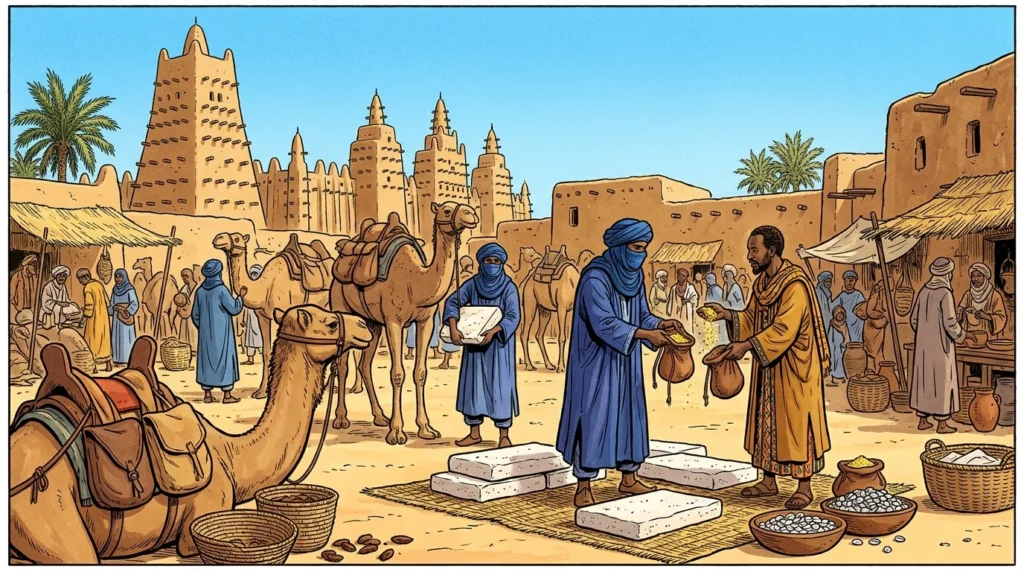
Since Herodotus, al-Mas’udi (tenth century), and al-Bakri (1068), outside chroniclers marveled at the practice of “silent trade” (dumb barter) along the frontier of the goldfields—a custom later corroborated by Venetian explorer Alvise Cadamosto in the 1450s. According to these accounts, Wangara merchants brought slabs of Saharan rock salt, glass beads, and copper rings to a designated riverbank clearing, beat large signal drums, arranged their wares in neat piles, and retreated out of sight. Local miners then emerged, placed a measure of gold dust beside each pile of salt, and withdrew. Returning the next morning, the merchants either collected the gold dust (leaving the salt behind) or reduced their salt pile to demand a higher price, completing the entire transaction without speaking a word or revealing the miners’ villages. [5]
Even where face-to-face brokerage replaced literal silent barter inside provincial market towns like Jenne (Djenné) and Niani, the Wangara operated a highly standardized weight and credit system. Gold dust was weighed on delicate brass balance beams using glass, brass, and seed weights calibrated to the Islamic mithqal (approximately 4.25 to 4.72 grams of gold). Beyond gold dust, Wangara donkey trains and human porters carried forest exports that could not be grown in the arid north: caffeine-rich kola nuts (Cola nitida, a stimulant permitted by Islamic law and prized across the Sahel), shea butter (karité oil used for cooking, lamps, and skin protection), elephant ivory, malagueta pepper (“Grains of Paradise”), and enslaved captives. [6]
Niger River Pirogues and the Saharan Termini of Walata, Timbuktu, and Gao
What gave the Mali Empire its decisive logistical advantage was its control over the great northern arc of the Niger River. At the inland delta hub of Jenne, cargoes brought by Wangara porters and donkeys from Bure and the southern forests were transferred onto fleets of large flat-bottomed wooden canoes (pirogues), each capable of carrying 15 to 30 tons of grain, rice, dried fish, shea butter, iron, and gold dust downstream to the edge of the Sahara. [7]
Where the navigable waters of the Niger met the southern desert shore (the sahil, origin of the word “Sahel”), three great entrepôt cities served as transshipment ports between river canoes and camel caravans:
- Walata (Iwalatan / Oualata): Located in southeastern Mauritania, Walata replaced ancient Koumbi Saleh in the thirteenth century as the western terminus for caravans descending from Sijilmasa (Morocco) via the Taghaza salt pans. Moroccan traveler Ibn Battuta entered Mali through Walata in April 1352 after a perilous two-month desert crossing.
- Timbuktu: Situated just north of the Niger River docks at Kabara, Timbuktu grew from a seasonal Tuareg camp into a cosmopolitan city after Mansa Musa annexed it peacefully in 1325 and commissioned the Andalusian architect Abu Ishaq al-Sahili to build the Djinguereber Mosque and a royal palace (Madugu).
- Gao (Kawkaw): Located further east down the Niger Bend, Gao commanded the eastern trans-Saharan routes linking the Niger to Takedda (copper mines), Ghat, Tripoli, and Cairo—routes along which fourteenth-century records describe massive annual caravans of up to 12,000 camels crossing between Egypt and Mali.
Rock Salt for Gold Dust, Barbary Horses, and the Fiscal Power of the Mansa
In the markets of Walata, Timbuktu, and Gao, the price ratios reflected the stark ecological complementarity of desert and savanna. Because the cereal-eating populations of the interior West African tropics suffered severe dietary sodium deficiency and lacked coastal evaporation pans, Saharan rock salt—quarried in 90-kilogram (200-pound) slabs at Taghaza and Taoudenni by enslaved laborers living in huts built entirely of salt blocks—was a biological necessity. Loaded two slabs to a camel, Taghaza salt worth 2 gold dinars (*mithqals*) at the desert oasis sold for 8 to 10 dinars upon reaching Walata or Timbuktu, and fetched 20 to 30 dinars or more—sometimes trading ounce-for-ounce with pure gold dust—when broken into small pieces in the southern forest markets. [8]
Alongside salt and Takedda copper rods, North African merchants imported Venetian and Egyptian glass beads, cowrie shells from the Indian Ocean (Cypraea moneta, introduced via Cairo and Venice as small-denomination currency), fine European and Maghrebi dyed woolen cloth, brass vessels, paper, Arabic books, and prized North African Barbary and Arabian cavalry horses. Because the tsetse fly (Glossina) transmitted fatal trypanosomiasis (sleeping sickness) to horses bred in the humid savanna, the Mansa had to import thousands of desert mounts continuously across the Sahara to maintain his elite 10,000-strong armored cavalry corps (headed by the farari commanders).
The Mansa‘s treasury captured huge customs revenues without stifling private commerce. According to al-Bakri and al-Umari, the imperial governors (farba) stationed at Walata, Timbuktu, and Gao levied a fixed import tariff of one gold dinar (mithqal) on every donkey- or camel-load of salt entering the empire, two dinars on every load leaving toward the southern goldfields, and higher duties on copper and general merchandise. In return, the Mali Empire guaranteed absolute security of property across a realm that took four months to traverse: when Ibn Battuta traveled from Walata to the capital and back through Timbuktu and Gao in 1352–1353, he marveled that neither travelers nor resident merchants had reason to fear brigands, and that if a foreign North African merchant died in Mali, his goods were never confiscated by the state but held in trust by a respected custodian until his rightful heirs arrived to claim them.
Theoretical & Balance-Sheet Transmission Mechanism
In the Kindleberger–Minsky taxonomy of financial instability (Kindleberger, 1978; Minsky, 1986) and Irving Fisher’s (1933) debt-deflation framework, speculative asset booms become systemic crises when credit expansion shifts balance sheets from hedge finance (cash flows covering principal and interest) to speculative and Ponzi finance (relying on rising asset prices and short-term margin roll-overs).
Once monetary tightening or an exogenous shock halts price appreciation, forced margin liquidations trigger Fisherian debt-deflation: fire-sale asset discounts erode bank collateral values, contracting credit supply across the real economy.
Sources and Further Reading
- Mark Cartwright, “ The Gold Trade of Ancient & Medieval West Africa,” World History Encyclopedia, 2019. Historical & Financial Reference
- Mark Cartwright, “ The Salt Trade of Ancient West Africa,” World History Encyclopedia, 2019. Historical & Financial Reference
- Mark Cartwright, “ Mali Empire,” World History Encyclopedia, 2019. Historical & Financial Reference
- Encyclopedia.com, “ Trans-Saharan Caravan Trade,” Gale Encyclopedia of World History, 2020. Historical & Financial Reference
- Library of Congress, “ Ancient Manuscripts from the Desert Libraries of Timbuktu: Exhibition Items,” Library of Congress Exhibitions, 2003. Official / State Archive
- South African History Online, “ The Empire of Mali (1230-1600),” South African History Online (SAHO), 2019. Historical & Financial Reference
- Irving Fisher — "The Debt-Deflation Theory of Great Depressions," Econometrica 1, no. 4 (FRASER Federal Reserve Archive, 1933): 337–357 Central Bank / Monetary Authority
- Charles P. Kindleberger & Robert Z. Aliber — Manias, Panics, and Crashes: A History of Financial Crises (Palgrave Macmillan) Peer-Reviewed / Academic Research
Cite This Historical Dossier (APA / Chicago)
APA (7th ed.): Ç., S. (Ed.). (2026). Bambuk, Bure, and the Wangara Guilds: Inside the Mali Empire's Gold and Salt Trade. In Forgotten Fortunes Historical Monograph Series (Forgotten Fortunes Editorial Desk). https://forgottenfortunes.net/mali-empire-gold-trade/
MLA (9th ed.): Ç., Soner, ed. "Bambuk, Bure, and the Wangara Guilds: Inside the Mali Empire's Gold and Salt Trade." Forgotten Fortunes: Financial & Monetary History Archive, 2026, https://forgottenfortunes.net/mali-empire-gold-trade/.
Chicago (17th ed.): Ç., Soner, ed. "Bambuk, Bure, and the Wangara Guilds: Inside the Mali Empire's Gold and Salt Trade." Forgotten Fortunes Historical Monograph Series (Forgotten Fortunes Editorial Desk), September 16, 2026. https://forgottenfortunes.net/mali-empire-gold-trade/.
Have an idea for another financial history documentary or article? Request a story →