
In This Article
When Queen Elizabeth I granted a royal charter to the Governor and Company of Merchants of London Trading into the East Indies on December 31, 1600, the London investors who subscribed 68,373 pounds sterling had a single commercial prize in mind: the fine spices of the Indonesian archipelago. Yet within a quarter-century, ruthless naval and financial competition from the Dutch East India Company (Vereenigde Oostindische Compagnie, or VOC), culminating in the execution of English factors on the island of Amboyna in February 1623, effectively broke English ambitions in the Moluccas. Forced to retreat from the clove and nutmeg islands, the English East India Company (EIC) executed one of the most consequential strategic pivots in commercial history—shifting its capital and ships toward the Mughal Empire and the Indian subcontinent, where painted calicoes, muslins, chintzes, and Bengal raw silk replaced spices as the engine of British global trade. [1]
The Spice Race and the Amboyna Massacre of February 1623
During its first two decades of ”Separate Voyages,” the English Company dispatched fleets directly to Bantam in Java, Aceh in Sumatra, and the Banda and Molucca islands to purchase pepper, cloves, mace, and nutmeg. There they collided with the VOC, chartered by the Dutch States-General in 1602 with a permanent joint-stock capital of 6.45 million guilders—roughly ten times the financial resources of its English rival—and armed with sovereign authority to build fortresses, wage war, and impose exclusive monopoly treaties on island rulers. [2]
Recognizing that Indonesian spice growers eagerly accepted Indian cotton textiles rather than European silver coins in payment for cloves and nutmeg, English captains had first anchored at Swally Hole near Surat on the Gujarat coast in 1608 and defeated a Portuguese squadron at the Battle of Swally in November 1612. In 1613, Mughal Emperor Jahangir issued an imperial decree (farman) permitting the English to establish a permanent trading factory at Surat, a privilege reinforced between 1615 and 1619 by the diplomatic embassy of Sir Thomas Roe, ambassador of King James I to the Mughal court at Ajmer. [3]
In the Spice Islands, meanwhile, an uneasy Anglo-Dutch Treaty of Defence signed in London in 1619 required the EIC to shoulder one-third of the maintenance costs of Dutch garrisons in exchange for one-third of the Moluccan spice harvest. Lacking the working capital to match Governor-General Jan Pieterszoon Coen’s heavy military outlays, the English factors fell into arrears and bitter mutual suspicion. In February 1623, the Dutch governor of Amboyna (Ambon), Herman van Speult, arrested the chief English factor, Gabriel Towerson, along with his English staff and Japanese mercenaries stationed at Fort Victoria, accusing them of plotting to seize the fortress. Subjected to water torture, Towerson and nine other Englishmen, nine Japanese soldiers, and a Portuguese overseer were beheaded on February 27, 1623 (March 9 New Style). Although the ”Amboyna Massacre” provoked decades of pamphlet fury and diplomatic claims in London, the EIC quietly withdrew from most of the archipelago, retaining only a minor pepper foothold at Bantam (until 1682) and Bencoolen while redirecting its resources to mainland India. [4]
Surat, Madras, and the Rise of the Indian Calico Trade
On the Indian mainland, the EIC operated not as a conqueror facing small island sultanates, but as a supplicant maritime trader inside the vast, wealthy Mughal Empire and the kingdoms of the southern Deccan. From its Western Presidency headquarters at Surat—the premier port of Mughal Gujarat and the embarkation gateway for pilgrims sailing to Mecca—the Company exported indigo from Sarkhej and Bayana, saltpetre from Bihar, and an expanding volume of Gujarati cotton piece-goods.
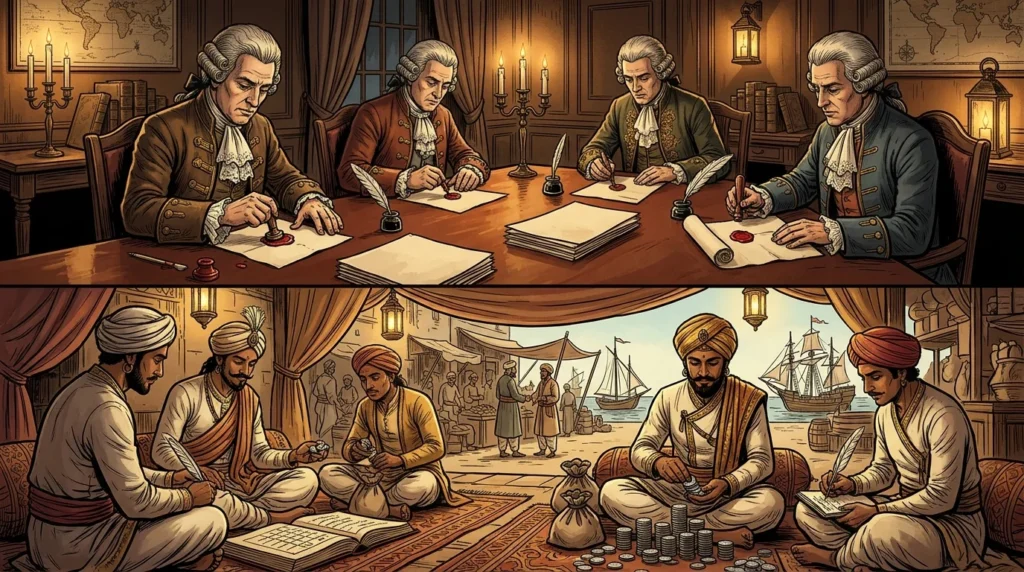
To secure painted and dyed cotton textiles that also suited both Southeast Asian barter and European consumers, the Company expanded down India’s eastern Coromandel Coast. After opening an early factory at Masulipatnam in 1611, EIC factor Francis Day negotiated a grant from the local Nayak ruler of Chandragiri (under the waning Vijayanagara Empire) in August 1639 for a strip of coastal land at Madraspatnam. There, in 1640, the Company erected Fort St. George, creating its first fortified, semi-autonomous enclave in India. When political turmoil engulfed the interior, Indian weavers, dyers, and Chettiar merchant-brokers migrated inside the walls of Madras, enabling the Company to contract directly with artisan communities through the dadni cash-advance system. [5]
The 1668 Royal Transfer of Bombay and the Calico Craze
The Company’s institutional footing changed dramatically after the Restoration of the Stuart monarchy in 1660. Under King Charles II’s Charter of 1661, the restructured joint-stock EIC gained explicit crown authority to coin money, exercise civil and criminal jurisdiction over its settlements, maintain troops and warships, and make war or peace with non-Christian powers. That same year, Charles II married the Portuguese princess Catherine of Braganza, whose royal dowry included the seven islands of Bombay (Mumbai) on India’s western coast. [6]
Discovering that royal administration of the distant, malarial islands drained the English Exchequer while provoking friction with local Portuguese landholders and Mughal governors, Charles II issued a Royal Charter on March 27, 1668, transferring Bombay to the East India Company in perpetuity ”in free and common socage, as of the Manor of East Greenwich,” in return for a nominal quit-rent of 10 pounds sterling in gold paid every September 30. Under the visionary governor Gerald Aungier (1669–1677), the Company drained marshes, established English courts of judicature, opened a mint striking silver rupees, and guaranteed religious liberty to Hindu Bania, Parsi, Armenian, and Muslim merchants. Possessing an all-weather deep-water harbor immune to landward raids by Maratha horsemen under Shivaji—who sacked Surat twice, in 1664 and 1670—Bombay officially replaced Surat as the seat of the Western Presidency in May 1687. [7]
Simultaneously, between 1660 and 1685, the composition of EIC imports into London underwent a commercial revolution. Washable, colorfast, lightweight Indian cotton calicoes, chintzes, and Bengal silks conquered English fashion, displacing heavy domestic woollens and expensive French linens. By the early 1680s, Indian textiles accounted for more than 70 to 80 percent of the total value of the Company’s Asian cargoes, while annual bullion exports from London passed 500,000 pounds sterling. [8]
Sir Josiah Child and the Disaster of Child’s War (1686–1690)
As the Company’s dividends and share prices soared in London, leadership fell under the sway of Sir Josiah Child, the billionaire governor of the EIC Court of Directors and a close ally of the Stuart kings James II and Charles II. Impressed by how the Dutch VOC extracted local tax revenues in Java to self-finance its spice cargoes, Child argued that the English Company must abandon its ”unarmed” commercial posture under Mughal jurisdiction and transform itself into a ”Company-State” possessing fortified sovereign enclaves capable of compelling favorable customs terms by force.
Friction centered on the rich province of Bengal, where the Company had traded at Hooghly since 1651 under a privilege granting exemption from inland transit tolls (rahdari) in return for a fixed annual payment of 3,000 rupees, while Emperor Aurangzeb later reimposed a 3.5 percent customs duty on European traders. Complaining of extortion by the Mughal governor of Bengal, Shaista Khan, Josiah Child persuaded King James II in 1686 to dispatch an unprecedented fleet of nineteen warships and Company vessels carrying royal infantry companies to wage war on the Mughal Empire—a conflict remembered as the Anglo-Mughal War, or ”Child’s War” (1686–1690).
The campaign was an immediate military and financial catastrophe. In Bengal, EIC agent Job Charnock clashed with Mughal troops at Hooghly in October 1686, burned the Balasore river forts, and retreated down the Hooghly River to the fever-ridden mudflats of Sutanuti and Hijili before being evacuated to Madras. On the western coast, Josiah Child’s namesake, General Sir John Child (Governor of Bombay), seized dozens of Mughal merchant ships and pilgrim vessels bound for Mecca in late 1688.
Aurangzeb’s Reckoning, the ₹150,000 Indemnity, and the Founding of Calcutta
Emperor Aurangzeb, then commanding a massive imperial army in the Deccan against Bijapur and Golconda, responded with swift fury. Across the empire, Mughal authorities arrested English factors at Surat, Masulipatnam, and Vizagapatam, confiscated Company goods, and placed the Surat factors in irons. In February 1689, Aurangzeb’s Afro-Indian naval commander, the Sidi Yakut Khan of Janjira, landed 20,000 troops on Bombay Island, overran the outer fortifications, and besieged Sir John Child inside Bombay Castle for more than a year.
Facing total ruin and expulsion from India, the Company sued abjectly for peace, dispatching two envoys—George Weldon and Abraham Navarro—to Aurangzeb’s imperial camp at Zebapur, where they appeared before the throne with their hands tied in submission. Following Sir John Child’s death during the siege in February 1690, Aurangzeb—recognizing that European maritime trade brought hundreds of thousands of silver rupees into the imperial treasury each year and that English warships could disrupt the Mecca pilgrimage routes—granted an imperial pardon and farman on February 27, 1690. In return for the restoration of its trading privileges, the EIC was compelled to pay a humiliating indemnity of 150,000 rupees (roughly 18,750 pounds sterling), restore all captured Mughal vessels and goods, and pledge to conduct itself strictly as obedient merchants.
Ironically, the humiliation of 1690 cleared the path for the Company’s enduring base in eastern India. Invited back to Bengal by the newly appointed Mughal viceroy Ibrahim Khan, Job Charnock landed at the riverside village of Sutanuti on August 24, 1690. Eight years later, the Company purchased the zemindari rights to Sutanuti and the adjacent villages of Kalikata and Govindapur, erecting Fort William and completing the triad of presidency capitals—Bombay, Madras, and Calcutta—from which the East India Company would dominate the eighteenth-century Indian Ocean economy.
Theoretical & Balance-Sheet Transmission Mechanism
In the Kindleberger–Minsky taxonomy of financial instability (Kindleberger, 1978; Minsky, 1986) and Irving Fisher’s (1933) debt-deflation framework, speculative asset booms become systemic crises when credit expansion shifts balance sheets from hedge finance (cash flows covering principal and interest) to speculative and Ponzi finance (relying on rising asset prices and short-term margin roll-overs).
Once monetary tightening or an exogenous shock halts price appreciation, forced margin liquidations trigger Fisherian debt-deflation: fire-sale asset discounts erode bank collateral values, contracting credit supply across the real economy.
Sources and Further Reading
- K. N. Chaudhuri, “ The Trading World of Asia and the English East India Company 1660–1760,” Cambridge University Press, 1978. Peer-Reviewed / Academic Research
- Adam Clulow, “ The Dutch East India Company and Amboyna,” Harvard University Press, 2018. Peer-Reviewed / Academic Research
- Mehreen M. Chida-Razvi, “ The Perception of Reception: The Importance of Sir Thomas Roe at the Mughal Court of Jahangir,” Journal of World History, 2014. Peer-Reviewed / Academic Research
- Philip J. Stern, “ Alcohol and the Ambivalence of the Early English East India Company-State,” The Historical Journal, Cambridge University Press, 2022. Peer-Reviewed / Academic Research
- Anthony Webster, “ War, Politics and India: The Battle for the East India Company Trade Monopoly,” Boydell and Brewer, 2009. Peer-Reviewed / Academic Research
- K. N. Chaudhuri, “ Conclusion: Quantitative and Structural Shifts in the East India Trade,” Cambridge University Press, 1978. Peer-Reviewed / Academic Research
- Irving Fisher — "The Debt-Deflation Theory of Great Depressions," Econometrica 1, no. 4 (FRASER Federal Reserve Archive, 1933): 337–357 Central Bank / Monetary Authority
- Charles P. Kindleberger & Robert Z. Aliber — Manias, Panics, and Crashes: A History of Financial Crises (Palgrave Macmillan) Peer-Reviewed / Academic Research
Cite This Historical Dossier (APA / Chicago)
APA (7th ed.): Ç., S. (Ed.). (2026). From Amboyna to Bombay: The East India Company’s Pivot. In Forgotten Fortunes Historical Monograph Series (Forgotten Fortunes Editorial Desk). https://forgottenfortunes.net/east-india-company-amboyna-bombay/
MLA (9th ed.): Ç., Soner, ed. "From Amboyna to Bombay: The East India Company’s Pivot." Forgotten Fortunes: Financial & Monetary History Archive, 2026, https://forgottenfortunes.net/east-india-company-amboyna-bombay/.
Chicago (17th ed.): Ç., Soner, ed. "From Amboyna to Bombay: The East India Company’s Pivot." Forgotten Fortunes Historical Monograph Series (Forgotten Fortunes Editorial Desk), September 18, 2026. https://forgottenfortunes.net/east-india-company-amboyna-bombay/.
Have an idea for another financial history documentary or article? Request a story →