In This Article
In the spring of 33 CE, during the twentieth year of the reign of Emperor Tiberius, the city of Rome and the Italian peninsula were convulsed by one of the most severe liquidity panics of antiquity. Triggered by a wave of prosecutions against usury and the sudden revival of a dormant statute enacted eighty-two years earlier by Julius Caesar—the Lex Julia de modo credendi possidendique intra Italiam—the crisis paralyzed Roman credit markets. As lenders simultaneously called in loans to comply with statutory portfolio rules and debtors dumped agricultural estates onto a market devoid of cash, land values collapsed and aristocratic fortunes faced ruin. Only after a senatorial relief measure backfired did Tiberius intervene as an ancient lender of last resort, deploying 100 million sesterces (sestertium milies) from the imperial treasury into three-year, interest-free loans secured by double collateral in Italian real property. [1]

Fiscal Contraction and the Revival of Caesar’s Lex Julia
To understand why the enforcement of an old debt statute sparked a systemic freeze in 33 CE, historians look first at the macroeconomic posture of Tiberius’s administration (14–37 CE). Unlike Augustus, who had poured vast sums of Egyptian war booty, public building contracts, and cash distributions (congiaria) into the Roman economy, Tiberius practiced relentless fiscal austerity. Over two decades, he curtailed public construction, reduced gladiatorial spectacles, and accumulated an unprecedented treasury surplus that Suetonius estimated at 2.7 billion sesterces by the end of his reign. Further draining liquid coin from private hands was the political fall of the Praetorian Prefect Lucius Aelius Sejanus in October 31 CE: the subsequent treason trials and confiscations transferred the estates and cash holdings of numerous wealthy senators and equestrians directly into the imperial fiscus and the public aerarium. [2]
Against this backdrop of tightening liquidity, an aggressive corps of private prosecutors (delatores) launched a sweeping campaign in early 33 CE against moneylenders (faeneratores) and senatorial creditors who were violating Julius Caesar’s law of 49–48 BCE regulating the terms of lending and landholding within Italy (de modo credendi possidendique intra Italiam). Originally enacted during the civil war between Caesar and Pompey to prevent capital flight, cap interest rates at 12 percent per annum (centesimae usurae, or one percent per month), and prop up Italian land prices, the Lex Julia required creditors to hold a fixed minimum proportion of their total capital in Italian agricultural real estate rather than solely in interest-bearing loans. During the long peace of the early Principate, the statute had fallen into disuse as members of the senatorial and equestrian orders quietly shifted larger shares of their portfolios into lucrative credit instruments. [3]
The 18-Month Grace Period and the Senatorial Land-Purchase Mandate
When the urban praetor Publius Sempronius Gracchus was flooded with indictments in 33 CE—because almost every member of the Roman elite was in technical breach of the law—he referred the crisis to the Senate, which in turn appealed to Tiberius on the island of Capri. As the historian Tacitus recorded in Book 6 of his Annals, the emperor refused to pardon the infractions outright, determined to uphold statutory morality, but granted creditors an eighteen-month grace period (annus et sex menses) within which to bring their private accounts and landholdings into strict compliance with the Lex Julia. [4]
Rather than calming the Forum, the eighteen-month deadline triggered an immediate credit contraction. Every lender with excess capital out at interest rushed to call in outstanding loans simultaneously in order to rebalance his balance sheet before prosecutors could strike. Seeking to shield heavily indebted senators from mass foreclosure, the Senate passed a supplementary decree (senatus consultum) stipulating that creditors must immediately invest two-thirds of the principal being repaid to them into Italian agricultural land, while debtors must immediately pay off two-thirds of their obligations.
Liquidity Hoarding, Fire Sales, and Narratives of Banking Contagion
As both Tacitus (Annals 6.17) and Suetonius (Tiberius 48) observed, the Senate’s two-thirds rule backfired disastrously by creating a perverse asymmetric incentive across the real estate market. Creditors demanded full repayment in cash immediately, yet because they knew that thousands of desperate debtors were being forced to liquidate estates at the exact same moment, buyers held back their cash waiting for land prices to plunge even further. As Tacitus noted, “the more any man was in debt, with the greater difficulty did he part with his property,” and the massive hoarding of silver and gold coinage caused circulating money to vanish into locked strongboxes. Estates that served as the legal property threshold for senatorial rank (1 million sesterces) and equestrian status (400,000 sesterces) could not be sold at any reasonable valuation, threatening dozens of noble families with legal demotion and social disgrace (infamia). [5]
In early twentieth-century financial literature, the 33 CE panic acquired an even more elaborate global narrative. Writing in the wake of the Wall Street Panic of 1907, the classical historian William Stearns Davis published The Influence of Wealth in Imperial Rome (1910), in which he illustrated how a Roman credit freeze could ripple through Mediterranean commerce by inventing composite case studies—most famously the supposed failure of the Alexandrian spice-and-ivory shipping house of “Seuthes and Son,” the dye workshops of “Malchus and Company” at Tyre, and the Roman banking partnerships of “Quintus Maximus and Lucius Vibo” and “Brothers Pettius” on the Via Sacra. Although later business historians frequently repeated Seuthes and Malchus as literal ancient firms, modern scholarship distinguishes Davis’s vivid 1910 pedagogical reconstructions from the authentic classical testimony of Tacitus, Suetonius, and Cassius Dio, which centers squarely on the Italian land-and-credit nexus among Roman senators, equestrians, and argentarii (deposit bankers). [6]
Tiberius’s 100-Million-Sesterce Bailout Facility
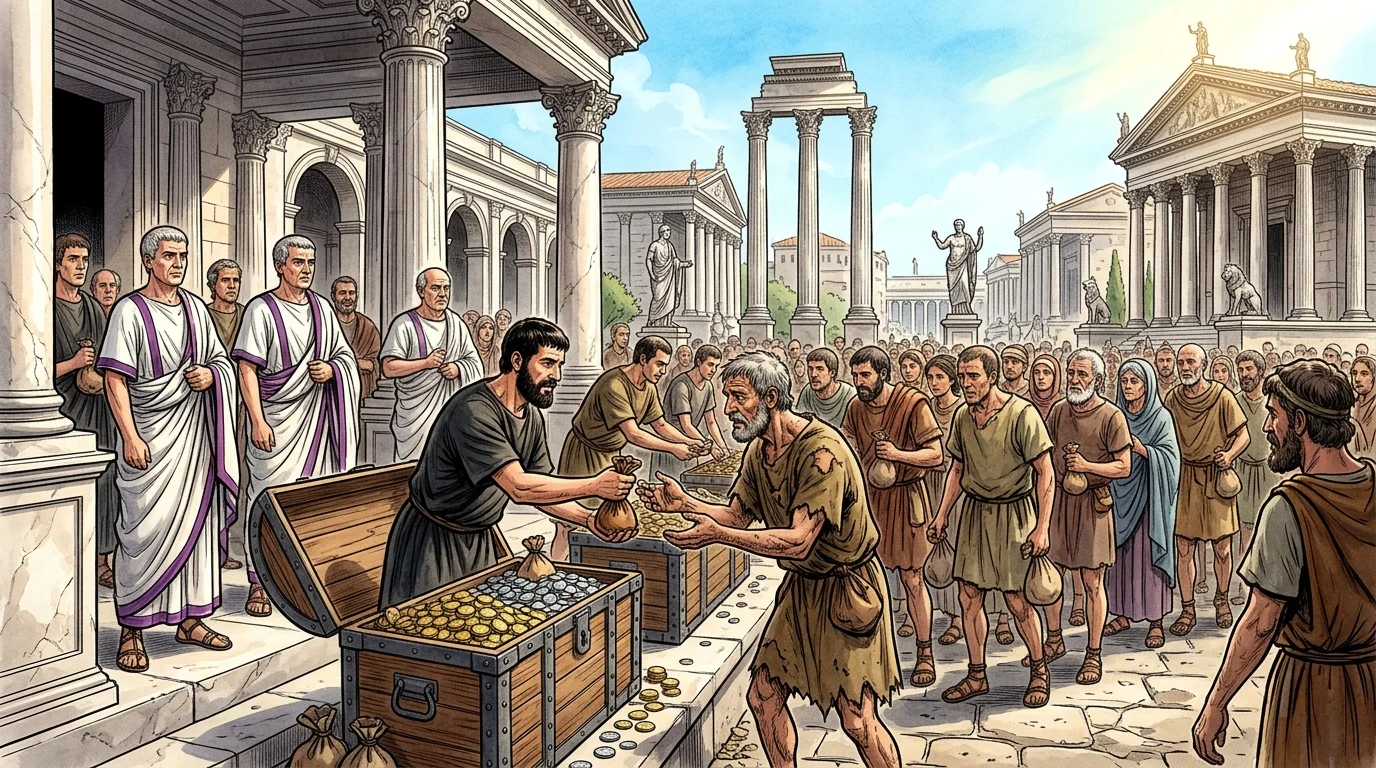
When the panic reached a crescendo and public disorder threatened the Forum, Tiberius finally acted from Capri with a decisive liquidity intervention. Drawing upon the vast reserves accumulated through years of fiscal restraint, the emperor placed 100 million sesterces (sestertium milies)—a sum equivalent to roughly one-eighth of the Roman state’s entire annual budget—into special public banking commissions (mensae) overseen by five consular senators. [7]
The terms of Tiberius’s emergency facility were carefully structured to break the deflationary spiral without rewarding insolvent speculators:
- Zero-Interest Liquidity: Distressed landowners could borrow from the state banking tables completely free of interest (sine usuris) for a term of three years (triennium).
- Double Real-Estate Collateral: To protect the public treasury against default, borrowers had to pledge Italian agricultural land worth at least double the loan principal (dupli praediis—a 50 percent loan-to-value ceiling based on pre-panic assessments).
The impact on market psychology was immediate. Because solvent landowners could now refinance their maturing debts through the imperial mensae at zero interest for three years, they immediately withdrew their estates from forced auction. Once the flood of fire-sale properties stopped, Italian land values rebounded, hoarded cash returned to circulation as private creditors realized that waiting for deeper price declines was futile, and the compulsory two-thirds land-purchase quota was quietly abandoned as unenforceable. Two millennia before modern central bank discount windows and quantitative easing, the Roman crisis of 33 CE demonstrated how regulatory shocks and liquidity hoarding can freeze an asset-backed credit system—and how a credible, collateralized state liquidity backstop can restore market equilibrium. [8]
Theoretical & Balance-Sheet Transmission Mechanism
In the Kindleberger–Minsky taxonomy of financial instability (Kindleberger, 1978; Minsky, 1986) and Irving Fisher’s (1933) debt-deflation framework, speculative asset booms become systemic crises when credit expansion shifts balance sheets from hedge finance (cash flows covering principal and interest) to speculative and Ponzi finance (relying on rising asset prices and short-term margin roll-overs).
Once monetary tightening or an exogenous shock halts price appreciation, forced margin liquidations trigger Fisherian debt-deflation: fire-sale asset discounts erode bank collateral values, contracting credit supply across the real economy.
Sources and Further Reading
- Cornelius Tacitus, “ The Annals, Book 6, Chapters 16–17 (The Financial Crisis of 33 CE and Tiberius’s 100-Million-Sesterce Loan Fund),” LacusCurtius, University of Chicago, c. 116 CE. Peer-Reviewed / Academic Research
- Gaius Suetonius Tranquillus, “ The Lives of the Twelve Caesars: Life of Tiberius, Chapter 48,” LacusCurtius, University of Chicago, c. 121 CE. Peer-Reviewed / Academic Research
- Cassius Dio, “ Roman History, Book 58, Chapter 21 (Credit Regulations and Public Loans in 33 CE),” LacusCurtius, University of Chicago, c. 229 CE. Peer-Reviewed / Academic Research
- William Stearns Davis, “ The Influence of Wealth in Imperial Rome,” The Macmillan Company (Internet Archive), 1910. Historical & Financial Reference
- Merav Haklai, “ Money in the Roman Empire from Hadrian to the Severi: A Study of Attitudes and Practice,” Oxford University Research Archive (ORA), University of Oxford, 2013. Peer-Reviewed / Academic Research
- Donald L. Wasson, “ Tiberius,” World History Encyclopedia, 2012. Historical & Financial Reference
- Irving Fisher — "The Debt-Deflation Theory of Great Depressions," Econometrica 1, no. 4 (FRASER Federal Reserve Archive, 1933): 337–357 Central Bank / Monetary Authority
- Charles P. Kindleberger & Robert Z. Aliber — Manias, Panics, and Crashes: A History of Financial Crises (Palgrave Macmillan) Peer-Reviewed / Academic Research
Cite This Historical Dossier (APA / Chicago)
APA (7th ed.): Ç., S. (Ed.). (2026). The Roman Financial Panic of 33 CE: Tiberius and the 100-Million-Sesterce Bailout. In Forgotten Fortunes Historical Monograph Series (Forgotten Fortunes Editorial Desk). https://forgottenfortunes.net/roman-financial-panic-33-ce-tiberius-bailout/
MLA (9th ed.): Ç., Soner, ed. "The Roman Financial Panic of 33 CE: Tiberius and the 100-Million-Sesterce Bailout." Forgotten Fortunes: Financial & Monetary History Archive, 2026, https://forgottenfortunes.net/roman-financial-panic-33-ce-tiberius-bailout/.
Chicago (17th ed.): Ç., Soner, ed. "The Roman Financial Panic of 33 CE: Tiberius and the 100-Million-Sesterce Bailout." Forgotten Fortunes Historical Monograph Series (Forgotten Fortunes Editorial Desk), September 12, 2026. https://forgottenfortunes.net/roman-financial-panic-33-ce-tiberius-bailout/.
Have an idea for another financial history documentary or article? Request a story →