In This Article
Laurion silver helped support the development of Athens as a monetary and naval power. Across the sixth and early fifth centuries BCE, Athens evolved from a crisis-ridden agrarian *polis* where indebted peasants were sold into chattel slavery before coins had even been struck in Attica into the preeminent naval and monetary superpower of the eastern Mediterranean. This financial transformation unfolded across three landmark stages: first, the archonship of Solon in 594/593 BCE, whose *Seisachtheia* (“shaking off of burdens”) abolished personal debt-bondage, uprooted stone encumbrance markers (*horoi*) from Attic soil, and recalibrated Athenian weights and measures; second, the mid-to-late sixth-century transition from weighed *Hacksilber* bullion and early heraldic silver coins (*Wappenmünzen*) to the standardized Athena-and-owl *tetradrachm* (~17.2 grams) around 515–510 BCE; and third, the extraordinary 483/482 BCE deep-vein silver strike at Maroneia in the Laurion mining district, which yielded a state treasury surplus of at least 100 talents (600,000 drachmas) that the statesman Themistocles persuaded the Athenian Assembly (*Ekklesia*) to invest in building 200 warships rather than distributing as a 10-drachma per-citizen cash dividend. [1]
The Agrarian Crisis of the *Hektemoroi* and Solon’s *Seisachtheia* (594/593 BCE)
At the dawn of the sixth century BCE, before coined money circulated in mainland Greece, Attic economic life rested on land tenure, barley and olive cultivation, and obligations denominated in natural measures of grain and uncoined silver bullion weighed on the balance scale. According to the later constitutional treatises preserved by Aristotle (*Athenaion Politeia*) and Plutarch (*Life of Solon*), as well as Solon’s own surviving elegiac and iambic verses, early sixth-century Attica had polarized into violent social strife (*stasis*) between wealthy aristocratic landowners (*Eupatridai*) and an impoverished peasantry.
Central to this crisis was the dependent class known as the *hektemoroi* (“sixth-parters”), smallholders or sharecroppers who were obligated to surrender one-sixth of their annual agricultural harvest—or, under an alternative ancient interpretation, retained only one-sixth while handing over five-sixths—to elite creditors. Across the Attic countryside, stone pillars known as *horoi* (boundary or encumbrance markers) stood planted in agricultural plots to signify that the land and its produce were pledged under conditional obligation. Worse still, under pre-Solonian customary law, all loans and sharecropping arrears were secured upon the physical person (*epi tois somasin*) of the debtor and his household. When drought or poor harvests caused a *hektemoros* to default, his aristocratic creditor seized the farmer or his children as debt-slaves (*agwgimoi*), either working them in chains on Attic estates or selling them abroad for silver across the Aegean.
Elected eponymous archon and mediator (*diallaktes*) with extraordinary legislative authority in 594/593 BCE, Solon enacted a radical, one-time socioeconomic settlement that the Greeks called the *Seisachtheia*—literally the “shaking off of burdens.” By decree, Solon canceled all existing private and public debts, emancipated all *hektemoroi* from their one-sixth tributary status into free smallholders, and used public and private funds to repatriate Athenian citizens who had been sold into foreign slavery so long ago that, in Solon’s own poetic words, they “no longer spoke the Attic tongue.” In a celebrated passage of his verses, Solon called upon Mother Earth herself as his witness before the tribunal of Time that he had “pulled up the *horoi* planted in many places” and made the formerly enslaved earth free. [2]
Crucially, Solon combined this one-time debt jubilee with a permanent institutional prohibition: henceforth, no Athenian citizen could ever again borrow or lend upon the security of a citizen’s physical body (*mê daneizein epi tois somasin*). Even when fourth-century BCE Athenians later reinvented stone *horoi* to publicize commercial hypothecations and dowry security on real estate, personal debt-bondage remained permanently outlawed, establishing the inviolability of the citizen body as the bedrock of Athenian democracy.
Weights, Measures, and the Transition from *Hacksilber* to *Wappenmünzen*
While ancient fourth-century sources retrospectively credited Solon with reforming Athenian “measures, weights, and coinage”—specifically stating that he recalibrated the mina of 70 drachmas up to 100 drachmas and replaced the heavier Pheidonian (Aeginetan) standard with the lighter Euboic-Attic standard—modern archaeological and numismatic research has clarified that Athens had not yet begun striking coins in 594/593 BCE. In Solon’s lifetime, payments mentioned in the archaic laws of Draco and Solon were either reckoned in heads of cattle (*boes*), measured in dry and liquid agricultural units (*medimnoi* of grain and *metretai* of olive oil) used to define Solon’s four timocratic census classes (*pentakosiomedimnoi*, *hippeis*, *zeugitai*, and *thetes*), or settled in weighed silver bullion (*argyrion*) measured in drachmas (“handfuls” of six iron spits, or *obeloi*) of roughly 4.3 grams each. [3]
Archaeological hoards from the early sixth century BCE show that uncoined cut silver ingots, jewelry fragments, and scrap bullion—known to scholars as *Hacksilber*—circulated alongside early electrum coins from Lydia and Ionia and silver “turtle” staters from the neighboring island of Aegina. Only around 545–540 BCE, during the tyrannies of Peisistratus and his sons Hippias and Hipparchus, did Athens begin minting its first civic silver coinage: the series termed *Wappenmünzen* (“heraldic” or “coat-of-arms coins”) by nineteenth-century German numismatists. [4]
Struck on the Euboic-Attic weight standard as didrachms (~8.6 grams) alongside fractional drachms, obols, and late-series tetradrachms, the *Wappenmünzen* carried no civic ethnic inscription on their faces. Instead, they featured a succession of fourteen changing pictorial devices—including an amphora, a triskeles, a beetle, an astragalos (knucklebone), a horse forepart, an owl, a bull’s head, a gorgoneion (Medusa head), and a chariot wheel—on the obverse, paired with a simple diagonal punch-mark (*incuse square*) on the reverse. Although early scholars once conjectured that these changing badges were the family crests of rival aristocratic clans such as the Alcmaeonids or Peisistratids, metallurgical analyses demonstrate that the *Wappenmünzen* were minted largely from imported Thracian and Siphnian silver mixed with early surface-mined Attic ore, and functioned as state-sanctioned civic issues whose changing emblems likely identified annual mint magistrates or Panathenaic festival cycles primarily intended for domestic payments within Attica. [5]
The Birth of the Athenian “Owl” *Tetradrachm* (c. 515–510 BCE)
During the final years of the Peisistratid tyranny under Hippias (around 520–515 BCE) or at the dawn of Cleisthenes’ democratic reforms (510–506 BCE), Athens abruptly abandoned the changing *Wappenmünzen* didrachms and introduced a revolutionary new coin denomination and design that would remain virtually unaltered in its archaic stylistic conventions for more than three centuries: the silver Athena/owl *tetradrachm* (four-drachma piece, weighing approximately 17.2 grams of 98%–99% pure silver). [6]
For the first time in Greek monetary history, Athens placed a human-scale divine portrait on the obverse and a figural animal emblem inside a framed reverse die, accompanied by the explicit three-letter civic ethnic inscription **ΑΘΕ** (*ATHE*, abbreviating *Athenaion*, “[coin] of the Athenians”). The obverse depicted the helmeted head of Athens’ patron goddess Athena, while the reverse displayed her sacred bird of wisdom, the little owl (*Athene noctua*), standing beside an olive twig and a crescent moon. By doubling the standard coin unit from the 8.6-gram didrachm to the heavy 17.2-gram *tetradrachm*—colloquially known across the Greek world simply as *glaukes* (“owls”)—Athens created a high-value trade bullion coin tailored for large-scale public works, mercenary and military payrolls, and international maritime commerce. [7]
The 483/482 BCE Laurion Silver Strike at Maroneia and Themistocles’ Naval Decree
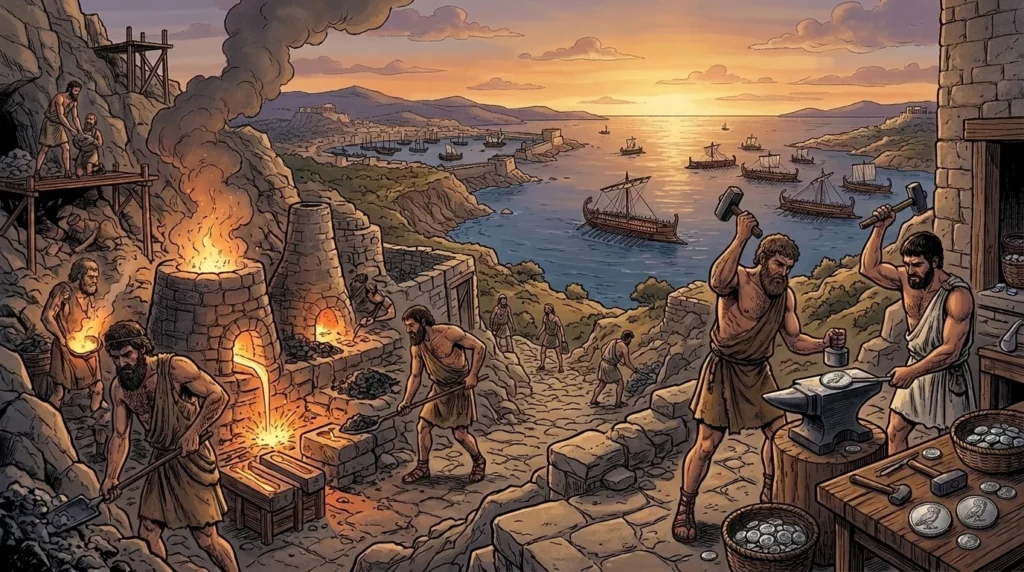
What transformed the Athenian owl *tetradrachm* from a respected regional currency into the dominant reserve money of the ancient Mediterranean was a geological and political watershed in southeastern Attica. In the coastal hills of the Laurion (Lavrion) district near Cape Sounion, silver-bearing galena (lead sulfide) ore occurred along distinct geological contact zones where porous marble met impermeable mica schist. Early miners had worked only the upper surface contact (the “first contact”), but by the early fifth century BCE Athenian prospectors—leasing public mining concessions from the state officials known as the *poletai*—began sinking vertical shafts up to 100 meters deep to reach the extraordinarily rich “third contact” vein system. [8]
In the archonship of Nicodemus in 483/482 BCE—just seven years after the Athenian hoplite victory over King Darius’s expeditionary force at Marathon (490 BCE) and on the eve of King Xerxes’ massive second Persian invasion—miners working the deep shafts at Maroneia in the Laurion district struck a colossal, previously untapped seam of high-grade argentiferous galena. Processed through stone crushing mills, helical ore-washing tables engineered to recycle scarce rainwater, and cupellation furnaces that separated molten lead oxide (*litharge*) from pure metallic silver, the Maroneia strike delivered an immediate windfall royalty and lease surplus of 100 talents of silver (according to Aristotle’s *Athenaion Politeia* 22.7 and Plutarch) or even 200 talents across the peak years—equivalent to 600,000 to 1,200,000 silver drachmas, or over 2.6 to 5.2 metric tons of pure state treasury silver.
Under traditional Greek fiscal practice, mineral revenues belonged collectively to the citizen body, and a populist proposal before the Assembly called for distributing the Laurion surplus directly to every adult male Athenian citizen at a rate of 10 drachmas per man (implying an eligible citizen body of roughly 30,000 and an annual distribution of 50 talents). Stepping before the Assembly, the far-sighted politician and general Themistocles—having already secured the ostracism of his conservative rival Aristides in 482 BCE—realized that Athens could not persuade citizens to forfeit their 10-drachma windfall by invoking a distant Persian threat alone. Instead, as Herodotus (7.144) records, Themistocles pointed to Athens’ ongoing, humiliating maritime war against the neighboring island of Aegina and persuaded the Assembly to forego the cash handout in order to construct a state-owned armada of 200 modern three-banked warships (*triremes*).
According to Aristotle’s account of the financing mechanism, the state advanced 1 talent (6,000 drachmas) from the Maroneia silver strike to each of the 100 wealthiest Athenian citizens, charging each man with overseeing the construction and outfitting of a hull on condition that if the Assembly approved the finished warship, the state loan was discharged, whereas if the work failed inspection, the wealthy commissioner had to refund the talent out of his personal estate. Minting millions of silver owl *tetradrachms* and fractional drachms and obols to pay shipwrights, timber importers, sailmakers, and rowers, the 483/482 BCE Laurion naval program monetized the entire Athenian domestic economy overnight. Two years later, in September 480 BCE, those 200 Laurion-funded triremes formed the decisive backbone of the allied Greek fleet that crushed Xerxes’ armada in the narrow straits at the Battle of Salamis—securing Athenian naval hegemony, establishing the Delian League, and launching the fifth-century BCE Golden Age during which Laurion owls circulated from Sicily and Egypt to the Levant, Anatolia, and Mesopotamia.
Theoretical & Balance-Sheet Transmission Mechanism
In the Kindleberger–Minsky taxonomy of financial instability (Kindleberger, 1978; Minsky, 1986) and Irving Fisher’s (1933) debt-deflation framework, speculative asset booms become systemic crises when credit expansion shifts balance sheets from hedge finance (cash flows covering principal and interest) to speculative and Ponzi finance (relying on rising asset prices and short-term margin roll-overs).
Once monetary tightening or an exogenous shock halts price appreciation, forced margin liquidations trigger Fisherian debt-deflation: fire-sale asset discounts erode bank collateral values, contracting credit supply across the real economy.
Sources and Further Reading
- Josiah Ober, “ Solon and the Horoi: Facts on the Ground in Archaic Athens“, Brill (Solon of Athens), 2006. Peer-Reviewed / Academic Research
- Colin M. Kraay, “ Coinage“, Cambridge University Press (The Cambridge Ancient History), 1988. Peer-Reviewed / Academic Research
- John Ellis Jones, “ The Laurion Silver Mines: A Review of Recent Researches and Results“, Greece & Rome (Cambridge University Press), 1982. Peer-Reviewed / Academic Research
- N. G. L. Hammond, “ The Narrative of Herodotus VII and the Decree of Themistocles at Troezen“, The Journal of Hellenic Studies, 1982. Peer-Reviewed / Academic Research
- John H. Kroll, “ The Agora Mint and Athenian Bronze Coinage“, Hesperia (American School of Classical Studies at Athens), 2001. Peer-Reviewed / Academic Research
- Michael Loy, “ Coinage Networks in Fifth-Century BCE Ionia“, Anatolian Studies (Cambridge University Press), 2024. Peer-Reviewed / Academic Research
- Irving Fisher — "The Debt-Deflation Theory of Great Depressions," Econometrica 1, no. 4 (FRASER Federal Reserve Archive, 1933): 337–357 Central Bank / Monetary Authority
- Charles P. Kindleberger & Robert Z. Aliber — Manias, Panics, and Crashes: A History of Financial Crises (Palgrave Macmillan) Peer-Reviewed / Academic Research
Cite This Historical Dossier (APA / Chicago)
APA (7th ed.): Ç., S. (Ed.). (2026). Solon's Seisachtheia, the Wappenmünzen, and the 483 BCE Laurion Silver Strike. In Forgotten Fortunes Historical Monograph Series (Forgotten Fortunes Editorial Desk). https://forgottenfortunes.net/athens-solon-seisachtheia-laurion-silver-owl-tetradrachm/
MLA (9th ed.): Ç., Soner, ed. "Solon's Seisachtheia, the Wappenmünzen, and the 483 BCE Laurion Silver Strike." Forgotten Fortunes: Financial & Monetary History Archive, 2026, https://forgottenfortunes.net/athens-solon-seisachtheia-laurion-silver-owl-tetradrachm/.
Chicago (17th ed.): Ç., Soner, ed. "Solon's Seisachtheia, the Wappenmünzen, and the 483 BCE Laurion Silver Strike." Forgotten Fortunes Historical Monograph Series (Forgotten Fortunes Editorial Desk), September 6, 2026. https://forgottenfortunes.net/athens-solon-seisachtheia-laurion-silver-owl-tetradrachm/.
Have an idea for another financial history documentary or article? Request a story →