In This Article
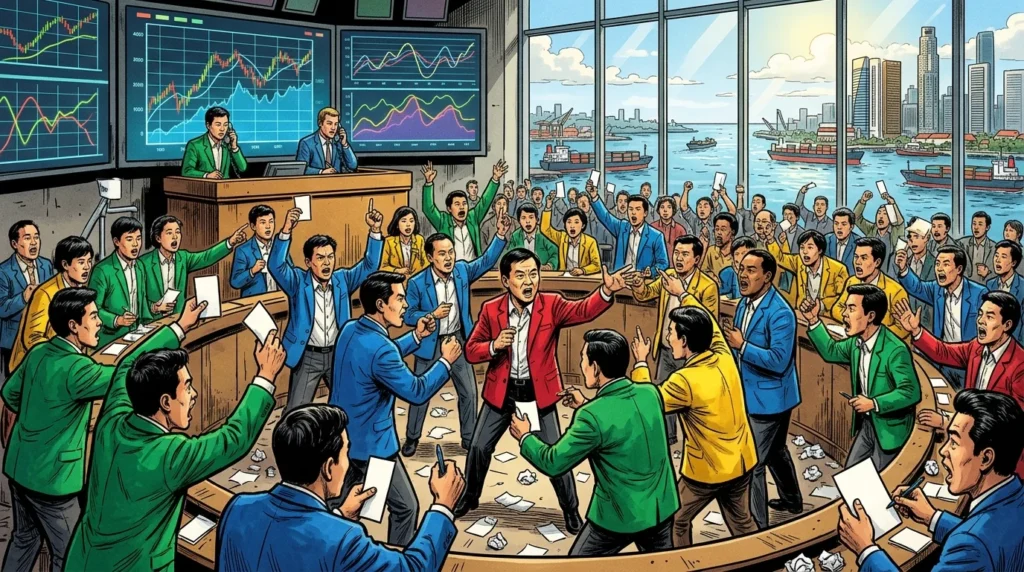
In the summer of 1964, a single diamond-drill hole in the boreal muskeg north of Timmins, Ontario triggered the most notorious penny-stock frenzy in Canadian history. Fueled by rumors that Windfall Oils and Mines Limited had intersected a massive base-metal ore body adjacent to Texas Gulf Sulphur’s rich Kidd Creek strike, retail speculators drove Windfall shares from C$0.56 to a peak of C$5.70 on the Toronto Stock Exchange (TSE) within three weeks. For nearly a month, corporate insiders George and Viola MacMillan withheld assay data showing the core was barren rock while liquidating millions of dollars in stock. When the company finally disclosed the truth on July 30, 1964, Windfall shares collapsed overnight, wiping out thousands of small investors. [1]

The fallout from the Windfall debacle permanently reshaped Canadian capital markets. Public fury forced the Ontario government to convene the Royal Commission to Investigate Trading in the Shares of Windfall Oils and Mines Limited under Justice Arthur Kelly in 1965 and to enact the landmark Ontario Securities Act of 1966, establishing modern North American insider-trading and continuous-disclosure standards. Over the following two decades, this regulatory tightening pushed high-risk resource promotion westward to the Vancouver Stock Exchange while propelling the Toronto Stock Exchange to pioneer the Computer Assisted Trading System (CATS) in November 1977—the world’s first automated electronic limit-order book. [2]
The Kidd Creek Strike and the Bay Street Boiler-Room Culture
For two decades after World War II, the Toronto Stock Exchange operated a dual personality. Alongside blue-chip Canadian banks, railways, and industrial manufacturers, its trading floor hosted the largest speculative mining market on earth. Under the loose provisions of post-war provincial rules, promotional underwriters acquired blocks of treasury shares in dormant shell companies at pennies per share, secured options on escalating price tranches, and used high-pressure telephone sales teams—known across Bay Street as boiler rooms—to distribute stock to retail buyers across Canada and the United States.
This speculative ecosystem erupted in April 1964 when the U.S.-based Texas Gulf Sulphur Company announced a monumental copper, zinc, and silver discovery in Kidd Township near Timmins, Ontario. After earlier downplaying rumors in a controversial April 12 press release that later prompted a landmark enforcement suit by the U.S. Securities and Exchange Commission, Texas Gulf confirmed on April 16, 1964 that its Kidd Creek drill holes had intersected more than 55 million tons of rich massive-sulphide ore. Within days, prospectors and junior mining promoters staked thousands of claims across the surrounding townships, and daily trading volume on the Toronto Stock Exchange surged to record levels exceeding 15 million shares. [3]
At the center of the Timmins staking rush stood Viola MacMillan, the longtime president of the Prospectors and Developers Association and Canada’s best-known mining promoter, together with her husband George MacMillan. Through their holding companies, the MacMillans controlled Windfall Oils and Mines Limited, a thinly capitalized junior company holding four unpatented mining claims immediately bordering the Texas Gulf Sulphur discovery zone in Prosser and Wark townships.
| Documented Figure / Metric | Historical Significance & Archival Context |
|---|---|
| $15 million | When trading resumed the next morning, July 31, panic selling overwhelmed the exchange floor, and Windfall shares plunged below C$0.80, erasing more than C$15 million in retail market value in hours. |
| $1.4 million | The Kelly Commission documented how the 26-day delay between the recovery of barren drill core on July 3 and the negative announcement on July 30 had been deliberately exploited to generate roughly C$1.4 million in trading profits for MacMillan-controlled accounts. |
Twenty-Six Days of Silence: The July 1964 Windfall Frenzy
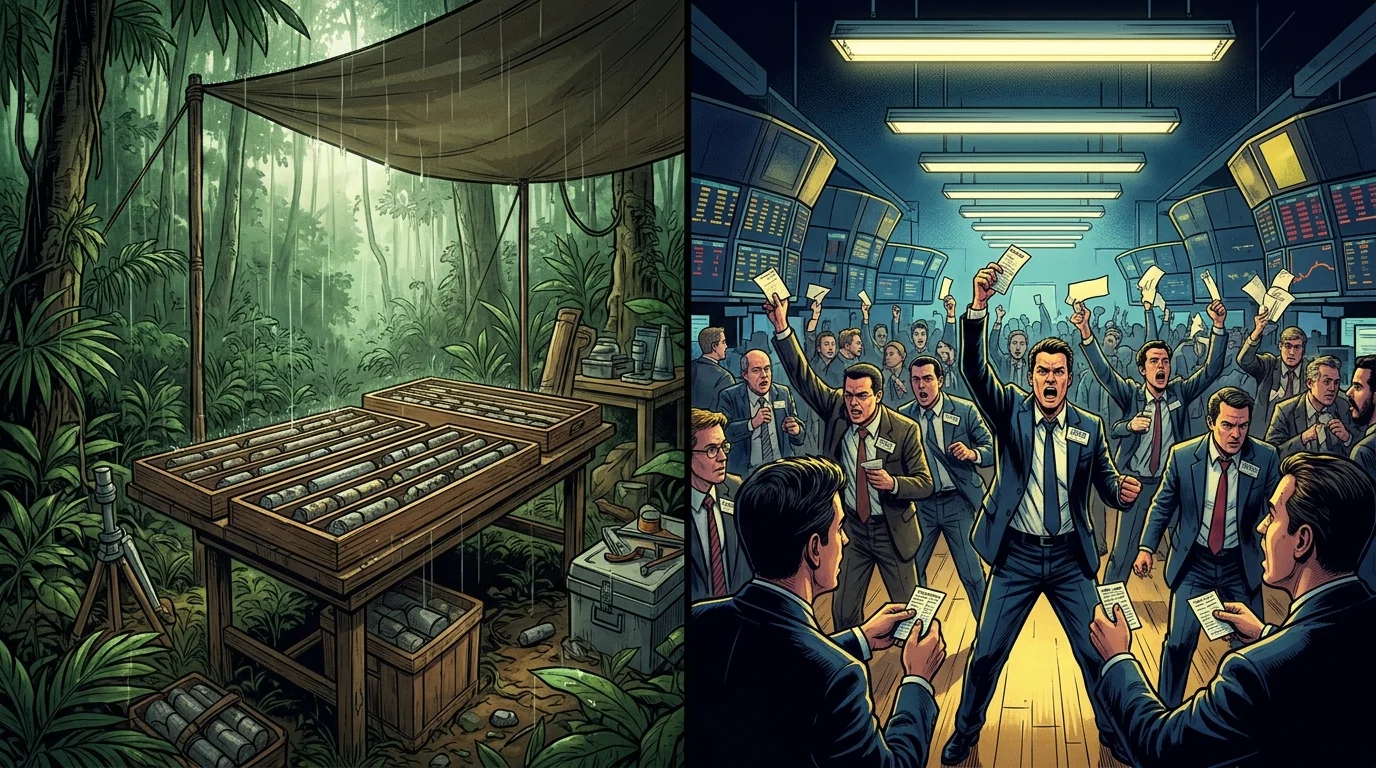
At the end of June 1964, Windfall Oils and Mines shares traded quietly around C$0.56 on the Toronto Stock Exchange. On July 3, 1964, contract drillers completed Windfall’s first diamond-drill hole, designated Hole W-1, and extracted the rock core for inspection. Visually, any experienced geologist could see that the core consisted of barren country rock devoid of commercial copper, zinc, or silver mineralization. [4]
Instead of releasing an immediate technical update, George and Viola MacMillan cloaked the drill site in theatrical secrecy. Guards turned away reporters, core boxes were transported under cover of darkness, and rumors swept the TSE floor and Timmins hotel lobbies that Hole W-1 had hit high-grade massive sulphides matching Texas Gulf’s Kidd Creek bonanza. On July 6, Windfall shares leaped past C$1.00 on heavy volume; by July 10, the stock exceeded C$2.00 as retail investors from taxi drivers to schoolteachers poured life savings into the promotion. [5]
Throughout mid-July 1964, TSE officials repeatedly pressed Windfall management to confirm or deny the market rumors. Rather than ordering an immediate chemical assay, the MacMillans issued evasive statements claiming that visual inspection was inconclusive and that the core was undergoing specialized geophysical testing before assaying. Behind the scenes, Viola MacMillan executed wash trades—simultaneously buying and selling shares through nominee accounts to manufacture artificial volume and price momentum—while MacMillan-controlled entities unloaded huge blocks of Windfall stock into the public frenzy. On July 20, 1964, Windfall shares touched an intraday peak of C$5.60 to C$5.70, valuing a company with four untested bush claims at more than C$25 million. [6]
Only after intense pressure from the Ontario Securities Commission (OSC) and the TSE Board of Governors did the MacMillans submit the core for formal chemical analysis. Late on Thursday, July 30, 1964, Windfall released the official assay certificate: Hole W-1 contained no commercial mineralization whatsoever. When trading resumed the next morning, July 31, panic selling overwhelmed the exchange floor, and Windfall shares plunged below C$0.80, erasing more than C$15 million in retail market value in hours. [7]
The 1965 Kelly Commission and the Kimber Report
The Windfall collapse ignited a political storm across Ontario. Newspaper investigations revealed that senior staff connected to the Ontario Securities Commission and prominent floor traders had traded heavily during the July run-up, while the TSE’s self-regulatory surveillance had failed to halt the stock despite obvious signs of manipulation. On August 10, 1964, Ontario Premier John Robarts appointed Justice Arthur Kelly of the Ontario Court of Appeal to head a Royal Commission to Investigate Trading in the Shares of Windfall Oils and Mines Limited. [8]
Published in September 1965, Justice Kelly’s report delivered a devastating indictment of both the MacMillans and the regulatory culture of Bay Street. The Kelly Commission documented how the 26-day delay between the recovery of barren drill core on July 3 and the negative announcement on July 30 had been deliberately exploited to generate roughly C$1.4 million in trading profits for MacMillan-controlled accounts. Justice Kelly recommended abolishing primary distribution of speculative penny mining shares directly through the facilities of the Toronto Stock Exchange floor and demanded strict statutory obligations requiring immediate public disclosure of material geological results.
The Kelly Commission’s findings converged with the March 1965 Report of the Attorney General’s Committee on Securities Legislation in Ontario, chaired by OSC Chairman John R. Kimber. Together, the Kimber Report and the Kelly Commission exposed how post-war Canadian corporate law left minority shareholders defenseless against insider self-dealing, secret option pools, and delayed financial reporting.
The Ontario Securities Act of 1966 and Insider Liability
Acting on the Kimber and Kelly recommendations, the Ontario Legislature enacted the Ontario Securities Act, 1966 (S.O. 1966, c. 142), which took effect on May 1, 1967. Widely recognized by legal scholars as the foundation of modern Canadian securities regulation, the 1966 Act transformed the Ontario Securities Commission from a passive registration bureau into an enforcement agency armed with investigative subpoena powers and administrative sanction authority.
The 1966 statute introduced three structural pillars to Canadian finance:
- Mandatory Insider Reporting and Liability: Corporate directors, senior officers, and holders of more than 10 percent of a company’s equity were required to file monthly public reports of all share transactions and were made statutorily liable to compensate counterparties and the corporation for profits gained through undisclosed material information.
- Continuous Timely Disclosure: Listed issuers were compelled to publish semi-annual comparative financial statements and to issue immediate press releases whenever a material change occurred in their business or exploration operations.
- Takeover-Bid and Primary-Distribution Controls: The Act imposed uniform disclosure circulars and pro-rata take-up rules on corporate takeovers while curtailing the use of the TSE floor for unseasoned penny-stock underwritings.
Although George and Viola MacMillan were acquitted of criminal fraud charges relating to the drill core itself, Viola MacMillan was convicted in 1967 under the Criminal Code of Canada for unlawful wash trading in shares of Golden Shaft Mines and sentenced to nine months in prison, fines of C$10,000, and removal from the helm of the Prospectors and Developers Association.
From CATS (1977) to the Vancouver Stock Exchange Boom
In the following decade, the Toronto Stock Exchange also modernized trading technology and market surveillance. The CATS rollout should not be treated as a demonstrably direct response to the Windfall case. Under Vice President of Operations Harold B. Hofmann, TSE engineers spent nearly eight years designing an automated matching engine to replace fragmented floor books and opaque specialist handling. On November 18, 1977, the TSE launched the Computer Assisted Trading System (CATS)—the world’s first screen-based, fully electronic continuous double-auction trading system on a major stock exchange.
Initially deployed across 90 less-liquid equities, CATS allowed brokers in remote offices to enter priced limit orders into a centralized computer terminal that displayed the full depth of bids and offers in real time and matched trades automatically by strict price-time priority. Electronic order matching reduced reliance on floor-trader discretion and created a stronger audit trail, though this design change alone does not establish how much market manipulation fell. During the 1980s, major international exchanges licensed Toronto’s CATS software as the backbone of their own electronic modernization, including the Paris Bourse—which adapted CATS into its Cotation Assistée en Continu (CAC) system in 1986—as well as the stock exchanges of Brussels, Madrid, and São Paulo.
Yet the regulatory cleanup of Toronto produced an unintended geographic displacement. Barred from conducting low-disclosure penny promotions on the TSE, junior resource promoters migrated west to the Vancouver Stock Exchange (VSE). Between 1983 and 1987, the VSE experienced a massive speculative boom in junior gold exploration and shell companies, trading billions of shares annually under relaxed listing rules that prompted academic researchers and international press outlets to dub Vancouver the penny-stock capital of the world—proving that while the 1964 Windfall scandal and the 1977 CATS revolution modernized Bay Street, the appetite for speculative frontier finance remained an enduring feature of Canadian markets.
Theoretical & Balance-Sheet Transmission Mechanism
In the Kindleberger–Minsky taxonomy of financial instability (Kindleberger, 1978; Minsky, 1986) and Irving Fisher’s (1933) debt-deflation framework, speculative asset booms become systemic crises when credit expansion shifts balance sheets from hedge finance (cash flows covering principal and interest) to speculative and Ponzi finance (relying on rising asset prices and short-term margin roll-overs).
Once monetary tightening or an exogenous shock halts price appreciation, forced margin liquidations trigger Fisherian debt-deflation: fire-sale asset discounts erode bank collateral values, contracting credit supply across the real economy.
Sources and Further Reading
- Ontario Royal Commission to Investigate Trading in the Shares of Windfall Oils and Mines Limited (Justice Arthur Kelly, Commissioner), “Report of the Royal Commission to Investigate Trading in the Shares of Windfall Oils and Mines Limited,” Queen’s Printer for Ontario, 1965. Historical & Financial Reference
- Dominion Bureau of Statistics (Statistics Canada), “Canada Year Book 1966: Official Sources of Information and Royal Commissions,” Queen’s Printer, 1966. Historical & Financial Reference
- Lawrence Kryzanowski, “Misinformation and Security Markets,” McGill Law Journal, 1978. Historical & Financial Reference
- Ananth Madhavan, David Porter, and Daniel Weaver, “Should Securities Markets Be Transparent? An Empirical Analysis of the Toronto Stock Exchange’s CATS System,” Bank of Canada / Journal of Financial Markets, 2005. Peer-Reviewed / Academic Research
- Joseph A. Groia and Pamela Hardie (referenced in York University Osgoode Hall Law School), “Securities Regulation of Ontario Venture Issuers: History of the Kimber Report and the 1966 Ontario Securities Act,” York University, 2014. Historical & Financial Reference
- Canadian Institute of Mining, Metallurgy and Petroleum (CIM), “The Complex Legacy of Viola MacMillan,” CIM Magazine, 2025. Historical & Financial Reference
- Irving Fisher — "The Debt-Deflation Theory of Great Depressions," Econometrica 1, no. 4 (FRASER Federal Reserve Archive, 1933): 337–357 Central Bank / Monetary Authority
- Charles P. Kindleberger & Robert Z. Aliber — Manias, Panics, and Crashes: A History of Financial Crises (Palgrave Macmillan) Peer-Reviewed / Academic Research
Cite This Historical Dossier (APA / Chicago)
APA (7th ed.): Ç., S. (Ed.). (2026). The 1964 Windfall Oils Scandal, the Kelly Commission, and the TSE's CATS Revolution. In Forgotten Fortunes Historical Monograph Series (Forgotten Fortunes Editorial Desk). https://forgottenfortunes.net/canada-1964-windfall-oils-scandal/
MLA (9th ed.): Ç., Soner, ed. "The 1964 Windfall Oils Scandal, the Kelly Commission, and the TSE's CATS Revolution." Forgotten Fortunes: Financial & Monetary History Archive, 2026, https://forgottenfortunes.net/canada-1964-windfall-oils-scandal/.
Chicago (17th ed.): Ç., Soner, ed. "The 1964 Windfall Oils Scandal, the Kelly Commission, and the TSE's CATS Revolution." Forgotten Fortunes Historical Monograph Series (Forgotten Fortunes Editorial Desk), September 13, 2026. https://forgottenfortunes.net/canada-1964-windfall-oils-scandal/.
Have an idea for another financial history documentary or article? Request a story →