In This Article
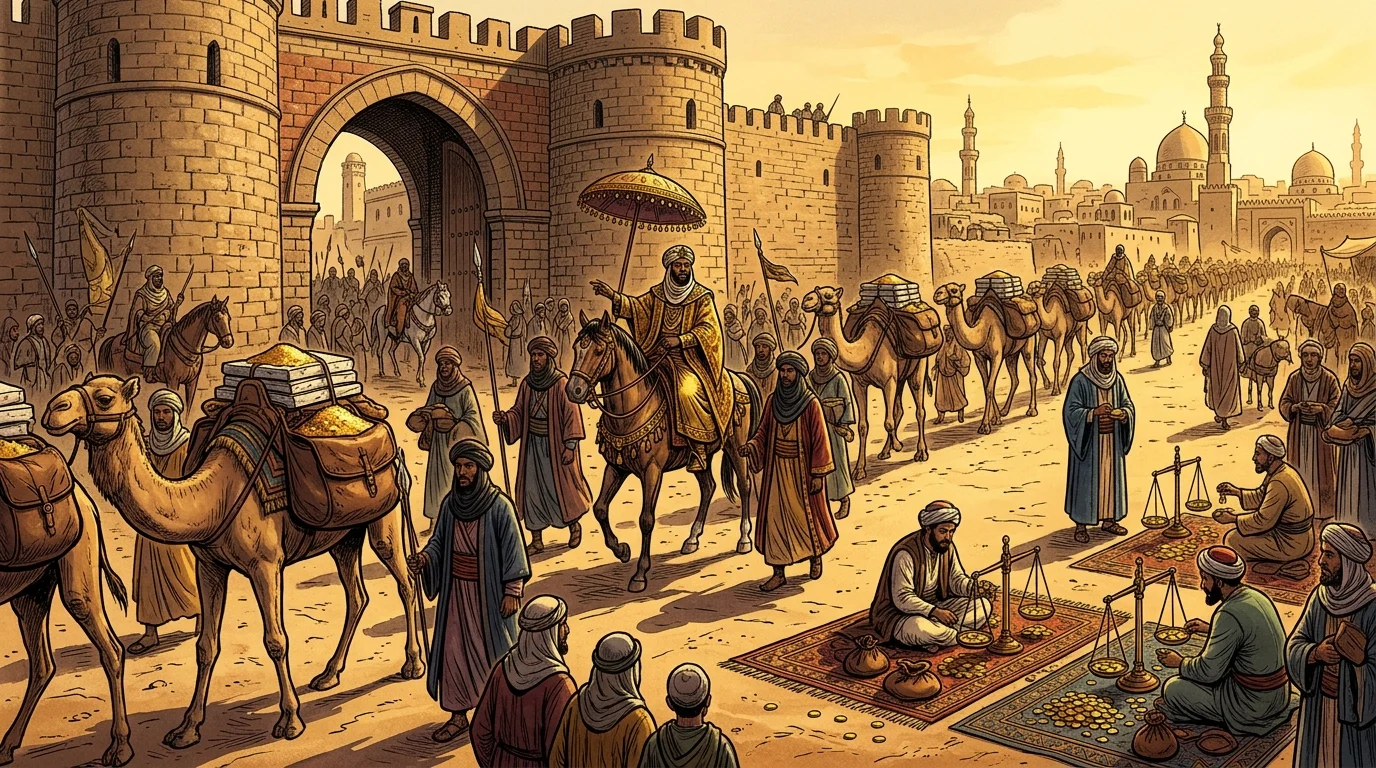
During his 1324 pilgrimage, after crossing the Sahara via Walata and Tuwat with an entourage of tens of thousands of soldiers, courtiers, heralds, and camels laden with unworked West African gold, Mansa Musa—mansa (emperor) of the Mali Empire—encamped at the foot of the Pyramids of Giza before entering Mamluk Cairo. Over the next three months, and along the pilgrimage route to Medina and Mecca, the West African monarch distributed and spent so much native gold dust (tibr) and bullion that he triggered the most famous commodity-money shock of the Middle Ages. As the Syrian chancery scholar Shihab al-Din al-‘Umari recorded twelve years later, the sudden flood of Malian bullion drove the exchange rate of the gold mithqal in Cairo down from 25 or more silver dirhams to 22 dirhams or fewer—depressing gold’s purchasing power for more than a decade and eventually forcing Mansa Musa on his return journey to borrow money back at steep interest from Cairene merchants led by Siraj al-Din ibn al-Kuwayk. Behind that dramatic episode stood a sophisticated West African monetary architecture that combined standardized gold dust, Saharan rock-salt slabs, copper rods, and imported Indian Ocean cowrie shells across the commercial cities of Timbuktu, Gao, Jenne, and Niani. [1]
Bambuk, Bure, and the Sovereign Gold Monopoly of Mali
Founded in the 1230s by Sunjata Keita along the upper Niger River, the Mali Empire owed its extraordinary medieval liquidity to its strategic control over the principal alluvial and reef goldfields of West Africa: Bambuk (between the Senegal and Falémé rivers), Bure (along the upper Niger and Tinkisso rivers in modern Guinea), and the northern trade routes tapping the Akan forest fields to the south. Together, these West African basins supplied more than half of the newly mined gold entering the monetary circulation of the Islamic Mediterranean and Latin Europe during the thirteenth and fourteenth centuries—providing the raw bullion for the Mamluk gold dinar in Egypt as well as the florin of Florence (1252), the genovino of Genoa, and the Venetian ducat (1284). [2]
Rather than attempting to garrison the gold-panning villages of Bure and Bambuk directly—which historically caused non-Muslim Soninke and Wangara miners to halt production—the emperors of Mali enforced a dual fiscal and monetary distinction between solid gold nuggets and alluvial gold dust (tibr). As fourteenth-century chroniclers al-‘Umari and Ibn Khaldun documented from Malian informants, imperial law decreed that every solid gold nugget (varying from one ounce to a pound or more) discovered in the mines belonged exclusively to the mansa‘s royal treasury as sovereign regalia. Gold panners and washed-gravel miners retained the fine gold dust, which entered private commerce and paid royal customs duties.
Consequently, the Mali Empire did not strike stamped gold coins within its heartland. Instead, unminted pure gold dust circulated as the premier high-value currency of the empire, measured on precision brass balances against glass, seed, and brass weights calibrated to the Islamic mithqal—equivalent to approximately 4.25 to 4.55 grams (roughly one seventh of a troy ounce) of fine gold. [3]
The Multi-Tiered Monetary System: Gold Dust, Taghaza Salt, Copper, and Cowries
Because a single mithqal of gold dust represented substantial purchasing power—capable of buying several pack animals or weeks of provisions—a pure gold standard could not settle small retail transactions in the bustling river and desert markets of Timbuktu, Jenne, Gao, and Walata. To prevent fractional scarcity, the Mali Empire operated a four-tiered commodity monetary system that segmented exchange by transaction size and geography.
At the top tier stood weighed gold dust (tibr) and twisted gold wire or rings, used for trans-Saharan caravan wholesale trade, horse purchases, luxury Mediterranean textiles, and state tribute. Immediately below gold stood standardized slabs of crystalline rock salt quarried from the desert pans of Taghaza in the northern Sahara. Cut into uniform 90-to-100-pound rectangular bars—two slabs making a standard camel load—Taghaza salt was essential to human and livestock survival in the salt-deficient savanna and forest belts south of the Niger. When the Moroccan traveler Ibn Battuta visited Mali in 1352–1353, he observed that a camel load of two salt bars sold for 8 to 10 gold mithqals in Walata on the desert edge, rose to 20 to 30 mithqals in the imperial capital and Niger river ports, and sometimes reached 40 mithqals in the southern interior. In everyday towns, merchants broke the rock-salt bars into small weighed fragments that circulated directly as hand-to-hand money to buy meat, millet, and sour milk. [4]
In the eastern provinces and copper-mining oasis of Takedda, standardized cast copper rods—graded into thick and thin bars exchanging at 400 to 600 rods per gold mithqal—served as a parallel medium of exchange for firewood, grain, and domestic labor. Finally, across the central markets of Mali’s Niger bend, small-denomination retail commerce was monetized through imported shells of the Maldivian money cowrie (Cypraea moneta). Harvested in the Maldive Islands in the Indian Ocean, shipped up the Red Sea to Cairo or across the Mediterranean to Morocco, and carried south across the Sahara on camelback, smooth white cowrie shells were durable, impossible to counterfeit locally, and easily counted in strings and baskets. During the mid-fourteenth century, cowries circulated in Mali at an official market exchange rate of roughly 1,150 cowrie shells per gold mithqal, giving ordinary weavers, boatmen, and food vendors a stable fractional currency. [5]
The 1324 Pilgrimage and the Cairo Gold Shock
It was this vast reservoir of sovereign gold nuggets and tributary tibr that Mansa Musa mobilized in 1324 when he departed Mali on the 4,000-mile hajj to Mecca. Arabic chronicles compiled by al-‘Umari (who lived in Cairo in the 1330s), Ibn Battuta, Ibn Khaldun, and the fifteenth-century Egyptian economic historian Taqi al-Din al-Maqrizi preserve independent eyewitness testimonies of the caravan’s arrival in Egypt in July 1324 during the third reign of the Mamluk Sultan al-Nasir Muhammad ibn Qalawun. [6]
According to interviews with Ibn Amir Hajib, governor of Old Cairo (Misr) who befriended Mansa Musa, and Muhanna ibn ‘Abd al-Baqi al-‘Ujrumi, who guided the emperor to the Hejaz, the Malian ruler brought an estimated 80 to 100 camel loads of pure gold—each load weighing roughly 300 pounds (3 qintars), totaling between 10 and 14 metric tons of bullion—alongside 500 heralds clad in Persian silk robes, each carrying a ceremonial staff of 500 mithqals (roughly 2.1 kilograms) of solid gold. Upon meeting Sultan al-Nasir Muhammad at the Cairo Citadel, Mansa Musa sent a treasury gift of 50,000 gold dinars, plus thousands of mithqals in unminted ingots to Mamluk emirs, chancery officials, religious endowments, and Sufis. [7]
Even more disruptive to Cairo’s monetary equilibrium was the retail spending of Mansa Musa’s West African courtiers in the bazaars of Cairo and Fustat. Accustomed to abundant gold at home and eager to acquire Egyptian linen robes, inlaid brassware, Turkish horses, and singing girls, the Malian entourage paid whatever price Cairene shopkeepers demanded—often five dinars for a garment worth one. Under the Mamluk bimetallic monetary system, the market exchange rate between the gold mithqal (or canonical dinar of 4.25 grams) and the silver dirham floated according to bullion supply at the Cairo mint. Before July 1324, a gold mithqal in Cairo regularly commanded 25 to 26 silver dirhams. Flooded with tens of thousands of ounces of unworked Malian gold within a single quarter, Cairo moneychangers discounted gold sharply: the mithqal plunged to 22 silver dirhams and below—a 12 to 15 percent depreciation of gold against silver and a sudden surge in nominal dinar commodity prices across Egypt and the Hejaz. [8]
The High-Interest Loan from Siraj al-Din ibn al-Kuwayk
By the time Mansa Musa completed the pilgrimage rites in Mecca and returned through the Sinai desert to Cairo in late 1324 and early 1325—having suffered heavy losses of men and camels in the desert cold and having lavished further gold on the sharifs and scholars of Medina and Mecca—his liquid gold reserves were entirely exhausted. Yet the emperor still had to outfit his surviving caravan for the four-month return march across the Sahara to the Niger. [9]
Turning from benefactor into debtor, Mansa Musa instructed his treasurers to borrow heavily from Cairo’s elite Karimi spice and bullion merchants. His chief creditor was the prominent Alexandrian and Cairene merchant-financier Siraj al-Din ibn al-Kuwayk, who advanced 50,000 gold dinars (and provided luxury goods on credit), while other Egyptian lenders demanded usurious short-term returns: as al-‘Umari recorded, Cairene moneylenders extracted 700 gold dinars for every 300 dinars lent—an extraordinary effective return of 133 percent. To recover the principal and interest, Siraj al-Din dispatched his agent, Taj al-Din, all the way across the Sahara to Mali with the returning royal caravan; when Siraj al-Din himself later traveled to Timbuktu to collect remaining balances, he died on the return journey at Gao after receiving full repayment in gold from the Malian court.
Although popular modern retellings sometimes claim that Mansa Musa borrowed gold in Cairo purely out of macroeconomic altruism to mop up excess liquidity and restore the Egyptian price level, fourteenth-century Arabic sources make clear that the borrowing was driven by acute cash-flow depletion at the end of a ruinously generous journey. Even so, the monetary overhang in Egypt persisted for more than a decade: when al-‘Umari composed Masalik al-absar in Cairo in the late 1330s, twelve years after the hajj, the gold mithqal had still not recovered its pre-1324 silver parity. Across the Mediterranean, news of the African monarch who had flooded Cairo with gold reached Majorcan cartographer Abraham Cresques, who immortalized Mansa Musa on the 1375 Catalan Atlas seated on a throne in West Africa holding a scepter and a massive orb of gold.
Theoretical & Balance-Sheet Transmission Mechanism
In the Kindleberger–Minsky taxonomy of financial instability (Kindleberger, 1978; Minsky, 1986) and Irving Fisher’s (1933) debt-deflation framework, speculative asset booms become systemic crises when credit expansion shifts balance sheets from hedge finance (cash flows covering principal and interest) to speculative and Ponzi finance (relying on rising asset prices and short-term margin roll-overs).
Once monetary tightening or an exogenous shock halts price appreciation, forced margin liquidations trigger Fisherian debt-deflation: fire-sale asset discounts erode bank collateral values, contracting credit supply across the real economy.
Sources and Further Reading
- Hadrien Collet, Échos d'Arabie. Le Pèlerinage à La Mecque de Mansa Musa (724–725/1324–1325) d'après des Nouvelles Sources, History in Africa (Cambridge University Press), 2019. Peer-Reviewed / Academic Research
- Michael A. Gomez, Mansā Mūsā and Global Mali, Princeton University Press, 2019. Peer-Reviewed / Academic Research
- J. E. G. Sutton, The African Lords of the Intercontinental Gold Trade Before the Black Death: al-Hasan bin Sulaiman of Kilwa and Mansa Musa of Mali, The Antiquaries Journal (Cambridge University Press), 1997. Peer-Reviewed / Academic Research
- Marion Johnson, The Cowrie Currencies of West Africa Part I, The Journal of African History (Cambridge University Press), 1970. Peer-Reviewed / Academic Research
- Ralph A. Austen, Regional study: trans-Saharan trade, Cambridge University Press, 2015. Peer-Reviewed / Academic Research
- Timothy F. Garrard, Myth and Metrology: The Early Trans-Saharan Gold Trade, The Journal of African History (Cambridge University Press), 1982. Peer-Reviewed / Academic Research
- Hadrien Collet, Searching for the Takārīr in Medieval Egypt: A Quest to Bridge Over Fragmentary Evidence, Dominican Institute for Oriental Studies, 2020. Historical & Financial Reference
- Irving Fisher — "The Debt-Deflation Theory of Great Depressions," Econometrica 1, no. 4 (FRASER Federal Reserve Archive, 1933): 337–357 Central Bank / Monetary Authority
- Charles P. Kindleberger & Robert Z. Aliber — Manias, Panics, and Crashes: A History of Financial Crises (Palgrave Macmillan) Peer-Reviewed / Academic Research
Cite This Historical Dossier (APA / Chicago)
APA (7th ed.): Ç., S. (Ed.). (2026). Mansa Musa's 1324 Gold Hajj, Cairo's Dinar Shock, and Mali's Monetary System. In Forgotten Fortunes Historical Monograph Series (Forgotten Fortunes Editorial Desk). https://forgottenfortunes.net/mansa-musa-1324-cairo-gold-inflation-mali-money/
MLA (9th ed.): Ç., Soner, ed. "Mansa Musa's 1324 Gold Hajj, Cairo's Dinar Shock, and Mali's Monetary System." Forgotten Fortunes: Financial & Monetary History Archive, 2026, https://forgottenfortunes.net/mansa-musa-1324-cairo-gold-inflation-mali-money/.
Chicago (17th ed.): Ç., Soner, ed. "Mansa Musa's 1324 Gold Hajj, Cairo's Dinar Shock, and Mali's Monetary System." Forgotten Fortunes Historical Monograph Series (Forgotten Fortunes Editorial Desk), September 6, 2026. https://forgottenfortunes.net/mansa-musa-1324-cairo-gold-inflation-mali-money/.
Have an idea for another financial history documentary or article? Request a story →