In This Article
Between the defeat of Persia in 480 BCE and the Macedonian occupation of 322 BCE, the port of Piraeus functioned as the central clearinghouse of eastern Mediterranean commerce. As the urban population of Attica swelled to between 250,000 and 300,000 residents, Classical Athens could survive only by importing massive quantities of overseas grain, ship timber, iron, linen, and pitch. To attract foreign shipmasters (naukleroi) and wholesale maritime merchants (emporoi)—most of whom were non-citizen resident aliens (metics) or foreigners (xenoi)—the Athenian democracy constructed a tightly regulated commercial zone in the Great Harbor of Piraeus known as the Emporion. Governed by specialized market magistrates, anchored by the Deigma sample pavilion, financed through a 2 percent ad valorem customs duty (pentekoste) auctioned to private tax-farming syndicates, and backed by diplomatic treaties with grain-exporting monarchs like King Leucon I of the Bosporan Kingdom, the Piraeus commercial system turned pure Laurion silver coinage and fast maritime courts into engines of continental trade. [1]

The Piraeus Emporion, the Deigma Sample Hall, and Harbor Magistrates
Following Themistocles’ fortification of Piraeus in the early fifth century BCE and the orthogonal urban plan laid out by the Milesian architect Hippodamus under Pericles, the Athenian state physically separated its naval war harbors (Zea and Munychia) from its commercial harbor (Kantharos). Along the eastern quay of the Kantharos basin, carved marble boundary stones—two of which survive with the inscription Emporiou Kai Hodou Horos (“Boundary of the Emporion and the Street”)—demarcated the extraterritorial wholesale zone where sea-borne cargo was unloaded, inspected, and taxed before it could enter the domestic retail market (agora).
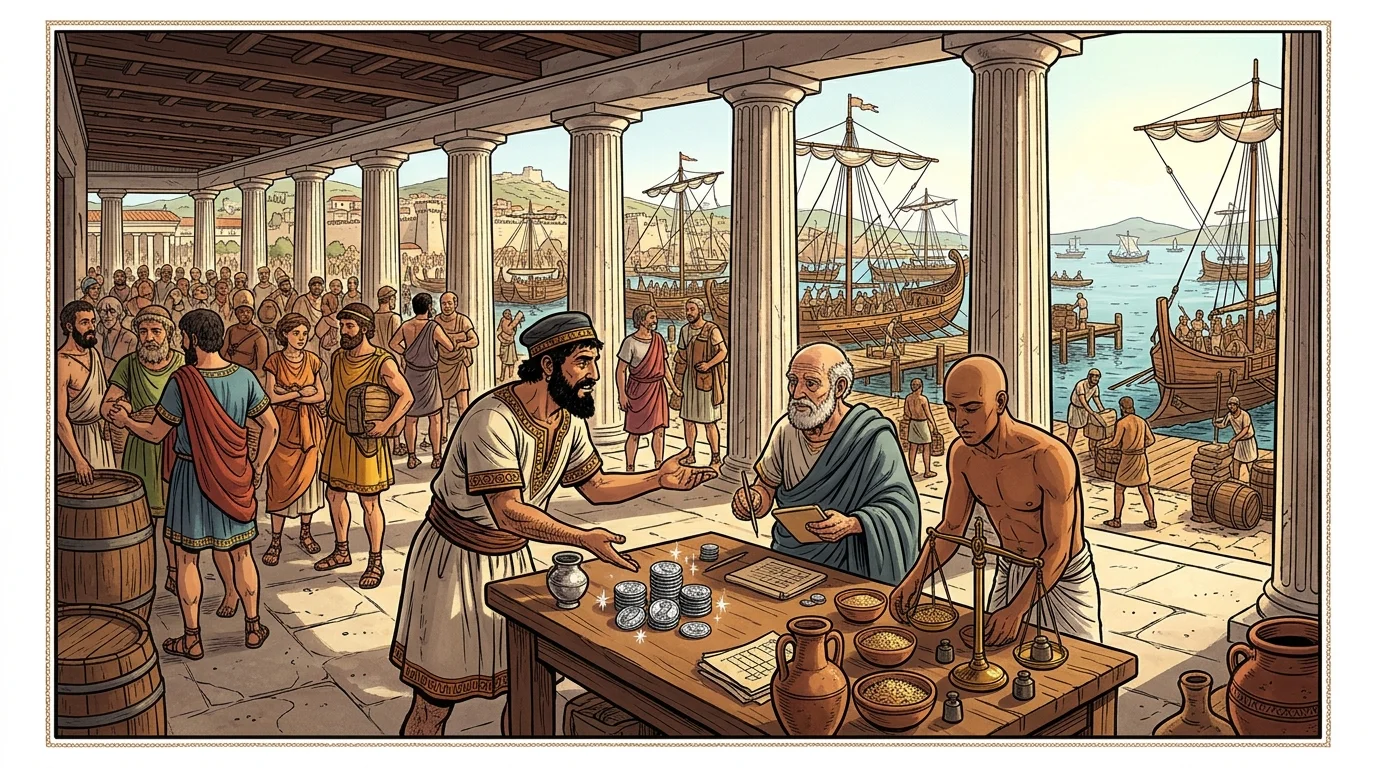
At the heart of the waterfront stood the Deigma (literally “the Show-Place” or “Sample Hall”), a colonnaded pavilion where newly arrived shipmasters placed small samples (deigmata) of their bulk cargoes—such as Pontic wheat, Sicilian barley, Chian wine, or Aegean olive oil—in bowls or pans for wholesale buyers and bankers to examine. Rather than hauling hundreds of sacks of grain off a merchantman only to find weak local prices, a captain could negotiate a bulk sale inside the Deigma while his vessel remained moored at the quay, or even re-export unsold cargo after paying harbor dues. Around the Deigma sat the tables (trapezai) of maritime moneychangers and private bankers like Pasion, who tested foreign coins, held deposit contracts, and arranged high-yield bottomry loans (nautika daneia) secured against ship hulls and cargo.
To prevent fraud and maintain market confidence, Athens stationed dedicated boards of ten magistrates chosen annually by lot directly inside the Piraeus Emporion:
- Epimeletai tou Emporiou (Overseers of the Emporion): Ten officials who policed the quays, enforced the law requiring two-thirds of all grain arriving at the Piraeus grain-market (sitikon emporion) to be brought up to the city of Athens for sale, and prosecuted Athenians or metics who lent money on ships that did not bring a return cargo of grain or vital commodities back to Athens.
- Sitophylakes (Grain Wardens): Originally ten and later thirty-five officials (fifteen in Piraeus and twenty in the city) who ensured that unground grain was sold at fair market prices and that millers and bakers priced barley-meal (alphita) and wheat loaves (artoi) strictly in proportion to wholesale grain costs.
- Metronomoi and Agoranomoi: Ten Inspectors of Weights and Measures (five in Piraeus, five in Athens) who verified that merchants used official Attic bronze and lead capacity standards, alongside ten Market Clerks who certified product quality and collected market stall fees.
Xenophon’s Ways and Means (Poroi 3.2): Why Merchants Preferred Silver Owls
Why did foreign captains sail to Piraeus even after Athens lost its fifth-century naval empire in 404 BCE and suffered a second fiscal crisis during the Social War of 357–355 BCE? In his 355 BCE fiscal treatise Ways and Means (Poroi), the Athenian historian and soldier Xenophon offered one of antiquity’s clearest analyses of monetary comparative advantage. Unlike nearly every other Greek port city—where local bronze or debased silver coins had no value beyond the city walls, forcing visiting shipmasters to barter their imports for a return cargo of local wine, timber, or manufactures—Athens exported money itself. [2]
As Xenophon observed in Poroi 3.2, at Piraeus merchants could choose from an unrivaled variety of transshipped consumer goods if they wished to load a return cargo; “or, if they do not desire to take a return cargo of goods, they can still carry away a handsome freight by exporting silver; for wherever they sell it, they are sure to realize a profit on the original capital invested.” Because Athens’s state-owned Laurion mines produced a continuous stream of 98–99 percent pure silver struck into uniform 17.2-gram Owl tetradrachms, silver was structurally cheaper at Piraeus (relative to grain and manufactured goods) than in silver-scarce ports in Egypt, the Black Sea, Cyprus, or the Levant. A grain merchant arriving from Crimea or Sicily could sell his wheat at the Deigma for silver Owls and sail out with light, compact bags of coin that commanded a hefty purchasing-power premium at his next port of call. [3]
To amplify this natural advantage without resorting to imperial tribute, Xenophon urged the Athenian Assembly to invest state funds in Piraeus harbor infrastructure: building additional public hostels (katagogeia) for visiting mariners, constructing covered merchant exchanges and rental shops, expanding the state-owned fleet of leased merchantmen, and instructing commercial magistrates (later formalized as the monthly dikai emporikai maritime courts) to settle contract disputes swiftly so captains were not delayed before the winter sailing closure.
The 2% Pentekoste Harbor Tax and Andocides vs. Agyrrhios’s Cartel
The fiscal mechanism through which Athens monetized this massive commercial turnover was the pentekoste (“one-fiftieth”), a flat 2 percent ad valorem customs tax levied on the declared value of all goods imported into or exported out of Piraeus, including grain and transit cargoes. Because Classical Athens lacked a permanent civil-service customs bureaucracy, the Poletai (Board of Ten Sellers) auctioned the right to collect the pentekoste for one year to the highest-bidding syndicate of private tax-farmers (pentekostologoi), who posted real-estate sureties and paid the promised sum to the state treasury while keeping any surplus revenue they collected at the docks. [4]
A famous courtroom speech delivered in 400/399 BCE—Andocides’ On the Mysteries (§§133–134)—preserves the exact numbers and cartel politics of this customs auction immediately after the restoration of the Athenian democracy. For two years running, a powerful syndicate of tax-farmers led by the prominent politician Agyrrhios had leased the Piraeus pentekoste for 30 silver talents per year (180,000 drachmas), paying off potential rival bidders with small shares on the steps of the White Poplar so no one would bid against them, and pocketing an annual profit of roughly 6 talents. In the third year, when increased peace-time shipping pushed the true revenue higher still, the orator and merchant Andocides stepped before the Council (Boule) and broke Agyrrhios’s cartel by bidding 36 talents (216,000 drachmas). Even at 36 talents, Andocides and his partners turned a modest profit after paying the state in full—meaning that total taxable imports and exports passing through Piraeus in 401/400 BCE exceeded 1,800 silver talents (10.8 million drachmas), and in prosperous mid-fifth- and mid-fourth-century years reached an estimated 2,000 to 3,000 talents annually. [5]
King Leucon I of the Bosporus and the 400,000-Medimnoi Grain Lifeline
No commodity taxed at the Piraeus docks was more politically sensitive than wheat. In his 355 BCE speech Against Leptines (20.31–33), the statesman Demosthenes reminded an Athenian jury that “we consume more imported grain than any other nation in the world,” and that the single largest source—equaling the combined grain imports from all other foreign markets—was the Bosporan Kingdom under King Leucon I (r. 389–349 BCE), whose realm encompassed the fertile steppes of the eastern Crimea (Panticapaeum and Theodosia) and the Taman Peninsula around the Kerch Strait. [6]
To lock in this food supply, Athens and the Spartocid dynasty of the Bosporus forged a reciprocal fiscal alliance recorded both in Demosthenes’ speech and on surviving marble decrees found at Piraeus. Whenever grain ships crowded into the Crimean ports of Panticapaeum and newly opened Theodosia, Leucon granted ships bound for Athens two extraordinary privileges: first, the right of priority loading (proagoge) ahead of all other foreign merchants; and second, complete exemption (ateleia) from his royal export duty of one-thirtieth (triakoste, or 3.33 percent). As Demosthenes calculated for the jurors, Athenians imported roughly 400,000 medimnoi (approximately 20.8 million liters, or 16,000 metric tons) of Bosporan wheat every year—a volume verifiable in the official ledgers of the Piraeus Grain Wardens (Sitophylakes). By waiving his 1/30th export tax on 400,000 medimnoi, Leucon effectively gifted Athens more than 13,000 medimnoi of free wheat every year, and during the severe Greek famine of 357/356 BCE shipped enough emergency grain that Athens not only fed its citizens at stable prices but earned 15 silver talents of surplus revenue for the state treasury. In gratitude, Athens awarded Leucon and his sons Athenian citizenship, gold crowns at the Panathenaic festival, and reciprocal tax immunity at Piraeus—demonstrating how harbor institutions, pure silver coinage, and bilateral customs diplomacy sustained Classical Greece’s largest metropolis. [7]
Theoretical & Balance-Sheet Transmission Mechanism
In the Kindleberger–Minsky taxonomy of financial instability (Kindleberger, 1978; Minsky, 1986) and Irving Fisher’s (1933) debt-deflation framework, speculative asset booms become systemic crises when credit expansion shifts balance sheets from hedge finance (cash flows covering principal and interest) to speculative and Ponzi finance (relying on rising asset prices and short-term margin roll-overs).
Once monetary tightening or an exogenous shock halts price appreciation, forced margin liquidations trigger Fisherian debt-deflation: fire-sale asset discounts erode bank collateral values, contracting credit supply across the real economy.
Sources and Further Reading
- Xenophon, “ Ways and Means (Poroi / On Revenues),” ToposText / Aikaterini Laskaridis Foundation. Historical & Financial Reference
- Xenophon (trans. H. G. Dakyns), “ On Revenues (Ways and Means, Chapter 3 on Piraeus Trade and Silver Exports),” Project Gutenberg. Historical & Financial Reference
- Andocides, “ On the Mysteries (§§133–134 on Agyrrhios and the 30-to-36-Talent Pentekoste Tax-Farming Auction),” ToposText / Aikaterini Laskaridis Foundation. Historical & Financial Reference
- Demosthenes, “ Against Leptines (20.29–40 on King Leucon I of the Bosporus and the 400,000-Medimnoi Grain Imports),” ToposText / Aikaterini Laskaridis Foundation. Historical & Financial Reference
- Moshe Amit, “ Athens and the Sea: A Study in Athenian Sea-Power (The Piraeus Emporion, Deigma, and Harbor Administration),” Collection Latomus / Ancient Ports Antiques, 1965. Historical & Financial Reference
- Irving Fisher — "The Debt-Deflation Theory of Great Depressions," Econometrica 1, no. 4 (FRASER Federal Reserve Archive, 1933): 337–357 Central Bank / Monetary Authority
- Charles P. Kindleberger & Robert Z. Aliber — Manias, Panics, and Crashes: A History of Financial Crises (Palgrave Macmillan) Peer-Reviewed / Academic Research
Cite This Historical Dossier (APA / Chicago)
APA (7th ed.): Ç., S. (Ed.). (2026). The Piraeus Emporion, the 2% Pentekoste Tax, and Bosporan Grain Imports. In Forgotten Fortunes Historical Monograph Series (Forgotten Fortunes Editorial Desk). https://forgottenfortunes.net/piraeus-emporion-athens-grain-trade/
MLA (9th ed.): Ç., Soner, ed. "The Piraeus Emporion, the 2% Pentekoste Tax, and Bosporan Grain Imports." Forgotten Fortunes: Financial & Monetary History Archive, 2026, https://forgottenfortunes.net/piraeus-emporion-athens-grain-trade/.
Chicago (17th ed.): Ç., Soner, ed. "The Piraeus Emporion, the 2% Pentekoste Tax, and Bosporan Grain Imports." Forgotten Fortunes Historical Monograph Series (Forgotten Fortunes Editorial Desk), September 16, 2026. https://forgottenfortunes.net/piraeus-emporion-athens-grain-trade/.
Have an idea for another financial history documentary or article? Request a story →

