In This Article
On December 19, 1789, five months after the storming of the Bastille, the French National Constituent Assembly created a specialized state financial agency, the Caisse de l’Extraordinaire, and authorized an initial emission of 400 million livres in large-denomination debt certificates known as assignats [1][2]. Confronted with a bankrupt royal treasury, collapsing tax revenues, and crushing Old Regime war debts, revolutionary lawmakers sought to monetize the vast estates recently expropriated from the Catholic Church and the Crown (biens nationaux) without dumping thousands of properties onto a depressed real estate market at once [1][3].

Designed initially as 5 percent interest-bearing bonds secured by public land—and meant to be retired and burned as soon as citizens used them to purchase confiscated estates—the assignats were rapidly transformed by fiscal necessity into non-interest-bearing legal-tender paper currency [1][2][3]. Between 1790 and early 1796, as revolutionary France fought a coalition of European powers and relied on the printing press to cover chronic budget deficits, cumulative assignat emissions reached approximately 45 billion livres, reducing the notes to roughly one-quarter of 1 percent of their face value [2][5]. Neither the ceremonial burning of the printing plates at the Place Vendôme on February 18, 1796, nor the introduction of replacement land warrants (mandats territoriaux) could restore confidence, culminating in the state’s complete repudiation of its revolutionary paper money on May 21, 1797 [1][5].
The Caisse de l’Extraordinaire and the Land-Backed Bond Design (1789–1790)
As economic historians Thomas J. Sargent and François R. Velde have shown, the French Revolution grew directly out of “unpleasant monetarist arithmetic”: unlike Great Britain, which raised peacetime tax surpluses to service war debt, eighteenth-century France ran persistent structural deficits exacerbated by the expenses of the Seven Years’ War and the American War of Independence [3][4]. On November 2, 1789, the National Assembly voted to place all ecclesiastical property at the disposal of the nation, creating a vast pool of nationalized real estate valued at two to three billion livres [2][3].
Selling church and crown lands directly for gold and silver coin required years of surveying and auctioning, whereas the treasury needed immediate cash to meet maturing short-term obligations [1][2]. On December 19, 1789, the Assembly established the Caisse de l’Extraordinaire—separate from the ordinary royal treasury—to administer revenues from land sales and issue 400 million livres in assignats in large denominations of 200, 300, and 1,000 livres bearing a 5 percent annual interest rate [1][2][5].
Under this initial “real bills” design, the assignat was not fiat money but a mortgage bond backed by productive land [3]. The state paid its creditors with assignats; creditors and investors used those assignats to bid on national estates at auction; and as soon as the Caisse de l’Extraordinaire received assignats in payment for land, the notes were legally required to be cancelled and burned, contracting the supply in lockstep with land privatization [1][2][3].
| Documented Figure / Metric | Historical Significance & Archival Context |
|---|---|
| 558 million livres | In July 1793, to shrink the money stock and punish hoarding, the Convention demonetized **558 million livres** of large-denomination assignats bearing the royal portrait, forcing holders to convert them into consolidated public debt certificates. |
| 45 billion livres | By early **1796**, the cumulative face value of assignats issued since 1789 reached approximately **45 billion livres**, while the notes traded in Paris at roughly **one-quarter of 1 percent (0.25%)** of their nominal value. |
| 30 livres | Existing assignats were made convertible into *mandats territoriaux* at a fixed statutory ratio of **30 livres in assignats to 1 livre in mandats**. |
| 90 percent | Because the public no longer trusted any revolutionary paper promise, the *mandats territoriaux* depreciated even faster than the assignats had: they opened at a steep discount before printing was even completed and lost more than 90 percent of their face value within six months. |
From Interest-Bearing Security to Pure Fiat Legal Tender (April–September 1790)
The boundary between a land-backed bond and circulating paper money dissolved within four months [1][2]. As political uncertainty prompted citizens to hoard gold and silver coin, France suffered an acute shortage of circulating currency [2][5]. In April 1790, the Assembly’s Finance Committee reported that the public demanded a new circulating medium [2]. On April 17, 1790, the Assembly officially declared the assignats legal tender for public and private debts across France while lowering their annual interest rate from 5 percent to 3 percent [1][2].
Although the initial 400 million livres temporarily relieved the treasury, the entire authorization was paid out by late August 1790 while tax collections continued to lag [1][2]. When ministers proposed a massive second emission, commercial sentiment turned sharply hostile: twenty-five of twenty-seven major French trading cities sent formal remonstrances to the Assembly warning that unbacked paper expansion would revive the catastrophic 1720 Mississippi Bubble inflation of John Law [2].
In the Assembly debates, however, Honoré Gabriel Riqueti, comte de Mirabeau, delivered a celebrated final speech on September 27, 1790, insisting that because assignats were pledged against fertile national land rather than idle metal, they were better secured than specie [2]. On September 29, 1790, by a vote of 508 to 423, the Assembly authorized an additional 800 million livres of assignats (in denominations down to 50 livres), **abolished interest payments on all assignats altogether**, capped total circulation at **1.2 billion livres**, and reaffirmed that all notes returned to the treasury for land must be burned [1][2][5].
Coin Disappearance, Fractional Notes, and Financial Repression (1791–1794)
Eliminating the interest coupon completed the assignat’s conversion into pure fiat currency, immediately triggering Gresham’s Law [3][5]. Because assignats were legal tender at par while their market value drifted below metallic coin, gold and silver vanished from everyday commerce, leaving employers and shopkeepers unable to make small change [2][5]. To replace the unregulated municipal and private paper tokens (billets de confiance) that proliferated across France, the Assembly authorized **5-livre assignats** in **May 1791** and introduced fractional assignats of **10, 15, 25, and 50 sous** in **January 1792** [2][5].
Because revolutionary expenditures far outpaced auction receipts from national lands, the statutory burn rule failed to prevent monetary expansion [1][3]. Between May and December 1791 alone, the government issued more than **1.3 billion livres** in additional assignats, and by **July 1791** the notes had depreciated to **87 percent** of their face value against specie [2][5].
Following the outbreak of war with Austria and Prussia in April 1792 and the execution of Louis XVI in January 1793, the National Convention resorted to coercive financial repression to force citizens to hold depreciating paper [3][5]. In July 1793, to shrink the money stock and punish hoarding, the Convention demonetized **558 million livres** of large-denomination assignats bearing the royal portrait, forcing holders to convert them into consolidated public debt certificates [1][3]. Under the Reign of Terror (June 1793–July 1794), the Committee of Public Safety enacted the Law of the Maximum capping grain and commodity prices, closed the Paris Bourse, banned trade in gold and silver coin, and made refusing assignats or accepting them at a discount punishable by heavy fines and the guillotine [2][3][5].
Thermidorian Hyperinflation and the Place Vendôme Plate Burning (1795–1796)
Coercion propped up the real purchasing power of the assignat only as long as the Terror lasted [3][4]. After the fall of Maximilien Robespierre in July 1794 (9 Thermidor) and the repeal of the Maximum price controls in December 1794, citizens rushed to spend accumulated paper balances, igniting a classic Cagan inflation-tax spiral [3][5]. As prices soared, the real value of tax collections collapsed, forcing the government under fiscal dominance to print ever-larger quantities of assignats simply to provision the army and feed Paris [3][4].
By early **1796**, the cumulative face value of assignats issued since 1789 reached approximately **45 billion livres**, while the notes traded in Paris at roughly **one-quarter of 1 percent (0.25%)** of their nominal value [2][5]. Shopkeepers refused paper tenders despite legal-tender laws, farmers withheld grain from urban markets unless paid in silver coin, and the cost of printing low-denomination notes exceeded their purchasing power [2][5].
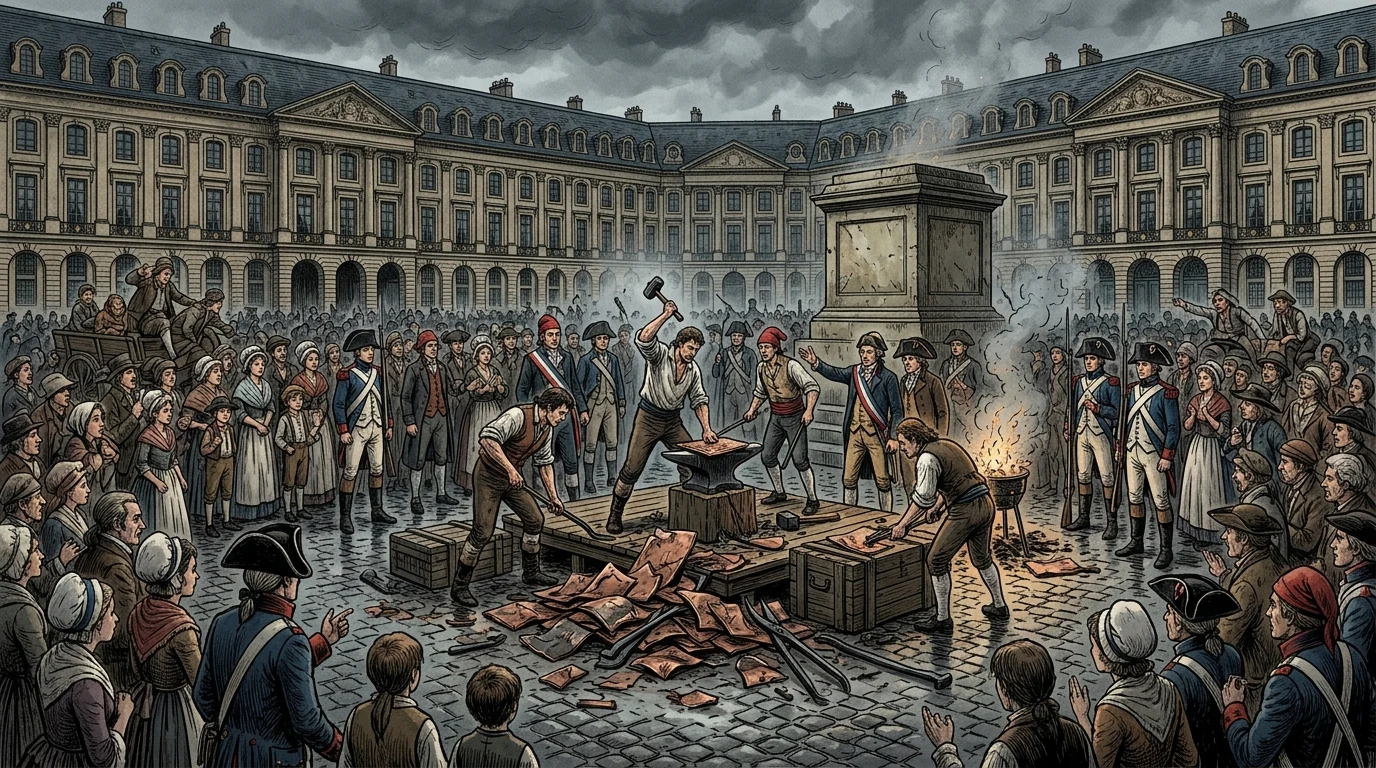
Faced with total monetary breakdown, the newly installed Directory enacted a statutory ceiling capping cumulative active assignat circulation at **40,000 million (40 billion) livres** [1]. To convince a skeptical public that the printing presses had stopped forever, authorities staged a public ceremony at 9:00 a.m. on **February 18, 1796** (30 Pluviôse Year IV) at the **Place Vendôme** in Paris, where officials broke and burned the official assignat copper plates, punches, matrices, and paper presses before a large crowd [1][2][5].
The Mandats Territoriaux and Final State Repudiation (1796–1797)
After issuing temporary treasury notes called *rescriptions* to bridge immediate expenses, the Directory attempted one final land-backed currency experiment on March 18, 1796 [1][5]. It authorized **2,400 million (2.4 billion) livres** in a new paper currency, the **mandats territoriaux** (territorial land warrants), which entitled holders to claim national real estate directly at pre-1790 valuations without competitive auction bidding [1][2][5]. Existing assignats were made convertible into *mandats territoriaux* at a fixed statutory ratio of **30 livres in assignats to 1 livre in mandats** [1][5].
Because the public no longer trusted any revolutionary paper promise, the *mandats territoriaux* depreciated even faster than the assignats had: they opened at a steep discount before printing was even completed and lost more than 90 percent of their face value within six months [2][5].
Ultimately, the collapse of paper money forced the spontaneous re-monetization of the French economy [4][5]. Aided by gold and silver specie inflows extracted from victorious French military campaigns in Italy and the Low Countries, metallic coins returned to open circulation across France by late 1796 and early 1797 [3][5]. On **May 21, 1797** (2 Prairial Year V), the French government formally demonetized and **repudiated all remaining outstanding assignats and mandats**—leaving France deeply suspicious of paper currency and paving the way for Napoleon Bonaparte’s return to a strict bimetallic franc standard and the founding of the Banque de France in 1800–1803 [1][3][4].
Theoretical & Balance-Sheet Transmission Mechanism
In the Kindleberger–Minsky taxonomy of financial instability (Kindleberger, 1978; Minsky, 1986) and Irving Fisher’s (1933) debt-deflation framework, speculative asset booms become systemic crises when credit expansion shifts balance sheets from hedge finance (cash flows covering principal and interest) to speculative and Ponzi finance (relying on rising asset prices and short-term margin roll-overs).
Once monetary tightening or an exogenous shock halts price appreciation, forced margin liquidations trigger Fisherian debt-deflation: fire-sale asset discounts erode bank collateral values, contracting credit supply across the real economy.
Sources and Further Reading
- Special Collections Research Center, “ Guide to the Collection of French Revolutionary Era Assignats, 1789–1796,” University of Chicago Library, 2009. Peer-Reviewed / Academic Research
- Andrew Dickson White, “ Fiat Money Inflation in France: How It Came, What It Brought, and How It Ended,” Liberty Fund / Online Library of Liberty, 1912. Historical & Financial Reference
- Thomas J. Sargent and John Stachurski, “ Inflation During the French Revolution (Quantitative Economics with Python, Chapter 38, based on Sargent and Velde 1995),” QuantEcon, 2024. Historical & Financial Reference
- Michael D. Bordo and Eugene N. White, “ British and French Finance during the Napoleonic Wars (NBER Working Paper No. 1517 / 9433 Series),” National Bureau of Economic Research, 1990. Peer-Reviewed / Academic Research
- Louis Rouanet and Ennio E. Piano, “ Filling the Void: Monies and Prices in the Death of the Assignat,” Working Paper (University of Texas at El Paso / Middle Tennessee State University), 2022-09. Peer-Reviewed / Academic Research
- Irving Fisher — "The Debt-Deflation Theory of Great Depressions," Econometrica 1, no. 4 (FRASER Federal Reserve Archive, 1933): 337–357 Central Bank / Monetary Authority
- Charles P. Kindleberger & Robert Z. Aliber — Manias, Panics, and Crashes: A History of Financial Crises (Palgrave Macmillan) Peer-Reviewed / Academic Research
Cite This Historical Dossier (APA / Chicago)
APA (7th ed.): Ç., S. (Ed.). (2026). French Revolutionary Assignats and the Collapse of Land-Backed Money. In Forgotten Fortunes Historical Monograph Series (Forgotten Fortunes Editorial Desk). https://forgottenfortunes.net/french-revolutionary-assignats-and-land-backed-debt/
MLA (9th ed.): Ç., Soner, ed. "French Revolutionary Assignats and the Collapse of Land-Backed Money." Forgotten Fortunes: Financial & Monetary History Archive, 2026, https://forgottenfortunes.net/french-revolutionary-assignats-and-land-backed-debt/.
Chicago (17th ed.): Ç., Soner, ed. "French Revolutionary Assignats and the Collapse of Land-Backed Money." Forgotten Fortunes Historical Monograph Series (Forgotten Fortunes Editorial Desk), August 27, 2026. https://forgottenfortunes.net/french-revolutionary-assignats-and-land-backed-debt/.
Have an idea for another financial history documentary or article? Request a story →