In This Article
Across the four decades separating the end of the Second World War from the Maastricht Treaty negotiations, the French franc stood at the center of a recurring struggle between domestic fiscal expansion and external monetary discipline. Twice during this period—first at the birth of the Fifth Republic in December 1958, and again at the height of the European Monetary System crisis in March 1983—French heads of state confronted an acute balance-of-payments emergency that threatened to sever France from Western Europe’s emerging common market. Under President Charles de Gaulle, Finance Minister Antoine Pinay, and economist Jacques Rueff, the stabilization decrees of December 27, 1958 devalued the currency by 17.55 percent, restored external convertibility, and introduced the redenominated nouveau franc on January 1, 1960 at a ratio of 100 old francs to one. Nearly a quarter-century later, after three successive devaluations within the European Monetary System between October 1981 and March 1983, President François Mitterrand, Finance Minister Jacques Delors, and Pierre Bérégovoy rejected nationalist proposals to float the currency behind protectionist walls, choosing instead the tournant de la rigueur (austerity turn) and the franc fort doctrine that anchored France to the Deutsche Mark and paved the way for the euro. [1]
Fourth Republic Inflation and the 1958 Balance-of-Payments Crisis
When General Charles de Gaulle returned to power in June 1958 amid the political collapse of the Fourth Republic, France’s industrial modernization masked a fragile monetary and external payments position. Although real gross domestic product had expanded briskly under the indicative planning inaugurated by Jean Monnet, the French state had financed postwar reconstruction, social transfers, and the costly colonial conflicts in Indochina and Algeria through chronic budget deficits and central bank advances from the Banque de France. Between 1945 and 1958, retail prices surged more than tenfold, eroding the purchasing power of the franc and forcing successive governments into repeated currency devaluations—including the Mayer devaluation of January 1948, the Bidault adjustment of September 1949, and the opération 20% engineered by Félix Gaillard in August 1957, which raised the official dollar exchange rate from 350 to 420 francs. [2]
By the spring of 1958, domestic inflation exceeding 15 percent per year had wiped out the competitive gains of the 1957 adjustment. The Treasury’s impasse budgétaire—the overall borrowing requirement of the central government—threatened to surpass 1,200 billion old francs, while the Banque de France’s gold and convertible foreign-exchange reserves had dwindled toward exhaustion, forcing Paris to seek emergency credit lines from the International Monetary Fund, the European Payments Union, and the United States. Crucially, the Treaty of Rome, signed in March 1957 to create the European Economic Community (EEC), committed France to begin dismantling customs tariffs and import quotas on January 1, 1959. Without a decisive stabilization of prices and the external accounts, France faced the humiliation of invoking the treaty’s safeguard clauses and retreating into autarky. [3]
| Documented Figure / Metric | Historical Significance & Archival Context |
|---|---|
| 11.1 percent | The monetary equilibrium established in 1958 began to fray after the social upheaval of May 1968—which triggered an 11.1 percent franc devaluation under President Georges Pompidou and Finance Minister Valéry Giscard d'Estaing in August 1969—and the collapse of the Bretton Woods fixed-rate system between 1971 and 1973. |
| 93 billion francs | By 1982, French consumer price inflation remained stuck near 12 to 14 percent compared with roughly 5 percent in West Germany, while France's bilateral trade deficit widened toward 93 billion francs. |
| 2.5 percent | In tense Brussels negotiations with West German Finance Minister Gerhard Stoltenberg, Delors secured a third EMS realignment combining a 2.5 percent devaluation of the franc with a 5.5 percent revaluation of the Deutsche Mark—sharing the political burden of an 8 percent bilateral exchange-rate adjustment. |
| 65 billion francs | Four days later, on March 25, 1983, Delors presented a sweeping austerity package—the tournant de la rigueur—aimed at slicing 65 billion francs from domestic demand and eliminating the external trade deficit within two years. |
The Pinay-Rueff Committee and the December 1958 Devaluation
Determined to restore national sovereignty through monetary orthodoxy, de Gaulle and his liberal Finance Minister, Antoine Pinay—whose 1952 gold-indexed bond issue (the emprunt Pinay) had earned him enduring credibility among French savers—appointed a nine-member committee of experts on September 30, 1958. Chaired by Jacques Rueff, a former Inspector General of Finances, former deputy governor of the Banque de France, and staunch advocate of classical monetary discipline, the committee delivered its confidential report on December 8, 1958. Rueff diagnosed inflation not as an inevitable byproduct of growth, but as the direct consequence of unfinanced state deficits and the automatic indexation of wages and agricultural prices, which turned every external price shock into a self-reinforcing wage-price spiral. [4]
Overriding resistance from social ministries worried about the electoral cost of austerity, de Gaulle adopted the Pinay-Rueff recommendations in full through the ordinances of December 27, 1958. To reduce the projected 1959 budget deficit below 600 billion old francs—a threshold safely covered by long-term domestic savings rather than central bank money creation—the government raised corporate, income, and indirect taxes on alcohol, tobacco, and energy, while slashing price subsidies on coal, electricity, rail transport, and staple foods. Just as importantly, the decrees abolished automatic statutory indexation linking industrial wages and farm support prices to retail price indices, retaining indexation only for the national minimum wage (the SMIG). [5]
On the external front, the franc was devalued by 17.55 percent against gold and the US dollar. Its official gold parity was reduced from 2.11588 milligrams to 1.80 milligrams of fine gold per old franc (Shortly thereafter redefined as 180 milligrams per new franc), moving the dollar parity from 420 old francs to 493.706 old francs per US dollar. In coordination with the United Kingdom and West Germany, France simultaneously restored external convertibility for non-residents on December 28, 1958, liquidating the bilateral clearing machinery of the European Payments Union and bringing the Bretton Woods par-value system into full operation across Western Europe. Confident in the new exchange rate, France liberalized 90 percent of its OEEC import quotas on schedule on January 1, 1959. [6]
The 1960 Nouveau Franc and the Mechanics of Redenomination
To give visible permanence to the stabilization and restore psychological prestige to the national currency, Ordinance No. 58-1341 of December 27, 1958 mandated the creation of a new monetary unit equal to 100 existing francs. By removing two zeros, the reform sought to endow France with a “heavy franc” (franc lourd) whose unit value would stand on par with the Swiss franc and the West German Deutsche Mark, erasing the arithmetic vestige of four decades of currency depreciation since the end of the franc germinal in 1914. [7]
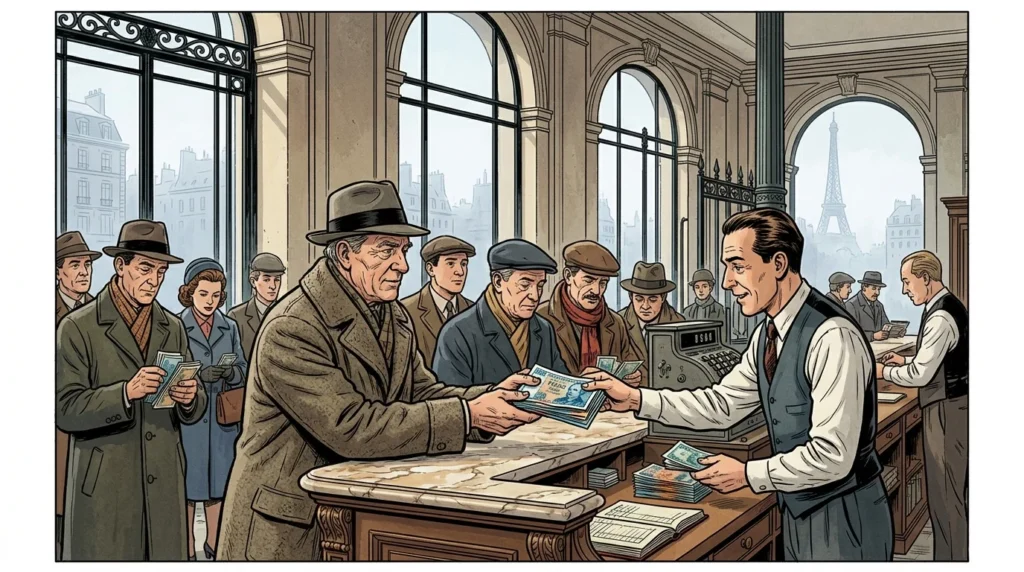
The transition was executed in carefully staged phases by the Ministry of Finance and the Banque de France. Beginning in July 1959, banknotes were issued bearing red overprints showing their value in nouveaux francs alongside the old denomination—so that a 5,000-franc note portraying King Henry IV was overstamped with “50 Nouveaux Francs.” On January 1, 1960, the nouveau franc (abbreviated NF) legally became France’s currency unit, with one new franc divided into 100 centimes and valued at 4.93706 NF per US dollar. All bank balances, government bonds, stock prices, wages, pensions, and commercial contracts were automatically divided by 100 without altering real purchasing power. On January 1, 1963, the transitional label nouveau franc was officially retired in favor of the simple designation franc (F), accompanied by a new series of banknotes honoring figures such as Voltaire, Racine, Pasteur, and Corneille. [8]
Macroeconomically, the Pinay-Rueff plan exceeded expectations: capital flight reversed immediately, French gold and dollar reserves surged by more than $1.5 billion within eighteen months, exports boomed inside the new EEC customs union, and real GDP grew at an average annual rate of nearly 6 percent throughout the 1960s. Yet among ordinary citizens, the psychological shock of redenomination proved remarkably tenacious; well into the 1980s and 1990s, millions of older French households continued to quote major purchases such as houses, automobiles, and lottery jackpots in “old francs” (anciens francs). [9]
The 1981 Socialist Reflation and Three EMS Currency Crises
The monetary equilibrium established in 1958 began to fray after the social upheaval of May 1968—which triggered an 11.1 percent franc devaluation under President Georges Pompidou and Finance Minister Valéry Giscard d’Estaing in August 1969—and the collapse of the Bretton Woods fixed-rate system between 1971 and 1973. Following the oil shocks of 1973 and 1979, France sought exchange-rate stability within the European Monetary System (EMS), launched in March 1979 by Giscard d’Estaing and West German Chancellor Helmut Schmidt around the Exchange Rate Mechanism (ERM), which bound member currencies within 2.25 percent fluctuation bands.
When Socialist leader François Mitterrand won the presidency in May 1981 and appointed Pierre Mauroy as prime minister, the new government embarked on an ambitious Keynesian stimulus (the relance Mauroy) designed to break mass unemployment through domestic demand expansion and state intervention. Within twelve months, the government nationalized five major industrial conglomerates and 39 commercial banks, raised the minimum wage (SMIC) by 10 percent, boosted family allowances and old-age pensions by 20 to 25 percent, reduced the statutory workweek from 40 to 39 hours without loss of pay, lowered the retirement age to 60, and created tens of thousands of public-sector jobs.
Because France’s principal trading partners—led by the Deutsche Bundesbank in West Germany and Paul Volcker’s Federal Reserve in the United States—were simultaneously pursuing tight disinflationary monetary policies, the unilateral French stimulus spilled directly into imports. By 1982, French consumer price inflation remained stuck near 12 to 14 percent compared with roughly 5 percent in West Germany, while France’s bilateral trade deficit widened toward 93 billion francs. Speculative capital outflows repeatedly forced the Banque de France to burn through its foreign-exchange reserves and borrow heavily in international markets to defend the franc’s ERM floor, compelling Paris to negotiate two early EMS realignments:
- October 4, 1981: A 3.0 percent devaluation of the French franc accompanied by a 5.5 percent revaluation of the Deutsche Mark and Dutch guilder within the ERM.
- June 12, 1982: A second realignment combining a 5.75 percent devaluation of the franc with a 4.25 percent revaluation of the Deutsche Mark, paired with a four-month temporary freeze on French wages and prices overseen by Finance Minister Jacques Delors.
March 1983: The Tournant de la Rigueur and the Franc Fort
Neither realignment halted the speculative pressure. By early March 1983, as local elections approached, the Banque de France was losing billions of francs per week in foreign-exchange interventions. Inside the Élysée Palace, Mitterrand convened ten days of dramatic secret deliberations between two rival economic camps. On one side stood the proponents of “l’autre politique” (the other policy)—including Jean Riboud, Laurent Fabius, Pierre Bérégovoy initially, and Jean-Pierre Chevènement—who urged Mitterrand to pull the franc out of the European Monetary System, let the currency float downward by 15 to 20 percent, erect temporary import surcharges, and slash interest rates to shield domestic industry. On the other side stood Finance Minister Jacques Delors, Prime Minister Pierre Mauroy, Banque de France Governor Renaud de La Genière, and Treasury Director Michel Camdessus, who warned that floating the franc outside the EMS would instantly deplete France’s remaining hard-currency reserves, trigger an import-driven inflationary spiral, force France to beg the IMF for a conditional bailout, and shatter the European Community.
After Bérégovoy and Fabius examined the Treasury’s true reserve figures and switched sides to warn that an EMS exit would bring immediate financial asphyxiation, Mitterrand made his historic decision on March 21, 1983: France would remain inside the EMS and accept the domestic discipline required to stay there. In tense Brussels negotiations with West German Finance Minister Gerhard Stoltenberg, Delors secured a third EMS realignment combining a 2.5 percent devaluation of the franc with a 5.5 percent revaluation of the Deutsche Mark—sharing the political burden of an 8 percent bilateral exchange-rate adjustment.
Four days later, on March 25, 1983, Delors presented a sweeping austerity package—the tournant de la rigueur—aimed at slicing 65 billion francs from domestic demand and eliminating the external trade deficit within two years. The plan imposed a mandatory 10 percent income-tax loan on wealthier taxpayers, levied a 1 percent special social-security contribution on all taxable incomes, raised taxes on tobacco, alcohol, and motor fuel, cut spending across state ministries and public enterprises, and capped foreign currency allowances for French tourists traveling abroad at 2,000 francs per adult per year through strict currency passbooks (carnets de change). Just as Rueff had done in 1958, Delors broke the mechanical indexation of wages to past inflation, indexing public-sector pay instead to the government’s forward inflation target.
Legacy: Monetary Disinflation and the Path to the Euro
Both the December 1958 Pinay-Rueff stabilization and the March 1983 tournant de la rigueur reshaped the institutional architecture of modern France. After Bérégovoy succeeded Delors at the Ministry of Finance in July 1984, the 1983 austerity turn evolved into the policy of désinflation compétitive (competitive disinflation) and the franc fort (strong franc): by locking the franc tightly to the Deutsche Mark after a final minor EMS realignment in January 1987, French policymakers forced inflation down from 13.6 percent in 1981 to below 3 percent by the late 1980s, eventually achieving an inflation rate lower than unified Germany’s in the early 1990s. Yet the social price of maintaining German-level real interest rates was high and persistent structural unemployment. Convinced that France had surrendered monetary autonomy to the Bundesbank without gaining a voice in setting European interest rates, Mitterrand and Delors—who became President of the European Commission in 1985—channeled the logic of March 1983 directly into the 1992 Maastricht Treaty, replacing the asymmetric EMS currency peg with a shared European central bank and the single currency.
Theoretical & Balance-Sheet Transmission Mechanism
In the Kindleberger–Minsky taxonomy of financial instability (Kindleberger, 1978; Minsky, 1986) and Irving Fisher’s (1933) debt-deflation framework, speculative asset booms become systemic crises when credit expansion shifts balance sheets from hedge finance (cash flows covering principal and interest) to speculative and Ponzi finance (relying on rising asset prices and short-term margin roll-overs).
Once monetary tightening or an exogenous shock halts price appreciation, forced margin liquidations trigger Fisherian debt-deflation: fire-sale asset discounts erode bank collateral values, contracting credit supply across the real economy.
Sources and Further Reading
- Cité de l'Économie (Banque de France), “ The Rueff-Pinay Stabilisation Plan in France“, Citéco Historical Timeline, 2023. Central Bank / Monetary Authority
- Cité de l'Économie (Banque de France), “ France's Left-Wing Economic Policy and the Subsequent Austerity Turn“, Citéco Historical Timeline, 2023. Central Bank / Monetary Authority
- Bibliothèque nationale de France (BnF), “ Du nouveau franc à l'euro“, Les Essentiels de la BnF, 2022. Historical & Financial Reference
- BNP Paribas Historical Archives, “ The BNCI Prepares Its Customers for the New Franc“, BNP Paribas History, 2020. Historical & Financial Reference
- Michael D. Bordo, Dominique Simard, and Eugene N. White, “ France and the Bretton Woods International Monetary System: 1960 to 1968“, National Bureau of Economic Research (NBER Working Paper No. 4642), 1994. Peer-Reviewed / Academic Research
- Fondation Jean-Jaurès, “ La politique économique de la gauche et le tournant de 1983“, Fondation Jean-Jaurès Publications, 2023. Historical & Financial Reference
- Florence Descamps and Laure Quennouëlle-Corre, “ Le tournant de mars 1983 a-t-il été un tournant néolibéral ?“, Histoire@Politique (Centre d'histoire de Sciences Po), 2018. Historical & Financial Reference
- Irving Fisher — "The Debt-Deflation Theory of Great Depressions," Econometrica 1, no. 4 (FRASER Federal Reserve Archive, 1933): 337–357 Central Bank / Monetary Authority
- Charles P. Kindleberger & Robert Z. Aliber — Manias, Panics, and Crashes: A History of Financial Crises (Palgrave Macmillan) Peer-Reviewed / Academic Research
Cite This Historical Dossier (APA / Chicago)
APA (7th ed.): Ç., S. (Ed.). (2026). From the 1960 Nouveau Franc to Mitterrand's 1983 Austerity Turn. In Forgotten Fortunes Historical Monograph Series (Forgotten Fortunes Editorial Desk). https://forgottenfortunes.net/france-pinay-rueff-nouveau-franc-1983-austerity/
MLA (9th ed.): Ç., Soner, ed. "From the 1960 Nouveau Franc to Mitterrand's 1983 Austerity Turn." Forgotten Fortunes: Financial & Monetary History Archive, 2026, https://forgottenfortunes.net/france-pinay-rueff-nouveau-franc-1983-austerity/.
Chicago (17th ed.): Ç., Soner, ed. "From the 1960 Nouveau Franc to Mitterrand's 1983 Austerity Turn." Forgotten Fortunes Historical Monograph Series (Forgotten Fortunes Editorial Desk), September 4, 2026. https://forgottenfortunes.net/france-pinay-rueff-nouveau-franc-1983-austerity/.
Have an idea for another financial history documentary or article? Request a story →