In This Article
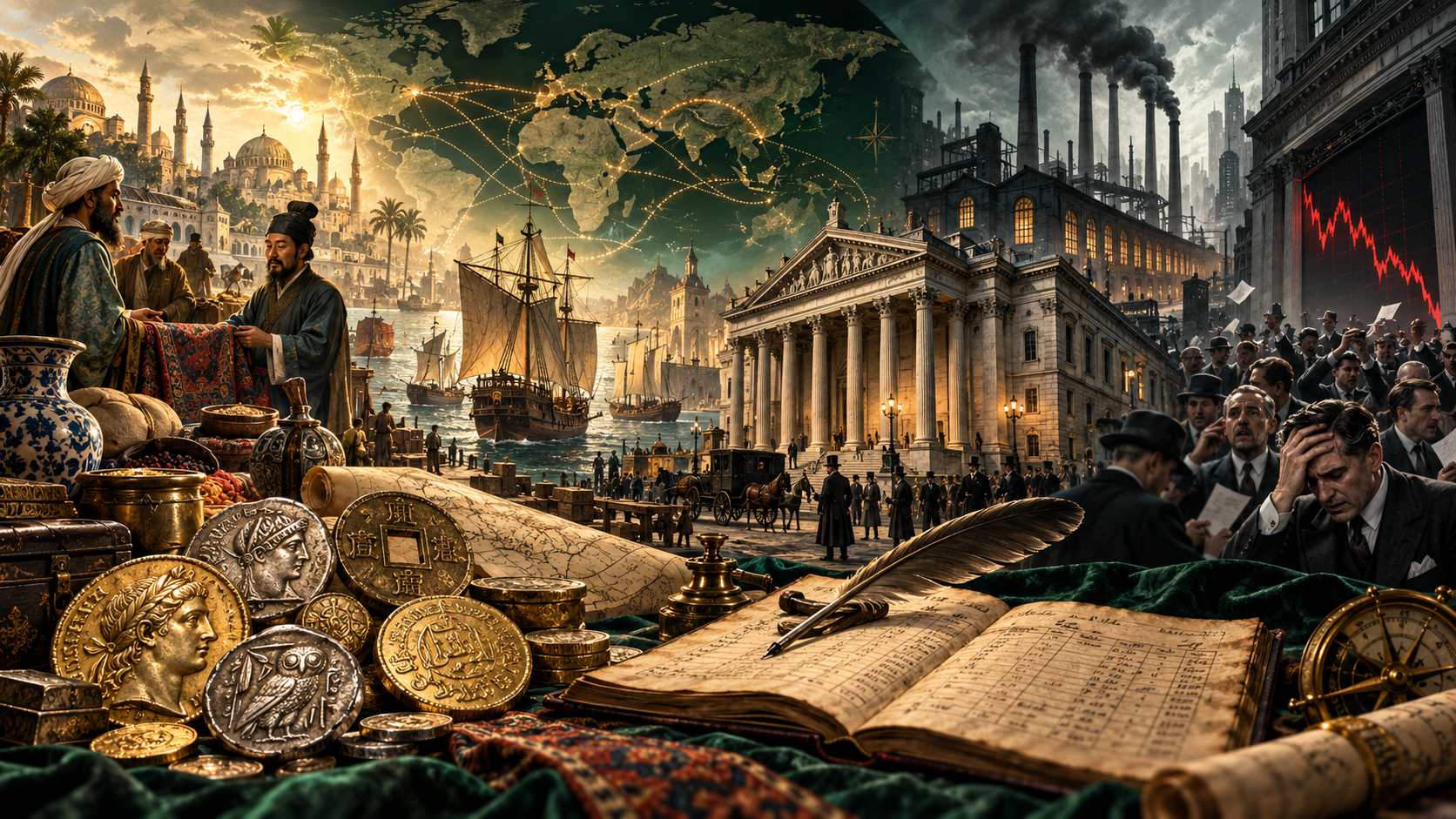
Imagine waking up in a world without banks, credit cards, stock exchanges, or modern currencies. You still need food, shelter, clothing, and work. People still produce things, exchange goods, borrow resources, and decide who gets what.
That world still has an economy.
Now imagine tracing how those everyday activities eventually produced global trade networks, powerful financial institutions, industrial revolutions, and economic crises that changed entire nations.
That is the world of economic history.
Economic history investigates how people earned a living, produced wealth, exchanged goods, organized work, and distributed resources across time. It connects the numbers found in old ledgers with the lives of the people behind them. [1]
It also asks a question that remains surprisingly relevant: How did the economic world we live in today come to exist?
What Is Economic History?
Economic history is the study of how economies worked and changed in the past. It examines trade, agriculture, wages, banking, industry, public debt, technology, taxation, living standards, and financial crises. But it does not study these subjects in isolation.
Consider a factory built in nineteenth-century Britain. A conventional business history might explain who founded it and how profitable it became. An economic historian might investigate something broader: where its capital came from, how machines changed productivity, what its workers earned, how imported raw materials reached the factory, and whether industrial growth improved people’s lives.
Economic history therefore combines the methods of history and economics.
According to the London School of Economics, economic historians examine everything from national economies and large companies to individual households. Their work uses both numerical evidence and historical documents to understand economic change. [1]
The discipline is ultimately about people, not just money.
How Is Economic History Different from Economics?
Economics studies how people and institutions make choices about scarce resources. It develops theories and models to explain production, prices, markets, employment, and other economic relationships.
Economic history asks how those relationships operated under particular historical conditions.
For example, economics can explain why banks are vulnerable when depositors suddenly demand their money back.
Economic history can investigate an actual banking panic: what caused people to withdraw their deposits, how banks responded, why the crisis spread, and how governments changed the rules afterward.
The two approaches work together.
Economic theory helps explain historical events. Historical evidence, in turn, can reveal the limitations of an economic theory.
Economic history is also different from the history of economic thought, which focuses primarily on how ideas developed through thinkers such as Adam Smith, David Ricardo, Karl Marx, and John Maynard Keynes.
Those ideas matter, but economic history also examines what happened in farms, factories, ports, households, markets, and banks—whether or not the people involved had ever read an economics book.
The Bank That Began with a Government Debt
One of the clearest examples of economic history begins in England in 1694. The English government needed money to finance its war against France. Raising that money was difficult and expensive. A new institution offered a solution.
Investors supplied £1.2 million, which was lent to the government at an initial interest rate of 8%. The arrangement helped establish the Bank of England, formally incorporated by Royal Charter on 27 July 1694. [2]
The financial mechanism was relatively straightforward.
The government needed capital immediately. Investors were willing to provide it in exchange for a contractual return. The new bank organized the financing and developed into an important financial institution.
The arrangement connected public borrowing, private investment, and institutional trust. Yet the significance of 1694 was not that banking suddenly appeared for the first time. Banking and credit had existed for centuries in different societies. The significance was how a particular government financing problem contributed to the development of an institution that would eventually become Britain’s central bank. Economic historians examine precisely these connections: how immediate financial decisions create institutions that survive long after the original problem has disappeared.
Why a Stock Market Crash Became a Human Disaster
Another example takes us to the United States in 1929. The Wall Street crash is one of the most famous events in financial history. Stock prices fell dramatically, wiping out substantial paper wealth and damaging confidence. But the Great Depression cannot be understood simply by looking at falling share prices. After the crash, the American economy suffered successive banking panics, falling output, deflation, business failures, and mass unemployment.
According to Federal Reserve historical research, real economic output declined by roughly 30% during the contraction, while unemployment reached approximately 25% by 1933. [3]
The banking system helped transmit and intensify the disaster.
When frightened customers withdrew deposits, banks came under pressure. Failed banks disrupted payments and lending. Surviving banks became more cautious, businesses struggled to obtain credit, and households reduced spending.
As spending and lending contracted, economic activity weakened further.
The Federal Reserve’s historical account identifies monetary contraction and policy failures as important contributors to the Depression’s severity. Historians and economists have examined how banking instability, monetary policy, the gold standard, and other forces interacted during the crisis. [3][4]
This is where economic history becomes more than a timeline. It helps explain how a financial disturbance can move through banks, factories, jobs, wages, and households until an entire society feels its consequences. The numbers describe the scale of the disaster. The history explains how it happened.
Economic History Is Not Only About Crashes
Financial crises receive attention because their consequences are dramatic. But economic history includes much more than moments of collapse.
It explores why some societies industrialized earlier than others, how transport networks changed trade, how improvements in agriculture supported population growth, and why access to land, education, technology, and credit differed across communities.
It also studies slavery, coerced labor, colonial trade, migration, household work, and the unequal distribution of economic opportunities.
These subjects matter because economic growth and human well-being are related but not identical.
A country might produce more goods while some workers endure dangerous conditions. A profitable trading system might depend on exploitation. Rising national income might conceal major differences between regions or social groups.
Economic history asks who created wealth, who controlled it, and who benefited.
It investigates not merely whether an economy became richer, but what becoming richer meant for the people living within it.
How Do Economic Historians Know What Happened?
Historical economies rarely leave behind the kind of comprehensive statistics that modern governments publish.
Researchers therefore reconstruct the past using many different forms of evidence.
Old price lists can indicate how food costs changed. Wage records provide clues about earnings. Shipping manifests reveal trading connections. Tax documents can show what governments collected. Bank accounts, company ledgers, and debt contracts help trace financial relationships.
Letters, newspapers, legal proceedings, and official correspondence can explain why people made particular decisions.
But historical evidence requires careful interpretation.
A wage recorded in an eighteenth-century ledger cannot simply be compared with a modern salary without considering prices, purchasing power, working conditions, and the type of labor involved.
Likewise, an estimate of historical national income is not automatically as precise as a modern statistical release. Responsible economic history distinguishes what documents establish, what calculations suggest, and what remains uncertain. The goal is not to force old evidence into a perfect modern spreadsheet. It is to reconstruct the past as accurately as the surviving evidence allows.
Why Does Economic History Matter Today?
Modern financial systems did not emerge fully formed.
Banking rules, currencies, stock exchanges, government borrowing arrangements, central banks, and investor protections developed through centuries of experimentation, political decisions, innovation, and sometimes devastating failures.
Studying that history helps us recognize recurring economic problems.
Why do investors repeatedly become attracted to promises of unusually high returns? Why can debt create opportunities during a boom but magnify losses during a crisis? Why do governments sometimes intervene to rescue financial institutions? Why can a policy that solves one problem create a different risk?
Historical examples do not provide automatic answers to today’s problems. Different periods have different technologies, laws, institutions, and political circumstances. What history provides is perspective. It teaches us to distinguish a genuinely new financial development from an old mechanism presented in unfamiliar packaging. Most importantly, it reminds us that economies are shaped by human decisions. Their institutions and rules can change—and have changed many times before.
The Story Behind the Numbers
Economic history is not simply the history of money.
It is the history of how people have organized their material lives: how they produced, exchanged, borrowed, worked, competed, cooperated, accumulated wealth, and endured hardship.
A government loan in 1694 helped establish a bank that still exists centuries later. Banking failures during the Great Depression demonstrated how financial instability could spread through an entire economy.
Each case illustrates the same principle: financial decisions are never isolated from the wider society in which they occur.
That is why economic history matters.
To understand today’s economy, we must understand the choices, institutions, successes, and failures that created it.
And sometimes, the most revealing stories are the ones history almost forgot.
Theoretical & Balance-Sheet Transmission Mechanism
In the Kindleberger–Minsky taxonomy of financial instability (Kindleberger, 1978; Minsky, 1986) and Irving Fisher’s (1933) debt-deflation framework, speculative asset booms become systemic crises when credit expansion shifts balance sheets from hedge finance (cash flows covering principal and interest) to speculative and Ponzi finance (relying on rising asset prices and short-term margin roll-overs).
Once monetary tightening or an exogenous shock halts price appreciation, forced margin liquidations trigger Fisherian debt-deflation: fire-sale asset discounts erode bank collateral values, contracting credit supply across the real economy.
Sources and Further Reading
- Economic History at LSE — London School of Economics and Political Science, Department of Economic History. · https://www.lse.ac.uk/Economic-History/Research/Economic-History-at-LSE Peer-Reviewed / Academic Research
- Details of the Bank of England Loan to the Government in 1694 — Bank of England, 23 October 2020. · https://www.bankofengland.co.uk/freedom-of-information/2020/details-of-the-bank-of-england-loan-to-the-government-in-1694 Central Bank / Monetary Authority
- Overview: The History of the Federal Reserve — Federal Reserve History, Federal Reserve System. · https://www.federalreservehistory.org/essays/federal-reserve-history Central Bank / Monetary Authority
- The Great Depression — Gary Richardson, Federal Reserve History. · https://www.federalreservehistory.org/essays/great-depression Central Bank / Monetary Authority
- About the Economic History Association — Economic History Association, EH.net. · https://eh.net/about/ Peer-Reviewed / Academic Research
- Irving Fisher — "The Debt-Deflation Theory of Great Depressions," Econometrica 1, no. 4 (FRASER Federal Reserve Archive, 1933): 337–357 Central Bank / Monetary Authority
- Charles P. Kindleberger & Robert Z. Aliber — Manias, Panics, and Crashes: A History of Financial Crises (Palgrave Macmillan) Peer-Reviewed / Academic Research
Cite This Historical Dossier (APA / Chicago)
APA (7th ed.): Ç., S. (Ed.). (2026). What Is Economic History? How Money Changed the World. In Forgotten Fortunes Historical Monograph Series (Forgotten Fortunes Editorial Desk). https://forgottenfortunes.net/what-is-economic-history/
MLA (9th ed.): Ç., Soner, ed. "What Is Economic History? How Money Changed the World." Forgotten Fortunes: Financial & Monetary History Archive, 2026, https://forgottenfortunes.net/what-is-economic-history/.
Chicago (17th ed.): Ç., Soner, ed. "What Is Economic History? How Money Changed the World." Forgotten Fortunes Historical Monograph Series (Forgotten Fortunes Editorial Desk), August 29, 2026. https://forgottenfortunes.net/what-is-economic-history/.
Have an idea for another financial history documentary or article? Request a story →