
In This Article
Between 1914 and 1945, Germany’s central bank—the Reichsbank—twice stood at the epicenter of monetary experiments that reshaped twentieth-century financial history. In November 1923, after nearly a decade of unbacked war-debt monetization and the printing-press financing of “passive resistance” in the occupied Ruhr valley drove the Papiermark to 4.2 trillion per US dollar, Finance Minister Hans Luther and Reich Currency Commissioner Hjalmar Schacht helped stabilize the currency after a prolonged fiscal and monetary crisis. By introducing the land-mortgage-backed Rentenmark on November 15, 1923 at a conversion ratio of one trillion to one and severing the Reichsbank’s discounting of government Treasury bills, they engineered what contemporaries hailed as the “Miracle of the Rentenmark” (Wunder der Rentenmark). Yet barely a decade later, after returning to the Reichsbank presidency under Adolf Hitler in March 1933, Schacht exploited the credibility of Germany’s stabilized currency to construct an audacious shadow-money apparatus: the Metallurgische Forschungsgesellschaft (Mefo). Between 1934 and 1938, RM 12 billion in off-budget Mefo bills quietly funded the clandestine rearmament of the Wehrmacht without appearing on the Reich Ministry of Finance’s public ledger or triggering immediate open inflation. [1]
From August 1914 War Finance to the 1923 Ruhr Hyperinflation
The structural roots of the Weimar hyperinflation were planted on August 4, 1914, when the Imperial Reichstag suspended the convertibility of the Goldmark into gold coin and authorized the Reichsbank to discount short-term Imperial Treasury bills (Reichsschatzwechsel) and loan-bureau notes (Darlehnskassenscheine) as legal cover for banknote issuance. Unlike the United Kingdom, which financed a substantial share of its First World War outlays through wartime income taxation, Imperial Germany gambled on military victory and postwar indemnities from defeated adversaries, funding roughly 85 percent of its war expenditures through nine public war bond drives (Kriegsanleihen) and short-term floating debt discounted at the Reichsbank. [2]
By the Armistice of November 1918, the purchasing power of the mark had already fallen by more than half, and the fledgling Weimar Republic inherited a crushing overhang of domestic war debt alongside the gold-denominated reparation obligations finalized in the London Schedule of Payments of May 1921 (set at 132 billion gold marks, of which 50 billion in “A” and “B” bonds represented the immediate liability). Although Finance Minister Matthias Erzberger’s 1919–1920 tax reforms centralized fiscal authority in Berlin, political polarization and fragile coalition governments left the Reichsbank under President Rudolf Havenstein continuously monetizing both government budget deficits and commercial trade bills at deeply negative real interest rates. [3]
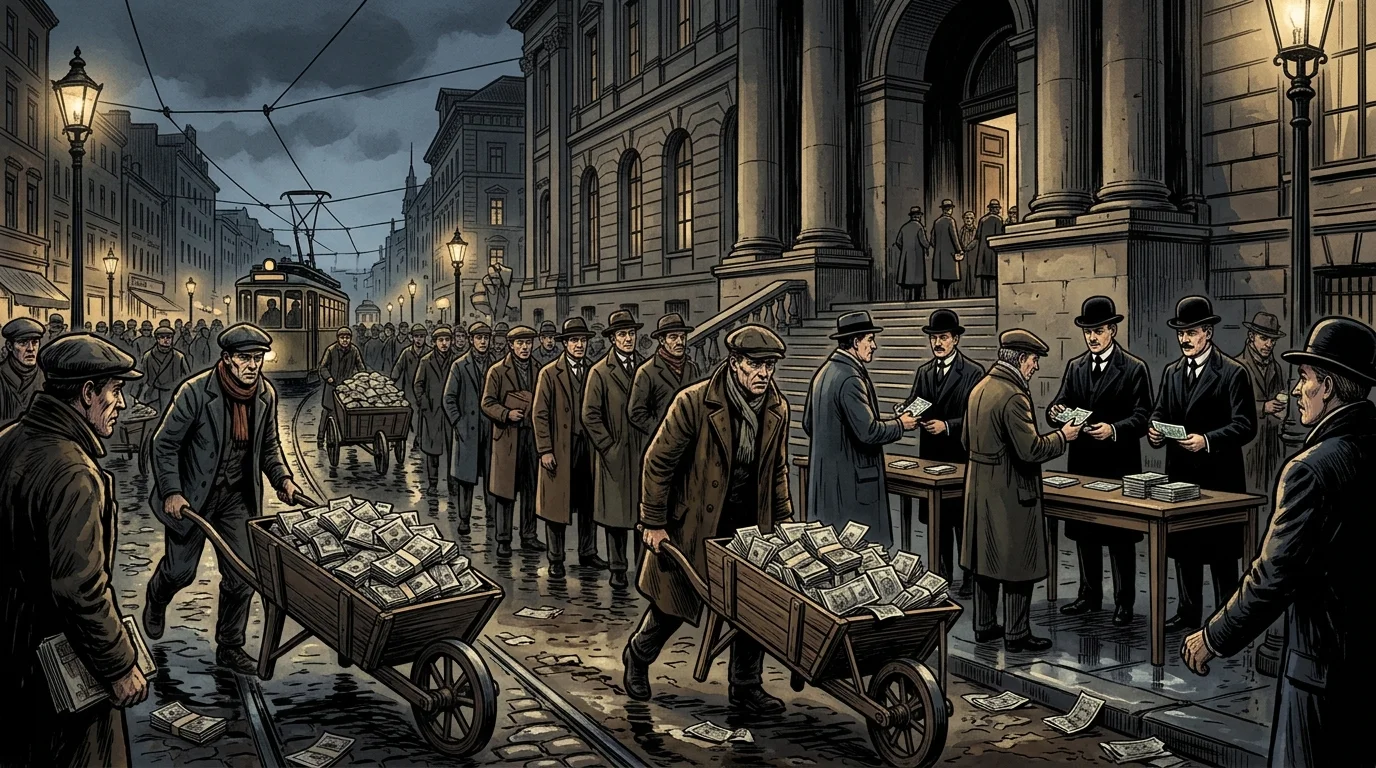
Following the assassination of Foreign Minister Walther Rathenau in June 1922, foreign investor confidence collapsed, turning domestic inflation into capital flight. The fatal shock arrived on January 11, 1923, when French and Belgian troops occupied the Ruhr industrial heartland after Germany defaulted on coal and timber deliveries. Chancellor Wilhelm Cuno’s government called on Ruhr miners, railwaymen, and industrialists to wage “passive resistance”—striking against the occupiers while the Reich Treasury paid their wages and corporate losses by discounting endless tranches of Treasury bills at the Reichsbank. By the autumn of 1923, more than 300 paper mills and 130 printing firms worked around the clock simply to supply the Reichsbank with higher-denomination notes. The US dollar exchange rate—which had stood at 4.20 Goldmarks in July 1914, 191 marks in January 1922, and 17,972 marks in January 1923—exploded to 4.62 million marks in August, 160 million in September, 25.2 billion in October, and finally 4.2 trillion (4,200,000,000,000) Papiermark per US dollar on November 20, 1923. [4]
| Documented Figure / Metric | Historical Significance & Archival Context |
|---|---|
| 150 billion marks | While the hyperinflation wiped out virtually the entire domestic public debt of the Reich—reducing federal wartime liabilities of more than 150 billion marks to mere pfennigs—it inflicted a profound social trauma on Germany's urban middle class (Mittelstand). |
| 4 percent | Mefo accepted the bill, the Reich government secretly guaranteed its ultimate payment, and the contractor could immediately take the three-month bill—extendable repeatedly for up to five years—to any German commercial bank or directly to the Reichsbank to be discounted for cash at a 4 percent interest rate. |
November 15, 1923: The Rentenmark Miracle and Fiscal Stabilization
By October 1923, the German monetary system had ceased to function as a store of value or unit of account: farmers refused to ship grain to cities in exchange for paper marks, workers demanded daily pay in sacks of cash that lost half their value by afternoon, and municipalities, railway districts, and industrial firms issued thousands of emergency scrip currencies (Notgeld), some denominated in rye, coal, kilowatt-hours, or gold. Recognizing that physical collapse was imminent, the new Chancellor Gustav Stresemann ended passive resistance in the Ruhr on September 26, 1923 and secured an Enabling Act on October 13 authorizing emergency monetary decrees. [5]
Because the Reichsbank possessed almost no remaining gold reserves to back a traditional currency, Finance Minister Hans Luther—drawing on an earlier proposal by nationalist economist Karl Helfferich for a “rye mark” (Roggenmark) and adapting it to gold values—established an independent issuing institution by decree on October 15, 1923: the Deutsche Rentenbank. Capitalized at 3.2 billion Rentenmark, the bank held no bullion. Instead, the state imposed a compulsory first-priority land and industrial mortgage of 6 percent interest on all German agricultural land, forestry, industrial plants, and commercial enterprises equal to 4 percent of their prewar assessed defense-tax value. Against these mortgages, the Rentenbank issued interest-bearing mortgage bonds (Rentenbriefe), which in turn served as the statutory backing for a new paper currency: the Rentenmark, valued equal to one prewar Goldmark (10/42 of a US dollar). [6]
On November 12, 1923, Stresemann appointed the fiercely orthodox private banker Hjalmar Schacht (managing partner of the Darmstädter und Nationalbank) as Reich Currency Commissioner (Reichswährungskommissar), and following Havenstein’s sudden death on November 20, Schacht became President of the Reichsbank in December 1923. Three interlocking measures launched on November 15, 1923 turned a psychological sleight of hand into an enduring stabilization: [7]
- Strict Issue Ceiling and Fiscal Cutoff: Total Rentenmark issuance was legally capped at 3.2 billion (later held below 2.4 billion), with at most 1.2 billion advanced to the Reich government to cover its transitional budget deficit. On November 15, the Reichsbank permanently closed its discount window to government Treasury bills, forcing Finance Minister Luther to balance the budget within weeks by firing 25 percent of federal civil servants, slashing state expenditures, and shifting tax assessments onto a gold-indexed basis.
- The 1 Trillion to 1 Exchange Rate Lock: On November 20, 1923, Schacht stabilized the Berlin exchange rate at exactly 4.2 trillion Papiermark per US dollar—making 1 trillion (1012) Papiermark equal to 1 Rentenmark, and 4.20 Rentenmark equal to $1.
- Crushing Speculation and Emergency Scrip: When currency speculators bet in early 1924 that the non-convertible Rentenmark would follow the Papiermark into oblivion, Schacht refused to redeem private Notgeld at the Reichsbank and imposed a draconian credit freeze in April 1924, forcing speculators to dump hoarded foreign exchange back onto the market to repay their mark loans.
With price stability restored and the international Dawes Committee providing an 800-million-gold-mark foreign loan in August 1924, the Reichsbank was reconstituted as an autonomous institution independent of the Reich government and introduced the gold-convertible Reichsmark (RM) on August 30, 1924 at par with the Rentenmark. [8]
Distributional Trauma and the Fear of Open Debt Monetization
While the hyperinflation wiped out virtually the entire domestic public debt of the Reich—reducing federal wartime liabilities of more than 150 billion marks to mere pfennigs—it inflicted a profound social trauma on Germany’s urban middle class (Mittelstand). Holders of war bonds, savings bank passbooks, life-insurance policies, and fixed mortgages saw a lifetime of thrift obliterated, whereas industrial debtors and landowners paid off capital obligations in worthless paper; the 1925 Revaluation Law (Aufwertungsgesetz) restored at most 15 to 25 percent of private mortgage values and just 2.5 percent for old holders of Reich bonds. When the Great Depression struck in 1929–1932, that collective memory of 1923—reinforced by the international constraints of the Dawes and Young reparation plans—deterred Chancellor Heinrich Brüning from devaluing the Reichsmark or engaging in large-scale deficit monetization as unemployment climbed past 6 million. [9]
Hjalmar Schacht’s Shadow Money: The 1934–1938 Mefo Bills
When Adolf Hitler took power in January 1933 and reappointed Hjalmar Schacht as Reichsbank President on March 17, 1933 (adding the post of Acting Minister of Economics in August 1934), the regime faced a fundamental financial contradiction. Hitler demanded immediate, massive rearmament on a scale that far exceeded tax revenues or domestic bond-market capacity. Yet the 1924 Bank Law strictly forbade the Reichsbank from advancing more than RM 100 million in operating credit to the Reich government, and open money printing risked both domestic panic over a repeat of 1923 and premature discovery by the Western signatories of the Versailles Treaty. [10]
In May 1933, Schacht engineered a covert discounting vehicle that exploited the Reichsbank’s legal authority to discount up to three-month “commercial bills of exchange” bearing three solvent corporate signatures. Four giants of German heavy industry—Krupp, Siemens, Gutehoffnungshütte, and Rheinmetall—jointly contributed a nominal share capital of just RM 1 million to found a shell company in Berlin with an innocuous research-sounding name: the Metallurgische Forschungsgesellschaft mbH (Metallurgical Research Corporation, abbreviated Mefo), directed from inside the Reichsbank and the Reich Ministry of Defense. [11]
The Mefo circuit operated with clinical precision. Whenever an armaments contractor delivered tanks, aircraft, artillery, or barracks to the armed forces, the contractor drew a bill of exchange not on the Reich Treasury, but on Mefo. Mefo accepted the bill, the Reich government secretly guaranteed its ultimate payment, and the contractor could immediately take the three-month bill—extendable repeatedly for up to five years—to any German commercial bank or directly to the Reichsbank to be discounted for cash at a 4 percent interest rate. Because Mefo bills were legally classified as private commercial paper rather than sovereign debt, they never appeared in published Reich budget tables or Reichsbank government-credit disclosures. Even more ingeniously, commercial banks and corporations willingly held vast quantities of Mefo bills in their own liquid portfolios as interest-bearing near-money, allowing the Reichsbank to absorb only a fraction onto its balance sheet and preventing an explosion in visible banknote circulation while wage and price controls (capped by the 1936 Price Stop Decree) suppressed consumer demand.
From RM 12 Billion in Mefo Debt to the 1939 Reichsbank Purge
Between 1934 and March 31, 1938, the Mefo shell company—backed by its tiny RM 1 million capital—issued a staggering RM 12 billion in Mefo bills, financing roughly one-third of all German military expenditure during the crucial phase of Wehrmacht buildup and exceeding the entire volume of regular long-term Reich bonds issued over the same years. By 1938, however, the German economy had reached full employment and full industrial capacity. Alarmed that continued off-balance-sheet credit creation under Hermann Göring’s Four-Year Plan would trigger runaway inflation when the five-year Mefo bills began maturing in 1938–1939, Schacht insisted on halting new Mefo issuance on April 1, 1938 (replacing them briefly with six-month non-interest-bearing Lieferungsschätze delivery bills).
The confrontation reached its climax on January 7, 1939, when Schacht and the entire Reichsbank Directorate sent Hitler a confidential memorandum warning that unrestrained state spending was wrecking the Reichsmark and exhausting the central bank’s reserves. Declaring this “mutiny,” Hitler dismissed Schacht as Reichsbank President on January 20, 1939 and enacted the Reichsbank Law of June 15, 1939, which stripped the central bank of all remaining statutory independence, subordinated it directly to the Führer, and abolished every legal ceiling on government debt monetization—turning the Reichsbank once again into the silent financing engine of total war.
Theoretical & Balance-Sheet Transmission Mechanism
In the Kindleberger–Minsky taxonomy of financial instability (Kindleberger, 1978; Minsky, 1986) and Irving Fisher’s (1933) debt-deflation framework, speculative asset booms become systemic crises when credit expansion shifts balance sheets from hedge finance (cash flows covering principal and interest) to speculative and Ponzi finance (relying on rising asset prices and short-term margin roll-overs).
Once monetary tightening or an exogenous shock halts price appreciation, forced margin liquidations trigger Fisherian debt-deflation: fire-sale asset discounts erode bank collateral values, contracting credit supply across the real economy.
Sources and Further Reading
- Deutsches Historisches Museum (DHM / LeMO), Die Währungsreform 1923 und das Wunder der Rentenmark, Lebendiges Museum Online (LeMO), 2023. Historical & Financial Reference
- Deutsches Historisches Museum (DHM / LeMO), Biografie: Hjalmar Schacht (1877–1970), Lebendiges Museum Online (LeMO), 2023. Historical & Financial Reference
- Deutsche Bundesbank, Von der Reichsbank zur Bundesbank: Stationen deutscher Notenbankgeschichte, Deutsche Bundesbank Historical Publications, 2023. Central Bank / Monetary Authority
- Albrecht Ritschl, Deficit Spending in the Nazi Recovery, 1933–1938: A Critical Reassessment, London School of Economics / CEPR, 2000. Peer-Reviewed / Academic Research
- Markus Brunnermeier, Sergio Correia, Stephan Luck, Emil Verner, and Tom Zimmermann, The Debt-Inflation Channel of the German Hyperinflation (Historical Appendix), National Bureau of Economic Research (NBER Working Paper No. 31298), 2023. Peer-Reviewed / Academic Research
- The Wiener Holocaust Library, Hjalmar Schacht, the Reichsbank, and Mefo Bills, The Holocaust Explained, 2023. Central Bank / Monetary Authority
- Hyperinflation in Germany 1923, Deutscher Bundestag, 2023. Historical & Financial Reference
- Hjalmar Schacht, Hjalmar Schacht and the Stabilization of the Mark (1927), German History in Documents and Images, 1927. Historical & Financial Reference
- Deutsche Bundesbank, “ Standard-bearer for Bundesbank independence“, Deutsche Bundesbank, 2016. Central Bank / Monetary Authority
- Irving Fisher — "The Debt-Deflation Theory of Great Depressions," Econometrica 1, no. 4 (FRASER Federal Reserve Archive, 1933): 337–357 Central Bank / Monetary Authority
- Charles P. Kindleberger & Robert Z. Aliber — Manias, Panics, and Crashes: A History of Financial Crises (Palgrave Macmillan) Peer-Reviewed / Academic Research
Cite This Historical Dossier (APA / Chicago)
APA (7th ed.): Ç., S. (Ed.). (2026). The 1923 Rentenmark Miracle and Hjalmar Schacht's Mefo Bills. In Forgotten Fortunes Historical Monograph Series (Forgotten Fortunes Editorial Desk). https://forgottenfortunes.net/germany-1923-hyperinflation-rentenmark-schacht-mefo-bills/
MLA (9th ed.): Ç., Soner, ed. "The 1923 Rentenmark Miracle and Hjalmar Schacht's Mefo Bills." Forgotten Fortunes: Financial & Monetary History Archive, 2026, https://forgottenfortunes.net/germany-1923-hyperinflation-rentenmark-schacht-mefo-bills/.
Chicago (17th ed.): Ç., Soner, ed. "The 1923 Rentenmark Miracle and Hjalmar Schacht's Mefo Bills." Forgotten Fortunes Historical Monograph Series (Forgotten Fortunes Editorial Desk), September 5, 2026. https://forgottenfortunes.net/germany-1923-hyperinflation-rentenmark-schacht-mefo-bills/.
Have an idea for another financial history documentary or article? Request a story →

