In This Article
Across the thirty-one years separating August 1914 from May 1945, the German state fought two total industrial wars while covering less than a third of its military outlays through ordinary taxation. Trauma from each conflict directly shaped the financial engineering of the next. In World War I, Imperial Treasury Secretary Karl Helfferich gambled on a rapid victory and post-war enemy indemnities, raising 98 billion marks through nine public war bond campaigns (Kriegsanleihen) while monetizing floating Treasury bills at the Reichsbank during the 1916 Hindenburg total-mobilization program—a debt mountain that ended in the 1923 Weimar hyperinflation and wiped out Germany’s middle-class bondholders. Haunted by the political memory of worthless Kriegsanleihen, the Nazi regime avoided public war bond drives altogether. Between 1933 and 1938, Reichsbank President Hjalmar Schacht financed 12 billion Reichsmarks of covert Wehrmacht rearmament off-budget through the dummy Metallurgische Forschungsgesellschaft (Mefo) bill scheme. Then, from 1939 to 1945, the Third Reich funded World War II through “noiseless war financing” (geräuschlose Kriegsfinanzierung), quietly siphoning household savings deposits and insurance reserves directly out of German banks into Reich debt behind a facade of frozen wages and prices. [1]
August 1914 and Karl Helfferich’s 98-Billion-Mark Kriegsanleihen Gamble
On August 4, 1914, the Reichstag enacted a package of emergency financial laws (Kriegsgesetze) that dismantled the prewar gold standard. The Reichsbank suspended the convertibility of banknotes into gold coin, abolished the tax on excess note issuance, permitted short-term Imperial Treasury bills (Reichsschatzanweisungen and Reichsschatzwechsel) to count as secondary backing for the currency, and created a network of state Loan Bureaus (Darlehnskassen). These Darlehnskassen advanced paper loan notes (Darlehnskassenscheine) against pledged securities, industrial commodities, and war bonds. Crucially, the Reichsbank was authorized to hold Darlehnskassenscheine in its vaults as legal primary reserve equivalents on par with gold, creating a self-reinforcing engine of credit expansion. [2]
Whereas Great Britain immediately doubled its wartime income tax and introduced excess-profits duties to curb civilian demand, Imperial Germany possessed a decentralized fiscal constitution in which direct income and property taxes belonged to the federal states (such as Prussia and Bavaria) rather than the Reich. Appointed State Secretary of the Imperial Treasury in February 1915 after serving on the board of Deutsche Bank, Karl Helfferich refused to fight the federal states for a wartime Reich income tax until belated war-profits levies were enacted in mid-1916. Addressing the Reichstag on August 20, 1915, Helfferich famously declared that Germany would not burden its citizens with crushing wartime taxes because “the leaden weight of the billions” had been earned by the instigators of the war and would be dragged by the defeated Allied powers through post-war indemnities. [3]
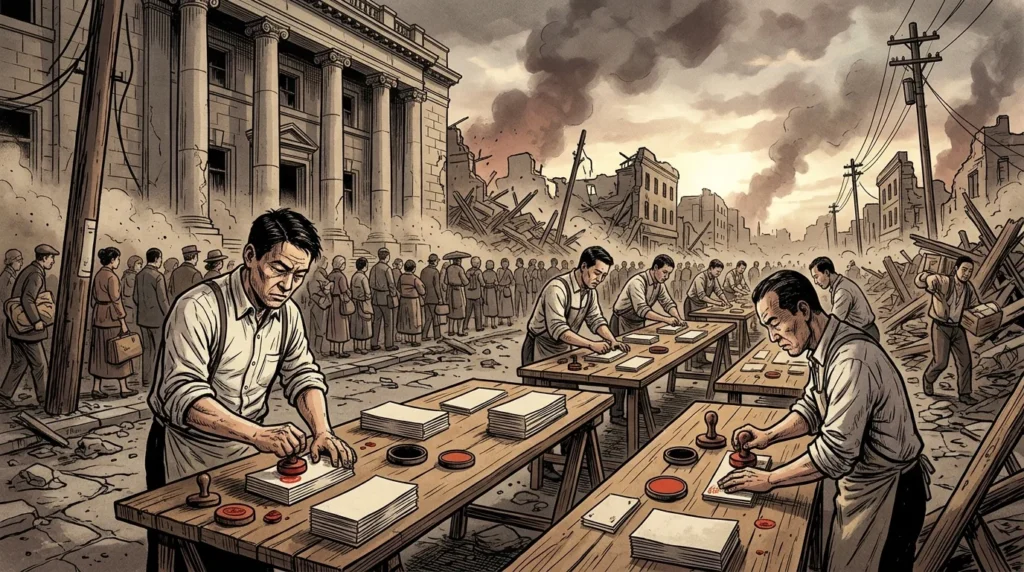
Instead, Imperial Germany relied on a two-step borrowing cycle: the Reich paid munitions contractors by discounting short-term Treasury bills at the Reichsbank, and every six months—in March and September from 1914 through 1918—it launched massive patriotic bond drives to consolidate that floating debt into long-term 5 percent Kriegsanleihen (War Loans). Backed by schools, churches, newspapers, and universal banks, the nine Kriegsanleihen campaigns attracted nearly 40 million individual subscriptions and raised a cumulative nominal total of roughly 98 billion marks, covering approximately 60 percent of Germany’s total wartime expenditure of 156 to 164 billion marks. [4]
The 1916 Hindenburg Program and the Exploding Floating Debt
Up through the fifth war loan in the autumn of 1916, public bond subscriptions nearly kept pace with the Reich’s short-term borrowing, allowing the Reichsbank to retire discounted Treasury bills at the close of each campaign. That equilibrium shattered in August 1916 when Field Marshal Paul von Hindenburg and General Erich Ludendorff assumed command of the Third Supreme Army Command (Oberste Heeresleitung, OHL) and launched the Hindenburg Program alongside the December 1916 Patriotic Auxiliary Service Act (Vaterländisches Hilfsdienstgesetz). [5]
Ordering a doubling of gunpowder and munitions production and a tripling of artillery and machine-gun output by the spring of 1917, the Hindenburg Program removed cost controls on military procurement. War corporations received cost-plus contracts that drove annual imperial spending from 26 billion marks in 1915–1916 to more than 48 billion marks by 1917–1918. Even though the sixth through ninth Kriegsanleihen continued to post record nominal subscriptions—peaking at 15 billion marks in the eighth loan of March 1918—the inflows no longer covered the Reich’s deficit. By November 1918, an un-consolidated floating debt of nearly 50 billion marks in short-term Treasury bills remained on the books alongside 98 billion marks in war bonds, while currency in circulation had quintupled. Without the Allied reparations Helfferich had promised, the Weimar Republic’s post-war monetization of this debt culminated in the 1923 hyperinflation, which reduced the Kriegsanleihen of millions of small German savers to pennies. [6]
Hjalmar Schacht and the 12-Billion-RM Mefo Bill Shadow Money Scheme (1933–1938)
When Adolf Hitler appointed Hjalmar Schacht to a second term as Reichsbank President in March 1933 (and Minister of Economics in 1934), the Nazi regime faced two binding constraints on rapid rearmament. Internationally, the 1919 Treaty of Versailles prohibited Germany from building an air force, tanks, or a large standing army, making open military appropriations in the Reich budget impossible. Domestically, the 1924 Dawes Plan Reichsbank Law strictly forbade the central bank from extending more than 100 million Reichsmarks in working credit to the government, while the German public remained deeply hostile to new state bond issues or visible money-printing. [7]
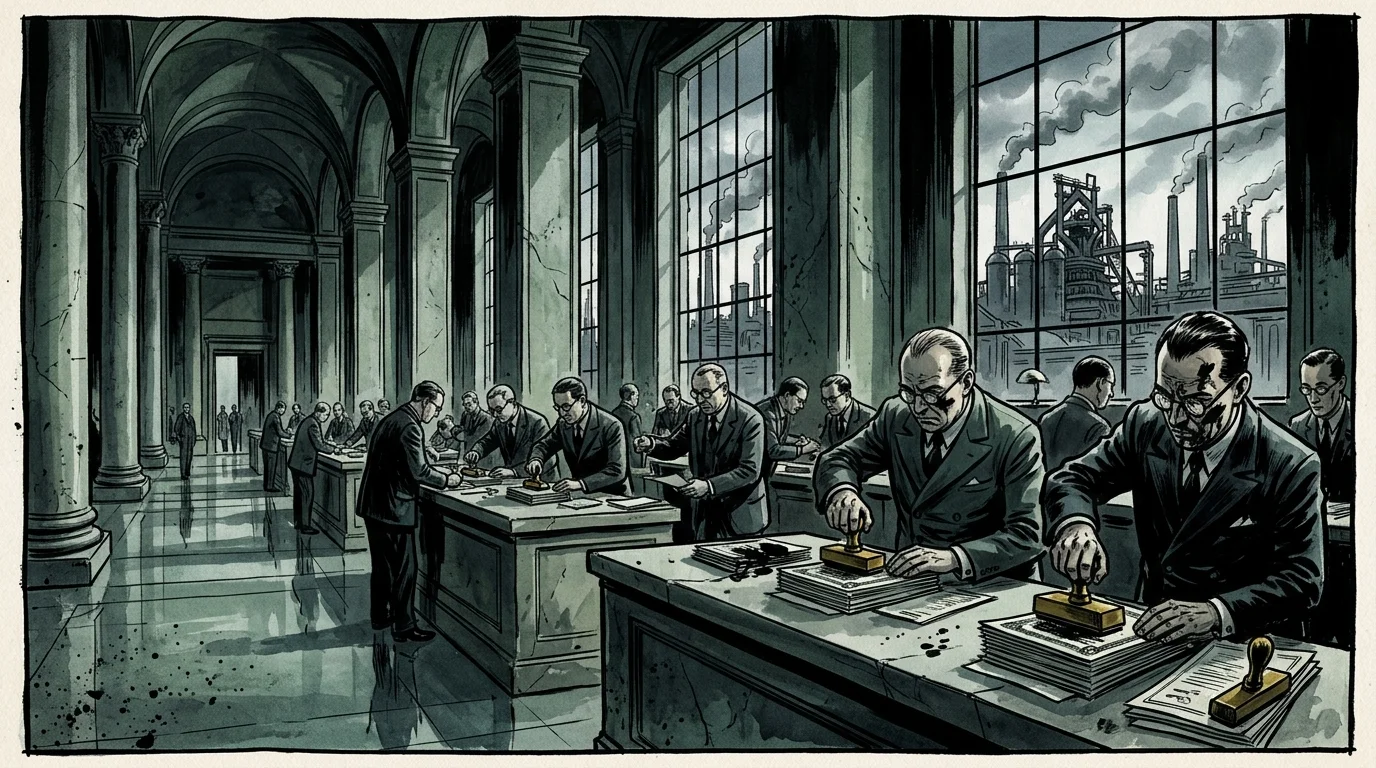
In May 1933, Schacht engineered an ingenious off-balance-sheet conduit: the Metallurgische Forschungsgesellschaft m.b.H. (Mefo), or Metallurgical Research Corporation. Incorporated with a nominal share capital of just one million Reichsmarks subscribed by four flagship German armaments and heavy-industry conglomerates—Krupp, Siemens, Gutehoffnungshütte, and Rheinstahl—Mefo had no factories, laboratories, or operating staff. Its sole function was to accept commercial bills of exchange drawn by military contractors: [8]
- Drawing and Guaranteeing the Bills: When an armaments manufacturer delivered aircraft components, artillery, or barracks to the Wehrmacht, it drew a three-month commercial bill of exchange on Mefo rather than billing the Reich Finance Ministry. Mefo stamped its acceptance on the bill, and the Reich government secretly guaranteed Mefo’s obligations while the Reichsbank guaranteed to discount the bills into cash at any time after an initial ninety-day period.
- Five-Year Rollover and 4 Percent Yield: Although legally structured as ninety-day commercial trade bills (which the Reichsbank was permitted to rediscount without statutory ceiling under the 1924 Banking Law), Mefo bills were renewable in three-month increments for up to five years and carried an attractive 4 percent annual interest rate.
- Parallel Inter-Firm Currency: Because Mefo bills were liquid, interest-bearing, and convertible at the Reichsbank window on demand, German corporations and commercial banks held billions of Reichsmarks in Mefo paper as cash equivalents or used them to pay their own industrial suppliers—keeping the bills out of the Reichsbank’s published balance sheet and concealing both the scale of German rearmament and the growth of the money supply.
Between 1934 and March 31, 1938, when issuance ceased, the Mefo operation financed 12 billion Reichsmarks of secret military expenditure—accounting for roughly one-third of all German armaments spending during the first five years of Nazi rule and comparing with an officially declared Reich public debt of 19 billion Reichsmarks in 1938. When the five-year maturity wall arrived in 1938–1939 and Hitler refused to curb military spending to redeem the maturing notes, Schacht warned of impending inflation in a January 7, 1939 memorandum signed by the Reichsbank Directorate, leading to his dismissal by Hitler on January 20, 1939, and the subordination of the Reichsbank directly to the Führer under the June 1939 Reichsbank Act.
Nazi “Silent War Financing” (Geräuschlose Kriegsfinanzierung), 1939–1945
Upon invading Poland in September 1939, the Nazi leadership deliberately rejected the World War I model of public war loan drives. Convinced that open bond referenda would invite embarrassing public apathy and revive memories of the 1914–1923 bond wipeout, the Reich Ministry of Finance and the Reichsbank instituted geräuschlose Kriegsfinanzierung—”noiseless” or “silent” war financing.
The mechanism operated as a closed-circuit monetary siphon built on the 1936 wage and price freeze (Lohn- und Preisstopp) and strict consumer rationing. As full wartime employment and military procurement pumped hundreds of billions of Reichsmarks into household pay packets and corporate accounts, German citizens found almost no civilian consumer goods available to buy, nor were private firms permitted to issue equities or corporate bonds without state approval. Having nowhere else to spend their surplus cash, households deposited their unspent wages into municipal savings banks (Sparkassen), credit cooperatives, commercial banks, and life insurance policies.
Without asking individual depositors for their consent or advertising public war bonds, the Reich Supervisory Office for Credit and the Reichsbank required the banks, Sparkassen, and insurance companies to invest virtually 100 percent of their incoming deposit growth directly into short-term Reich Treasury bills (Reichsschatzanweisungen) and non-marketable liquidity loans (Li-Anleihen). By 1944–1945, German savings banks and commercial lenders had become passive collection agencies for the Nazi war chest: sovereign debt bloated from 37 billion Reichsmarks in August 1939 to 380 billion Reichsmarks by April 1945, while currency in circulation soared from 11 billion to over 70 billion Reichsmarks. Just as Helfferich’s 98 billion marks in visible war bonds had been obliterated in 1923, Nazi Germany’s 380 billion Reichsmarks in “silent” bank-intermediated war debt was extinguished in the June 1948 West German Currency Reform, which cancelled Reich obligations and converted surviving Reichsmark bank deposits into Deutsche Marks at less than 10 percent of face value.
Theoretical & Balance-Sheet Transmission Mechanism
In the Kindleberger–Minsky taxonomy of financial instability (Kindleberger, 1978; Minsky, 1986) and Irving Fisher’s (1933) debt-deflation framework, speculative asset booms become systemic crises when credit expansion shifts balance sheets from hedge finance (cash flows covering principal and interest) to speculative and Ponzi finance (relying on rising asset prices and short-term margin roll-overs).
Once monetary tightening or an exogenous shock halts price appreciation, forced margin liquidations trigger Fisherian debt-deflation: fire-sale asset discounts erode bank collateral values, contracting credit supply across the real economy.
Sources and Further Reading
- Stephen Gross, “Confidence and Gold: German War Finance 1914–1918,” Central European History, Cambridge University Press, 2009. Peer-Reviewed / Academic Research
- European Association for Banking and Financial History (eabh), “War Finance and the German Banking System,” eabh Working Papers (No. 14-08), 2014. Historical & Financial Reference
- Lillian Goldman Law Library (Avalon Project), “The Nuremberg Trial: Judgment on Hjalmar Schacht and Rearmament Finance,” Yale Law School, 1946. Peer-Reviewed / Academic Research
- Steffen Murau, Armin Haas, Andrei Guter-Sandu, and Matteo Giordano, “The Mefo Operation: A Macro-Financial Analysis of Hjalmar Schacht’s Shadow Money Scheme,” Monetary Architecture Project / Journal of Economic Issues, 2025. Peer-Reviewed / Academic Research
- Jahrbuch für Wirtschaftsgeschichte, “Geräuschlose Kriegsfinanzierung and the German Financial Sector in World War II,” Jahrbuch für Wirtschaftsgeschichte (RePEc Archive), 2020. Historical & Financial Reference
- Leibniz Institute for Financial Research SAFE, “German Public Debt, Money Supply, and War Finance Statistics, 1871–1945 (HISTAT),” Goethe University Frankfurt / SAFE, 2018. Historical & Financial Reference
- Irving Fisher — "The Debt-Deflation Theory of Great Depressions," Econometrica 1, no. 4 (FRASER Federal Reserve Archive, 1933): 337–357 Central Bank / Monetary Authority
- Charles P. Kindleberger & Robert Z. Aliber — Manias, Panics, and Crashes: A History of Financial Crises (Palgrave Macmillan) Peer-Reviewed / Academic Research
Cite This Historical Dossier (APA / Chicago)
APA (7th ed.): Ç., S. (Ed.). (2026). From WWI Kriegsanleihen to Mefo Bills and Silent War Finance in Germany, 1914–1945. In Forgotten Fortunes Historical Monograph Series (Forgotten Fortunes Editorial Desk). https://forgottenfortunes.net/mefo-bills-german-war-finance/
MLA (9th ed.): Ç., Soner, ed. "From WWI Kriegsanleihen to Mefo Bills and Silent War Finance in Germany, 1914–1945." Forgotten Fortunes: Financial & Monetary History Archive, 2026, https://forgottenfortunes.net/mefo-bills-german-war-finance/.
Chicago (17th ed.): Ç., Soner, ed. "From WWI Kriegsanleihen to Mefo Bills and Silent War Finance in Germany, 1914–1945." Forgotten Fortunes Historical Monograph Series (Forgotten Fortunes Editorial Desk), September 19, 2026. https://forgottenfortunes.net/mefo-bills-german-war-finance/.
Have an idea for another financial history documentary or article? Request a story →