In This Article
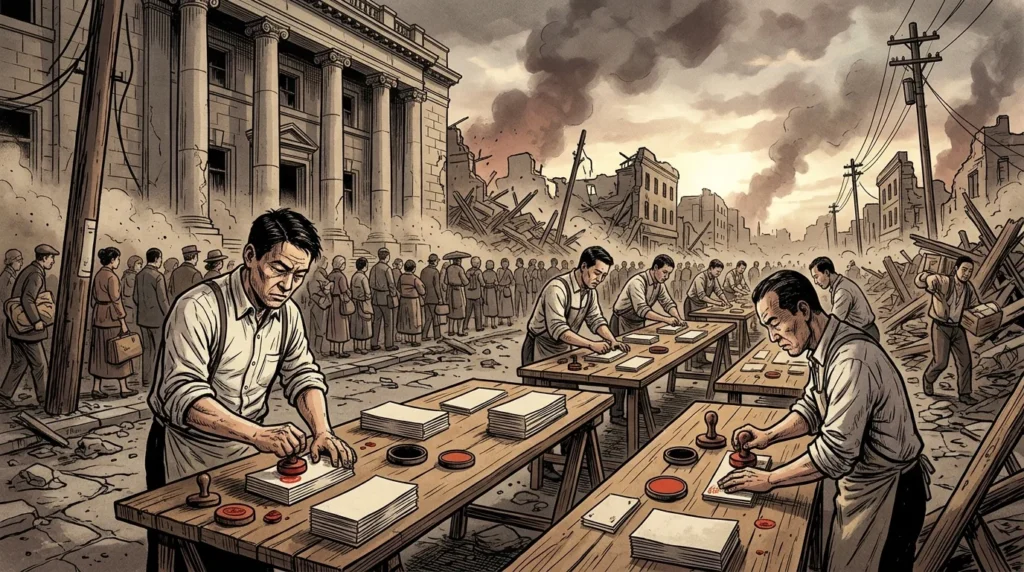
When the Empire of Japan surrendered in August 1945, its physical cities were in ashes, yet the balance sheets of its largest corporations and commercial banks remained swollen with paper claims against the state. Throughout World War II, the Imperial Japanese Government had induced industrial conglomerates and munitions factories to expand production by guaranteeing compensation for war damage, plant conversion losses, and unfulfilled military contracts. By late 1945, these outstanding wartime indemnity commitments exceeded 80 billion yen—a staggering sum equivalent to more than half of Japan’s wartime gross national product. Honouring those claims threatened to unleash Weimar-style hyperinflation and enrich the very zaibatsu industrialists whom the Allied Occupation sought to dismantle; repudiating them outright threatened to bankrupt the entire commercial banking system, which held massive portfolios of munitions loans backed by those state guarantees. [1]
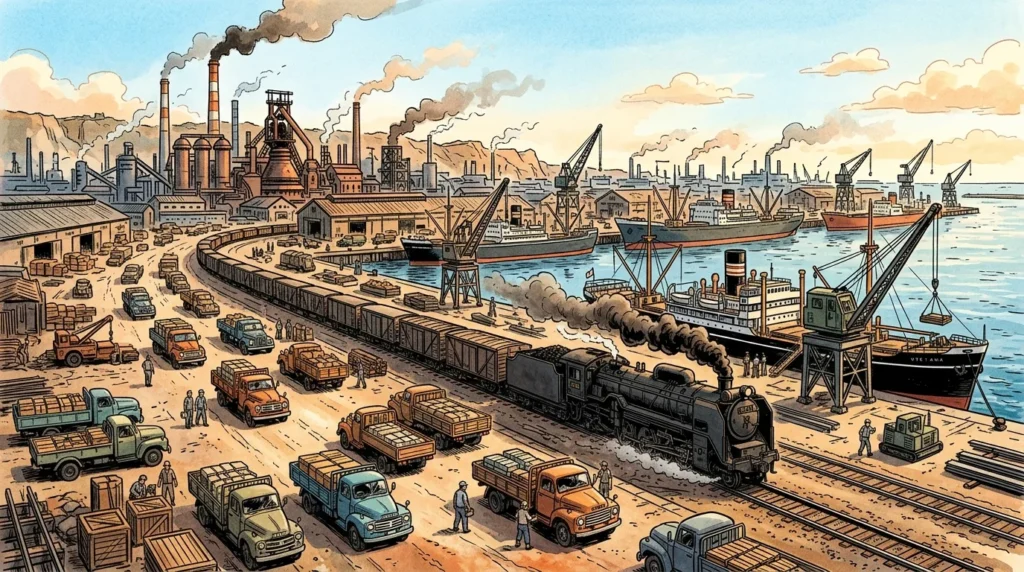
Over the next seven years, Allied authorities under General Douglas MacArthur (SCAP) and the Japanese government led by Prime Minister Shigeru Yoshida executed one of the most radical financial restructurings of the twentieth century. First, the October 1946 Wartime Compensation Special Measures Law imposed a 100 percent confiscatory tax on wartime indemnity claims while splitting insolvent banks and corporations into “Old” and “New” accounts to quarantine balance-sheet losses. Second, to restart paralysed heavy industry, the state created the Reconstruction Finance Bank (Fukkō Kin’yū Kinko) in January 1947, printing Bank of Japan credit to fund “priority production” (keisha seisan) in coal and steel. Finally, after Detroit banker Joseph Dodge halted central-bank money printing in 1949 and plunged Japan into a severe stabilization slump, the June 1950 outbreak of the Korean War injected more than $2.3 billion in United States military “special procurements” (tokuju), rescuing Japanese industry and launching the postwar economic miracle. [2]
The 80-Billion-Yen Overhang and the October 1946 Confiscatory Tax
During the Pacific War, the Japanese Ministry of Finance and the Ministry of Munitions constructed an elaborate system of contingent state liabilities to mobilize private capital for total war. Under legislation such as the General Mobilization Law and wartime marine and air-raid insurance statutes, Tokyo promised to indemnify munitions manufacturers, shipbuilders, aircraft producers, and chemical combines against bombing destruction, plant relocation expenses, and contract cancellations. When hostilities ceased on August 15, 1945, the Bank of Japan and the Ministry of Finance continued disbursing billions of yen in extraordinary military budget funds to settle contractor claims, causing bank note circulation to double within months and fueling a violent surge in black-market prices. [3]
Alarmed by both the inflationary surge and the prospect that wartime industrialists would be shielded from financial loss, Supreme Commander for the Allied Powers (SCAP) headquarters issued a directive in November 1945 ordering Tokyo to freeze large war-indemnity payouts and asserted that “war does not pay.” In February 1946, the Shidehara cabinet enacted the Emergency Financial Measures Ordinance, freezing existing bank deposits and introducing the “New Yen” currency swap to temporarily contract the money supply. Yet the underlying insolvency problem remained unresolved: Japanese commercial banks—particularly the giant city banks associated with Mitsui, Mitsubishi, Sumitomo, Yasuda, and the Industrial Bank of Japan—had extended hundreds of billions of yen in working-capital loans to munitions contractors whose only means of repayment was government war compensation. [4]
After months of tense negotiations between SCAP’s Economic and Scientific Section and Finance Minister Tanzan Ishibashi in the first Yoshida cabinet, the Imperial Diet enacted the Wartime Compensation Special Measures Law (Senji Hoshō Tokubetsu Sochi-hō) on October 19, 1946, effective October 30, 1946. Rather than formally defaulting on sovereign obligations, the statute preserved legal continuity by recognizing the government’s wartime debts and simultaneously levying a 100 percent Wartime Compensation Special Tax (Senji Hoshō Tokubetsu-zei) on all war-damage claims, munitions contract guarantees, and payments already disbursed after August 15, 1945. Across nonfinancial corporations and financial institutions, more than 80 billion yen in state compensation claims were extinguished overnight. [5]
| Documented Figure / Metric | Historical Significance & Archival Context |
|---|---|
| 90 percent | In nonfinancial corporations, accumulated reserves and revaluation gains on inflated inventories were applied first; remaining deficits wiped out up to 90 percent of existing shareholder equity, and any residual losses were imposed as haircuts on Old Account bank creditors. |
| 30 percent | Meanwhile, physical industrial output in 1946 languished at barely 30 percent of its prewar (1934–1936) level. |
| 4.1 billion yen | Between January 1947 and March 1949, the RFB’s outstanding loan portfolio exploded from 4.1 billion yen to 131.9 billion yen—accounting for roughly one-third of all corporate lending in Japan and over 70 percent of new fixed-capital investment in coal, iron, steel, electricity, and marine shipping. |
| 70 percent | Over 70 percent of these debentures were purchased directly by the Bank of Japan. |
Splitting the Balance Sheets: Old Accounts and New Accounts
Wiping out war indemnities immediately rendered Japan’s major industrial firms and commercial banks balance-sheet insolvent. According to Ministry of Finance corporate restructuring records analyzed by financial historian Takeo Hoshi, Japanese industrial corporations suffered 91.8 billion yen in aggregate “special losses” (tokubetsu sonshitsu), of which 66.9 billion yen stemmed directly from the wartime compensation cancellation and 19.8 billion yen from the confiscation of overseas colonial assets in Korea, Taiwan, and Manchuria. [6]
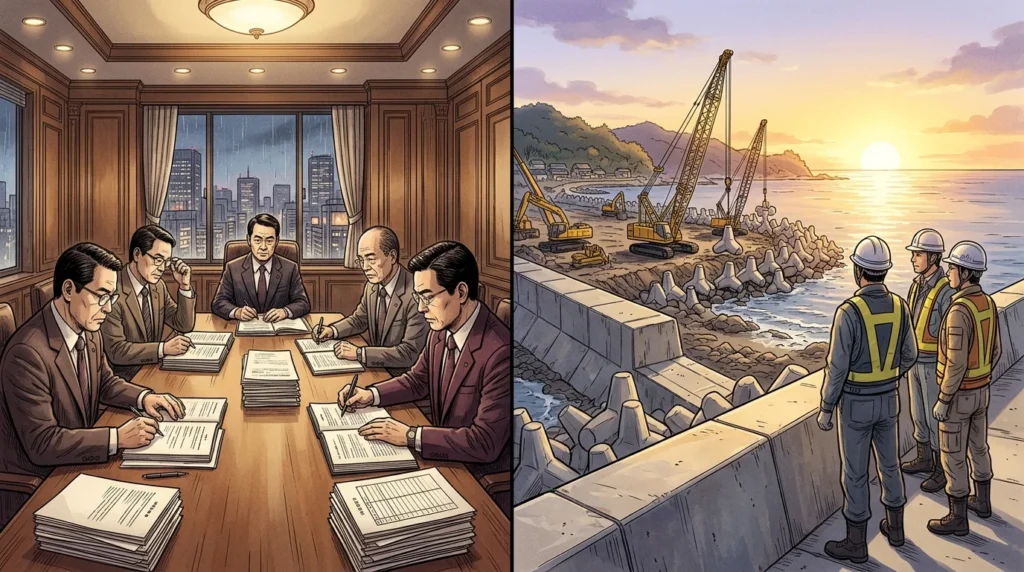
To prevent a disorderly chain of corporate liquidations from shutting down physical factories, the Diet enacted two companion statutes in August and October 1946: the Financial Institutions Emergency Measures Law and the Enterprise Reconstruction and Reorganization Law (Kigyō Saiken Seibi-hō), alongside the Financial Institutions Reconstruction and Reorganization Law (Kin’yū Kikan Saiken Seibi-hō). As of midnight on August 11, 1946, every affected corporation and bank was legally bifurcated into a “New Account” (shin kanjō) and an “Old Account” (kyū kanjō). [7]
In the corporate sector, physical machinery, active inventories, and working capital essential for peacetime civilian production were transferred into the clean New Account, allowing factory managers to continue operating and borrowing free from legacy debt overhang. All cancelled war-indemnity claims, overseas asset write-offs, and pre-August 1946 bank liabilities were quarantined inside the Old Account. Similarly, inside commercial banks, small household deposits (classified as “First Restricted Deposits” under a threshold of 15,000 to 32,000 yen per household) and government bonds were placed in the New Account, while defaulted munitions loans and large corporate and institutional deposits (“Second Restricted Deposits”) were segregated into the Old Account. [8]
Over the following two years, auditors extinguished the Old Account losses through a strict statutory waterfall. In nonfinancial corporations, accumulated reserves and revaluation gains on inflated inventories were applied first; remaining deficits wiped out up to 90 percent of existing shareholder equity, and any residual losses were imposed as haircuts on Old Account bank creditors. Inside the banks, shareholders lost virtually 100 percent of their paid-in capital (totalling roughly 2 billion yen across 69 reorganized financial institutions), while holders of large Second Restricted Deposits absorbed write-downs exceeding 20 billion yen before the cleaned Old and New Accounts were re-merged in March 1948. [9]
The Reconstruction Finance Bank and Priority Production (1947–1949)
While the Old/New Account surgery saved Japan’s banking infrastructure from collapse, commercial banks locked in multi-year balance-sheet reorganization were paralysed and unable to extend long-term capital. Meanwhile, physical industrial output in 1946 languished at barely 30 percent of its prewar (1934–1936) level. Factories lacked coal to fire furnaces, while coal mines lacked steel rails, cables, and machinery to extract coal—a classic postwar supply-side bottleneck. [10]
To break this stalemate, Tokyo University economist Hiromi Arisawa formulated the “Priority Production System” (Keisha Seisan Hōshiki), adopted by the Yoshida cabinet in December 1946. Under this industrial strategy, all available imported fuel oil and domestic resources were concentrated into coal mining; the resulting coal output was allocated directly to iron and steel mills, whose steel products were then recycled back into coal mines, electric power plants, and chemical fertilizer factories.
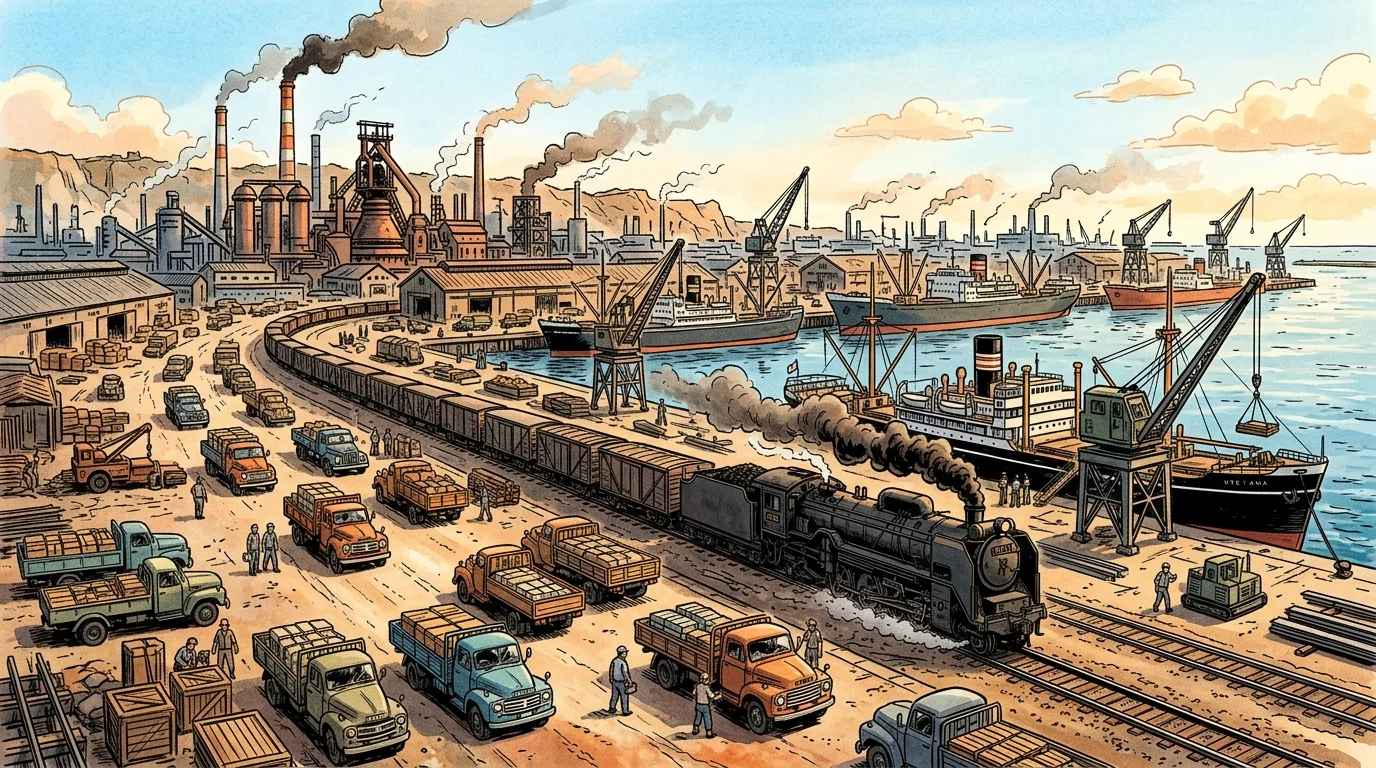
Because private commercial banks could not finance unprofitable coal mines and steelworks whose output prices were capped below production cost by official anti-inflation controls, the government established the Reconstruction Finance Bank (Fukkō Kin’yū Kinko, or RFB) in January 1947. Operating alongside fiscal “price-differential subsidies” (kakaku saeki hokin) that compensated producers for selling coal and steel below cost, the RFB served as the financial engine of priority production. Between January 1947 and March 1949, the RFB’s outstanding loan portfolio exploded from 4.1 billion yen to 131.9 billion yen—accounting for roughly one-third of all corporate lending in Japan and over 70 percent of new fixed-capital investment in coal, iron, steel, electricity, and marine shipping.
Crucially, because domestic savings were depleted, the RFB funded itself by issuing Reconstruction Finance Bank debentures (fukkō-sai). Over 70 percent of these debentures were purchased directly by the Bank of Japan. By monetizing RFB bonds, the central bank injected vast quantities of high-powered money into the economy. Industrial output recovered to roughly 70 percent of prewar levels by late 1948, and national coal production hit its 30-million-ton annual target, but the monetary cost was severe: wholesale prices surged more than threefold between 1947 and early 1949 in what Japanese economists termed “RFB inflation” (Fukkin infure).
The 1949 Dodge Line Stabilization Shock
As the Cold War intensified in 1948, Washington concluded that Japan had to be transformed from a subsidized occupation ward into a self-supporting industrial ally integrated into global trade. In February 1949, President Harry S. Truman dispatched Joseph M. Dodge, president of the Detroit Bank, to Tokyo with ministerial rank to enforce SCAP’s Nine-Point Economic Stabilization Program. Diagnosing the Japanese economy as “walking on stilts”—one stilt consisting of American aid and the other of domestic RFB credit and price subsidies—Dodge imposed a draconian fiscal and monetary stabilization package known as the “Dodge Line.”
Starting with the fiscal 1949 budget, Dodge mandated a “super-balanced budget” that eliminated not only the general-account deficit but also all special-account borrowing, using tax surpluses to retire government debt held by the Bank of Japan. Price-differential subsidies were systematically phased out, and in April 1949 the Reconstruction Finance Bank was ordered to halt all new lending (before being formally liquidated in January 1952 and succeeded by the non-inflationary Japan Development Bank). On April 25, 1949, SCAP abolished Japan’s complex multiple exchange-rate system for individual commodities and fixed a unified exchange rate of 360 yen to 1 US dollar—a rate that endured until the collapse of the Bretton Woods system in 1971.
The Dodge Line extinguished postwar hyperinflation almost overnight, but the sudden withdrawal of RFB credit and fiscal subsidies triggered an acute deflationary contraction known as the “stabilization panic” (antei kyōkō). Denied state loans, thousands of small and medium-sized enterprises went bankrupt, major machinery and chemical manufacturers laid off hundreds of thousands of workers, unsold export inventories piled up after Great Britain devalued the pound sterling by 30.5 percent in September 1949, and the Tokyo stock market plunged by more than half between May 1949 and spring 1950.
Korean War Special Procurements (Tokuju): “A Gift from the Gods”
Just as the Dodge Line deflation threatened to push Japan into a protracted depression, geopolitical conflict on the Korean Peninsula transformed the nation’s external balance. On June 25, 1950, North Korean forces crossed the 38th parallel into South Korea. Within days, United States and United Nations military forces mobilized Japan as their primary forward staging area, repair depot, and industrial supply base.
Beginning in July 1950, the US Eighth Army and the US Logistics Command in Japan issued massive dollar-denominated contracts to Japanese firms for goods and services—officially designated as “special procurements” (tokuju). Over the course of the Korean War (1950–1953) and the immediate post-armistice period through 1955, direct military procurement contracts and spending by US military personnel in Japan injected between $2.3 billion and $3.5 billion in hard foreign currency into the Japanese economy. In 1951 and 1952 alone, special procurement receipts financed roughly 35 to 40 percent of Japan’s total commodity imports, completely eliminating the dollar shortage that had crippled postwar trade.
The tokuju windfall acted as a massive Keynesian demand stimulus without requiring domestic deficit spending. Mountains of unsold textiles, steel plate, cement, automotive trucks, sandbags, barbed wire, and communications equipment were purchased for cash within weeks. Toyota Motor Company, which had been pushed to the brink of bankruptcy in spring 1950 by a severe credit squeeze and labor strike, was rescued by US Army orders for 4,679 military trucks between July 1950 and 1951. Prime Minister Shigeru Yoshida famously privately remarked that the Korean War economic boom was “a gift from the gods” (ten’yū) that rescued Japanese capitalism from the Dodge Line squeeze.
By October 1950, Japan’s mining and manufacturing production index surpassed its prewar 1934–1936 average for the first time, and by 1951 real corporate profits had soared. Crucially, the combination of the 1946 Old/New Account balance-sheet cleanup, the physical capacity rebuilt under 1947–1948 priority production, the price stability and 360-yen exchange rate locked in by the 1949 Dodge Line, and the hard-currency capital accumulated during the 1950–1953 tokuju boom laid the institutional foundations of Japan’s postwar main-bank system and high-speed industrial growth.
Theoretical & Balance-Sheet Transmission Mechanism
In the Kindleberger–Minsky taxonomy of financial instability (Kindleberger, 1978; Minsky, 1986) and Irving Fisher’s (1933) debt-deflation framework, speculative asset booms become systemic crises when credit expansion shifts balance sheets from hedge finance (cash flows covering principal and interest) to speculative and Ponzi finance (relying on rising asset prices and short-term margin roll-overs).
Once monetary tightening or an exogenous shock halts price appreciation, forced margin liquidations trigger Fisherian debt-deflation: fire-sale asset discounts erode bank collateral values, contracting credit supply across the real economy.
Sources and Further Reading
- Takeo Hoshi, “ Cleaning Up the Balance Sheets: Japanese Experience in the Postwar Reconstruction Period,” The World Bank, Economic Development Institute Working Paper No. 94-51, 1994. International Financial Institution
- Koichi Hamada and Munehisa Kasuya, “ The Reconstruction and Stabilization of the Postwar Japanese Economy: Possible Lessons for Eastern Europe?,” Yale University Economic Growth Center Discussion Paper No. 672, 1992. Historical & Financial Reference
- Hiroshi Nakaso, “ Development Finance in the Economy Facing Double Trilemmas,” Bank of Japan, 2015-09-02. Central Bank / Monetary Authority
- Tsutomu Yokose and Cheickna Sangare, “ Priority Production System: Post-WWII Economic Recovery in Japan,” Japan International Cooperation Agency (JICA) and International University of Japan, 2021. Historical & Financial Reference
- Japan Bank for International Cooperation, “ Postwar Reconstruction and the Birth of Japan Export Bank, JBIC’s Forerunner,” JBIC Today, 2023-01. Historical & Financial Reference
- Kojiro Akashita, “ The Korean War and Japanese Ports: Support for the UN Forces and Its Influences,” National Institute for Defense Studies (NIDS) Security Reports, 2007. Historical & Financial Reference
- Takafusa Nakamura, “ The Postwar Japanese Economy, 1945–1973,” in The Cambridge History of Japan, Vol. 6, Cambridge University Press, 1989. Peer-Reviewed / Academic Research
- Japan Center for Asian Historical Records, “War Indemnity Special Measures Law,” National Archives of Japan / JACAR, official historical glossary. Historical & Financial Reference
- Irving Fisher — "The Debt-Deflation Theory of Great Depressions," Econometrica 1, no. 4 (FRASER Federal Reserve Archive, 1933): 337–357 Central Bank / Monetary Authority
- Charles P. Kindleberger & Robert Z. Aliber — Manias, Panics, and Crashes: A History of Financial Crises (Palgrave Macmillan) Peer-Reviewed / Academic Research
Cite This Historical Dossier (APA / Chicago)
APA (7th ed.): Ç., S. (Ed.). (2026). Japan’s Postwar Debt Wipeout and the Korean War Recovery. In Forgotten Fortunes Historical Monograph Series (Forgotten Fortunes Editorial Desk). https://forgottenfortunes.net/japan-1946-wartime-debt-korean-war/
MLA (9th ed.): Ç., Soner, ed. "Japan’s Postwar Debt Wipeout and the Korean War Recovery." Forgotten Fortunes: Financial & Monetary History Archive, 2026, https://forgottenfortunes.net/japan-1946-wartime-debt-korean-war/.
Chicago (17th ed.): Ç., Soner, ed. "Japan’s Postwar Debt Wipeout and the Korean War Recovery." Forgotten Fortunes Historical Monograph Series (Forgotten Fortunes Editorial Desk), September 18, 2026. https://forgottenfortunes.net/japan-1946-wartime-debt-korean-war/.
Have an idea for another financial history documentary or article? Request a story →