In This Article
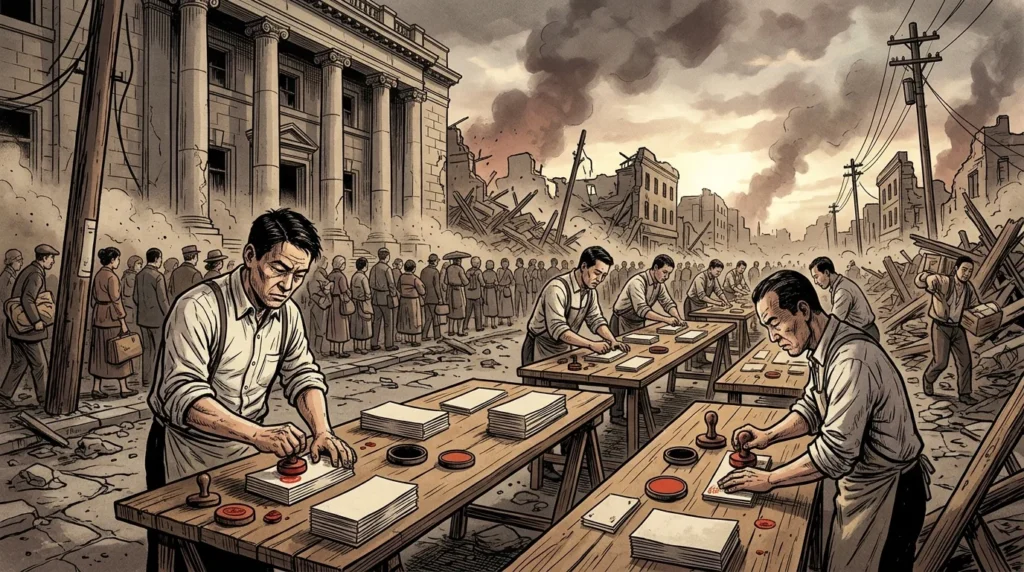
Across the post-Cold War era, Japan’s Ministry of Finance confronted two extraordinary fiscal mobilizations—one triggered by a foreign war in which Japanese troops could not legally fight, and the other by the most destructive natural and nuclear catastrophe in the country’s postwar history. During the 1990–1991 Persian Gulf crisis, constitutional constraints under Article 9 barred Tokyo from dispatching combat forces to the US-led coalition, prompting Prime Minister Toshiki Kaifu’s government to pledge $13 billion (approximately ¥1.7 trillion) in coalition and frontline financial support backed by short-term bridging bonds and temporary corporate and petroleum tax surcharges. Twenty years later, after the March 11, 2011 Great East Japan Earthquake and Tsunami devastated the Tohoku coastline and crippled the Fukushima Daiichi nuclear plant, Tokyo scaled up that ring-fenced fiscal architecture to unprecedented levels—issuing dedicated Reconstruction Bonds (Fukkōsai) inside a ¥32 trillion recovery framework redeemed through a 25-year, 2.1 percent income-tax surcharge and sales of state-held corporate shares. [1]
Article 9 Constraints and the 1990–1991 Gulf Crisis
When Iraqi President Saddam Hussein’s forces invaded Kuwait on August 2, 1990, Japan stood at the peak of its economic output as the world’s second-largest economy and largest net creditor nation, importing roughly 70 percent of its crude oil from the Persian Gulf. Yet Tokyo possessed no legal or institutional mechanism to join the United States and its allies in armed military intervention. Under the postwar Cabinet Legislation Bureau interpretation of Article 9 of the 1947 Constitution, Japan renounced war as a sovereign right and was strictly prohibited from exercising collective self-defense or deploying the Japan Self-Defense Forces (SDF) to foreign combat zones. [2]
Under intense pressure from US President George H. W. Bush and the US Congress to share the burden of opposing Iraqi aggression, Prime Minister Toshiki Kaifu initially announced a $1 billion logistical aid package for multinational forces in late August 1990, followed in September by an additional $1 billion for the military coalition and $2 billion in economic assistance for frontline states—principally Egypt, Jordan, and Turkey—whose economies were battered by the United Nations trade embargo against Iraq. Simultaneously, the Kaifu administration drafted a United Nations Peace Cooperation Bill in October 1990 to permit non-combat SDF personnel to provide logistical support overseas, but fierce domestic opposition and resistance within the Diet forced the government to abandon the bill in November 1990. [3]
| Documented Figure / Metric | Historical Significance & Archival Context |
|---|---|
| $13 billion | Approved by the Diet in early March 1991, Japan's $13 billion outlay covered roughly 20 percent of total coalition war costs. |
| ¥19 trillion | The guidelines initially projected at least ¥19 trillion in public reconstruction spending during an "Intensive Reconstruction Period" covering the first five years (FY2011–FY2015) and ¥23 trillion over ten years. |
Financing the $13 Billion Gulf War Contribution (1991)
When Operation Desert Storm commenced on January 17, 1991, US Treasury Secretary Nicholas Brady pressed Japanese Finance Minister Ryutaro Hashimoto at a Group of Seven meeting in New York for a massive additional financial commitment to underwrite coalition war costs. On January 24, 1991, the Kaifu Cabinet pledged an additional $9 billion—equivalent to ¥1.17 trillion at the official budget exchange rate of ¥130 per dollar—raising Japan’s cumulative Gulf War financial contribution to $13 billion (roughly ¥1.7 trillion in total budgetary outlays). [4]
Passing the ¥1.17 trillion second supplementary budget for fiscal year 1990 required an intricate political and fiscal compromise in the National Diet, where the ruling Liberal Democratic Party (LDP) had lost its upper-house majority in the 1989 Recruit and consumption-tax elections. To win the votes of centrist opposition party Komeito and the Democratic Socialist Party, the Ministry of Finance structured the $9 billion tranche as a strictly ring-fenced fiscal operation rather than deficit borrowing under the Public Finance Act: [5]
- Short-Term Deficit-Financing Bridge Bonds: The government issued special short-term government bonds (Tanki Tokurei Kōsai) to disburse the ¥1.17 trillion rapidly to the Gulf Peace Fund administered for the multinational coalition, stipulating that the funds be used for logistical, transport, medical, and non-lethal administrative expenses.
- Administrative Expenditure Cuts: To win Komeito’s backing, the Cabinet agreed to trim roughly ¥500 billion from existing government budgets and defense procurement plans, ensuring that taxpayers did not bear the entire burden alone.
- Temporary Corporate and Petroleum Tax Surcharges: Rather than rolling the bridge bonds into long-term national debt, the Diet enacted a one-year temporary tax package effective for fiscal year 1991. Corporations faced a 2.5 percent surcharge on their corporate income tax liabilities above ¥3 million, while the petroleum tax rate on crude oil and imported petroleum products was raised by 50 percent (adding ¥1,020 per kiloliter of crude oil) to generate the roughly ¥670 billion needed to redeem the short-term Gulf War bonds in full.
Approved by the Diet in early March 1991, Japan’s $13 billion outlay covered roughly 20 percent of total coalition war costs. Yet fluctuations in the yen-dollar exchange rate between the January pledge (¥130 per dollar) and the spring 1991 disbursements reduced the dollar value of the ¥1.17 trillion transfer to roughly $8.5 billion until Tokyo remitted an extra ¥70 billion ($500 million) in July 1991. Worse still for Japanese diplomats, when the Kuwaiti government published a full-page thank-you advertisement in major American newspapers in March 1991 listing 30 coalition partners, Japan was omitted entirely—cementing the stinging domestic and international label of “checkbook diplomacy” (kogitte gaikō) and spurring the 1992 enactment of the International Peace Cooperation Law permitting SDF participation in UN peacekeeping operations. [6]
The March 2011 Great East Japan Earthquake and Fiscal Shock
Exactly two decades after the Gulf War tax package, Japan’s fiscal planners drew directly on the 1991 precedent of dedicated bridging bonds paired with ring-fenced redemption taxes—this time on a vastly larger scale. On March 11, 2011, a magnitude-9.0 undersea megathrust earthquake off the Pacific coast of Tohoku triggered tsunami waves exceeding 15 meters that inundated 561 square kilometers of coastal municipalities across Iwate, Miyagi, and Fukushima prefectures and precipitated triple core meltdowns at Tokyo Electric Power Company’s Fukushima Daiichi Nuclear Power Station. [7]
The disaster claimed more than 19,700 lives (with over 2,500 people remaining missing), destroyed or damaged more than 1.1 million buildings, and displaced roughly 470,000 residents. Japan’s Cabinet Office estimated the direct physical destruction to housing, factories, roads, ports, and utilities at approximately ¥16.9 trillion—nearly triple the ¥6.3 trillion in direct fiscal outlays triggered by the 1995 Great Hanshin-Awaji (Kobe) Earthquake. Unlike 1991, when Japan’s gross public debt stood near 65 percent of GDP, the 2011 catastrophe struck when Japanese gross government debt already exceeded 200 percent of GDP, making conventional open-ended deficit bond issuance a potential threat to sovereign bond market stability. [8]
The ¥32 Trillion Reconstruction Framework and Fukkōsai
Following recommendations from the Reconstruction Design Council, Prime Minister Naoto Kan’s administration adopted the Basic Guidelines for Reconstruction on July 29, 2011, establishing a 10-year reconstruction period (FY2011–FY2020) and creating a Special Account for Reconstruction from the Great East Japan Earthquake separate from the general budget. The guidelines initially projected at least ¥19 trillion in public reconstruction spending during an “Intensive Reconstruction Period” covering the first five years (FY2011–FY2015) and ¥23 trillion over ten years. Under Prime Minister Yoshihiko Noda and subsequent administrations, the five-year intensive framework was raised to ¥25 trillion in 2013 and the full ten-year reconstruction budget expanded to approximately ¥32 trillion (later extended through FY2025 to over ¥32.9 trillion).
Under the Act on Special Measures for Securing Financial Resources Necessary for Reconstruction from the Great East Japan Earthquake, enacted on November 30, 2011, the Ministry of Finance authorized the issuance of dedicated Reconstruction Bonds (Fukkōsai) as bridging finance. Unlike regular Japanese Government Bonds (JGBs) whose principal is rolled over across generations via the 60-year redemption rule, Reconstruction Bonds were legally segregated from construction and deficit-financing bonds and backed by dedicated revenue streams pledged to redeem the entire stock of Fukkōsai by fiscal year 2037.
The 25-Year Tax Surcharge and State Asset Sales
To service and retire the Reconstruction Bonds without passing the debt permanently to future generations, the November 2011 legislation locked in a multi-pillar redemption structure combining expenditure cuts, nontax privatization revenues, and temporary national and local surtaxes:
- The 2.1 Percent Special Income Tax for Reconstruction: From January 1, 2013 through December 31, 2037—a 25-year window—every individual and withholding taxpayer in Japan was assessed a Special Income Tax for Reconstruction (Fukkō Tokubetsu Shotokuzei) equal to 2.1 percent of their base national income tax liability.
- Corporate and Local Inhabitant Tax Surcharges: Corporations paid a Special Corporate Tax for Reconstruction equal to 10 percent of their base corporate tax liability for two years (FY2012–FY2013, shortened from three years to support economic recovery), while local municipal and prefectural inhabitant taxes were raised by ¥1,000 per capita per year for ten years (FY2014–FY2023) to fund local disaster prevention.
- Sale of State-Owned Shares in Japan Tobacco and Japan Post: To generate over ¥5 trillion in non-tax redemption revenues, the government liquidated a one-sixth stake in Japan Tobacco Inc. (reducing the state’s statutory shareholding from 50 percent to one-third in March 2013 for roughly ¥970 billion) and earmarked the proceeds from multiple public share offerings of state-owned Japan Post Holdings Co., Ltd. (which raised roughly ¥4 trillion between 2015 and 2021), alongside transfers of Bank of Japan and foreign-exchange special account surpluses.
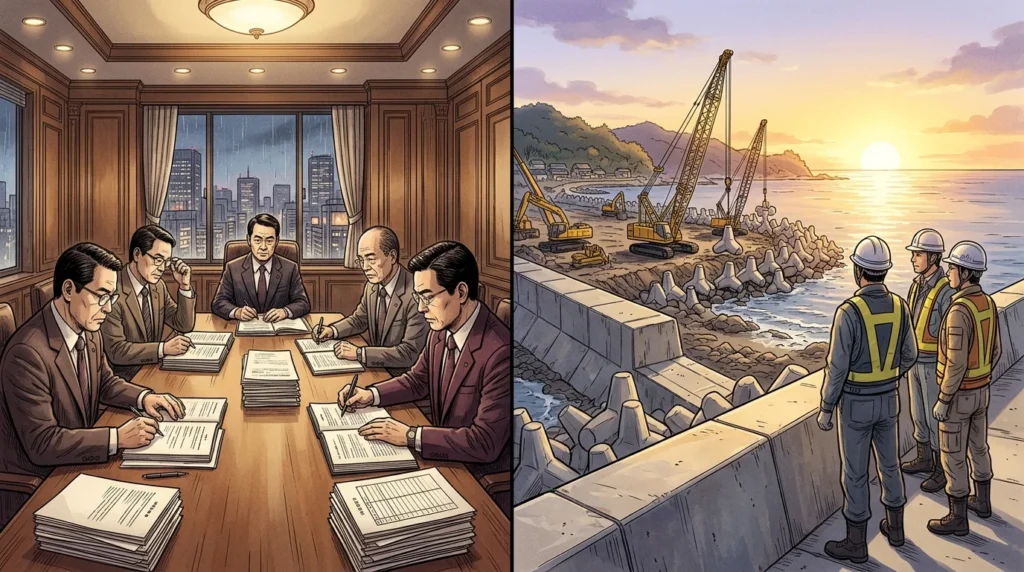
Together, Japan’s 1991 Gulf War tax package and its 2011 Great East Japan Earthquake Reconstruction Bonds demonstrate how Tokyo’s fiscal authorities repeatedly relied on ring-fenced bridge bonds and hypothecated tax surcharges to manage sudden national emergencies. Where the 1991 package retired ¥1.17 trillion inside a single fiscal year to overcome Article 9 military constraints, the 2011 Fukkōsai architecture stretched that same fiscal discipline across a quarter-century horizon to rebuild an entire region without triggering a sovereign bond market crisis.
Theoretical & Balance-Sheet Transmission Mechanism
In the Kindleberger–Minsky taxonomy of financial instability (Kindleberger, 1978; Minsky, 1986) and Irving Fisher’s (1933) debt-deflation framework, speculative asset booms become systemic crises when credit expansion shifts balance sheets from hedge finance (cash flows covering principal and interest) to speculative and Ponzi finance (relying on rising asset prices and short-term margin roll-overs).
Once monetary tightening or an exogenous shock halts price appreciation, forced margin liquidations trigger Fisherian debt-deflation: fire-sale asset discounts erode bank collateral values, contracting credit supply across the real economy.
Sources and Further Reading
- Kazuto Suzuki, “ The Gulf War and Japanese Diplomacy,” Nippon.com, 2014-12-03. Historical & Financial Reference
- Sam Jameson and Leslie Helm, “ Japan Details Tax Hike Plan for Gulf Aid: Gulf War: Proposal Would Raise $9 Billion by Boosting Levies on Oil, Corporate Profits and Cigarettes,” Los Angeles Times, 1991-01-31. Historical & Financial Reference
- Reconstruction Headquarters in response to the Great East Japan Earthquake, “ Basic Guidelines for Reconstruction in response to the Great East Japan Earthquake,” Government of Japan, 2011-07-29. Historical & Financial Reference
- Shigeki Morinobu, “ Fiscal Management Lessons from the Great East Japan Earthquake,” The Tokyo Foundation for Policy Research, 2012-03-08. Historical & Financial Reference
- Reconstruction Agency, “ Current Status of Reconstruction and Challenges: Financial Resources and Scale of Budget,” Reconstruction Agency, Government of Japan, 2025-04-07. Historical & Financial Reference
- Ministry of Finance, Japan, “ Debt Management Report 2025,” Ministry of Finance, Japan, 2025. Historical & Financial Reference
- Irving Fisher — "The Debt-Deflation Theory of Great Depressions," Econometrica 1, no. 4 (FRASER Federal Reserve Archive, 1933): 337–357 Central Bank / Monetary Authority
- Charles P. Kindleberger & Robert Z. Aliber — Manias, Panics, and Crashes: A History of Financial Crises (Palgrave Macmillan) Peer-Reviewed / Academic Research
Cite This Historical Dossier (APA / Chicago)
APA (7th ed.): Ç., S. (Ed.). (2026). Japan's $13 Billion Gulf War Outlay and 2011 Earthquake Reconstruction Bonds. In Forgotten Fortunes Historical Monograph Series (Forgotten Fortunes Editorial Desk). https://forgottenfortunes.net/japan-gulf-war-reconstruction-bonds/
MLA (9th ed.): Ç., Soner, ed. "Japan's $13 Billion Gulf War Outlay and 2011 Earthquake Reconstruction Bonds." Forgotten Fortunes: Financial & Monetary History Archive, 2026, https://forgottenfortunes.net/japan-gulf-war-reconstruction-bonds/.
Chicago (17th ed.): Ç., Soner, ed. "Japan's $13 Billion Gulf War Outlay and 2011 Earthquake Reconstruction Bonds." Forgotten Fortunes Historical Monograph Series (Forgotten Fortunes Editorial Desk), September 12, 2026. https://forgottenfortunes.net/japan-gulf-war-reconstruction-bonds/.
Have an idea for another financial history documentary or article? Request a story →