In This Article
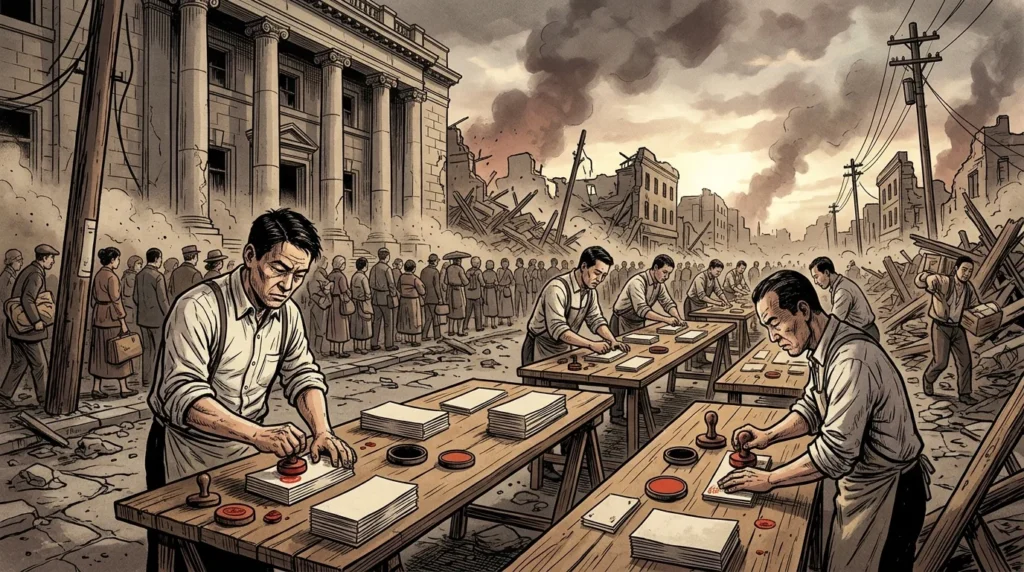
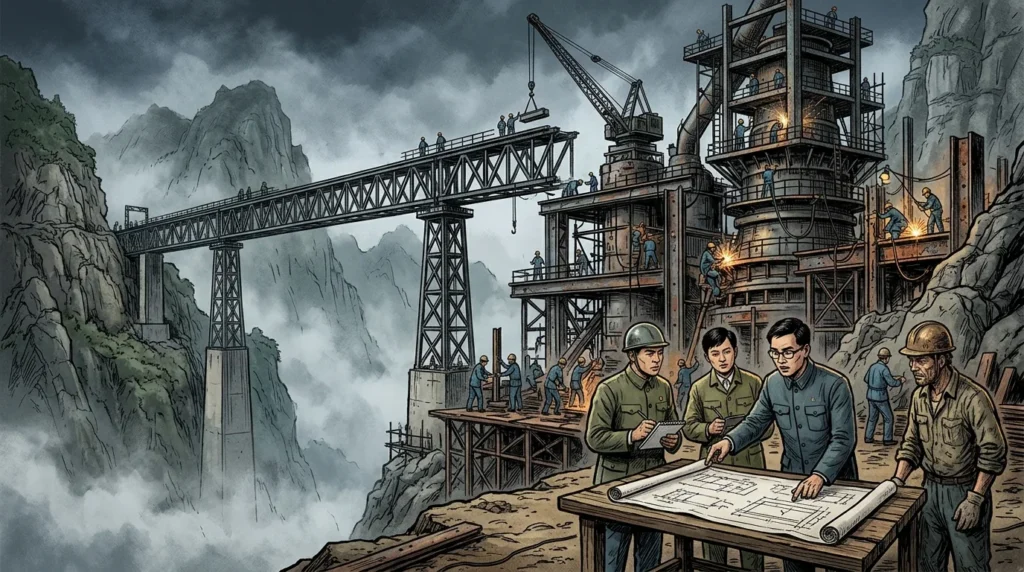
When Imperial Japanese troops clashes with Chinese forces at the Marco Polo Bridge on July 7, 1937 and seized Shanghai, Nanjing, Guangzhou, and Wuhan over the following fifteen months, Chiang Kai-shek’s Nationalist government retreated deep into the mountainous interior of Sichuan Province to establish its wartime capital at Chongqing. Military withdrawal saved the Nationalist army from annihilation, but it inflicted a fiscal catastrophe without precedent in modern Asian history. By the autumn of 1938, Japanese occupation of China’s eastern river valleys and coastal treaty ports had stripped the Ministry of Finance of more than 80 percent of its prewar revenue base. Cut off from modern bond markets and coastal tax collectors, Finance Minister H. H. Kung (Kong Xiangxi), diplomat-financier T. V. Soong (Song Ziwen), and Shanghai banker Chen Guangfu (K. P. Chen) improvised a four-pronged wartime fiscal survival strategy: bartering strategic interior commodities—tung oil, Yunnan tin, and Jiangxi tungsten—for US Export-Import Bank and Soviet credits, securing a $500 million unconditional US Treasury loan in March 1942, nationalizing the rural Land Tax in July 1941 to collect grain directly in kind, and covering more than 75 percent of annual wartime budget deficits through the printing presses of the Central Bank of China. [1]

The 1937–1938 Coastal Revenue Collapse: Customs, Salt, and Consolidated Taxes
During the “Nanjing Decade” (1927–1937), Finance Ministers T. V. Soong and H. H. Kung had constructed a modernized fiscal apparatus centered on the Yangtze Delta and treaty ports. In the fiscal year prior to July 1937, over 80 percent of the central government’s tax receipts came from just three indirect revenue pillars: the Maritime Customs Administration (Haiguan), which collected import and export tariffs at coastal ports; the Salt Gabelle (Yanshui), levied predominantly on coastal evaporation pans in Jiangsu, Hebei, and Shandong; and the Consolidated Excise Taxes (Tongshui) on machine-manufactured cotton yarn, flour, matches, cement, and rolled tobacco produced in Shanghai and Tianjin factories. [2]
Japan’s amphibious assault on Shanghai in August–November 1937 and its advance up the Yangtze to Wuhan and into Guangzhou in October 1938 shattered all three pillars simultaneously. By 1939, Customs revenues reaching Chongqing had fallen by roughly 85 percent as Japanese authorities seized the Shanghai, Tianjin, and Guangzhou customhouses and forced the British Inspector-General of Customs, Sir Frederick Maze, to deposit occupied-port tariffs into the Japanese-controlled Yokohama Specie Bank. Coastal salt fields fell behind Japanese lines, while more than three-quarters of China’s modern industrial spindles and tax-paying factories were destroyed or occupied. [3]
At the exact moment that annual central government cash revenues plunged from roughly 870 million yuan in 1937 to less than 300 million yuan in 1939, military mobilization to maintain more than 3 million frontline troops drove wartime expenditures upward nearly threefold. Efforts by H. H. Kung to introduce Western-style direct taxes—income tax, wartime excess-profits tax, and inheritance tax—in the agrarian interior of Sichuan, Yunnan, and Guizhou yielded less than 5 to 8 percent of total wartime expenditures. [4]
| Documented Figure / Metric | Historical Significance & Archival Context |
|---|---|
| $25 Million | Under the landmark $25 Million Tung Oil Loan signed in December 1938 (formally executed in February 1939), the US Export-Import Bank extended a five-year credit to the Universal Trading Corporation guaranteed by the Bank of China. |
| $1.6 billion | Alongside $1.6 billion in wartime Lend-Lease military aid administered through T. |
| $220 million | Beginning in late 1943, Kung and Soong persuaded Morgenthau to ship $220 million of the loan tranche in physical gold bullion to Chongqing, where the Central Bank of China sold gold bars and jewelry over the counter to soak up excess paper currency. |
| 1.41 billion yuan | Total fabi note circulation expanded from 1.41 billion yuan on the eve of war in June 1937 to 15.1 billion yuan in December 1941, 189.5 billion yuan in December 1944, and 1,031.9 billion yuan when Japan surrendered in August 1945—a more than 730-fold expansion in the money supply. |
Barter Diplomacy: Soviet Credits and the 1938 Universal Trading Corporation Tung Oil Loan
To prevent China’s foreign-exchange reserves from vanishing and to purchase desperate shipments of aviation fuel, trucks, artillery, and rifles, Chongqing turned to resource-backed barter credits. Between March 1938 and 1939, while Western democracies hesitated to extend direct military loans for fear of provoking Tokyo or violating the US Neutrality Acts, the Soviet Union signed three barter credit agreements with China totaling $250 million, exchanging Soviet Polikarpov fighter aircraft, T-26 tanks, artillery, and munitions for Chinese deliveries of tea, wool, hides, tungsten, antimony, and tin shipped overland across Xinjiang. [5]
To unlock American financial support without triggering Neutrality Act prohibitions on sovereign loans to belligerents, H. H. Kung dispatched prominent banker Chen Guangfu (founder of the Shanghai Commercial and Savings Bank) to Washington in September 1938 to negotiate with US Treasury Secretary Henry Morgenthau Jr. After months of intensive bargaining, Morgenthau and President Franklin D. Roosevelt approved a commercial commodity-credit structure in December 1938. Chen incorporated the Universal Trading Corporation (UTC) under New York State law—headquartered at Rockefeller Center in Manhattan—as a wholly owned purchasing and sales subsidiary of the Chinese government, paired with the state-owned Foo Shing Trading Corporation (Fuxing Shangye Gongsi) inside China. [6]
Under the landmark $25 Million Tung Oil Loan signed in December 1938 (formally executed in February 1939), the US Export-Import Bank extended a five-year credit to the Universal Trading Corporation guaranteed by the Bank of China. In return, UTC contracted to deliver 220,000 tons of Chinese tung oil (wood oil extracted from the seeds of the Vernicia fordii tree in Sichuan, Hunan, and Guangxi, indispensable to US naval and industrial paint, varnish, and waterproofing manufacturers) while using the dollar proceeds to purchase American Dodge and GMC trucks, gasoline, and machinery for transport up the newly carved Burma Road. [7]
Despite ferocious Japanese bombing of the Burma Road and Haiphong rail links, Chen Guangfu’s network delivered the tung oil shipments ahead of schedule, retiring the $25 million loan in full by March 1942. The commercial success of the Tung Oil Loan enabled T. V. Soong (who arrived in Washington as Chiang Kai-shek’s personal representative in June 1940) and Chen to negotiate three larger Export-Import Bank resource loans before Pearl Harbor: [8]
- The April 1940 Yunnan Tin Loan ($20 million): Secured by deliveries of 40,000 tons of refined Chinese tin to the US Metals Reserve Company.
- The October 1940 Tungsten Loan ($25 million): Backed by strategic tungsten ore exports essential for armor-piercing projectiles and high-speed machine tools.
- The February 1941 Metal Reserve Credit ($50 million): Secured against tungsten, antimony, and tin exports, bringing total pre-Pearl Harbor US Export-Import Bank commodity credits to $120 million.
The July 1941 Nationalization of the Land Tax in Kind (Tianfu Zhengshi)
While foreign commodity loans kept external supply lines open, internal price inflation inside Free China accelerated sharply after 1940 once Japan severed the Indochina railway and pressured Britain into temporarily closing the Burma Road. Because provincial warlords had controlled rural land taxes (tianfu) since 1928—collecting fixed assessments in paper money that lost 80 percent of its real purchasing power as grain prices soared—wealthy Sichuan landlords were paying virtually nothing in real terms while the central government printed billions of paper yuan to buy rice at inflated market prices to feed its 3.5 million soldiers and civil servants.
Acting on recommendations from American economic adviser Laughlin Currie and domestic fiscal reformers at the Third National Financial Conference in Chongqing in June 1941, Chiang Kai-shek issued a sweeping fiscal decree effective July 1, 1941: the central government reclaimed the rural Land Tax from the provinces and ordered that all land taxes—alongside compulsory state grain purchases (zhenggou) and forced grain borrowings (zhengjie)—be collected directly in physical measures of unhusked rice (gu) and wheat rather than paper currency.
Between 1941 and 1945, the Ministry of Food and the Ministry of Finance extracted between 50 million and 70 million piculs (shi dan, roughly 2.5 to 3.5 million metric tons) of grain annually from the Chinese countryside—with Sichuan Province alone supplying over one-third of the national quota. The Land Tax in Kind saved the Nationalist state from fiscal starvation: it provided non-inflationary daily rice rations (pingjia mi) for soldiers, teachers, and civil servants in Chongqing and Kunming without requiring the treasury to bid for grain in open markets. Yet in the villages, corrupt county magistrates and landlords shifted the requisition quotas disproportionately onto smallholders and tenant farmers, breeding deep rural grievance across the interior.
The March 1942 US$500 Million Loan, Gold Sales, and Fabi Hyperinflation
Following Japan’s attack on Pearl Harbor in December 1941 and the fall of Rangoon in March 1942—which completely severed the Burma Road and left Free China accessible only by airlift over the Himalayan “Hump”—Washington moved to shore up Chongqing’s sagging currency. Alongside $1.6 billion in wartime Lend-Lease military aid administered through T. V. Soong’s China Defense Supplies, the US Congress unanimously approved a $500 Million Financial Aid Credit in February 1942, signed by Treasury Secretary Morgenthau and T. V. Soong on March 21, 1942 with no collateral requirements, no fixed interest, and no wartime repayment schedule.
H. H. Kung used $200 million of the US loan to issue US Dollar Savings Certificates and Dollar Victory Bonds in Chongqing at the artificial official exchange rate of 20 fabi yuan to US$1—a time when the black-market dollar already traded at 80 to 200 yuan—allowing well-connected Chongqing insiders to convert depreciating paper fabi into hard US dollar claims. Beginning in late 1943, Kung and Soong persuaded Morgenthau to ship $220 million of the loan tranche in physical gold bullion to Chongqing, where the Central Bank of China sold gold bars and jewelry over the counter to soak up excess paper currency. Because US Treasury gold shipments were delayed by wartime logistics and leaked to speculative syndicates in Chongqing, the gold-sale policy failed to halt the monetary deluge.
Throughout the eight-year conflict, the four government banks—led by the Central Bank of China, the Bank of China, the Bank of Communications, and the Farmers Bank of China—covered between 75 and 85 percent of Chongqing’s annual fiscal deficit simply by printing unbacked fabi (legal tender notes, first introduced in the November 1935 currency reform). Total fabi note circulation expanded from 1.41 billion yuan on the eve of war in June 1937 to 15.1 billion yuan in December 1941, 189.5 billion yuan in December 1944, and 1,031.9 billion yuan when Japan surrendered in August 1945—a more than 730-fold expansion in the money supply. By August 1945, the Chongqing wholesale price index stood at more than 2,000 times its June 1937 level, having wiped out the savings of China’s urban salaried middle class, professors, and civil servants and fatally weakened the fiscal foundations of the Nationalist Republic prior to the resumption of the Chinese Civil War.
Theoretical & Balance-Sheet Transmission Mechanism
In the Kindleberger–Minsky taxonomy of financial instability (Kindleberger, 1978; Minsky, 1986) and Irving Fisher’s (1933) debt-deflation framework, speculative asset booms become systemic crises when credit expansion shifts balance sheets from hedge finance (cash flows covering principal and interest) to speculative and Ponzi finance (relying on rising asset prices and short-term margin roll-overs).
Once monetary tightening or an exogenous shock halts price appreciation, forced margin liquidations trigger Fisherian debt-deflation: fire-sale asset discounts erode bank collateral values, contracting credit supply across the real economy.
Sources and Further Reading
- Time Magazine, “Foreign Trade: Tung Oil Wanted,” Time Archive, 1939-01-02. Historical & Financial Reference
- Lin, Hsiao-ting, and Wu, Jingping, “K. P. Chen, the Universal Trading Corporation, and Sino-American Wartime Financial Diplomacy,” Bulletin of Historical Research, National Taiwan Normal University, 2010. Peer-Reviewed / Academic Research
- U.S. Department of State, “Foreign Relations of the United States: Diplomatic Papers, 1945, The Far East, China, Volume VII, Document 815 (Implementation of the $500 Million Credit and Gold Sales),” Office of the Historian, 1945. Official / State Archive
- U.S. Department of State, “Foreign Relations of the United States, 1947, The Far East: China, Volume VII, Document 941 (Universal Trading Corporation and Export-Import Bank Commodity Credits),” Office of the Historian, 1947. Official / State Archive
- Coble, Parks M., “The Collapse of Nationalist China: How Chiang Kai-shek Lost China’s Financial, Economic, and Military War,” Cambridge University Press, 2023. Peer-Reviewed / Academic Research
- Mitchener, Kris James, and Weidenmier, Marc D., “Empire, Public Goods, and the Roosevelt Corollary: Sovereign Debt and Fiscal Institutions,” National Bureau of Economic Research (NBER) Working Paper No. 11062, 2005. Peer-Reviewed / Academic Research
- Irving Fisher — "The Debt-Deflation Theory of Great Depressions," Econometrica 1, no. 4 (FRASER Federal Reserve Archive, 1933): 337–357 Central Bank / Monetary Authority
- Charles P. Kindleberger & Robert Z. Aliber — Manias, Panics, and Crashes: A History of Financial Crises (Palgrave Macmillan) Peer-Reviewed / Academic Research
Cite This Historical Dossier (APA / Chicago)
APA (7th ed.): Ç., S. (Ed.). (2026). Tung Oil Loans, Grain Taxes, and Fabi Printing in Wartime China (1937–1945). In Forgotten Fortunes Historical Monograph Series (Forgotten Fortunes Editorial Desk). https://forgottenfortunes.net/china-tung-oil-loans-wartime/
MLA (9th ed.): Ç., Soner, ed. "Tung Oil Loans, Grain Taxes, and Fabi Printing in Wartime China (1937–1945)." Forgotten Fortunes: Financial & Monetary History Archive, 2026, https://forgottenfortunes.net/china-tung-oil-loans-wartime/.
Chicago (17th ed.): Ç., Soner, ed. "Tung Oil Loans, Grain Taxes, and Fabi Printing in Wartime China (1937–1945)." Forgotten Fortunes Historical Monograph Series (Forgotten Fortunes Editorial Desk), September 20, 2026. https://forgottenfortunes.net/china-tung-oil-loans-wartime/.
Have an idea for another financial history documentary or article? Request a story →