
In This Article
When the Cold War ended and Brazil emerged from hyperinflation in 1994 under the Plano Real, the country’s defense planners faced a dual crisis: an collapsing state-owned military-industrial complex and vast, unmonitored frontiers across the Amazon basin and the South Atlantic. Over the next three decades, Brasília transformed how it financed, governed, and acquired strategic defense capabilities. Beginning in 1994 with two watershed decisions—the US$1.4 billion Export-Import Bank financing of the Sistema de Vigilância da Amazônia (SIVAM) with U.S. contractor Raytheon and the December 1994 privatization of near-bankrupt aircraft maker Embraer under a state golden share—Brazil moved away from subsidized state arsenals toward public-private risk-sharing and export-credit-financed technology transfer. That model reached its zenith under the 2008 National Defense Strategy, which committed tens of billions of reais to the French-backed PROSUB conventional and nuclear submarine shipyard at Itaguaí and the US$4.7 billion Swedish Saab Gripen E/F fighter program. [1]
Amazonian Sovereignty and the US$1.4 Billion SIVAM Financing Scandal (1994–1995)
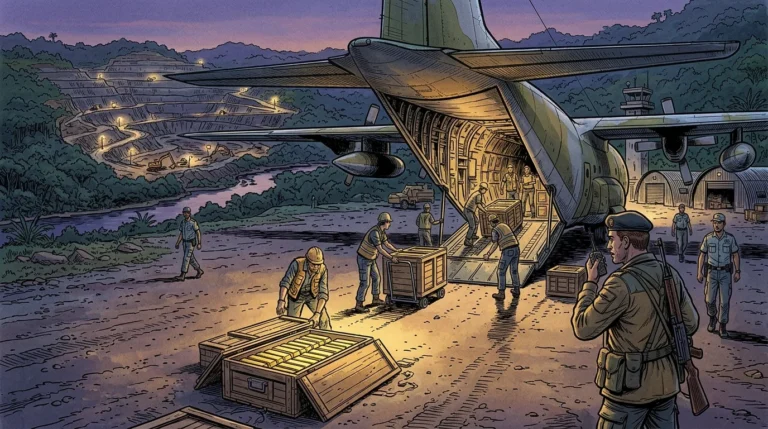
Conceived in 1990 by Brazil’s Secretariat for Strategic Affairs (SAE) and the Ministry of Aeronautics and publicly unveiled at the June 1992 United Nations Earth Summit in Rio de Janeiro, the Sistema de Vigilância da Amazônia (SIVAM) was designed to establish permanent electronic and environmental sovereignty over the 5.2-million-square-kilometer Legal Amazon. Combining forty-six fixed and mobile ground radar stations, satellite imaging receivers, environmental weather sensors, regional coordination centers in Manaus, Belém, and Porto Velho, and a central command hub in Brasília, SIVAM aimed to simultaneously track clandestine narcotrafficking flights, illegal gold mining (garimpo), and rainforest deforestation. [2]
Because Brazil’s federal treasury lacked the long-term capital to fund the US$1.4 billion procurement domestically during the stabilization of the early 1990s, the contract hinged on foreign sovereign export-credit guarantees. A fierce geopolitical bidding war pitted a French consortium led by Thomson-CSF against U.S. defense contractor Raytheon Company. Backed by an aggressive commercial diplomacy campaign under U.S. President Bill Clinton and Commerce Secretary Ron Brown—and a 1994 project-finance package approved by the Export-Import Bank of the United States (EXIM)—Raytheon won the prime contract in partnership with Brazilian systems integrator Atech (Fundação Aplicações de Tecnologias Críticas) and Embraer, which was contracted to supply modified ERJ-145 twinjets equipped with Erieye airborne early-warning radars (designated R-99A and R-99B). [3]
In November 1995, just as the US$1.4 billion financing package awaited final authorization in the Brazilian Senate, a major wiretap scandal nearly derailed the project. Transcripts of court-authorized Federal Police wiretaps on the telephone of Ambassador Júlio César Gomes dos Santos, chief of protocol and close adviser to President Fernando Henrique Cardoso, captured conversations with Raytheon’s Brazilian lobbyist, Commander José Afonso Assumpção, discussing pressure on senators delaying the SIVAM contract report. The revelations triggered a political firestorm in Brasília, forcing the immediate resignations of Gomes dos Santos and Aeronautics Minister Brigadier Mauro Gandra. Despite opposition calls to annul the award, the Cardoso administration defended the strategic necessity of the radar network, the Senate formally ratified the EXIM financing in May 1996, and SIVAM entered operational service in July 2002—later providing the technological foundation for the Brazilian Army’s Integrated Border Monitoring System (SISFRON). [4]
The December 1994 Privatization of Embraer and the Golden Share
In the very same year that SIVAM’s financing was structured, Brazil executed one of the most consequential aerospace turnarounds in modern corporate history. Founded in 1969 in São José dos Campos as a state-controlled enterprise spearheaded by the Brazilian Air Force (FAB) and aeronautical engineer Ozires Silva, Empresa Brasileira de Aeronáutica S.A. (Embraer) had built respected military trainers (the Tucano) and commuter turboprops (the Bandeirante and Brasília). By 1990–1994, however, the loss of federal export subsidies, post-Cold War military procurement cuts, and the commercial failure of the costly CBA-123 Vector turboprop pushed Embraer to the brink of insolvency. Its workforce was slashed from more than 12,600 employees to roughly 5,500, and unpaid debts exceeded US$400 million while development of its crucial 50-seat regional jet, the ERJ-145, stalled for lack of capital. [5]
Recalled by President Itamar Franco to rescue the company he had founded, Ozires Silva negotiated a financial restructuring that culminated in Embraer’s privatization auction on December 7, 1994. A domestic-led consortium headed by investment bank Companhia Bozano, Simonsen (alongside U.S. firm Wasserstein Perella) and two giant Brazilian corporate pension funds—Previ (the pension fund of Banco do Brasil employees) and Sistel (the pension fund of Telebrás telecommunications workers)—acquired controlling voting equity for roughly US$154 million and injected fresh working capital. Crucially, to safeguard national security and indigenous military engineering, the Brazilian federal government retained a special-class “golden share” granting Brasília permanent veto power over any transfer of corporate control, changes to the company’s name or headquarters, or termination of military aviation programs. [6]
Freed from civil-service procurement bottlenecks and recapitalized by Bozano, Simonsen and the pension funds under CEO Maurício Botelho, Embraer completed the ERJ-145—which debuted at the 1995 Paris Air Show—and subsequently launched the E-Jet family (E170–E195), vaulting past Bombardier to become the world’s third-largest commercial aircraft manufacturer behind Boeing and Airbus. Simultaneously, the golden-share framework preserved Embraer’s symbiosis with the Brazilian Air Force, enabling the development of the A-29 Super Tucano light attack aircraft and the twin-turbofan KC-390 Millennium multi-mission military transport and aerial refueling jet—and later allowing the Brazilian government in 2018 to veto a direct takeover of Embraer’s defense assets during partnership negotiations with Boeing. [7]
The “Blue Amazon” and the 2008 PROSUB Submarine Shipyard at Itaguaí
By 2007–2008, the discovery of vast ultra-deepwater “pre-salt” (pré-sal) petroleum reserves off the coast of Rio de Janeiro and São Paulo—coupled with sustained commodity-boom fiscal revenues—prompted President Luiz Inácio Lula da Silva and Defense Minister Nelson Jobim to promulgate Brazil’s December 2008 National Defense Strategy (Estratégia Nacional de Defesa, END). The doctrine explicitly prohibited off-the-shelf foreign arms purchases, mandating that major defense contracts include full technology transfer, domestic industrial offsets, and joint production inside Brazil. [8]
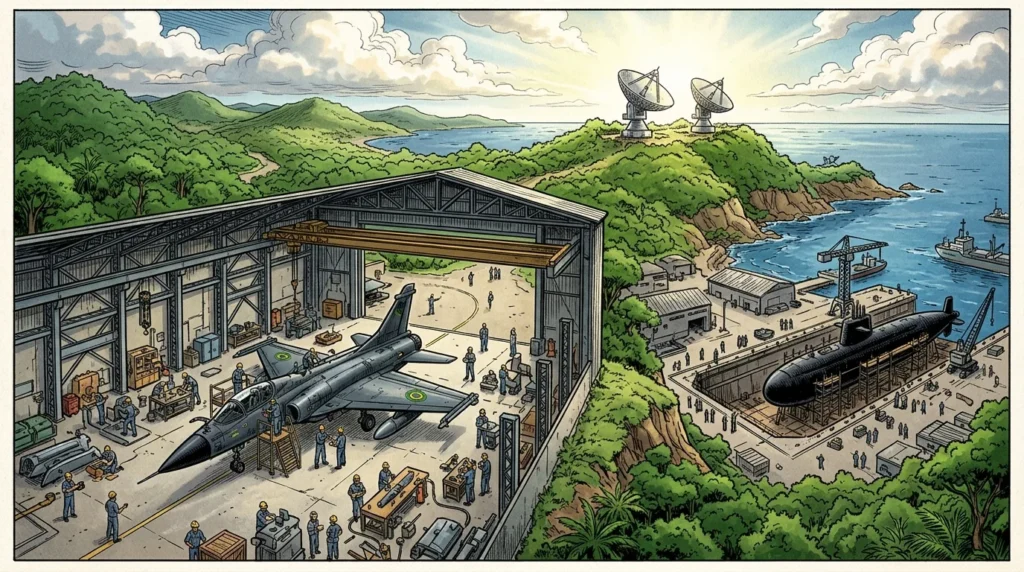
The flagship naval pillar of the 2008 strategy was the Submarine Development Program (Programa de Desenvolvimento de Submarinos, PROSUB), established through a December 2008 bilateral defense treaty with French President Nicolas Sarkozy initially valued at €6.7 billion (and budgeted at roughly R$31.85 billion in multi-year domestic appropriations). Designed to patrol the 4.5-million-square-kilometer maritime exclusive economic zone that the Brazilian Navy terms the “Blue Amazon” (Amazônia Azul), PROSUB contracted French naval shipbuilder DCNS (later renamed Naval Group) to transfer submarine hull design and combat-system technology to a newly formed Brazilian joint venture, Itaguaí Construções Navais (ICN). [9]
At a purpose-built industrial complex in Itaguaí on the coast of Rio de Janeiro—comprising a metallic-structures manufacturing unit, construction and maintenance shipyards, and a specialized naval base—ICN and the Brazilian Navy undertook the local construction of four enlarged conventional diesel-electric Scorpène-class submarines (the S-BR Riachuelo class, capable of 70-day patrols): the Riachuelo (S40, launched in December 2018), Humaitá (S41, launched in December 2020), Tonelero (S42), and Angostura (S43). In parallel, PROSUB integrated the Navy’s indigenous nuclear fuel-cycle and pressurized-water reactor program (LABGENE at Aramar) with French non-nuclear hull engineering to build the SN-BR Álvaro Alberto, aimed at making Brazil the seventh nation in the world to operate a nuclear-powered attack submarine.
The US$4.7 Billion Saab Gripen E/F Fighter and Technology-Transfer Model (2014–2024)
What PROSUB accomplished for naval shipbuilding, the F-X2 fighter procurement program replicated in supersonic combat aviation. Conducted between 2008 and 2013 to replace the Brazilian Air Force’s aging Mirage 2000 and Northrop F-5EM fleets, the F-X2 competition pitted Boeing’s F/A-18E/F Super Hornet and Dassault’s Rafale against Sweden’s Saab Gripen NG. Following revelations in 2013 of U.S. National Security Agency electronic espionage targeting Brazilian government communications—and attracted by Sweden’s willingness to grant unrestricted access to source codes and joint airframe assembly—Brazil selected Saab in December 2013.
In October 2014, the Brazilian Ministry of Defense signed a 39.3 billion Swedish kronor (approximately US$4.7 billion to US$5.4 billion with weapons and financing adjustments) contract with Saab AB for 36 Gripen E/F (designated F-39E/F in Brazil) single- and twin-seat multi-role fighters, backed by long-term credit from the Swedish Export Credit Corporation (SEK). Under the industrial offset pact, more than 350 Brazilian engineers and technicians trained at Saab’s facilities in Linköping, Sweden, while Embraer established a Gripen Design and Development Network and a final assembly line at its Gavião Peixoto plant in São Paulo state. Across the 30-year arc from SIVAM and Embraer’s 1994 privatization to PROSUB and the Gripen E/F, Brazil demonstrated how emerging powers could leverage sovereign export credit, pension-fund equity, and golden-share industrial policy to build high-technology defense capacity—even while navigating recurrent fiscal austerity and procurement investigations.
Theoretical & Balance-Sheet Transmission Mechanism
In the Kindleberger–Minsky taxonomy of financial instability (Kindleberger, 1978; Minsky, 1986) and Irving Fisher’s (1933) debt-deflation framework, speculative asset booms become systemic crises when credit expansion shifts balance sheets from hedge finance (cash flows covering principal and interest) to speculative and Ponzi finance (relying on rising asset prices and short-term margin roll-overs).
Once monetary tightening or an exogenous shock halts price appreciation, forced margin liquidations trigger Fisherian debt-deflation: fire-sale asset discounts erode bank collateral values, contracting credit supply across the real economy.
Sources and Further Reading
- Export-Import Bank of the United States (EXIM), “EXIM Historical Timeline: 1994 Financing of Amazon Rainforest Surveillance Project,” Export-Import Bank of the United States, 2024. Official / State Archive
- Massachusetts Institute of Technology (MIT Mission 2006), “Project SIVAM (System for the Vigilance of the Amazon),” Massachusetts Institute of Technology, 2002. Peer-Reviewed / Academic Research
- Embraer Historical Center, “History of Embraer: From State Founding to 1994 Privatization and Global Expansion,” Embraer S.A., 2023. Historical & Financial Reference
- Marcos de Oliveira, “A Deal in the Air: Embraer, the 1994 Golden Share, and Brazil’s Defense Strategy,” Revista Pesquisa FAPESP (Issue 268), 2018-06. Historical & Financial Reference
- Domingos Zaparolli, “Renewing the Fleet: Brazilian Navy’s Submarine Development Program (PROSUB),” Revista Pesquisa FAPESP (Issue 273), 2018-11. Historical & Financial Reference
- Naval Group, “Key Milestones for the Brazilian Submarine Program Celebrated in Itaguaí,” Naval Group, 2020-12-11. Peer-Reviewed / Academic Research
- Saab AB, “Statement Regarding Brazil’s Acquisition of 36 Gripen E/F Fighters in the 2008–2014 FX-2 Programme,” Saab AB Newsroom, 2024-10-10. Historical & Financial Reference
- Irving Fisher — "The Debt-Deflation Theory of Great Depressions," Econometrica 1, no. 4 (FRASER Federal Reserve Archive, 1933): 337–357 Central Bank / Monetary Authority
- Charles P. Kindleberger & Robert Z. Aliber — Manias, Panics, and Crashes: A History of Financial Crises (Palgrave Macmillan) Peer-Reviewed / Academic Research
Cite This Historical Dossier (APA / Chicago)
APA (7th ed.): Ç., S. (Ed.). (2026). Radar, Jets, and Submarines: SIVAM, Embraer's Privatization, and PROSUB (1994–2024). In Forgotten Fortunes Historical Monograph Series (Forgotten Fortunes Editorial Desk). https://forgottenfortunes.net/brazil-embraer-privatization-sivam/
MLA (9th ed.): Ç., Soner, ed. "Radar, Jets, and Submarines: SIVAM, Embraer's Privatization, and PROSUB (1994–2024)." Forgotten Fortunes: Financial & Monetary History Archive, 2026, https://forgottenfortunes.net/brazil-embraer-privatization-sivam/.
Chicago (17th ed.): Ç., Soner, ed. "Radar, Jets, and Submarines: SIVAM, Embraer's Privatization, and PROSUB (1994–2024)." Forgotten Fortunes Historical Monograph Series (Forgotten Fortunes Editorial Desk), September 20, 2026. https://forgottenfortunes.net/brazil-embraer-privatization-sivam/.
Have an idea for another financial history documentary or article? Request a story →