In This Article
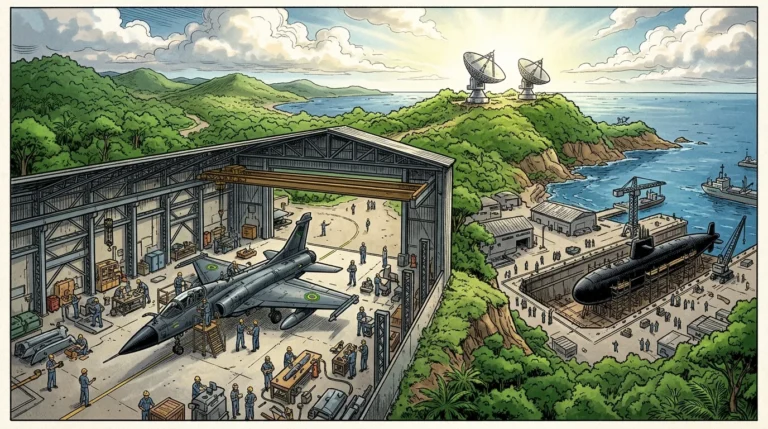
Between 2005 and 2013, buoyed by crude oil prices that peaked above $100 per barrel, Venezuelan President Hugo Chávez signed more than $11 billion in defense procurement and sovereign credit contracts with the Russian Federation’s state arms exporter, Rosoboronexport. Within a decade, the Bolivarian National Armed Forces (FANB) replaced their aging US-supplied arsenal with 24 Sukhoi Su-30MK2 heavy multirole strike fighters, S-300VM (Antey-2500) long-range surface-to-air missile batteries, T-72B1 main battle tanks, and 100,000 Kalashnikov AK-103 assault rifles. Yet when world oil prices collapsed in 2014 and Petróleos de Venezuela (PDVSA) production fell into structural decline, President Nicolás Maduro pivoted from petrodollar arms imports to a domestic garrison economy—creating the military oil and mining corporation CAMIMPEG in February 2016, opening the 111,843-square-kilometer Orinoco Mining Arc, and liquidating more than three-quarters of the Central Bank of Venezuela’s physical gold reserves while 31 metric tons of bullion remained frozen inside the Bank of England. [1]
The 2006 US Arms Embargo and the Rosoboronexport Credit Pipeline
For half a century before the Bolivarian Revolution, Venezuela’s military doctrine and logistics were closely integrated with the United States and Western European defense contractors. In 1983, under the Peace Delta program, Caracas became the first Latin American government permitted by Washington to purchase General Dynamics F-16A/B Fighting Falcon jet fighters. After Hugo Chávez took office in 1999 and survived a brief April 2002 coup, relations with the George W. Bush administration deteriorated rapidly over Chávez’s alliance with Cuba, rhetoric against US military hegemony, and alleged ties to Colombian guerrillas. [2]
In May 2006, the US Department of State formally imposed a comprehensive arms embargo under Section 40A of the Arms Export Control Act, prohibiting all commercial sales or retransfers of US defense articles, spare parts, and avionics upgrades to Venezuela. Washington’s ban grounded portions of Venezuela’s F-16 squadron and blocked Caracas from acquiring Spanish military transport aircraft and Brazilian light attack planes that contained American-manufactured engines or cockpit electronics. [3]
Chávez responded by traveling to Moscow in July 2006 to forge an unprecedented military-technical partnership with President Vladimir Putin and Rosoboronexport. Beginning with an initial $3 billion cash-and-credit package in 2005–2006 and expanding through sovereign Russian lines of credit of $2.2 billion in 2009 and $4 billion in 2010–2011, Venezuela became Moscow’s largest arms customer in the Western Hemisphere. The flagship acquisitions transformed Venezuela’s order of battle: [4]
- Aerospace and rotary power: 24 Sukhoi Su-30MK2 twin-engine multirole fighters delivered between late 2006 and 2008 to replace the F-16s as Venezuela’s primary air-superiority and maritime-strike platform, accompanied by more than 50 Russian military helicopters (Mi-17V-5 transport, Mi-35M2 Hind attack, and heavy Mi-26T2 Halo helicopters).
- Integrated air defense shield: Two battalions of the mobile S-300VM (Antey-2500) theater ballistic and cruise missile defense system, reinforced by Buk-M2E medium-range missiles, modernized S-125 Pechora-2M batteries, and thousands of Igla-S shoulder-fired surface-to-air missiles.
- Armored and infantry systems: 92 T-72B1 main battle tanks, BMP-3 infantry fighting vehicles, BTR-80A armored personnel carriers, Smerch 300mm multiple-launch rocket systems, and 100,000 AK-103 (7.62×39mm) assault rifles, alongside a 2006 contract to build a domestic Kalashnikov rifle and ammunition manufacturing plant in Maracay (CAVIM), which suffered years of construction delays, cost overruns, and embezzlement inquiries before partial commissioning.
To underwrite these sovereign arms loans and cement geopolitical protection, Caracas simultaneously granted Russian state oil giant Rosneft minority equity stakes across five major joint ventures in the Orinoco Heavy Oil Belt (Petromonagas, Petroperijá, Boquerón, Petromiranda, and Petrovictoria), while PDVSA later pledged 49.9 percent of its US refining subsidiary CITGO as collateral for a $1.5 billion Rosneft loan in 2016. [5]
| Documented Figure / Metric | Historical Significance & Archival Context |
|---|---|
| $1.7 billion | Beginning in 2015, as oil revenues collapsed, the BCV executed a series of costly gold swaps with international commercial banks—most prominently pledging 20 tons of gold with Deutsche Bank in a $1.7 billion swap arrangement—to raise emergency dollar liquidity for debt payments. |
| $1.2 billion | Only one major overseas tranche escaped liquidation: roughly 31 metric tons of Venezuelan gold bars (valued between $1.2 billion and $2 billion) that had been left in the vaults of the Bank of England in London after the 2011 repatriation to facilitate international swap transactions. |
Decree 2,231 (February 2016): CAMIMPEG and the Militarized Economy
When global oil prices plunged from over $100 per barrel in mid-2014 to under $30 in early 2016, Venezuela’s oil-dependent fiscal model imploded. Starved of hard currency to service sovereign bonds, Chinese oil-for-loan tranches, and Russian defense credits, President Nicolás Maduro insulated his administration against coup risks by handing direct control over profitable state enterprises, ports, food distribution, and natural resources to active-duty and retired generals of the FANB. [6]
On February 10, 2016, published in Official Gazette No. 40,845, Maduro signed Presidential Decree No. 2,231 creating the Compañía Anónima Militar de Industrias Mineras, Petrolíferas y de Gas (CAMIMPEG). Placed directly under the Ministry of Defense headed by General-in-Chief Vladimir Padrino López, CAMIMPEG was granted a sweeping corporate charter to rehabilitate oil wells, operate gas fields, repair drilling rigs, provide oilfield security, and extract and market minerals without subjection to standard parliamentary oversight by the opposition-controlled National Assembly. [7]
Within months, the military’s corporate footprint expanded across the entire supply chain of daily survival. In April and July 2016, Maduro created the Comités Locales de Abastecimiento y Producción (CLAP) subsidized food-box distribution network and established the Gran Misión Abastecimiento Soberano, placing Padrino López and regional military commanders in operational command of Venezuela’s major seaports, customs houses, agro-industrial plants, and basic food imports. [8]
The 2016 Orinoco Mining Arc (Arco Minero del Orinoco)
Two weeks after chartering CAMIMPEG, on February 24, 2016 (Decree No. 2,248), Maduro officially established the Arco Minero del Orinoco (Orinoco Mining Arc) National Strategic Development Zone. Spanning 111,843 square kilometers south of the Orinoco River across northern Bolívar State—roughly 12.2 percent of Venezuela’s entire national territory—the zone opened vast reserves of alluvial and hard-rock gold, coltan, diamonds, iron ore, and bauxite to joint extraction by state military companies (including CAMIMPEG and the state gold company Minerven) and foreign operators. [9]
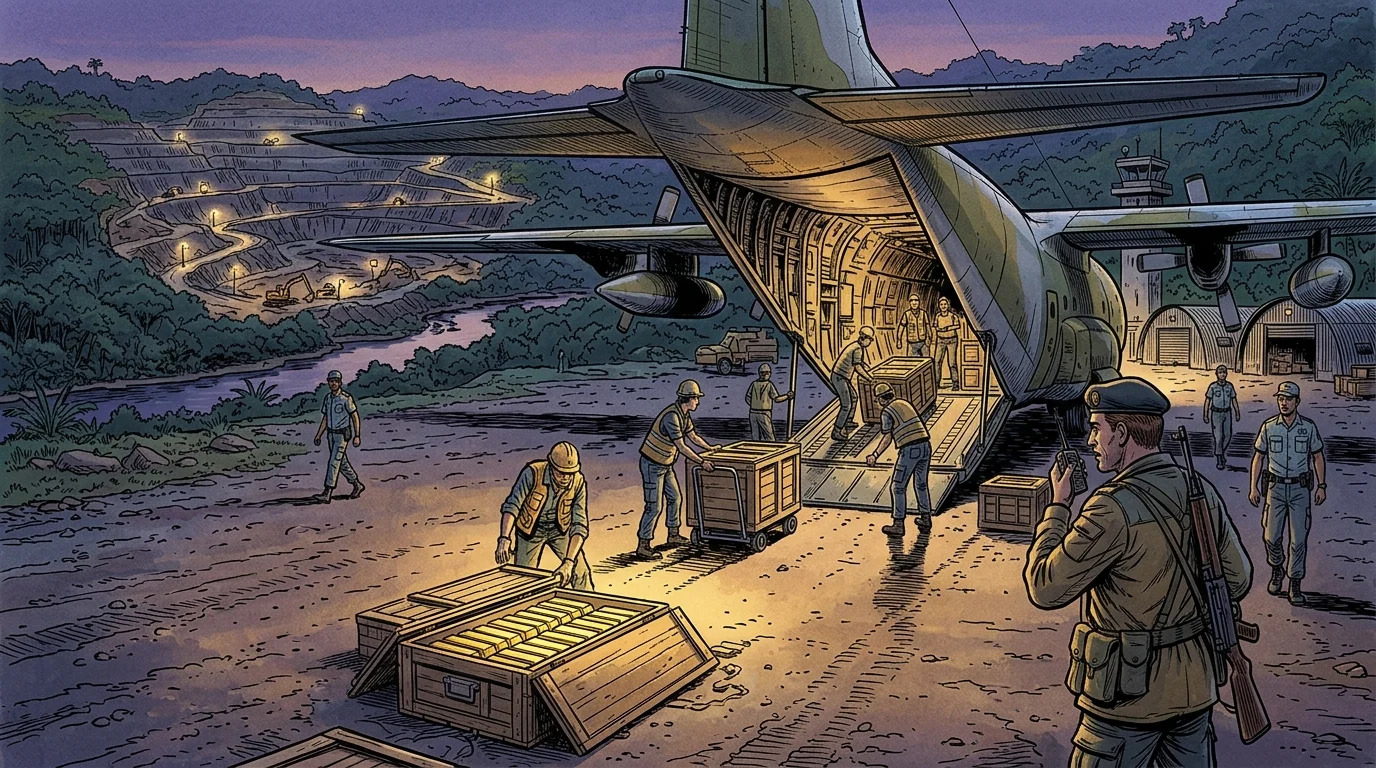
In practice, as formal industrial mining partners retreated amid US Treasury sanctions (which blacklisted Minerven in March 2019), extraction across the Orinoco Mining Arc devolved into a violent, mercury-polluted shadow economy. Armed criminal syndicates (sindicatos) and Colombian guerrilla factions—most notably the National Liberation Army (ELN) and FARC dissidents—operated open-pit mines in concert with local military garrisons, splitting gold production shares that were smelted at Minerven facilities and flown north to the Central Bank of Venezuela (BCV) vaults in Caracas.
From the 2011 Gold Repatriation to the Bank of England Freeze
The turn toward illicitly mined Orinoco gold was driven by the rapid exhaustion of the Central Bank of Venezuela’s historic monetary gold hoard. In August 2011, fearing that Western sanctions—similar to those just imposed on Muammar Gaddafi’s Libya—could freeze Venezuelan assets overseas, Hugo Chávez ordered the immediate repatriation of 160 metric tons of Venezuelan monetary gold (worth roughly $11 billion at the time) held in custodian vaults in London, Paris, and Zurich. Between November 2011 and early 2012, armed convoys escorted the airlifted gold bars through downtown Caracas into the BCV vaults, bringing Venezuela’s total monetary gold reserves to approximately 365 metric tons—then the fifteenth-largest official gold stock in the world.
By bringing the bullion home, Chávez inadvertently made it vastly easier for his successor to liquidate the reserves without international regulatory scrutiny. Beginning in 2015, as oil revenues collapsed, the BCV executed a series of costly gold swaps with international commercial banks—most prominently pledging 20 tons of gold with Deutsche Bank in a $1.7 billion swap arrangement—to raise emergency dollar liquidity for debt payments. When the swaps lapsed or defaulted in 2017–2018, Venezuela forfeited the pledged bullion. Simultaneously, between 2018 and 2020, the Maduro government used commercial charter flights to airlift dozens of metric tons of central bank and Orinoco gold directly to buyers and refineries in the United Arab Emirates, Türkiye, and Uganda in exchange for hard currency cash and food imports, draining BCV gold holdings from 365 tons in 2012 to under 70 metric tons by 2022.
Only one major overseas tranche escaped liquidation: roughly 31 metric tons of Venezuelan gold bars (valued between $1.2 billion and $2 billion) that had been left in the vaults of the Bank of England in London after the 2011 repatriation to facilitate international swap transactions. When Maduro sought to repatriate or liquidate those 31 tons in late 2018 and early 2019, the Bank of England refused to release the bullion after the British government recognized National Assembly Speaker Juan Guaidó as Venezuela’s interim president in January 2019. In a landmark series of lawsuits—‘Maduro Board’ of the Central Bank of Venezuela v. ‘Guaidó Board’ of the Central Bank of Venezuela—the UK Supreme Court (December 2021) and the Commercial Court in London (July 2022) upheld the freeze under the constitutional ‘one voice’ doctrine, leaving the last overseas remnant of Venezuela’s sovereign gold reserves locked beneath Threadneedle Street.
Theoretical & Balance-Sheet Transmission Mechanism
In the Kindleberger–Minsky taxonomy of financial instability (Kindleberger, 1978; Minsky, 1986) and Irving Fisher’s (1933) debt-deflation framework, speculative asset booms become systemic crises when credit expansion shifts balance sheets from hedge finance (cash flows covering principal and interest) to speculative and Ponzi finance (relying on rising asset prices and short-term margin roll-overs).
Once monetary tightening or an exogenous shock halts price appreciation, forced margin liquidations trigger Fisherian debt-deflation: fire-sale asset discounts erode bank collateral values, contracting credit supply across the real economy.
Sources and Further Reading
- Kofman, Michael, et al., “Russian-Venezuelan Relations: Geopolitical and Military-Technical Cooperation,” Center for Naval Analyses (CNA), 2019-06. Historical & Financial Reference
- Borger, Julian, “Chávez Buys $3bn in Russian Arms,” The Guardian, 2006-07-27. Historical & Financial Reference
- Associated Press, “Venezuela Begins Kalashnikov and Drone Production Under Chávez,” The Guardian, 2012-06-14. Historical & Financial Reference
- Rendon, Moises, and Sandin, Linnea, “Illegal Mining in Venezuela: Death and Devastation in the Amazonas and Orinoco Regions,” Center for Strategic and International Studies (CSIS), 2020-04-16. Historical & Financial Reference
- Diálogo Americas, “The Mining Arc: The Silent Operation that Sustains the Maduro Regime,” U.S. Southern Command / Diálogo, 2021. Historical & Financial Reference
- Al Jazeera, “Venezuela Brings Home Gold Reserves,” Al Jazeera English, 2011-11-26. Historical & Financial Reference
- Bowcott, Owen, “UK High Court Hears Claims BoE Unlawfully Blocks Venezuelan Gold,” The Guardian, 2020-06-25. Historical & Financial Reference
- Irving Fisher — "The Debt-Deflation Theory of Great Depressions," Econometrica 1, no. 4 (FRASER Federal Reserve Archive, 1933): 337–357 Central Bank / Monetary Authority
- Charles P. Kindleberger & Robert Z. Aliber — Manias, Panics, and Crashes: A History of Financial Crises (Palgrave Macmillan) Peer-Reviewed / Academic Research
Cite This Historical Dossier (APA / Chicago)
APA (7th ed.): Ç., S. (Ed.). (2026). Petrodollars for Sukhois, CAMIMPEG, and the Liquidation of Venezuela's Gold Reserves. In Forgotten Fortunes Historical Monograph Series (Forgotten Fortunes Editorial Desk). https://forgottenfortunes.net/venezuela-camimpeg-gold-reserves/
MLA (9th ed.): Ç., Soner, ed. "Petrodollars for Sukhois, CAMIMPEG, and the Liquidation of Venezuela's Gold Reserves." Forgotten Fortunes: Financial & Monetary History Archive, 2026, https://forgottenfortunes.net/venezuela-camimpeg-gold-reserves/.
Chicago (17th ed.): Ç., Soner, ed. "Petrodollars for Sukhois, CAMIMPEG, and the Liquidation of Venezuela's Gold Reserves." Forgotten Fortunes Historical Monograph Series (Forgotten Fortunes Editorial Desk), September 20, 2026. https://forgottenfortunes.net/venezuela-camimpeg-gold-reserves/.
Have an idea for another financial history documentary or article? Request a story →