In This Article
Between the founding of the People’s Republic of China (PRC) in October 1949 and the launch of market reforms in December 1978, military mobilization and the threat of foreign invasion dictated the fiscal architecture and geographic layout of the Chinese economy. Across three distinct Cold War phases, Beijing forged extraordinary financial and planning mechanisms to build a defense-industrial base under conditions of extreme scarcity. In 1950, economic planner Chen Yun broke the back of inherited civil-war hyperinflation while funding the Korean War by issuing commodity-indexed “People’s Victory Parity Bonds” (Renmin Shengli Zheshi Gongzhai) and allocating over 40 percent of central budgets to defense. During the First Five-Year Plan (1953–1957), China constructed its modern metallurgical, machinery, and armaments core around 156 Soviet-assisted turnkey industrial projects. Then, following the Sino-Soviet split and the August 1964 Gulf of Tonkin crisis, Chairman Mao Zedong redirected more than RMB 205 billion—roughly 40 percent of national capital construction across 1964–1980—into the secretive “Third Front” (Sanxian Jianshe) campaign, transplanting over 1,100 factories, steel mills, and railways deep into the mountainous interior of Sichuan, Guizhou, Yunnan, and Shaanxi. [1]
1950: Commodity-Indexed Victory Bonds and Halting Hyperinflation
When the Chinese Communist Party proclaimed the PRC on October 1, 1949, the new government inherited a shattered fiscal apparatus and the final stages of one of history’s worst hyperinflations. With the People’s Liberation Army (PLA) still advancing into southwestern and southern China and the state payroll swollen by millions of military and administrative personnel, roughly two-thirds of the central government’s 1949 budget deficit was financed by printing new renminbi notes through the People’s Bank of China (PBOC). Wholesale prices in Shanghai and Tianjin surged multiple times over between April 1949 and February 1950, as urban merchants hoarded grain, cotton yarn, and coal to hedge against paper currency depreciation. [2]
To finance the 1950 fiscal deficit without relying exclusively on the printing press, the Central Financial and Economic Commission—led by Chen Yun and Finance Minister Bo Yibo—engineered a bond instrument specifically designed for an economy that no longer trusted nominal paper money. On December 2, 1949, the Central People’s Government approved the issuance of the 1950 People’s Victory Parity Bonds (Renmin Shengli Zheshi Gongzhai), launching sales on January 5, 1950. Rather than denominating the bonds in paper renminbi, the state denominated them in physical “parity units” (fen). Each parity unit was legally indexed to the weighted average wholesale price across six major cities—Shanghai, Tianjin, Hankou, Xi’an, Guangzhou, and Chongqing—of a fixed basket of four daily necessities: 6 catties (3 kilograms) of rice (or millet in Tianjin), 1.5 catties (0.75 kilograms) of wheat flour, 4 Chinese feet (1.33 meters) of white fine cotton cloth, and 16 catties (8 kilograms) of coal. [3]
Carrying a 5 percent annual interest rate and redeemable in five annual installments between 1951 and 1956, the bonds guaranteed that both principal and coupon payments would scale automatically with the People’s Bank of China’s published ten-day commodity parity index. Although the government initially planned two tranches totaling 200 million parity units, the first tranche of 100 million units (roughly 140 million actual units subscribed by autumn 1950, equivalent to more than RMB 260 million in post-1955 new currency) proved so effective at draining speculative private liquidity—especially from Shanghai and Tianjin private industrialists and commercial guilds assigned subscription quotas—that the second tranche was canceled. Combined with the March 1950 unification of national tax and treasury receipts and state dumping of grain and cotton reserves onto urban markets, the Victory Bonds brought hyperinflation to an abrupt halt by spring 1950. [4]
Financing the Korean War: Defense Budgets and Arms Donations (1950–1953)
Hardly had domestic prices stabilized when the outbreak of the Korean War in June 1950 and the entry of the Chinese People’s Volunteers into Korea in October 1950 plunged the young republic into a high-intensity industrial conflict against United States-led United Nations forces. Operating under the banner of “Resist America, Aid Korea” (Kangmei Yuanchao), Beijing shifted its fiscal priorities from civilian reconstruction to wartime mobilization. Between 1950 and 1952, direct military expenditures consumed more than 40 percent of the central government budget—reaching roughly 41.1 percent in 1950 and peaking near 48 percent in 1951—before averaging roughly a third of central outlays across the entire conflict. [5]
To sustain millions of troops at the front without reigniting the inflationary spiral of 1949, the state combined strict central treasury rationing with extraordinary domestic extraction campaigns and Soviet military credits. Moscow supplied weapons, artillery, vehicles, and MiG-15 jet fighters on credit—accumulating roughly $1.35 billion to $2 billion in war and military debt that China meticulously repaid with shipments of tungsten, tin, antimony, pork, soybeans, and grain by 1965. Domestically, besides tightening agricultural grain levies and urban commercial taxes through the intense “Three-Anti” and “Five-Anti” campaigns against private capital, the Chinese People’s Committee to Resist America and Aid Korea launched a nationwide Patriotic Arms-Donation Campaign in June 1951. Over the next twelve months, work units, rural cooperatives, and private merchants contributed 5.565 trillion old renminbi (equivalent to RMB 556.5 million after the 1955 10,000-to-1 currency redenomination)—a sum sufficient to fund the equivalent of 3,710 fighter aircraft for the fledgling PLA Air Force. [6]
The First Five-Year Plan and the 156 Soviet Industrial Projects (1953–1957)
The Korean War exposed the perilous backwardness of China’s domestic defense manufacturing: Chinese forces had fought with a logistical nightmare of captured Japanese, American, and Nationalist rifles alongside purchased Soviet arms. Determined to build an autonomous heavy-industrial and military-industrial complex, Beijing launched its First Five-Year Plan (1953–1957) anchored by the historic 156 Major Industrial Projects (156 xiang zhongdian gongcheng)—a comprehensive package of turnkey factories, engineering blueprints, machinery, and technical training negotiated with Joseph Stalin and Nikita Khrushchev between 1950 and 1954. [7]
Of the 156 designated projects (150 of which were formally constructed), 44 were direct military-ordnance, aviation, electronics, tank, and shipbuilding plants, while the remaining projects built the foundational energy and metallurgical inputs required for modern warfare: integrated iron and steel complexes at Anshan, Wuhan, and Baotou; the First Automobile Works in Changchun; heavy machine-tool, boiler, and turbine works in Harbin and Shenyang; and major coal shafts and thermal power stations. Absorbing nearly half of China’s industrial capital investment during the First Five-Year Plan and supported by more than 10,000 Soviet engineers and specialists, the 156 projects transformed China’s industrial structure. Because these plants relied on Soviet rail links or existing prewar industrial infrastructure, however, over half of the projects were concentrated in Northeast China (Manchuria) and northern industrial cities, leaving over 70 percent of China’s industrial output clustered along the eastern coast and northern borderlands. [8]
1964–1978: Mao’s “Third Front” (Sanxian Jianshe) and Panzhihua Steel
By 1964, the geopolitical premise behind the First Five-Year Plan’s geography had collapsed. The bitter Sino-Soviet split turned China’s long northern border from a secure socialist rear into a potential invasion corridor for Soviet mechanized divisions, while the August 1964 Gulf of Tonkin Incident and rapid escalation of American bombing in Vietnam convinced Mao Zedong that the United States might strike China’s vulnerable coastal cities from the sea and air. Rejecting initial drafts of the Third Five-Year Plan that prioritized consumer goods and coastal efficiency (“eating, wearing, and using”), Mao warned Party leaders in May–August 1964 that China could not sleep soundly with its steel mills, arsenals, and railways concentrated in exposed coastal and Manchurian centers.
Mao divided China into three strategic geo-military zones: the First Front (coastal and border provinces exposed to immediate attack), the Second Front (an intermediate buffer belt running from Anhui and Henan to Guangxi), and the Third Front (Sanxian)—a vast, rugged, mountainous interior sanctuary encompassing 13 provinces and autonomous regions centered on Sichuan, Guizhou, Yunnan, Shaanxi, Gansu, Ningxia, and Qinghai, plus the mountainous western hinterlands of Henan, Hubei, and Hunan. Under the slogan “Prepare for war, prepare for famine, for the sake of the people,” Beijing launched a top-secret mobilization that lasted from 1964 to 1980.
The financial scale of the Third Front was staggering. During the Third Five-Year Plan (1966–1970), the Third Front absorbed 52.7 percent of all national capital construction investment, followed by 41.1 percent during the Fourth Five-Year Plan (1971–1975). Across the entire 1964–1980 campaign, the Chinese state poured more than RMB 205 billion—roughly 40 percent of total national capital construction outlays—into the interior, mobilizing over 4 million workers, engineers, and PLA railway engineering troops. More than 1,100 large and medium-sized coastal factories, military arsenals, nuclear facilities, and research institutes were dismantled or split in two and relocated into mountain valleys, karst caves, and isolated gorges under the doctrine of “dispersed, close to the mountains, and hidden (in caves)” (fensan, kaoshan, yinbi).
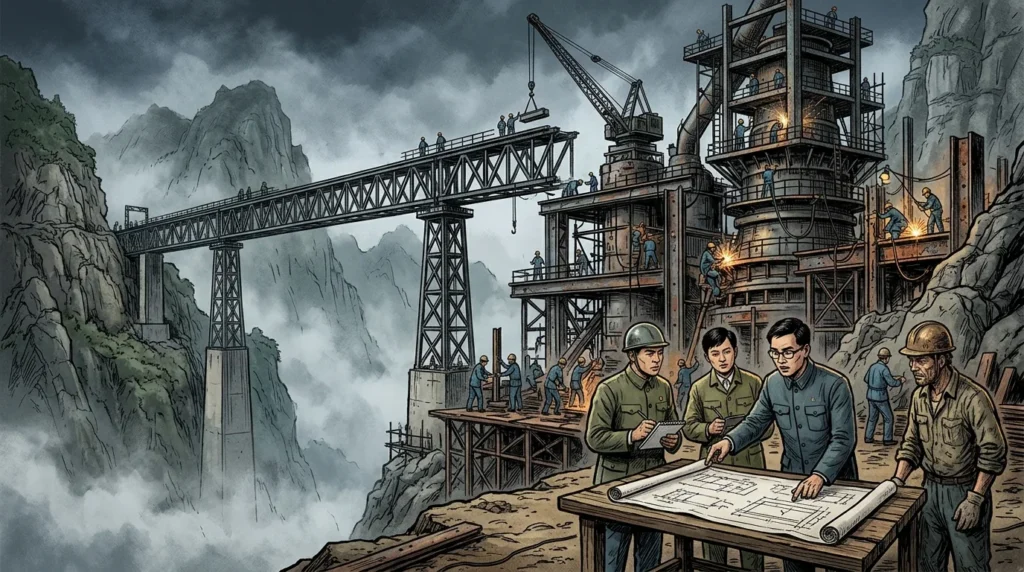
The crowning monument of the Third Front was the creation from scratch of the Panzhihua Iron and Steel Company (Pangang) in a desolate, precipitous gorge along the Jinsha River on the Sichuan–Yunnan border. Rich in vanadium-titanium magnetite ore but completely lacking roads or flat land, Panzhihua saw tens of thousands of workers blast terraces out of sheer cliffs to erect blast furnaces that poured their first molten iron on July 1, 1970. To link Panzhihua and the interior industrial bases to the national grid, approximately 300,000 railway troops and laborers constructed the 1,091-kilometer Chengdu–Kunming Railway (Chengkun Railway, completed in July 1970), boring 427 tunnels and spanning 991 bridges across some of the most seismically unstable terrain on earth. Although economists such as Barry Naughton later demonstrated that the isolated locations and duplicated supply chains of Third Front plants depressed China’s aggregate capital productivity by an estimated 10 to 15 percent by the late 1970s, the campaign permanently integrated China’s southwestern and northwestern interior into the national rail, energy, aerospace, and industrial network.
Theoretical & Balance-Sheet Transmission Mechanism
In the Kindleberger–Minsky taxonomy of financial instability (Kindleberger, 1978; Minsky, 1986) and Irving Fisher’s (1933) debt-deflation framework, speculative asset booms become systemic crises when credit expansion shifts balance sheets from hedge finance (cash flows covering principal and interest) to speculative and Ponzi finance (relying on rising asset prices and short-term margin roll-overs).
Once monetary tightening or an exogenous shock halts price appreciation, forced margin liquidations trigger Fisherian debt-deflation: fire-sale asset discounts erode bank collateral values, contracting credit supply across the real economy.
Sources and Further Reading
- Bank of China, “ Financial Prices Stabilized for Recovery of the National Economy (1949 – 1950),” Bank of China History, 2008-09-26. Historical & Financial Reference
- Ulrich Theobald, “ PR China – Money and Finance 1950-1951,” ChinaKnowledge.de Encyclopaedia on Chinese History, 2016. Historical & Financial Reference
- Common Program Historical Archive, “ Article 39: Currency, Banking, and the 1950 People’s Victory Parity Bonds,” The Common Program of the People’s Republic of China 1949–1954, 2020. Historical & Financial Reference
- Office of the Historian, “ The Chinese Revolution of 1949,” U.S. Department of State, 2016. Official / State Archive
- Zhangfeng Jin, “ The Legacies of the Soviet Influence in the 1950s: China’s 156 Major Industrial Projects,” Global Labor Organization (GLO) Discussion Paper No. 932, EconStor, 2021. Historical & Financial Reference
- The China Quarterly, “ The ‘Third Front’ after Sixty Years,” Cambridge University Press, 2024. Peer-Reviewed / Academic Research
- Irving Fisher — "The Debt-Deflation Theory of Great Depressions," Econometrica 1, no. 4 (FRASER Federal Reserve Archive, 1933): 337–357 Central Bank / Monetary Authority
- Charles P. Kindleberger & Robert Z. Aliber — Manias, Panics, and Crashes: A History of Financial Crises (Palgrave Macmillan) Peer-Reviewed / Academic Research
Cite This Historical Dossier (APA / Chicago)
APA (7th ed.): Ç., S. (Ed.). (2026). How Maoist China Financed Industrialization and War. In Forgotten Fortunes Historical Monograph Series (Forgotten Fortunes Editorial Desk). https://forgottenfortunes.net/maoist-china-victory-bonds-third-front/
MLA (9th ed.): Ç., Soner, ed. "How Maoist China Financed Industrialization and War." Forgotten Fortunes: Financial & Monetary History Archive, 2026, https://forgottenfortunes.net/maoist-china-victory-bonds-third-front/.
Chicago (17th ed.): Ç., Soner, ed. "How Maoist China Financed Industrialization and War." Forgotten Fortunes Historical Monograph Series (Forgotten Fortunes Editorial Desk), September 18, 2026. https://forgottenfortunes.net/maoist-china-victory-bonds-third-front/.
Have an idea for another financial history documentary or article? Request a story →