
In This Article
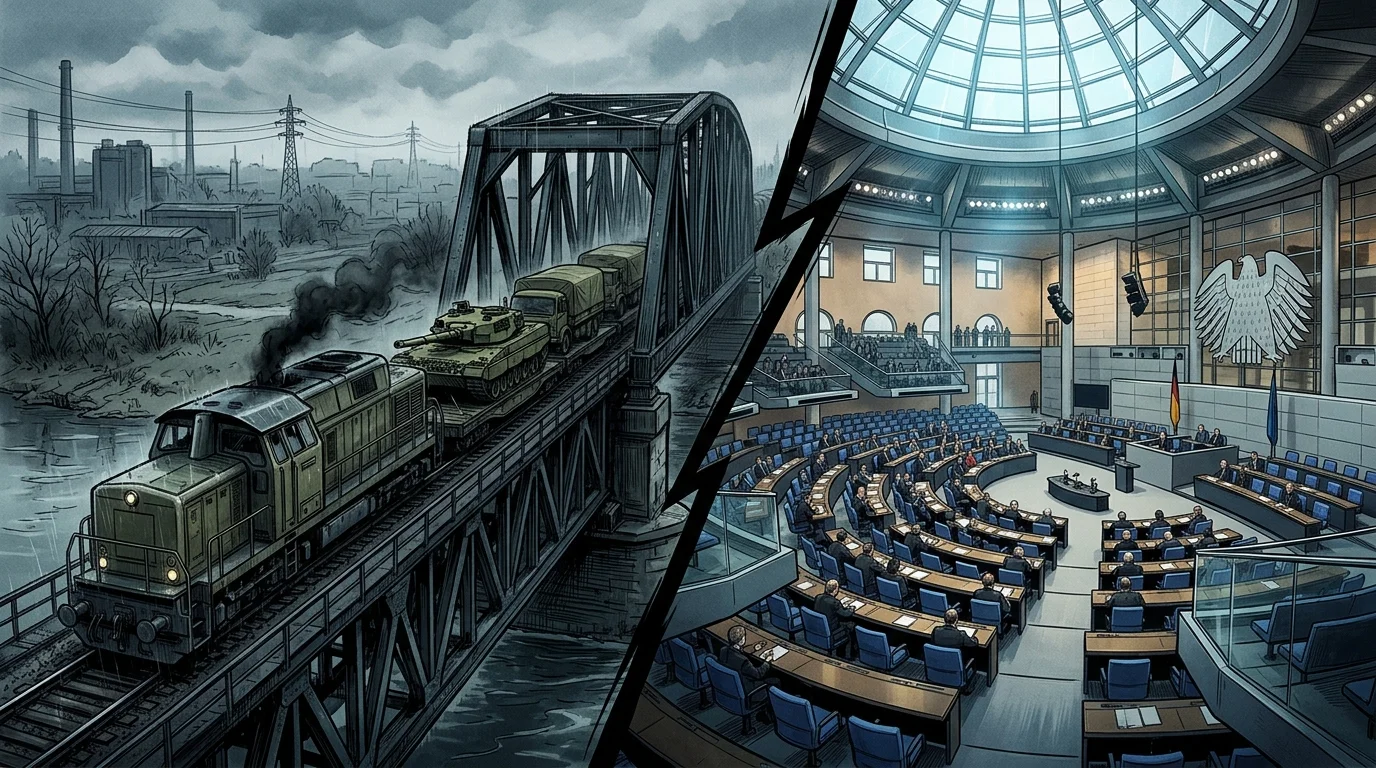
Across the three decades following the fall of the Berlin Wall, the fiscal architecture of unified Germany’s security policy was bookended by two extraordinary sovereign financial commitments triggered by Moscow. In the autumn of 1990, as the price of securing Soviet consent to German reunification and NATO membership under the Two-Plus-Four Treaty, Chancellor Helmut Kohl’s government signed the German-Soviet Financial Transitional Agreement (Überleitungsabkommen) of October 9, 1990. Under that bilateral pact and subsequent supplementary pledges, Bonn committed between DM 12 billion and DM 15 billion—including a DM 7.8 billion turnkey housing construction program in the Soviet successor states—to fund the upkeep, retraining, and orderly withdrawal of roughly 380,000 Soviet soldiers of the Western Group of Forces (Westgruppe der Truppen, or WGT) and 120,000 family members and civilian dependents from eastern Germany by August 31, 1994. [1]

Once the last Russian regiments departed Berlin in 1994, Germany cashed in a three-decade post-Cold War “peace dividend,” shrinking the Bundeswehr and allowing defense outlays to fall from roughly 2.5 percent of gross domestic product (GDP) in 1990 to around 1.1 to 1.2 percent in the decade following the 2009 constitutional debt brake (Schuldenbremse). That fiscal paradigm ended abruptly on February 27, 2022—three days after Russia’s full-scale invasion of Ukraine—when Chancellor Olaf Scholz proclaimed a historic Zeitenwende (“turning point”) before an emergency Sunday session of the Bundestag. On June 3, 2022, the Bundestag amended Article 87a of the Basic Law (Grundgesetz) by a two-thirds supermajority to establish the Sondervermögen Bundeswehr: a €100 billion off-budget special fund with its own debt-issuance authorization exempted from the constitutional debt brake. [2]
The 1990 Two-Plus-Four Bargain and the Überleitungsabkommen
When negotiations over German unity accelerated in the spring and summer of 1990, the largest military obstacle on the ground was the Soviet Western Group of Forces stationed across the German Democratic Republic (GDR). Comprising roughly 380,000 troops, accompanied by approximately 120,000 family members and civilian employees and equipped with thousands of main battle tanks, artillery pieces, and hundreds of thousands of tons of ammunition, the WGT was the formidable forward spearhead of the Warsaw Pact. For Soviet President Mikhail Gorbachev, withdrawing half a million military personnel and dependents into a collapsing Soviet economy suffering from acute housing shortages and hard-currency insolvency posed an explosive domestic political risk. [3]
During the July 1990 Caucasus summit in Arkhyz and Zheleznovodsk, Chancellor Helmut Kohl and Finance Minister Theo Waigel unlocked Gorbachev’s agreement to full German sovereignty within NATO by offering a comprehensive bilateral financial package tied to a binding four-year withdrawal timetable. Embedded alongside Article 4 of the multilateral Two-Plus-Four Treaty of September 12, 1990, two bilateral treaties codified the operation: the German-Soviet Agreement on Some Transitional Measures (Überleitungsabkommen), signed in Bonn on October 9, 1990, and the Treaty on the Conditions of the Temporary Stay and the Modalities of the Planned Withdrawal of Soviet Troops (Aufenthalts- und Abzugsvertrag), signed on October 12, 1990. [4]
The October 9, 1990 Überleitungsabkommen structured a core DM 12 billion West German federal budget commitment—complemented by a DM 3 billion interest-free credit guarantee, bringing the initial package to DM 15 billion—divided into four principal fiscal pillars: [5]
- The DM 7.8 Billion Special Housing Program: To prevent returning Soviet officers and non-commissioned officers from being quartered in tents or barracks, Germany allocated DM 7.8 billion (later augmented during the 1992 Kohl-Yeltsin negotiations) to finance the construction of at least 36,000 (ultimately over 45,000) turnkey apartments across dozens of garrison towns in Russia, Ukraine, and Belarus, administered through the Kreditanstalt für Wiederaufbau (KfW) and built by international general contractors.
- Stationing and Maintenance Grants (DM 3 Billion): A transitional fund covered the hard-currency living expenses, utilities, and logistical maintenance of the WGT troops remaining on eastern German soil between the introduction of the Deutsche Mark in July 1990 and their final departure in 1994.
- Transport Costs (DM 1 Billion): Direct financing paid for rail, sea, and road freight moving troops, heavy armor, and military stores eastward across Poland and the Baltic Sea.
- Vocational Retraining (DM 200 Million): As detailed in Bundestag Drucksache 12/1607 in November 1991, the federal government provided DM 200 million under Article 5 of the Überleitungsabkommen to train demobilized Soviet officers and soldiers in civilian business management, construction trades, electronics, and agriculture for reintegration into the post-Soviet labor market.
| Documented Figure / Metric | Historical Significance & Archival Context |
|---|---|
| DM 1.5 trillion | With the Soviet threat gone and the federal budget strained by over DM 1.5 trillion in fiscal transfers to reconstruct the former East Germany, successive German governments systematically downsized the Bundeswehr. |
| 2.5 percent | Measured as a share of economic output, German military spending fell from roughly 2.5 percent of GDP in 1990 to 1.4 percent by 2000 and bottomed out near 1.15 percent of GDP between 2014 and 2017—well below the 2 percent GDP benchmark agreed at the 2014 NATO Wales Summit. |
Executing the 1991–1994 Withdrawal and Settling Property Claims
Following the dissolution of the Soviet Union in December 1991, the Russian Federation under President Boris Yeltsin assumed control of the WGT and renegotiated the withdrawal schedule with Chancellor Kohl in December 1992. In exchange for an additional DM 550 million toward the housing program (raising total non-repayable German outlays to roughly DM 12.55 billion to DM 13.5 billion) and a mutual zero-sum waiver (Null-Lösung) writing off Soviet compensation claims for military barracks built in the GDR against German claims for severe environmental contamination on over 1,000 WGT bases, Yeltsin agreed to advance the final withdrawal deadline by four months from December 31, 1994 to August 31, 1994. [6]
Conducted peacefully over four years, the relocation of roughly 540,000 military and civilian personnel, 120,000 pieces of heavy military equipment, and 2.6 million tons of matériel—including 677,000 tons of ammunition—represented the largest peacetime military transfer in history. On August 31, 1994, President Yeltsin and Chancellor Kohl attended the official farewell ceremony at Berlin’s Treptow Memorial and the Lustgarten, marking the end of nearly half a century of Soviet military presence on German territory. [7]
Three Decades of the Post-Cold War Peace Dividend
With the Soviet threat gone and the federal budget strained by over DM 1.5 trillion in fiscal transfers to reconstruct the former East Germany, successive German governments systematically downsized the Bundeswehr. Under the Two-Plus-Four Treaty cap, the combined West and East German armed forces were reduced from over 500,000 troops in 1990 to fewer than 370,000 by 1994, and subsequent defense reforms shrank active troop strength to roughly 183,000 by the early 2020s while suspending compulsory military conscription in 2011. [8]
Measured as a share of economic output, German military spending fell from roughly 2.5 percent of GDP in 1990 to 1.4 percent by 2000 and bottomed out near 1.15 percent of GDP between 2014 and 2017—well below the 2 percent GDP benchmark agreed at the 2014 NATO Wales Summit. At the same time, Germany’s 2009 constitutional debt brake (Schuldenbremse), enshrined in Articles 109(3) and 115(2) of the Basic Law, capped federal structural net borrowing at 0.35 percent of GDP. Within constrained annual budgets (Individual Plan 14), personnel and operating costs crowded out capital procurement, leaving the Bundeswehr with acute shortages of ammunition, spare parts, operational helicopters, and secure digital radios. [9]
The 2022 Zeitenwende and the €100 Billion Sondervermögen Bundeswehr
Russia’s full-scale invasion of Ukraine on February 24, 2022 shattered the post-1990 assumption that economic interdependence and energy trade with Moscow guaranteed European security. Convening the Bundestag for an extraordinary session on Sunday, February 27, 2022, Chancellor Olaf Scholz declared a Zeitenwende in German foreign and security policy, announcing that Germany would immediately establish a €100 billion special fund (Sondervermögen Bundeswehr) to modernize the armed forces and permanently invest more than 2 percent of GDP in defense year after year.
Because borrowing €100 billion within the regular federal budget would have violated the restored constitutional debt brake once pandemic emergency exemptions expired in 2023, Finance Minister Christian Lindner and the ruling “traffic-light” coalition (SPD, Greens, and FDP) negotiated a constitutional amendment with the opposition Christian Democratic Union and Christian Social Union (CDU/CSU). On June 3, 2022, the Bundestag voted by 567 to 96 (with 20 abstentions)—exceeding the required two-thirds constitutional majority—to insert a new paragraph, Article 87a(1a), into the Basic Law alongside the companion Bundeswehrfinanzierungs- und sondervermögensgesetz (BwFinSVermG):
- Constitutional Exemption from the Debt Brake: Article 87a(1a) authorized the federal government to establish an off-budget special fund for the Bundeswehr endowed with its own one-time credit authorization of up to €100 billion, explicitly stipulating that the debt brake rules of Article 109(3) and Article 115(2) of the Basic Law do not apply to this credit authorization.
- Strict Earmarking for Alliance and Defense Capabilities: At the insistence of the CDU/CSU opposition, the constitutional text and implementing statute restricted the €100 billion exclusively to multi-year major equipment procurement, research, and capability development for the Bundeswehr—such as F-35A stealth fighter jets for nuclear sharing, heavy transport helicopters, air-defense systems, combat vehicles, naval corvettes and frigates, digital command systems, and ammunition replenishment—rather than routine administrative overhead.
- Bridging to the 2 Percent NATO Target: Designed to be disbursed over roughly five years (2022–2027), the €100 billion debt-financed fund lifted Germany’s combined defense expenditure to the 2 percent NATO threshold on a multi-year average while the regular defense budget was slated for structural expansion once the special fund was exhausted.
From the DM 12–15 billion checkbook diplomacy of the 1990 Überleitungsabkommen that paid the Red Army to go home to the €100 billion constitutional debt authorization of 2022 designed to deter Russian aggression, Germany’s post-Cold War fiscal trajectory came full circle.
Theoretical & Balance-Sheet Transmission Mechanism
In the Kindleberger–Minsky taxonomy of financial instability (Kindleberger, 1978; Minsky, 1986) and Irving Fisher’s (1933) debt-deflation framework, speculative asset booms become systemic crises when credit expansion shifts balance sheets from hedge finance (cash flows covering principal and interest) to speculative and Ponzi finance (relying on rising asset prices and short-term margin roll-overs).
Once monetary tightening or an exogenous shock halts price appreciation, forced margin liquidations trigger Fisherian debt-deflation: fire-sale asset discounts erode bank collateral values, contracting credit supply across the real economy.
Sources and Further Reading
- Deutscher Bundestag, “ Schriftliche Fragen mit den in der Woche vom 11. November 1991 eingegangenen Antworten der Bundesregierung (Drucksache 12/1607),” Deutscher Bundestag, 1991-11-15. Historical & Financial Reference
- Susann Heinecke, “ Die deutsche Russlandpolitik 1991–2005: Entwicklungen und gesellschaftliche Einflüsse in außenpolitischen Entscheidungsprozessen,” Universität zu Köln, 2011. Historical & Financial Reference
- Christoph Meißner, “ Der Truppenabzug aus Ostdeutschland: Truppenabzug 1991–1994,” dekoder / Deutsch-Russisches Museum Berlin-Karlshorst, 2019-08-08. Historical & Financial Reference
- Deutscher Bundestag, “ Bundestag beschließt das Sondervermögen für die Bundeswehr,” Deutscher Bundestag, 2022-06-03. Historical & Financial Reference
- Bundeszentrale für politische Bildung (bpb), “ Sondervermögen Bundeswehr,” Bundeszentrale für politische Bildung, 2022-03-07. Historical & Financial Reference
- Federal Ministry of Defence (BMVg), “ Over EUR 100 billion for the Bundeswehr – and for our security,” Federal Ministry of Defence (BMVg), 2022-02-27. Historical & Financial Reference
- Xiao Liang and Nan Tian, “ Explainer: The proposed hike in German military spending,” Stockholm International Peace Research Institute (SIPRI), 2022-03-29. Historical & Financial Reference
- Irving Fisher — "The Debt-Deflation Theory of Great Depressions," Econometrica 1, no. 4 (FRASER Federal Reserve Archive, 1933): 337–357 Central Bank / Monetary Authority
- Charles P. Kindleberger & Robert Z. Aliber — Manias, Panics, and Crashes: A History of Financial Crises (Palgrave Macmillan) Peer-Reviewed / Academic Research
Cite This Historical Dossier (APA / Chicago)
APA (7th ed.): Ç., S. (Ed.). (2026). From Checkbook Reunification to Zeitenwende: Germany's 1990 and 2022 Defense Finance Shifts. In Forgotten Fortunes Historical Monograph Series (Forgotten Fortunes Editorial Desk). https://forgottenfortunes.net/germany-bundeswehr-special-fund/
MLA (9th ed.): Ç., Soner, ed. "From Checkbook Reunification to Zeitenwende: Germany's 1990 and 2022 Defense Finance Shifts." Forgotten Fortunes: Financial & Monetary History Archive, 2026, https://forgottenfortunes.net/germany-bundeswehr-special-fund/.
Chicago (17th ed.): Ç., Soner, ed. "From Checkbook Reunification to Zeitenwende: Germany's 1990 and 2022 Defense Finance Shifts." Forgotten Fortunes Historical Monograph Series (Forgotten Fortunes Editorial Desk), September 9, 2026. https://forgottenfortunes.net/germany-bundeswehr-special-fund/.
Have an idea for another financial history documentary or article? Request a story →


