In This Article
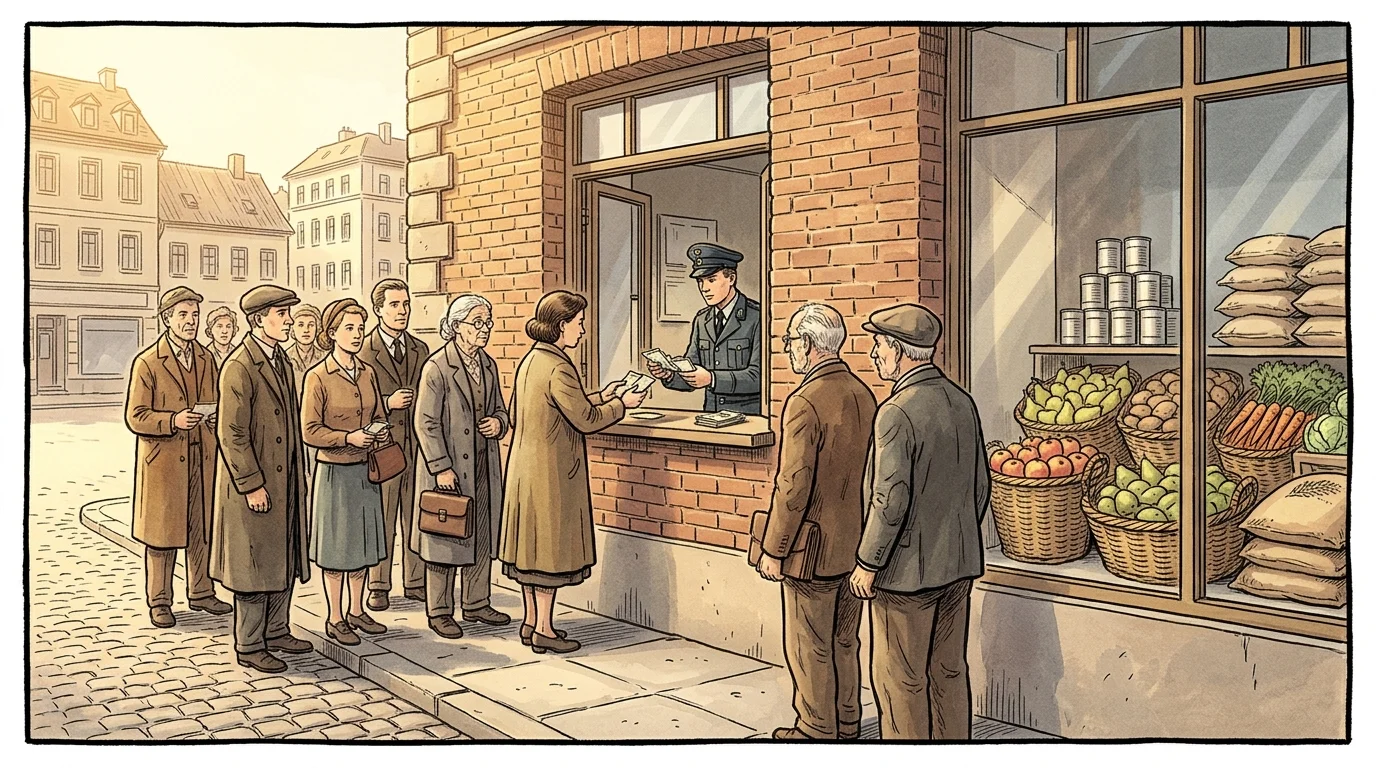
On Sunday, June 20, 1948, millions of residents across the American, British, and French occupation zones of western Germany lined up at food ration offices to surrender 40 Reichsmarks of wartime paper currency in exchange for 40 crisp banknotes of an entirely new currency: the Deutsche Mark. Executed under the Allied military codename Operation Birddog and paired with Ludwig Erhard’s audacious dismantling of Nazi-era price controls, the West German currency reform (Währungsreform) eradicated a massive inflationary overhang that had paralyzed European recovery since 1945. By slashing private Reichsmark bank deposits at an effective conversion ratio of 100 to 6.5 while converting ongoing wages, rents, and pensions at 1 to 1, the June 1948 monetary reset ended the cigarette barter economy overnight, anchored the central-banking authority of the newly created Bank deutscher Länder, and laid the monetary foundation for the West German economic miracle (Wirtschaftswunder). [1]

Suppressed Inflation, the Reichsmark Overhang, and the Cigarette Economy
Unlike the Weimar hyperinflation of 1922–1923, when prices doubled every few days in open markets, the monetary destruction inherited by defeated Germany in May 1945 took the form of “suppressed” or “repressed” inflation. Beginning in 1936, the National Socialist regime had imposed a comprehensive price and wage freeze (Preisstopp) while silently financing rearmament and World War II by forcing German commercial banks, savings institutions, and insurers to absorb hundreds of billions of Reichsmarks in Reich treasury bills and government bonds, alongside reckless central-bank money printing by the Reichsbank. [2]
By the end of the war in 1945, currency in circulation had ballooned from roughly RM 6 billion in 1936 to more than RM 70 billion, while bank deposits and Reich debt claims exceeded RM 300 billion. At the same time, Allied strategic bombing, territorial partition, coal shortages, and war damage had reduced German industrial production to roughly one-third of its 1936 level. Because the Allied Control Council initially maintained the 1936 price and wage freeze to prevent open hyperinflation, the volume of worthless Reichsmarks in circulation vastly exceeded the supply of goods available at official prices. [3]
Under these conditions, the Reichsmark ceased to function as a store of value or medium of exchange. Farmers refused to deliver grain, livestock, or potatoes for paper marks; manufacturers hoarded raw materials and semi-finished inventory rather than sell at official ceiling prices; and workers skipped factory shifts on “hamstering” expeditions into the countryside to trade family heirlooms for food. Across bombed-out German cities, American cigarettes emerged as the de facto reserve currency—trading at 5 to 7 Reichsmarks per single cigarette—while inter-firm commerce devolved into clumsy bilateral barter arrangements known as compensation trades. [4]
The Colm-Dodge-Goldsmith Plan, Operation Birddog, and the Rothwesten Conclave
As early as May 1946, a team of American economists led by Gerhard Colm, Joseph M. Dodge, and Raymond W. Goldsmith submitted a blueprint to General Lucius D. Clay, the U.S. Military Governor in Germany, recommending a radical 10-to-1 currency cut combined with a capital levy on real property to equalize war losses between money savers and owners of real estate or factories. For nearly two years, however, four-power negotiations within the Allied Control Council stalled over Soviet insistence on printing new banknotes in Leipzig without Western inspection. After the Soviet delegation walked out of the Allied Control Council on March 20, 1948, the three Western powers proceeded unilaterally. [5]
Months earlier, in the autumn of 1947, the U.S. Department of the Army had launched a top-secret logistical operation codenamed Operation Birddog. Working under strict security in the United States, the American Bank Note Company and the Bureau of Engraving and Printing printed roughly 10.7 billion Deutsche Marks of new banknotes—whose name had been proposed by 26-year-old U.S. Military Government economist Edward A. Tenenbaum. Packed into 23,000 wooden crates weighing approximately 500 tons, the notes were shipped secretly from New York and Philadelphia to Bremerhaven between November 1947 and April 1948 and stored in the subterranean vaults of the former Reichsbank building in Frankfurt am Main. [6]
To draft the implementing legislation and adapt the Allied currency laws to German banking practice, Western occupation authorities convened a secret conclave of eleven German monetary experts—including Karl Bernard, Wilhelm Vocke, Victor Wrede, Otto Pfleiderer, and Erwin Hielscher—on April 21, 1948. Transported in blacked-out buses with unknown destination to the barbed-wire-enclosed Fritz-Erler-Kaserne military base at Rothwesten near Kassel, the German specialists worked for forty-nine days until June 8, 1948, alongside Tenenbaum as Allied liaison officer. Meanwhile, on March 1, 1948, the Western Allies established the Bank deutscher Länder in Frankfurt as a federalized two-tier central bank owned by the state central banks (Landeszentralbanken), creating the institutional issuer for the new currency and the direct predecessor of the Deutsche Bundesbank. [7]
The Four Currency Laws and the 100:6.5 Conversion Cut
Implemented through four Allied military laws between June 18 and October 1, 1948, the currency reform executed a drastic surgical contraction of the West German money supply: [8]
- The Currency Law (First Law, effective June 20, 1948): Abolished the Reichsmark, Rentenmark, and Allied Military Mark and declared the Deutsche Mark sole legal tender from June 21. On Sunday, June 20, every resident of the three Western zones received an immediate per-capita cash payout (Kopfgeld) of 40 DM in exchange for 40 RM, followed by a second installment of 20 DM in August–September 1948. Businesses received an emergency liquidity advance of 60 DM per employee to meet immediate payrolls, while federal, state, and municipal authorities received an initial endowment equal to one-sixth of their six-month revenue stream.
- The Issue Law (Second Law, June 20, 1948): Granted the Bank deutscher Länder the exclusive monopoly on issuing banknotes up to an initial statutory ceiling of DM 10 billion and authorized it to set minimum reserve requirements and discount rates independently of German political ministries.
- The Conversion Law (Third Law, June 27, 1948): Established the differential treatment of ongoing flows versus accumulated monetary stocks. Recurring obligations—including wages, salaries, rents, leases, and social-security pensions—were converted at a ratio of 1 RM to 1 DM, preserving workers’ real purchasing power. All Reich government bonds and Nazi wartime liabilities totaling roughly RM 400 billion were completely annulled, though banks and insurers whose assets had consisted of worthless Reich debt received interest-bearing state “equalization claims” (Ausgleichsforderungen) so their balance sheets remained solvent. Private Reichsmark cash and bank deposits were initially slated for a 10:1 conversion, with half (5 DM per 100 RM) released into a free account (Freikonto) and the other half locked in a blocked account (Festkonto).
- The Blocked Accounts Law (Fourth Law, October 1, 1948): Fearing that releasing the blocked balances would reignite inflation as velocity accelerated in the summer of 1948, Allied authorities cancelled 70 percent of the blocked 5 DM portion, released 20 percent (1 DM), and held 10 percent (0.50 DM) for medium-term investment accounts. Consequently, the final effective conversion rate for private Reichsmark bank balances above the per-capita allowance stood at exactly 100 Reichsmarks to 6.50 Deutsche Marks—wiping out 93.5 percent of nominal money holdings.
Ludwig Erhard’s Price Decontrol Coup and the Overnight Return of Goods
While Tenenbaum and the Allied military governors engineered the monetary contraction, Ludwig Erhard, elected Director of the Economic Administration of the Anglo-American Bizone in March 1948, recognized that a new currency would quickly fail if trapped inside the Nazi apparatus of rationing and fixed prices. On June 18, 1948, the Frankfurt Economic Council passed the “Guiding Principles Law” (Leitsätzegesetz), which authorized Erhard to abolish price controls and resource allocation rules on manufactured and consumer goods while retaining temporary ceilings only on basic foodstuffs, coal, iron, steel, utilities, and housing rents.
On the afternoon of Sunday, June 20, 1948—deliberately choosing a Sunday when Allied military offices were closed and could not easily veto his announcement—Erhard went on German radio to proclaim the immediate lifting of price controls and rationing across hundreds of categories of consumer and industrial goods. When summoned by General Clay to explain why he had altered Allied price regulations without prior clearance, Erhard famously replied that he had not altered them; he had abolished them. Clay, supported by his economic advisers, permitted Erhard’s bold deregulation to stand.
The microeconomic response on Monday, June 21, 1948, stunned observers across Europe. Shop windows that had stood empty for years suddenly filled with shoes, clothing, bicycles, pots, pans, cameras, and fresh vegetables that merchants and manufacturers had secretly hoarded in anticipation of sound money. Factory absenteeism plummeted immediately as workers realized that weekly wages paid in Deutsche Marks could buy real goods in legal stores, and the cigarette black market vanished within days.
The Berlin Blockade, the Lasting Equalization of Burdens, and the Bundesbank Legacy
The geopolitical repercussions of June 20, 1948, were equally profound. Viewing the Western currency reform as the decisive step toward a separate West German state, the Soviet Military Administration announced its own currency conversion in the Soviet zone on June 23 and demanded that the Soviet-issued Ostmark circulate throughout all four sectors of Berlin. When the Western Allies instead introduced the Deutsche Mark (stamped with a “B” for Berlin) into West Berlin, Soviet forces severed all road, rail, and barge links to the city on June 24, 1948, triggering the eleven-month Berlin Blockade and Allied Airlift.
Domestically, because the 93.5 percent cut in monetary savings penalized bondholders and depositors while leaving owners of factories, inventories, and real estate with intact physical capital facing vastly reduced debt burdens (mortgages were converted at 10:1 with 90 percent captured by the state as public land charges), the newly founded Federal Republic of Germany enacted the Equalization of Burdens Act (Lastenausgleichsgesetz) in August 1952. That statute imposed a 50 percent wealth levy on real assets held on June 21, 1948—payable in installments over thirty years until 1979—redistributing over DM 140 billion to war-damaged savers, bomb victims, and twelve million eastern expellees. Above all, the triumphant popular memory of June 20, 1948, forged an enduring national consensus around monetary stability and central-bank independence, institutionalizing the anti-inflation mandate carried forward by the Deutsche Bundesbank in 1957 and later embedded into the statute of the European Central Bank.
Theoretical & Balance-Sheet Transmission Mechanism
In the Kindleberger–Minsky taxonomy of financial instability (Kindleberger, 1978; Minsky, 1986) and Irving Fisher’s (1933) debt-deflation framework, speculative asset booms become systemic crises when credit expansion shifts balance sheets from hedge finance (cash flows covering principal and interest) to speculative and Ponzi finance (relying on rising asset prices and short-term margin roll-overs).
Once monetary tightening or an exogenous shock halts price appreciation, forced margin liquidations trigger Fisherian debt-deflation: fire-sale asset discounts erode bank collateral values, contracting credit supply across the real economy.
Sources and Further Reading
- Joachim Nagel and Deutsche Bundesbank, “ The Economic and Currency Reform of 1948: The Basis for Stable Money,” Deutsche Bundesbank, 2023-06-20. Central Bank / Monetary Authority
- Deutsche Bundesbank, “ Währungsreform 1948,” Deutsche Bundesbank, 2018. Central Bank / Monetary Authority
- Deutsche Bundesbank, “ Dates of the German Monetary Policy (1948–1998),” Deutsche Bundesbank, 2019. Central Bank / Monetary Authority
- German Historical Institute Washington, “ Currency Reform (June 20, 1948),” German History in Documents and Images (GHDI), 2020. Historical & Financial Reference
- Friedrich A. Lutz, “ The German Currency Reform and the Revival of the German Economy,” Economica, New Series, Vol. 16, No. 62, 1949. Peer-Reviewed / Academic Research
- Simon Mee, “ Central Bank Independence and the Legacy of the German Past,” Cambridge University Press, 2019. Central Bank / Monetary Authority
- Irving Fisher — "The Debt-Deflation Theory of Great Depressions," Econometrica 1, no. 4 (FRASER Federal Reserve Archive, 1933): 337–357 Central Bank / Monetary Authority
- Charles P. Kindleberger & Robert Z. Aliber — Manias, Panics, and Crashes: A History of Financial Crises (Palgrave Macmillan) Peer-Reviewed / Academic Research
Cite This Historical Dossier (APA / Chicago)
APA (7th ed.): Ç., S. (Ed.). (2026). West Germany's June 20, 1948 Currency Reform and the Birth of the Deutsche Mark. In Forgotten Fortunes Historical Monograph Series (Forgotten Fortunes Editorial Desk). https://forgottenfortunes.net/1948-deutsche-mark-currency-reform/
MLA (9th ed.): Ç., Soner, ed. "West Germany's June 20, 1948 Currency Reform and the Birth of the Deutsche Mark." Forgotten Fortunes: Financial & Monetary History Archive, 2026, https://forgottenfortunes.net/1948-deutsche-mark-currency-reform/.
Chicago (17th ed.): Ç., Soner, ed. "West Germany's June 20, 1948 Currency Reform and the Birth of the Deutsche Mark." Forgotten Fortunes Historical Monograph Series (Forgotten Fortunes Editorial Desk), September 9, 2026. https://forgottenfortunes.net/1948-deutsche-mark-currency-reform/.
Have an idea for another financial history documentary or article? Request a story →