In This Article
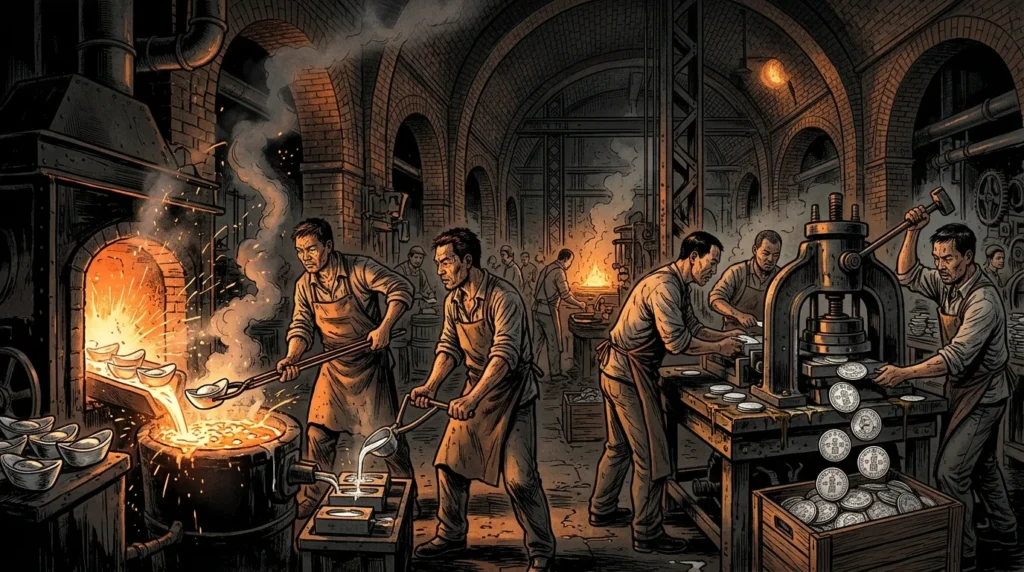
On December 1, 1948, in the northern railway city of Shijiazhuang, Hebei Province, the North China People’s Government consolidated three regional communist banks to establish the People’s Bank of China (PBOC) and issued the first notes of a new unified currency: the Renminbi (“People’s Currency”). Born amid the final military campaigns of the Chinese Civil War, the First Series Renminbi was designed to replace both a patchwork of revolutionary border-area notes and the collapsing Nationalist Gold Yuan. Yet the new central bank immediately confronted a monetary emergency of its own, as vast military deficits drove wholesale prices upward by more than seventyfold during 1949. Over the next six years, economic planner Chen Yun and the PBOC executed one of modern history’s most striking monetary stabilizations, anchoring savings and wages to real-commodity parity deposit units (zheshi chuxu danwei) indexed to grain, cloth, oil, and coal before replacing the war-era banknotes at a 10,000-to-1 ratio with the Second Series Renminbi on March 1, 1955. [1]

From Fragmented Liberated-Area Currencies to Shijiazhuang (1948)
Throughout the Second Sino-Japanese War (1937–1945) and the ensuing Civil War (1946–1949), Chinese Communist Party (CCP) base areas operated as isolated rural enclaves, each maintaining its own bank of issue, fiscal accounts, and paper currency to prevent Nationalist currency depreciation from draining local goods. By late 1947, more than a dozen distinct communist currencies circulated across northern, eastern, and northwestern China—including notes of the Jin-Cha-Ji Border Region Bank, the Beihai Bank in Shandong, the Ji-Nan Bank in southern Hebei, and the Xibei (Northwest) Peasant Bank. [2]
While monetary fragmentation protected individual base areas during guerrilla warfare, it became a severe obstacle once People’s Liberation Army (PLA) field armies linked the North China, East China, and Northwest theaters into a contiguous territory in 1948. Differing exchange rates across adjacent districts disrupted grain requisitioning, inter-regional trade, and military logistics. Meanwhile, in Nationalist-held cities, Chiang Kai-shek’s government had replaced the worthless fabi in August 1948 with the Gold Yuan (Jinyuanquan) at a rate of 3 million fabi to 1 Gold Yuan, only for the Gold Yuan itself to descend into terminal hyperinflation within weeks. [3]
Under the direction of Dong Biwu, Chairman of the North China People’s Government, and financial administrator Nan Hanchen, authorities first merged the Jin-Cha-Ji Border Region Bank and the Ji-Nan Bank into the Huabei (North China) Bank in mid-1948. On December 1, 1948, the Huabei Bank, the Beihai Bank, and the Xibei Peasant Bank were formally amalgamated in Shijiazhuang to form the People’s Bank of China, with Nan Hanchen appointed as its first governor. That same day, the PBOC placed the First Series Renminbi into circulation—featuring the bank’s name calligraphed by Dong Biwu—and began redeeming existing communist base-area currencies at fixed official parities (such as 100 Beihai or Xibei yuan, or 1,000 Jin-Cha-Ji yuan, per 1 Renminbi yuan) while expelling the Nationalist Gold Yuan from newly captured cities at rapidly declining conversion rates. [4]
Wartime Deficits and theFour Inflationary Waves of 1949–1950
Unifying the currency did not immediately halt inflation. When the People’s Republic of China (PRC) was proclaimed on October 1, 1949, the central government was supporting more than five million soldiers and civil servants while also honoring a pledge to retain former Nationalist administrative personnel on state payrolls. Tax collection in newly occupied southern and western provinces was barely functioning, railway networks were shattered, and state revenues covered only about one-third of state expenditures in 1949. The remaining two-thirds of the fiscal deficit had to be financed directly by printing Renminbi. [5]
Between December 1948 and the end of 1949, the volume of Renminbi in circulation expanded roughly 160-fold, and the First Series Renminbi—which had launched with small denominations of 1, 5, 10, 20, 50, and 100 yuan—was forced to introduce progressively larger notes of 500, 1,000, 5,000, 10,000, and eventually 50,000 yuan across 12 denominations and 62 distinct design versions. Private speculators in Shanghai, Tianjin, Wuhan, and Guangzhou hoarded grain, cotton yarn, coal, silver dollars, and foreign currency, betting that the Communist regime would suffer the same monetary collapse that had destroyed the Nationalists. Four distinct nationwide inflationary waves struck in April 1949, July 1949, November 1949, and February 1950, with wholesale price indices across major cities multiplying more than seventyfold between January 1949 and March 1950. [6]
Chen Yun’s Stabilization Strategy and the “Two White and One Black” Campaign
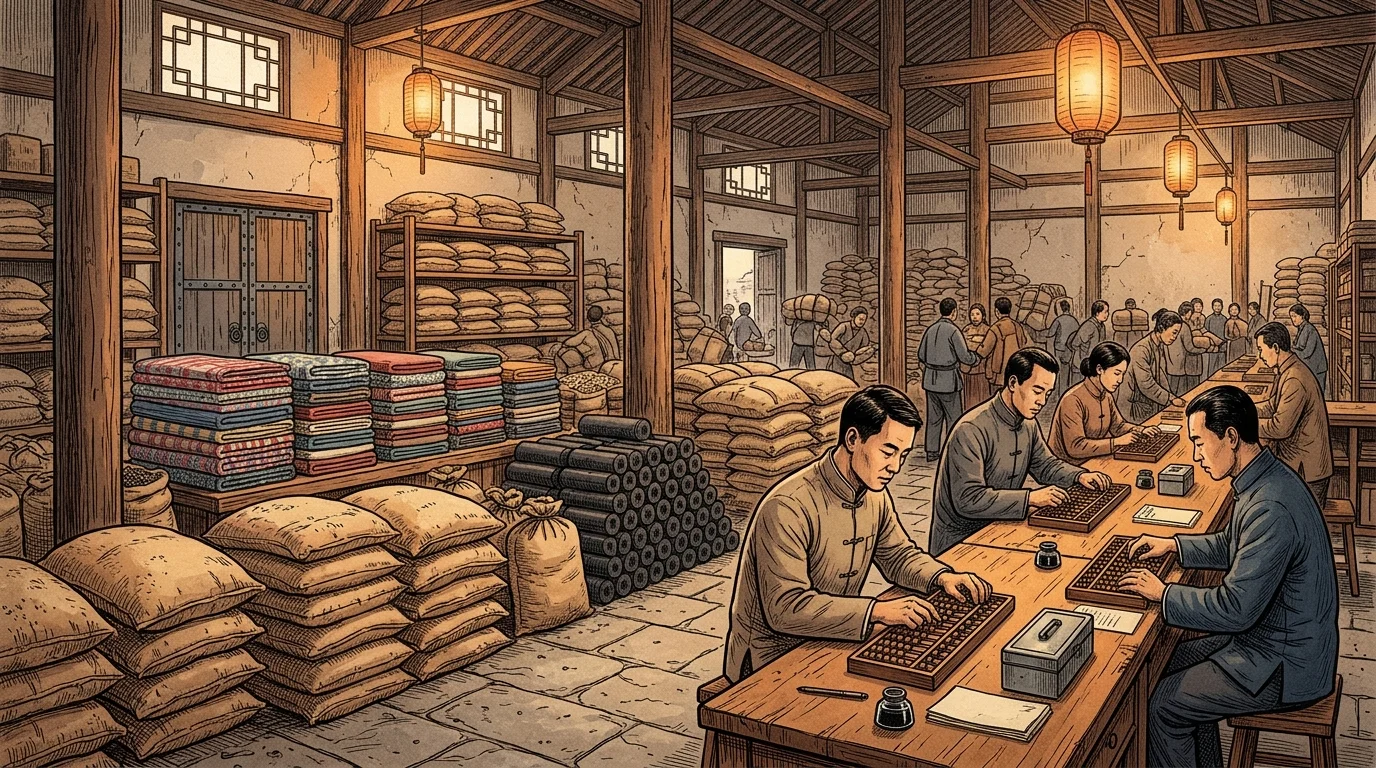
To defeat urban speculation and restore confidence in the currency, the CCP leadership appointed veteran revolutionary organizer Chen Yun to head the Central Financial and Economic Commission (CFEC) in mid-1949. Working alongside PBOC Governor Nan Hanchen and Finance Minister Bo Yibo, Chen Yun recognized that in an economy devoid of gold or hard-currency reserves, paper money could only be backed by state command over physical necessities—what he famously termed the “Two White and One Black” (liangbai yishi): white rice and grain, white cotton cloth and yarn, and black coal. [7]
First, under Article 39 of the September 1949 Common Program, the state outlawed the domestic circulation of silver coins, gold, and foreign currencies, shutting down the Shanghai Stock Exchange and gold bullion markets in mid-1949. Second, in November 1949, Chen Yun orchestrated a coordinated nationwide commodity offensive. State trading companies quietly amassed vast stockpiles of grain and cotton cloth from the countryside and Northeast China and transported them by rail into Shanghai, Tianjin, and Wuhan. As private hoarders bid commodity prices to dizzying peaks in late November 1949, state trading corporations suddenly dumped massive quantities of grain, yarn, and coal onto urban wholesale markets day after day while the PBOC simultaneously tightened credit, raised bank interest rates, and called in commercial loans. Caught in a brutal liquidity squeeze while market prices plunged by 30 to 40 percent, urban speculators were bankrupted en masse. [8]
Commodity-Indexed Parity Units (Zheshi Danwei) and Victory Bonds
Alongside market intervention, the People’s Bank of China deployed an ingenious institutional indexing mechanism to stop the flight from bank deposits into physical goods: the real-commodity parity unit, or zheshi danwei (折实单位, also known as the zheshi chuxu danwei for savings deposits). First introduced in Tianjin and Shanghai in the spring and summer of 1949 and subsequently extended nationwide, the parity unit decoupled the real value of bank deposits, state wages, and public debt from nominal currency depreciation.
Rather than denominating savings accounts in fixed nominal yuan that lost value every week, the PBOC defined one Shanghai parity unit as the combined local wholesale market price of a fixed basket of four essential everyday commodities:
- 1 sheng (roughly 1.56 jin or 0.78 kilograms) of medium-grade white rice (or millet/wheat flour in northern cities such as Beijing and Tianjin);
- 1 chi (one-third of a meter) of standard Dragon Head brand white cotton cloth;
- 1 liang (roughly 50 grams) of peanut or vegetable cooking oil; and
- 1 jin (500 grams) of coal briquettes.
Every day (or every ten days for bond accounting), the People’s Bank of China published the nominal Renminbi cash quotation of one zheshi parity unit based on prevailing state wholesale prices. When workers, enterprises, or households deposited nominal Renminbi in a parity savings account, their balance was recorded in zheshi units. Upon withdrawal, the bank paid out principal plus interest multiplied by the current day’s Renminbi value of the parity unit, guaranteeing that savers could always purchase the exact same physical quantity of rice, cloth, oil, and coal regardless of inflation.
In January 1950, the central government applied the same commodity-indexing mechanism to sovereign finance by issuing the 1950 People’s Victory Real-Commodity Parity Bonds (Renmin Shengli Zheshi Gongzhai), denominated in national parity units called fen (each fen representing the weighted wholesale price across six major cities of 6 jin of rice or millet, 1.5 jin of wheat flour, 4 chi of white cotton cloth, and 16 jin of coal). Combined with the March 3, 1950 State Council directive unifying national fiscal revenues and expenditures and requiring all state organs and enterprises to deposit their cash exclusively in the People’s Bank of China, the parity-unit system drained hundreds of billions of idle yuan out of circulation. By March 1950, wholesale prices stabilized nationwide and actually declined slightly over the remainder of the year.
The March 1, 1955 Redenomination and the Second Series Renminbi
Once price stability was firmly established between 1950 and 1952, the emergency commodity parity units had fulfilled their historical purpose and were phased out as ordinary nominal deposits regained full public trust. However, the legacy of the 1948–1950 civil-war inflation left the First Series Renminbi burdened with unwieldy nominal denominations: a simple retail purchase required thousands of yuan, accounting ledgers were cluttered with zeros, and the 62 hastily printed note varieties of the First Series suffered from poor paper quality and vulnerability to counterfeiting.
On February 21, 1955, the State Council promulgated the Decree on the Issuance of the New Renminbi and the Withdrawal of the Current Renminbi. Beginning on March 1, 1955, the People’s Bank of China introduced the Second Series Renminbi—consisting of 11 finely engraved paper denominations ranging from 1 fen (0.01 yuan), 2 fen, and 5 fen through 1, 2, 3, 5, and 10 yuan (with metal fen coins added in December 1957)—and exchanged all outstanding First Series Renminbi notes at a uniform statutory ratio of 10,000 old yuan to 1 new yuan.
Executed without confiscation or differential haircutting across urban and rural holders, the conversion of all prices, wages, bank deposits, and contracts by moving the decimal point four places to the left proceeded smoothly. By May–June 1955, the First Series notes were completely withdrawn from circulation, leaving the Second Series Renminbi as the stable monetary foundation of China’s planned economy for the next quarter-century.
Theoretical & Balance-Sheet Transmission Mechanism
In the Kindleberger–Minsky taxonomy of financial instability (Kindleberger, 1978; Minsky, 1986) and Irving Fisher’s (1933) debt-deflation framework, speculative asset booms become systemic crises when credit expansion shifts balance sheets from hedge finance (cash flows covering principal and interest) to speculative and Ponzi finance (relying on rising asset prices and short-term margin roll-overs).
Once monetary tightening or an exogenous shock halts price appreciation, forced margin liquidations trigger Fisherian debt-deflation: fire-sale asset discounts erode bank collateral values, contracting credit supply across the real economy.
Sources and Further Reading
- Federal Reserve Bank of Minneapolis, “ A Brief Timeline of the People’s Bank of China,” Federal Reserve Bank of Minneapolis, 2003-09-01. Central Bank / Monetary Authority
- Ulrich Theobald, “ PR China – Money and Finance 1950-1951,” ChinaKnowledge.de: An Encyclopaedia on Chinese History, Literature and Art, 2018. Historical & Financial Reference
- CommonProgram.science, “ Art 39 of the Common Program of the PRC 1949-1954: Currency and Banking,” CommonProgram.science Historical Archive, 2020. Historical & Financial Reference
- Our China Story, “ China’s first series of RMB issued,” Our China Story / Contemporary China Institute, 2023-12-01. Historical & Financial Reference
- Xia Chen, “ Banking and Financial System in the Early People’s Republic of China,” University of Glasgow, 2021. Peer-Reviewed / Academic Research
- Monthly Review, “ Renminbi: A Century of Change,” Monthly Review, 2023. Peer-Reviewed / Academic Research
- Irving Fisher — "The Debt-Deflation Theory of Great Depressions," Econometrica 1, no. 4 (FRASER Federal Reserve Archive, 1933): 337–357 Central Bank / Monetary Authority
- Charles P. Kindleberger & Robert Z. Aliber — Manias, Panics, and Crashes: A History of Financial Crises (Palgrave Macmillan) Peer-Reviewed / Academic Research
Cite This Historical Dossier (APA / Chicago)
APA (7th ed.): Ç., S. (Ed.). (2026). The 1948–1955 Birth of the Renminbi, Commodity Parity Units, and the 10,000:1 Reform. In Forgotten Fortunes Historical Monograph Series (Forgotten Fortunes Editorial Desk). https://forgottenfortunes.net/china-1955-renminbi-reform/
MLA (9th ed.): Ç., Soner, ed. "The 1948–1955 Birth of the Renminbi, Commodity Parity Units, and the 10,000:1 Reform." Forgotten Fortunes: Financial & Monetary History Archive, 2026, https://forgottenfortunes.net/china-1955-renminbi-reform/.
Chicago (17th ed.): Ç., Soner, ed. "The 1948–1955 Birth of the Renminbi, Commodity Parity Units, and the 10,000:1 Reform." Forgotten Fortunes Historical Monograph Series (Forgotten Fortunes Editorial Desk), September 11, 2026. https://forgottenfortunes.net/china-1955-renminbi-reform/.
Have an idea for another financial history documentary or article? Request a story →