
In This Article
In 1581, the ninth year of the Wanli Emperor’s reign, Grand Secretary Zhang Juzheng ordered the nationwide extension of the Yitiaobianfa—the Single Whip Law—completing a century-long fiscal transformation that bound the fate of the Ming Empire to the silver mines of the Andes and Japan. For the first century and a half of Ming rule, imperial taxation had rested on a sprawling, archaic dual foundation: the Twice-Yearly Tax (liangshui) paid in physical grain and textiles, and the statutory corvée labor service (yaoyi) assessed on registered households according to their adult male count (ding) and property rank under the lijia ten-family tithing system. Following his 1578–1581 empire-wide cadastral land survey, which uncovered hundreds of millions of mu of untaxed gentry estates, Zhang Juzheng merged dozens of disparate land levies, household labor requisitions, postal-relay obligations, and local tribute surcharges into a single consolidated assessment levied primarily on cultivated land and payable strictly in weighed, uncoined silver ingots (wenyin or sycee). By requiring roughly 150 million subjects to settle their fiscal obligations in fine silver despite sparse domestic silver mining, Ming China became a major destination for imported silver, with proposed annual inflow estimates varying widely across studies from Spanish America via the Acapulco–Manila Galleons and from Japan’s Iwami Ginzan mines. Yet this metallic integration carried a lethal vulnerability: when Little Ice Age droughts, trade disruptions in Manila and Nagasaki, wartime surcharges, and rampant copper-coin debasement converged in the 1630s and early 1640s, the copper-to-silver exchange rate more than tripled from 800 bronze cash per tael to over 2,000–2,500 cash per tael, crushing peasant taxpayers who earned copper cash in local markets but owed taxes in silver. [1]

The Lijia Breakdown, the 1578–1581 Cadastral Survey, and the Single Whip Law
The fiscal machinery designed by Ming founder Zhu Yuanzhang in the late fourteenth century envisioned a static, self-sufficient agrarian society recorded in the Yellow Registers (Huangce) of households and the Fish-Scale Registers (Yulin tuce) of land parcels. Every ten years, village headmen in the 110-household lijia system were rotated into unpaid administrative duties: collecting grain taxes, transporting tribute goods to distant granaries, staffing imperial postal stations, and supplying local magistrates with ink, paper, firewood, and labor. By the early sixteenth century, commercial expansion and rampant tax evasion had reduced the lijia corvée system to chaos. Powerful degree-holding gentry households (shenshi), who enjoyed legal exemptions from corvée labor, accepted fraudulent land commendations (toukao) from wealthier farmers, shrinking the taxable tax base and shifting an unbearable burden of yaoyi labor onto poor smallholder peasants, millions of whom fled their ancestral villages as unregistered vagrants (liumin). [2]
Starting in the 1530s, reform-minded provincial governors across Zhejiang, Jiangxi, and the Yangtze delta—including Pang Shangpeng and Hai Rui—experimented with local “Single Whip” (yitiaobian, originally a pun on “stabilizing the clauses” yitiaobian) consolidations that folded ad hoc corvée assessments into the land tax. When Zhang Juzheng assumed leadership of the Grand Secretariat in 1572 as tutor and regent to the nine-year-old Wanli Emperor, the Ming central treasury was running chronic deficits while northern frontier garrisons were months behind on pay. Rather than raising statutory tax rates, Zhang set out to capture concealed wealth and rationalize collection. [3]
In November 1578, Zhang Juzheng launched a compulsory empire-wide cadastral resurvey using a standardized measuring cord of 3.2 meters (the buzigong) to audit every plot of arable land across all fifteen provinces, overriding fierce obstruction from aristocratic and bureaucratic landlords. Completed between 1580 and 1581, the survey expanded the empire’s registered taxable acreage from roughly 4.6 million qing (460 million mu) to more than 7.01 million qing (over 701 million mu, approximately 47 million hectares). Armed with updated land rolls, Zhang promulgated the Single Whip Reform across the empire in 1581. Its core institutional mechanisms were fourfold: [4]
- Consolidation of Corvée into Land Assessments: The myriad regular and irregular household labor obligations (lijia service, junyao equalized corvée, militia provisioning, and local government maintenance) were merged with the summer and autumn land taxes into a single composite quota assessed primarily on land acreage rather than household headcounts, shifting the fiscal burden from landless laborers to large landowners.
- Abolition of Unpaid Tax-Captains in Favor of Hired Labor: Instead of conscripting peasant householders to perform physical labor and transport duties, county magistrates used the collected tax silver to hire paid wage laborers (guyi) on the open market.
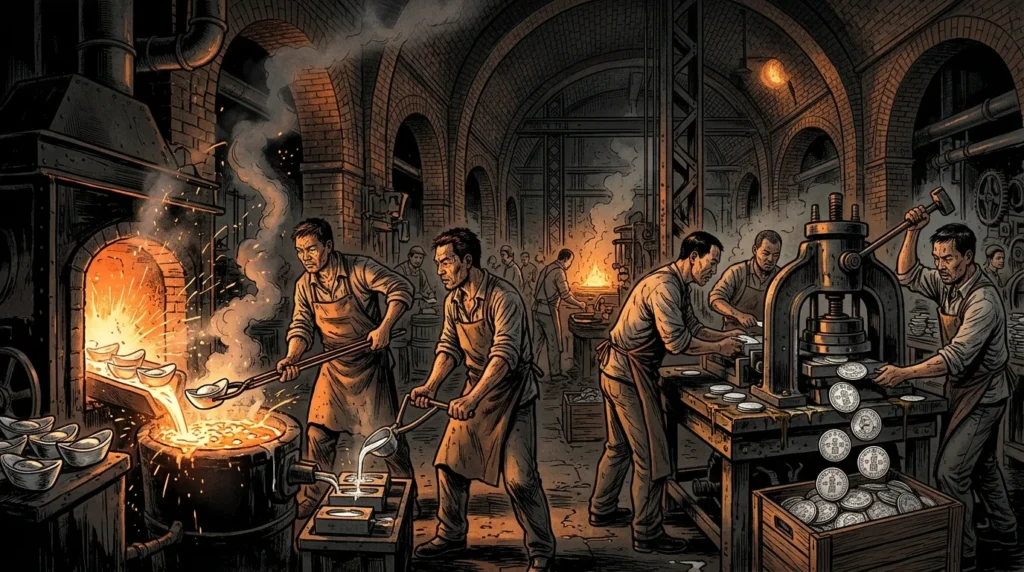
- Strict Monetization in Weighed Silver: Apart from a residual strategic quota of tribute grain (caoliang) shipped up the Grand Canal to feed Beijing, all consolidated taxes were calculated and collected in weighed silver taels (liang, approximately 37.5 grams), augmented by a meltage and assay fee (huohao) to cover the cost of casting fragmentary silver pieces into standardized fifty-tael horseshoe ingots (yuanbao) for the Ministry of Revenue’s Taicang Treasury.
- Direct Official Collection: Taxpayers deposited their silver directly into sealed wooden chests (guishou) placed in front of the county yamen, where clerks weighed the silver on calibrated balance scales and issued printed three-stub tax receipts (sanliandan), curbing extortion by village tax-farmers.
The immediate fiscal payoff was dramatic. While the Taicang Treasury had struggled to collect roughly two million taels of silver annually in the early sixteenth century, annual central silver receipts surpassed four million taels under Zhang Juzheng’s administration, accumulating more than six million taels of surplus bullion in the capital vaults—enough to cover nearly a decade of imperial expenditure—by the time of Zhang’s death in 1582. [5]
A 100% Bimetallic Arbitrage Premium and the Global “Silver Sink”
Because Ming China neither minted standardized silver coins nor possessed productive domestic silver mines—domestic output from Yunnan and Zhejiang mines averaged fewer than 20 to 30 metric tons per year during the late sixteenth century—the Single Whip Reform amplified an extraordinary global monetary arbitrage. Inside Ming markets, the acute scarcity of silver relative to bronze cash and gold pushed the bimetallic exchange ratio to roughly 1 ounce of gold for 5.5 to 7 ounces of silver during the late sixteenth century. At the exact same moment, in Lisbon, Seville, Amsterdam, and Mexico City, the gold-to-silver ratio stood at approximately 1 to 12 or 1 to 14, while in Japan it stood near 1 to 10. Purchased with Chinese silk, damasks, raw cotton thread, or Jingdezhen blue-and-white porcelain, an ounce of foreign silver commanded roughly double the purchasing power in Ming China that it possessed in Europe or the Americas. [6]
Economic historians Dennis O. Flynn and Arturo Giráldez have shown how this 100-percent Chinese valuation premium turned the Ming Empire into the magnetic “silver sink” (or “suction pump”) that powered the first wave of global trade. Bullion poured into Ming coastal ports along two primary oceanic arteries: [7]
- The Japanese Silver Pipeline (Iwami Ginzan and Nagasaki): In the 1530s, Japanese miners at the Iwami Ginzan lode in Shimane Prefecture adopted the Korean haifukiho (cupellation with lead ash) smelting technique, unlocking vast silver production across western Honshu. At its peak between 1560 and 1630, Japan produced up to one-third of the world’s mined silver. Because the Ming court banned direct official trade with Japan due to wokou piracy, Portuguese nao do trato (“Black Ships”) operating between Macau and Nagasaki—alongside Chinese maritime syndicates sailing out of Yuegang (Haicheng) in Fujian—carried between 100 and 150 metric tons of Japanese silver (“soma silver”) into China annually in exchange for raw white Jiangnan silk.
- The Trans-Pacific Manila Galleon Route (Potosí and Zacatecas): In the Spanish Americas, the discovery of the Cerro Rico of Potosí in Upper Peru (1545) and the mines of Zacatecas and Guanajuato in New Spain, combined with the mercury amalgamation patio process in the 1550s–1570s, unleashed a flood of New World silver. Following the Spanish founding of Manila in 1571—just ten years before Zhang Juzheng’s Single Whip edict—giant Manila Galleons (Nao de China) sailed annually from Acapulco across the Pacific loaded with silver reales de a ocho (Spanish pieces of eight). Waiting in Manila Bay each spring were thirty to fifty Fujianese merchant junks (sangleyes), which traded silk, porcelain, musk, and ironware for an average of 50 to 100 metric tons (roughly 1.5 to 3 million pesos) of American silver per year, while an additional stream of American silver reached China via Lisbon, Goa, and Macau.
Between 1570 and 1630, this global bullion influx injected an estimated 7,000 to 10,000 metric tons of silver into the Ming economy, lubricating rapid commercialization across the Yangtze delta and the southeastern coast and gradually pushing China’s gold-to-silver ratio toward the global parity of 1 to 13 by the 1630s. [8]
Ming Bimetallism on the Ground: Silver for Taxes, Copper Cash for Survival
Beneath the macro-level prosperity of the late-Ming silver boom lay a fragile two-tier monetary structure that exposed ordinary peasants and urban artisans to severe exchange-rate risk. Unlike Spain or Mughal India, the Ming state never struck silver coins; silver circulated by weight (taels, mace, candareens) and fineness as cast ingots or clipped shards (suiyin), which required assaying and weighing with every transaction and proved far too valuable for daily retail purchases. Instead, the daily economy of the peasantry—buying grain, salt, cooking oil, tools, and paying casual agricultural wages—operated entirely in cast copper-alloy cash coins (tongqian).
When the Single Whip Law required land and corvée taxes to be paid in pure silver, every peasant household was forced to act as a miniature currency exchanger. After harvesting their wheat, millet, or rice, farmers first had to sell their crops in local market towns for strings of bronze cash, and then carry those copper coins to local moneychangers (qianzhuang) or tax agents to purchase the refined wenyin silver required by the county yamen. So long as the exchange rate between bronze coin and silver remained stable near the late-sixteenth-century benchmark of 700 to 800 well-cast copper cash per tael of silver, the Single Whip mechanism functioned smoothly.
The 1630s–1644 Copper Debasement and Silver Deflation Crisis
During the Chongzhen reign (1628–1644), a toxic combination of fiscal militarization, monetary debasement, climatic disaster, and trade shocks shattered the copper-to-silver equilibrium. Beginning in 1618, to fund massive frontier armies fighting Nurhaci’s Later Jin (Manchu) forces in Liaodong and suppressing domestic rebellions, the Ming court enacted the “Three Military” surtaxes—the Liaodong Surtax (Liaoxiang), Training Surtax (Lianxiang), and Suppression Surtax (Jiaoxiang)—which eventually added more than 16 million taels of silver per year onto the regular Single Whip land tax quota.
At the very moment when the central government demanded record quantities of silver from the interior provinces, the supply of sound money in local markets disintegrated along two fronts:
- Copper Coin Debasement and Private Counterfeiting: Desperate for seigniorage profits to fund the war effort, provincial mints during the Tianqi (1621–1627) and Chongzhen eras drastically reduced the weight and copper purity of official Chongzhen Tongbao cash coins, substituting cheap lead and zinc. Private counterfeiters flooded the Yangtze valley and northern plains with thin, brittle illicit coins (siqian) and archaic scrap coins. As Gresham’s Law took hold, merchant houses refused to accept debased copper cash except at steep discounts against pure silver.
- Silver Hoarding, Trade Disruptions, and Agrarian Collapse: In the late 1630s, maritime silver inflows constricted sharply: the Tokugawa Shogunate issued its Sakoku edicts banning Japanese merchants from sailing abroad (1635) and expelling the Portuguese from Nagasaki (1639), while Spanish authorities in Manila cracked down on unregistered Acapulco bullion shipments and massacred over 20,000 Chinese residents in Manila in 1639–1640. Domestically, the worst megadrought and cold snap of the Little Ice Age struck northern China between 1637 and 1643, destroying harvests while wealthy gentry and merchants hoarded silver bullion in subterranean vaults to shelter their fortunes from war and banditry.
The result was a catastrophic divergence between the two halves of the Ming monetary system—a phenomenon contemporaries called “expensive silver and cheap coin” (yingui qianjian). From a stable rate of roughly 800 copper cash per tael of silver in the 1590s, the market rate deteriorated to 1,000 cash per tael in 1628, 1,300 cash by 1635, 1,600 cash by 1638, and between 2,000 and 2,500 copper cash per tael across Jiangnan and northern China by 1642–1643. For a peasant household selling produce or labor for debased copper cash, the real burden of a silver-denominated Single Whip tax bill—already doubled by the Three Military Surtaxes—effectively tripled again in copper terms. For some households, paying taxes in silver became harder as the copper-silver exchange rate moved against them. Such pressures formed part of a much wider crisis involving war, severe harvest failures, rebellion, and state weakness. Li Zicheng captured Beijing in April 1644, but historians disagree on how large a causal role imported-silver disruptions played in the fall of the dynasty.
Theoretical & Balance-Sheet Transmission Mechanism
In the Kindleberger–Minsky taxonomy of financial instability (Kindleberger, 1978; Minsky, 1986) and Irving Fisher’s (1933) debt-deflation framework, speculative asset booms become systemic crises when credit expansion shifts balance sheets from hedge finance (cash flows covering principal and interest) to speculative and Ponzi finance (relying on rising asset prices and short-term margin roll-overs).
Once monetary tightening or an exogenous shock halts price appreciation, forced margin liquidations trigger Fisherian debt-deflation: fire-sale asset discounts erode bank collateral values, contracting credit supply across the real economy.
Sources and Further Reading
- Ulrich Theobald, “ Yitiaobianfa 一條鞭法, the Single-Whip Fiscal System,” ChinaKnowledge.de, 2016. Historical & Financial Reference
- World History Encyclopedia, “ Ming Taxation & the Silver Economy,” World History Encyclopedia, 2026. Historical & Financial Reference
- Encyclopedia.com, “ Ming Dynasty (1368–1644): The Single-Whip Reform,” Encyclopedia.com, 2019. Historical & Financial Reference
- Dennis O. Flynn, “ Silver in a Global Context, 1400–1800 (The Cambridge World History),” Cambridge University Press, 2015. Peer-Reviewed / Academic Research
- Richard von Glahn, “ Myth and Reality of China’s Seventeenth-Century Monetary Crisis,” The Journal of Economic History (Cambridge University Press), 1996. Peer-Reviewed / Academic Research
- Mark Cartwright, “ Manila Galleon,” World History Encyclopedia, 2021. Historical & Financial Reference
- Irving Fisher — "The Debt-Deflation Theory of Great Depressions," Econometrica 1, no. 4 (FRASER Federal Reserve Archive, 1933): 337–357 Central Bank / Monetary Authority
- Charles P. Kindleberger & Robert Z. Aliber — Manias, Panics, and Crashes: A History of Financial Crises (Palgrave Macmillan) Peer-Reviewed / Academic Research
Cite This Historical Dossier (APA / Chicago)
APA (7th ed.): Ç., S. (Ed.). (2026). Zhang Juzheng's 1581 Single Whip Reform, the Global Silver Sink, and the Late-Ming Monetary Crisis. In Forgotten Fortunes Historical Monograph Series (Forgotten Fortunes Editorial Desk). https://forgottenfortunes.net/single-whip-reform-ming-silver/
MLA (9th ed.): Ç., Soner, ed. "Zhang Juzheng's 1581 Single Whip Reform, the Global Silver Sink, and the Late-Ming Monetary Crisis." Forgotten Fortunes: Financial & Monetary History Archive, 2026, https://forgottenfortunes.net/single-whip-reform-ming-silver/.
Chicago (17th ed.): Ç., Soner, ed. "Zhang Juzheng's 1581 Single Whip Reform, the Global Silver Sink, and the Late-Ming Monetary Crisis." Forgotten Fortunes Historical Monograph Series (Forgotten Fortunes Editorial Desk), September 16, 2026. https://forgottenfortunes.net/single-whip-reform-ming-silver/.
Have an idea for another financial history documentary or article? Request a story →