
In This Article
In the eighth year of the Hongwu reign (1375), Ming dynasty founder Zhu Yuanzhang inaugurated one of premodern history’s most ambitious and coercive experiments in pure fiat currency: the Da Ming Tongxing Baochao, or Great Ming Circulating Treasure Note. Printed on oversized sheets of dark gray mulberry-bark paper measuring roughly 34 by 22 centimeters—the largest banknotes ever issued in bulk—the 1-guan note bore an official face value of 1,000 copper cash coins (wen) or one tael (approximately 37.5 grams) of pure silver. Unlike the earlier Song dynasty Jiaozi and Huizi or the early Yuan dynasty Jiaochao, which had initially relied on metallic reserves, salt certificates, or administrative redemption rules to anchor market confidence, the Hongwu Emperor’s paper currency was explicitly and permanently inconvertible. No imperial treasury office would exchange a Great Ming Treasure Note for bronze coin or silver bullion on demand. Instead, the dynasty sought to sustain the notes through statutory monopoly, draconian criminal penalties banning the monetary use of gold and silver, and fiscal absorption laws such as the Yongle Emperor’s compulsory household salt-tax ration (hukou shiyan). Within half a century, unconstrained printing without a retirement sink reduced the 1-guan note to less than one-thousandth of its face value, compelling the Zhengtong court in 1436 to commute southern grain-tribute obligations into weighed silver ingots known as Jinhuayin (“Gold-Floral Silver”) and setting China on a silver standard from the bottom up. [1]

Copper Scarcity and the 1375 Founding of the Baochao Supervisorate
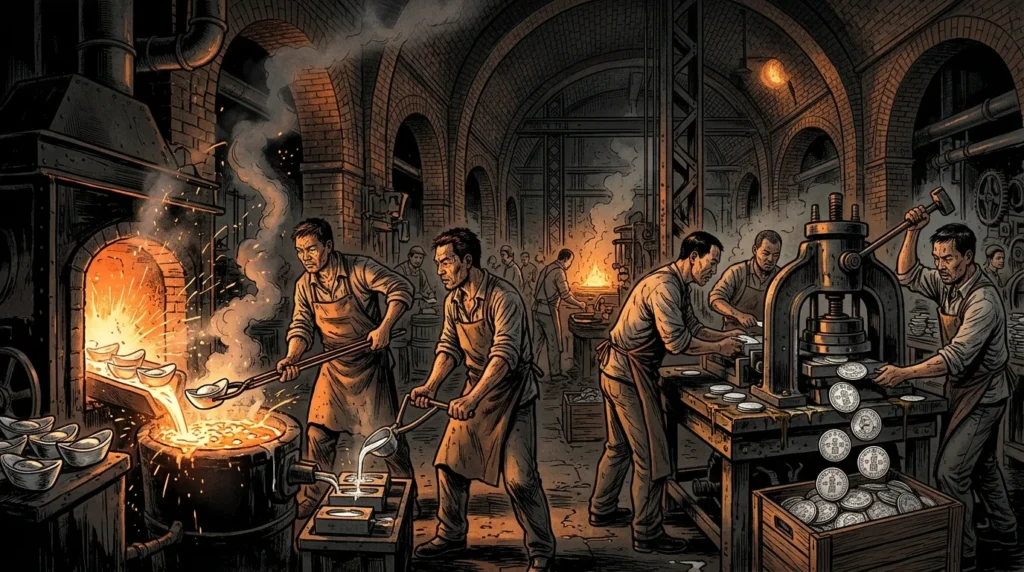
When Zhu Yuanzhang proclaimed the Ming dynasty in Nanjing in 1368 after expelling the Mongol Yuan court, his administration intended to restore a classical orthodox bronze coinage system. As early as 1361, while still contending for control of the Yangtze valley, Zhu had established the Baoyuan Mint in Nanjing to cast bronze Dazhong Tongbao coins, followed in 1368 by provincial mints casting Hongwu Tongbao cash in five denominations ranging from one to ten wen. Yet the early Ming state immediately collided with a severe structural shortage of copper ore. Generations of warfare, the exhaustion of accessible surface lodes in southern and central China, and centuries of coin hoarding and illicit melting had depleted domestic bronze supplies. Even when provincial officials coerced households into surrendering family bronze vessels, bells, and Buddhist statues for recasting, the empire’s mints could produce barely a fraction of the circulating medium required for an agrarian and commercial population of more than 60 million people. [2]
Faced with chronic deflationary pressure and the inability to pay military garrisons and civil stipends in bronze coin, the Hongwu Emperor reversed course in the spring of 1375. He established the Treasure Note Supervisorate (Baochao Tiju Si) under the Secretariat—later transferred to the Ministry of Revenue (Hubu)—and ordered the Imperial Paper Mill in Nanjing to manufacture mulberry-bark sheets for six paper denominations: 100, 200, 300, 400, 500 wen, and 1 guan (1,000 wen). By imperial edict, one guan of paper money was equated to 1,000 bronze cash coins, one tael of silver, or one-quarter tael of gold, and was declared valid for purchasing one shi (approximately 107 liters) of husked rice. [3]
The physical design of the 1-guan note reflected the autocratic ethos of early Ming statecraft. Beneath the bold six-character header reading Da Ming Tongxing Baochao, a woodblock-printed border adorned with coiled dragons framed an illustration of ten strings of 100 copper cash coins. Below the pictorial strings, text in classical script proclaimed that the Ministry of Revenue, having received the Emperor’s decree, printed and issued the note to circulate alongside copper cash throughout the empire forever. It ended with an uncompromising penal warning: anyone who counterfeited the note would be beheaded, while anyone who informed on and captured a counterfeiter would receive a state reward of 250 taels of silver (or 25 guan in early equivalents) together with the entirety of the criminal’s confiscated real and personal property. Two large vermilion official seal impressions on the obverse and another on the reverse authenticated each sheet. [4]
Inconvertibility, the Ban on Precious Metals, and Unconstrained Issue
The fatal flaw of the Ming monetary regime lay not in the physical durability of mulberry-bark paper, but in the complete absence of a metallic anchor or an institutional mechanism for retiring excess notes from circulation. When the Mongol conqueror Kublai Khan had introduced the Zhongtong Yuanbao Jiaochao in 1260, local stabilizing treasuries (Pingzhun Ku) held silver and gold reserves to buy back depreciated notes and maintain parity, while worn notes could be exchanged for fresh ones upon payment of a modest three-percent administrative fee. The Ming treasury replicated the outward administrative vocabulary of the Yuan system—establishing Receipt and Exchange Treasuries (Shouchao Ku) to swap dilapidated notes for new ones—but stripped away every convertibility safeguard. Citizens could never present a Baochao note to the state in exchange for silver, gold, or bronze cash. [5]
To prevent Gresham’s Law from driving the unbacked paper notes out of the marketplace, the Hongwu Emperor outlawed competing media of exchange. Alongside the 1375 launch of the Baochao, the court prohibited private merchants and householders from using gold or silver as money in commercial transactions. Citizens possessing gold or silver bullion were permitted only to sell it to the state in exchange for paper notes at official ratios, while private contracts denominated in silver faced confiscation and penal servitude. When bronze coins still circulated at a premium against paper, the emperor periodically shut down the provincial bronze mints—first in 1376, again in 1387, and definitively in 1394—when the court banned the circulation of copper cash altogether to leave mulberry-bark paper as the sole legal tender of the realm. [6]
Even a strictly enforced fiat monopoly, however, required fiscal discipline matching note issuance to tax withdrawals. Instead, the early Ming treasury treated the printing blocks of Nanjing and later Beijing as an inexhaustible revenue engine. Official salaries for civil mandarins and imperial clansmen, rewards for frontier troops, diplomatic gifts to foreign tribute missions, and massive requisitions for public works were disbursed overwhelmingly in newly printed Baochao. While commercial excise taxes (shangshui) could be paid in paper at a ratio of 30 percent copper cash and 70 percent paper notes, the vast bulk of Ming state revenue—the twice-yearly agrarian land tax—continued to be collected in physical grain, silk, and hemp cloth. By 1390, the Ministry of Revenue was printing nearly nine million guan of new notes in a single year while withdrawing only a tiny fraction through commercial excises. As notes flooded the cities without a corresponding fiscal sink, the market value of the 1-guan note slid from 1,000 copper cash in 1375 to roughly 400 cash by 1385 and 160 cash by 1394. In the provinces of Jiangnan, Fujian, and Guangdong, merchants openly priced goods in silver taels or bronze coin, quoting inflated paper-note prices ten times higher than metallic prices. [7]
The Yongle Emperor’s Coercive Revival and the Hukou Shiyan Salt-Tax Sink
When Zhu Di seized the throne as the Yongle Emperor (reigned 1402–1424), fiscal expenditures soared to unprecedented heights. The Yongle court financed five grand military expeditions into the Mongolian steppe, the invasion and occupation of northern Vietnam (Jiaozhi), the construction of the new imperial capital and Forbidden City in Beijing, the dredging of the Grand Canal, and the seven monumental maritime voyages of Admiral Zheng He across the Indian Ocean—during which Ming envoys distributed millions of guan of Baochao to rulers from Java to Hormuz. Because the court never minted a single new reign-title bronze coin during the entire Yongle era, the printing presses bore the brunt of monetizing these imperial megaprojects. [8]
By 1403, the purchasing power of a 1-guan note had plunged to less than 0.03 tael of silver—roughly three percent of its statutory 1375 parity—and the price of a shi of rice in paper currency had risen more than thirtyfold. Determined to arrest the collapse of his father’s currency without curtailing state spending, the Yongle Emperor turned to coercive fiscal engineering. He reiterated the death penalty and frontier banishment for merchants caught transacting in gold or silver, and in 1404 he adopted a proposal by Censor-in-Chief Chen Ying to absorb redundant paper currency through a compulsory empire-wide salt ration tax known as the hukou shiyan (household-registered salt consumption scheme).
Under the hukou shiyan system, the state forced every registered adult male and female in the empire to purchase a fixed monthly ration of one jin (approximately 600 grams) of state-monopoly salt, while minors were assessed half a jin. For each jin of salt allocated, the household was legally obligated to pay one guan of Da Ming Baochao into local treasuries. In theory, this poll tax tied to a biological necessity would force tens of millions of peasant and urban households to acquire paper notes on the market and surrender them to the state for retirement, shrinking the money supply and restoring the note’s purchasing power.
In practice, the hukou shiyan devolved into an oppressive regressive capitation tax that failed to halt hyperinflation. State salt depots frequently failed to deliver the actual salt rations to villages—forcing subjects to pay “salt notes” (yanchao) in paper notes while receiving nothing in return—yet the Ministry of Revenue immediately re-spent the collected notes or printed tens of millions of fresh sheets to cover ongoing deficits in Beijing. By the end of the Yongle reign in 1424 and the accession of the Hongxi and Xuande emperors in 1425, a 1-guan note traded in Jiangnan markets for just 0.0009 to 0.001 tael of silver (less than one-thousandth of its original 1375 value) or roughly one to two copper cash coins. Civil officials in Beijing whose nominal stipends had been commuted into Baochao saw their real salaries obliterated, reducing junior mandarins to penury until the court began commuting parts of their pay into silk bolts, pepper, and sappanwood brought back by Zheng He’s fleets.
The Xuande Emperor (reigned 1425–1435) made one final attempt to rescue the mulberry-bark currency between 1428 and 1429 by multiplying commercial transit fees, shop taxes, orchard levies, and boat tolls fivefold—and establishing thirty-three inland customs barriers (chaoguan) along the Grand Canal and Yangtze River—all payable exclusively in Baochao that were supposed to be burned upon collection. Although the new customs houses momentarily lifted the note’s market price to roughly 0.015 tael of silver in the early 1430s, the underlying rejection of unbacked paper in private trade proved irreversible.
The 1436 Jinhuayin Reform and the Bottom-Up Birth of China’s Silver Standard
The decisive break came in 1436, the first year of the young Zhengtong Emperor’s reign. Across the rich agricultural prefectures of the lower Yangtze delta (Jiangnan) and the southern provinces of Zhejiang, Jiangxi, Huguang, Fujian, Guangdong, and Guangxi, peasant taxpayers faced crippling surcharges to transport physical tribute grain across mountain passes and up the Grand Canal to the northern capital in Beijing and the frontier garrisons along the Great Wall. At the same time, private commercial life in southern China had already spontaneously coalesced around uncoined silver bullion, which merchants weighed on precision balance scales (dengzi) in units of taels (liang) and mace (qian) and graded by assay purity.
Recognizing that the state could neither revive the discredited Da Ming Baochao nor logistically transport every sack of southern tribute grain north, Minister of Revenue Huang Fu and Vice Minister Zhou Chen—then serving as Grand Coordinator of Jiangnan—memorialized the throne to institutionalize silver tax commutation. In the autumn of 1436, the Zhengtong court issued a landmark imperial edict commuting approximately four million shi of southern grain tribute—at an official conversion rate of four shi of grain per one tael of high-purity silver—into roughly one million taels of silver bullion annually. Because the court specified that the remitted ingots must be cast to fine assay standards exhibiting a faint golden-flowery crystalline sheen on their surface, the commuted revenue became officially known as Jinhuayin (“Gold-Floral Silver”).
Simultaneously in 1436, the Zhengtong government lifted the seventy-year-old statutory prohibition on using gold and silver in private commercial contracts and quietly reduced the onerous hukou shiyan paper-note exactions. Initially, the one million taels of Jinhuayin were deposited into the Imperial Inner Treasury (Neichengyun Ku) in Beijing to pay military officer stipends in cash silver rather than worthless paper notes. By the 1440s and 1450s, both the Ministry of Revenue’s Taicang Treasury and provincial administrations were systematically commuting corvée labor dues, salt monopoly licenses, and military supply requisitions into silver taels.
Historical Legacy of the Great Ming Paper-Money Collapse
Although the Ming dynasty never formally promulgated an edict abolishing the Da Ming Baochao—and notes bearing the unchanging Hongwu reign title continued to be used as a nominal unit of account for certain customs tolls and minor fines into the late fifteenth century—the mulberry-bark currency had ceased to function as living money by the 1450s. Its trajectory from a 1-tael-per-guan statutory fiat instrument in 1375 to less than 0.001 tael by 1425 stands as a classic demonstration of monetary economics: coercive legal-tender statutes and capital punishment cannot sustain an inconvertible currency when the issuing sovereign prints notes without restraint and provides no credible fiscal or metallic redemption channel.
Equally consequential was the institutional pivot of 1436. By bowing to grassroots market preference and commuting southern grain taxes into Jinhuayin, the Ming court transformed China from an empire of state-issued paper notes and bronze cash into an uncoined silver bullion economy. That bottom-up silverization—later codified nationwide under Grand Secretary Zhang Juzheng’s 1581 Single Whip Reform—created the immense structural demand for monetary silver that would soon draw hundreds of millions of ounces of bullion from Japanese mines and Spanish American galleons into Ming markets, reshaping the entire early modern global economy while leaving imperial China deeply wary of state paper money for the next four centuries.
Theoretical & Balance-Sheet Transmission Mechanism
In the Kindleberger–Minsky taxonomy of financial instability (Kindleberger, 1978; Minsky, 1986) and Irving Fisher’s (1933) debt-deflation framework, speculative asset booms become systemic crises when credit expansion shifts balance sheets from hedge finance (cash flows covering principal and interest) to speculative and Ponzi finance (relying on rising asset prices and short-term margin roll-overs).
Once monetary tightening or an exogenous shock halts price appreciation, forced margin liquidations trigger Fisherian debt-deflation: fire-sale asset discounts erode bank collateral values, contracting credit supply across the real economy.
Sources and Further Reading
- Richard von Glahn, “ The Rise and Demise of Paper Money in Imperial China,” Hoover Institution, 2022. Historical & Financial Reference
- Nanjing Museum, “ Great Ming Circulating Treasure Note (Da Ming Tongxing Baochao),” Nanjing Museum Collection, 2023. Historical & Financial Reference
- Iwai Shigeki, “ Public Finance (The Cambridge Economic History of China),” Cambridge University Press, 2022. Peer-Reviewed / Academic Research
- Ulrich Theobald, “ Ming Period Economy,” ChinaKnowledge.de, 2016. Historical & Financial Reference
- World History Encyclopedia, “ Ming Taxation & the Silver Economy,” World History Encyclopedia, 2026. Historical & Financial Reference
- National Bank of Belgium Museum, “ The Banknote: A Chinese Invention,” National Bank of Belgium, 2020. Historical & Financial Reference
- Irving Fisher — "The Debt-Deflation Theory of Great Depressions," Econometrica 1, no. 4 (FRASER Federal Reserve Archive, 1933): 337–357 Central Bank / Monetary Authority
- Charles P. Kindleberger & Robert Z. Aliber — Manias, Panics, and Crashes: A History of Financial Crises (Palgrave Macmillan) Peer-Reviewed / Academic Research
Cite This Historical Dossier (APA / Chicago)
APA (7th ed.): Ç., S. (Ed.). (2026). The 1375 Great Ming Treasure Note: Mulberry-Bark Fiat Money and the 1436 Silver Turn. In Forgotten Fortunes Historical Monograph Series (Forgotten Fortunes Editorial Desk). https://forgottenfortunes.net/great-ming-treasure-note-collapse/
MLA (9th ed.): Ç., Soner, ed. "The 1375 Great Ming Treasure Note: Mulberry-Bark Fiat Money and the 1436 Silver Turn." Forgotten Fortunes: Financial & Monetary History Archive, 2026, https://forgottenfortunes.net/great-ming-treasure-note-collapse/.
Chicago (17th ed.): Ç., Soner, ed. "The 1375 Great Ming Treasure Note: Mulberry-Bark Fiat Money and the 1436 Silver Turn." Forgotten Fortunes Historical Monograph Series (Forgotten Fortunes Editorial Desk), September 16, 2026. https://forgottenfortunes.net/great-ming-treasure-note-collapse/.
Have an idea for another financial history documentary or article? Request a story →