In This Article
During the Old Babylonian period (c. 1800–1600 BCE), the rulers of the First Dynasty of Babylon—most notably King Hammurabi (r. c. 1792–1750 BCE), his son Samsu-iluna (r. c. 1749–1712 BCE), and his great-great-grandson Ammi-saduqa (r. c. 1646–1626 BCE)—governed an economy that operated without coined money yet relied on sophisticated credit contracts, bi-commodity accounting, and royal market regulation. Everyday exchange and credit rested on a dual standard of weighed silver (measured in talents, minas, and shekels) and measured barley grain (measured in gur and sila). Because compound agrarian debt repeatedly threatened to strip smallholder peasants of their land, livestock, and personal freedom, Babylonian monarchs combined three complementary fiscal instruments: statutory interest ceilings inscribed in §§88–96 of the Code of Hammurabi (20 percent per year on silver and 33.33 percent on barley), licensed merchant contractors (tamkārum) who converted perishable palace commodity surpluses into silver at fixed discounts, and periodic royal “clean slate” decrees (mīšarum) that ordered officials to literally break the clay tablets recording non-commercial agrarian debts. [1]

The Bi-Commodity Standard of Weighed Silver and Barley
In Old Babylonian cities such as Babylon, Sippar, Larsa, and Ur, money functioned primarily as a unit of account and a store of value rather than a state-minted coin. Scribes and merchants priced land, houses, slaves, copper, wool, and sesame in standard sexagesimal weights of refined silver: 1 talent (biltum, roughly 30 kilograms) equaled 60 minas (manûm, about 500 grams each),1 mina equaled 60 shekels (šiqlum, approximately 8.33 grams each), and 1 shekel subdivided into 180 barleycorns (še). In large commercial transactions, parties weighed out silver rings, coils, wire, or cut bullion fragments (šibirtum) on balance scales against stone weights calibrated to royal or temple standards. [2]
Yet most rural cultivators and urban laborers rarely handled physical silver in daily life. Instead, barley served as the ubiquitous medium of payment for wages, rations, land rents, and small retail purchases. In the standard Old Babylonian royal equivalence, 1 gur (300 sila, or roughly 300 liters) of barley was valued at 1 shekel of silver at harvest time. Crucially, credits and debits were recorded on cuneiform clay tablets sealed inside clay envelopes by witnesses, allowing agrarian taxes, palace wool deliveries, and tavern beer tabs to clear across the agricultural year without requiring physical metal to change hands until harvest settlement. [3]
Statutory Interest Caps in §§88–96 of the Code of Hammurabi
Because small farmers routinely borrowed seed-barley in the autumn or sustenance rations during the lean winter months before the spring harvest, credit was indispensable to Mesopotamian agriculture—and chronically prone to predatory abuse. On the tall black basalt stela erected toward the end of his reign (now preserved in the Louvre Museum), Hammurabi codified strict statutory limits on interest rates and merchant lending practices in laws §§88 through 96 (parts of which are reconstructed from clay tablet fragments covering a worn gap near the base of the stone monument). [4]
Law §88 established a two-tier statutory ceiling that persisted across Mesopotamian history for more than a millennium: for a loan of barley, a merchant (tamkārum) could take at most 100 sila of grain as interest per gur (300 sila) per year—an annual interest rate of 33.33 percent (one-third). For a loan of silver, the maximum legal interest was 1/6 of a shekel and 6 grains per shekel—equivalent to 12 shekels per 60-shekel mina, or exactly 20 percent per year. The higher ceiling on barley reflected seasonal price dynamics: grain borrowed before planting when stocks were scarce was repaid at harvest when abundant supply depressed barley prices relative to silver. [5]
To prevent creditors from evading these caps through metrological fraud or forced conversions, Laws §§89–96 imposed draconian penalties. Under Law §89, if a debtor lacked silver to repay a silver loan and offered barley instead, the merchant had to accept the grain at the royal exchange rate and calculate interest at the 20 percent silver rate rather than the 33.33 percent grain rate; any merchant who raised the interest rate beyond the royal tariff forfeited everything he had lent. Law §94 went even further: if a merchant lent grain or silver using a light weight or smaller measure and demanded repayment using a heavy weight or larger measure, he lost the entire loan principal and interest. Complementing these rules, Law §48 provided automatic disaster relief: if the storm god Adad flooded a farmer’s field or drought ruined the crop so that no grain grew in that year, the debtor was directed to wet his clay tablet—softening the clay to rewrite the maturity date—and pay no interest for that year. [6]
Palace Wool and Fish Marketing Contractors (Tamkārum)
The figure at the center of these credit laws was the tamkārum (plural tamkārū), an institutional and private merchant who bridged the royal palace economy and local commodity markets. Unlike the 20th-century scholarly view advanced by Karl Polanyi, which imagined ancient Mesopotamia as a marketless redistributive bureaucracy, thousands of cuneiform archives from Larsa and Sippar reveal that the Old Babylonian palace outsourced commodity monetization to syndicates of private tamkārū overseen by a chief merchant (wakil tamkārī).
Each year, crown estates and royal herds produced vast physical surpluses of perishable or bulky commodities: wool sheared from palace sheep flocks, sesame, dates from royal orchards, and dried fish caught in southern marshes. Rather than maintaining a sprawling retail sales force, the palace delivered bulk consignments of wool, dates, and fish to licensed tamkārū on credit. Under standard palace marketing contracts, the commodities were valued at a fixed official tariff, and the merchant was granted a generous one-third discount—for example, receiving 3 shekels’ worth of palace wool or dates in exchange for a sealed tablet promising to deliver 2 shekels of refined silver to the royal treasury at a later date. In the meantime, the tamkārum sold the goods on local markets or lent them out as interest-bearing commodity loans to rural households, converting the king’s agricultural tribute into liquid silver while earning both the palace discount and retail credit margins. [7]
Misharum Edicts and the Edict of Ammi-saduqa (1646 BCE)
Even with 20 percent and 33.33 percent interest caps, a sequence of two or three poor harvests or military call-ups inevitably pushed thousands of peasant families into insolvency. Under Law §117 of Hammurabi’s Code, a defaulting head of household could hand over his wife, son, or daughter into debt bondage (kiššātum) to work in the creditor’s house for a maximum of three years, with release mandated in the fourth year. In practice, however, accumulating arrears to palace tax collectors and private merchants threatened to turn free citizens—who owed military corvée and labor service to the crown—into permanent debt-serfs on the estates of wealthy creditors. [8]
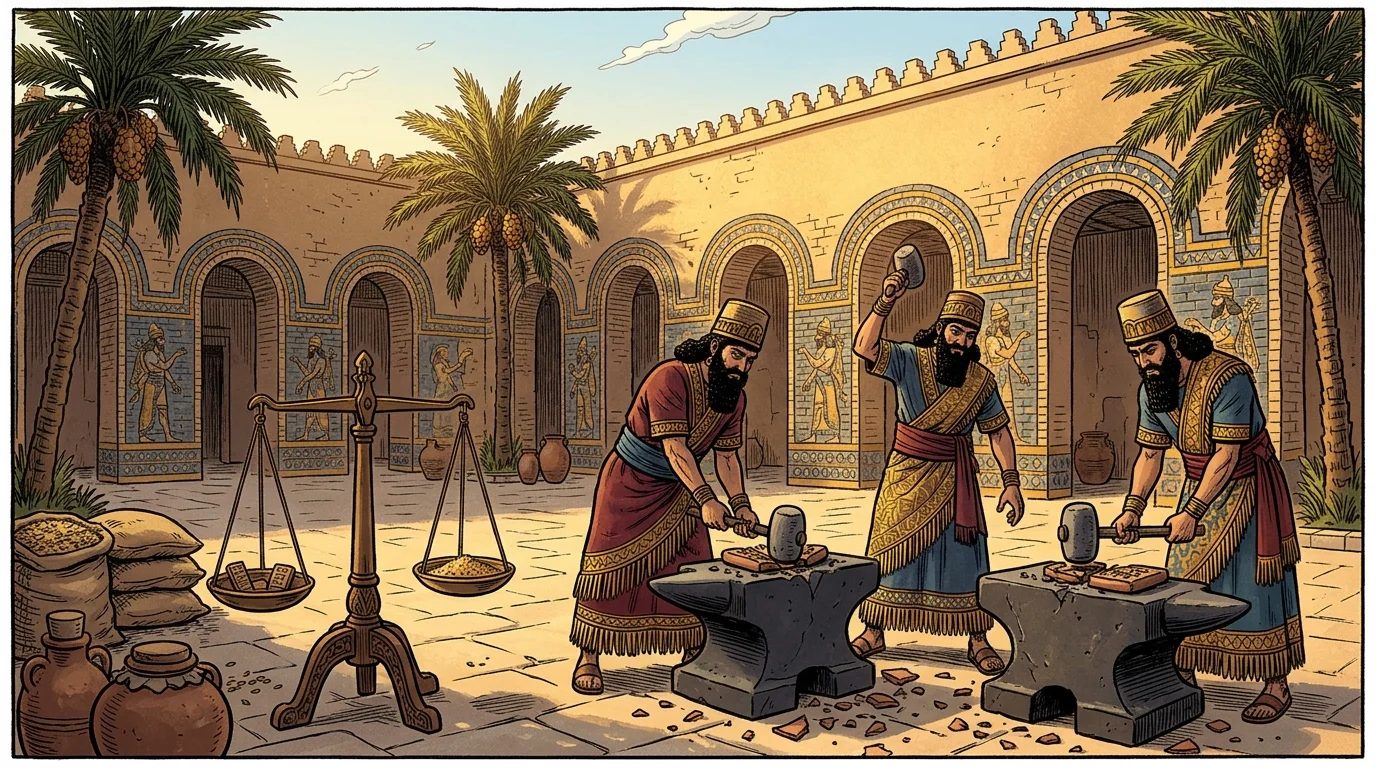
To prevent the concentration of land and labor in the hands of the creditor class, Old Babylonian kings proclaimed a mīšarum (“equity” or “justice”) upon ascending the throne and periodically thereafter at intervals of roughly seven to fifteen years. When the king “raised the golden torch” to announce a mīšarum, royal commissioners convened in every city to audit and smash invalid loan tablets (ṭuppamḫepûm, literally “breaking the clay tablets”).
While Hammurabi and Samsu-iluna recorded multiple mīšarum decrees in their year-names and administrative letters, the most complete surviving text is the 22-clause Edict of Ammi-saduqa, promulgated on the accession of King Ammi-saduqa around 1646 BCE. Its provisions reveal the surgical precision of Babylonian debt relief:
- Cancellation of Agrarian Arrears and Consumer Loans (§§1–4): All outstanding back-taxes and commodity arrears owed to the palace by tenant cultivators, shepherds, and tributary workers—along with private interest-bearing loans of silver and barley (ḫubullum) extended to any “Akkadian or Amorite” citizen—were declared null and void, and their clay tablets were ordered broken.
- Punishment for Disguised Consumer Loans (§§5–7): If a creditor had pressured a farmer early or drafted a fraudulent tablet disguising an interest-bearing consumer loan as a commercial sale or advance purchase to bypass an anticipated royal mīšarum, the borrower could swear an oath before the city judges; the tablet was smashed and a creditor who still attempted to collect faced the death penalty.
- Exemption of Commercial Venture Capital (§§8–9): Crucially, the edict explicitly exempted genuine commercial loans and business partnerships. If an Akkadian or Amorite received silver, barley, or merchandise for a trading expedition (ḫarrānum), as a joint-venture equity partnership (tappûtum), or as working capital advanced between merchants, its tablet was not broken and had to be repaid according to the original contract.
- Emancipation of Debt-Bondservants (§§20–21): Any free citizen of Babylon, Sippar, Larsa, Ur, Uruk, or Isin who had sold himself, his wife, or his children into debt servitude or been seized as a pledge for unpaid silver or barley debts was immediately freed (“because the king has instituted mīšarum in the land”), whereas house-born chattel slaves were excluded from release.
By drawing a clear legal boundary between predatory agrarian debt (ḫubullum) and productive mercantile investment (tappûtum and ḫarrānum), the Old Babylonian kings preserved their tax-paying peasantry and citizen army without freezing long-distance trade in tin, copper, and textiles.
Theoretical & Balance-Sheet Transmission Mechanism
In the Kindleberger–Minsky taxonomy of financial instability (Kindleberger, 1978; Minsky, 1986) and Irving Fisher’s (1933) debt-deflation framework, speculative asset booms become systemic crises when credit expansion shifts balance sheets from hedge finance (cash flows covering principal and interest) to speculative and Ponzi finance (relying on rising asset prices and short-term margin roll-overs).
Once monetary tightening or an exogenous shock halts price appreciation, forced margin liquidations trigger Fisherian debt-deflation: fire-sale asset discounts erode bank collateral values, contracting credit supply across the real economy.
Sources and Further Reading
- L. W. King (trans.), “ The Code of Hammurabi,” Avalon Project, Yale Law School, 2008. Peer-Reviewed / Academic Research
- Hanover Historical Texts Project, “ Code of Hammurabi: Selected Economic and Commercial Laws,” Hanover College Department of History, 1998. Peer-Reviewed / Academic Research
- Encyclopedia.com Historical Archives, “ Ammi-saduqa and the Royal Edict of Debt Cancellation,” Gale / Cengage Reference, 2019. Historical & Financial Reference
- Encyclopedia.com Historical Archives, “ Justice and Reform in Ancient Mesopotamia: Misharum Edicts,” Gale / Cengage Reference, 2019. Historical & Financial Reference
- Encyclopedia.com Historical Archives, “ Money, Prices, and Banking in Ancient Mesopotamia,” Gale / Cengage Reference, 2019. Historical & Financial Reference
- Encyclopedia.com Reference Library, “ Moneylending: Ancient Near Eastern Credit and Interest Practices,” Gale / Cengage Reference, 2019. Historical & Financial Reference
- Irving Fisher — "The Debt-Deflation Theory of Great Depressions," Econometrica 1, no. 4 (FRASER Federal Reserve Archive, 1933): 337–357 Central Bank / Monetary Authority
- Charles P. Kindleberger & Robert Z. Aliber — Manias, Panics, and Crashes: A History of Financial Crises (Palgrave Macmillan) Peer-Reviewed / Academic Research
Cite This Historical Dossier (APA / Chicago)
APA (7th ed.): Ç., S. (Ed.). (2026). Hammurabi's Interest Caps, Misharum Debt Edicts, and Babylonian Merchants. In Forgotten Fortunes Historical Monograph Series (Forgotten Fortunes Editorial Desk). https://forgottenfortunes.net/hammurabi-interest-caps-debt-relief/
MLA (9th ed.): Ç., Soner, ed. "Hammurabi's Interest Caps, Misharum Debt Edicts, and Babylonian Merchants." Forgotten Fortunes: Financial & Monetary History Archive, 2026, https://forgottenfortunes.net/hammurabi-interest-caps-debt-relief/.
Chicago (17th ed.): Ç., Soner, ed. "Hammurabi's Interest Caps, Misharum Debt Edicts, and Babylonian Merchants." Forgotten Fortunes Historical Monograph Series (Forgotten Fortunes Editorial Desk), September 15, 2026. https://forgottenfortunes.net/hammurabi-interest-caps-debt-relief/.
Have an idea for another financial history documentary or article? Request a story →