In This Article
On Sunday, July 1, 1990—three months before the formal political reunification of Germany—the West German Deutsche Mark (DM) became the sole legal tender of the German Democratic Republic (GDR), replacing the East German Mark (Mark der DDR, colloquially called the Ostmark). Executed under the State Treaty Establishing a Monetary, Economic and Social Union (Staatsvertrag) signed on May 18, 1990, the currency changeover transferred monetary sovereignty over East Germany to the Deutsche Bundesbank in Frankfurt. While the overnight conversion of roughly 24.7 million East German accounts and the physical delivery of DM 28 billion in banknotes represented a historic logistical triumph, the political decision by Chancellor Helmut Kohl’s government to convert recurring wages, salaries, pensions, and core household savings at a 1:1 exchange rate overrode the economic warnings of Bundesbank President Karl Otto Pöhl. The resulting real appreciation shock priced East German industry out of domestic and foreign markets almost overnight, necessitated vast fiscal transfers, and drove Bundesbank interest-rate tightening that strained the European Exchange Rate Mechanism (ERM). [1]

From the Fall of the Berlin Wall to Kohl’s February 1990 Offer
Following the opening of the Berlin Wall on November 9, 1989, the decaying economic reality of the German Democratic Republic triggered a mass exodus of East German citizens into the Federal Republic of Germany. By January 1990 alone, roughly 300,000 GDR citizens had resettled in West Germany, threatening to overwhelm West German municipalities while stripping East Germany of skilled labor. On the streets of Leipzig, Dresden, and East Berlin, demonstrators summarized their demand in a famous chant: “Kommt die D-Mark, bleiben wir – kommt sie nicht, geh’n wir zu ihr!” (“If the D-Mark comes, we stay; if it doesn’t, we go to it!”). [2]
Confronted with this demographic emergency and seeking to lock in rapid political unification ahead of East Germany’s March 1990 Volkskammer elections, West German Chancellor Helmut Kohl announced on February 6, 1990 that Bonn would offer immediate negotiations on a German economic and monetary union. The political announcement caught the leadership of the Deutsche Bundesbank by surprise. Bundesbank President Karl Otto Pöhl and the West German Council of Economic Experts had repeatedly argued that monetary union should serve as the crowning final step of gradual economic convergence and price reform rather than its opening act, warning that abolishing the exchange rate between two economies with vastly different productivity levels would strip East Germany of its only macroeconomic shock absorber. [3]
| Documented Figure / Metric | Historical Significance & Archival Context |
|---|---|
| 60 percent | Industrial output in eastern Germany plunged by more than 60 percent within a year, and open and hidden unemployment soared into the millions. |
| 4 percent | This deficit-financed demand boom pushed unified German inflation above 4 percent by 1991–1992. |
The Exchange Rate Debate and the May 1990 State Treaty
Once political momentum made an early currency union inevitable, fierce debate centered on the conversion rate between the Mark der DDR and the Deutsche Mark. In the GDR’s state-administered foreign trade accounts, East German combines had effectively required between 4.0 and 4.4 Ostmarks to earn 1 Deutsche Mark in Western export markets (referred to internally as the Richtungskoeffizient), while black-market and border exchange rates for cash fluctuated between 5:1 and 10:1. [4]
Reflecting this enormous productivity gap, the Bundesbank recommended a general conversion rate of 2:1 across both stock variables (savings and debts) and flow variables (wages and prices), arguing that a 1:1 conversion of wages would devastate East German competitiveness while an overly generous conversion of bank deposits would swell the money supply and stoke inflation. However, East German citizens and politicians—supported by West German political leaders worried about continued westward migration—insisted on a 1:1 conversion, noting that at a 2:1 rate average East German nominal wages would have fallen below 20 percent of West German levels. [5]
Signed in Bonn on May 18, 1990 by West German Finance Minister Theo Waigel and East German Finance Minister Walter Romberg, the Staatsvertrag codified a politically negotiated compromise that took effect on July 1, 1990: [6]
- 1:1 conversion for flows: All recurring payments—including wages, salaries, pensions, scholarships, leases, and rents—were converted from Ostmarks into Deutsche Marks at par (1:1).
- Graduated 1:1 caps for household savings: Personal bank deposits held by GDR residents were converted at 1:1 up to strict age-tiered ceilings: up to 2,000 Marks for children aged 14 and under; up to 4,000 Marks for working-age adults aged 15 to 59; and up to 6,000 Marks for senior citizens aged 60 and older.
- 2:1 conversion for excess balances and enterprise debts: Household savings above the age-based allowances, corporate deposits, and all domestic bank loans and state enterprise debts were converted at a rate of 2 Ostmarks for 1 Deutsche Mark (with speculative balances acquired shortly before the cutoff converted at 3:1).
Weighted across all converted deposit categories, the average stock conversion rate worked out to roughly 1.8 Ostmarks per Deutsche Mark, expanding the broad German money supply (M3) by roughly DM 180 billion—about 15 percent, slightly above the ~10 percent productive output share of the GDR—and increasing currency in circulation by DM 8.5 billion (just under 6 percent) during July 1990. [7]
Operation July 1, 1990: The Bundesbank’s Logistical Mobilization
Whatever its reservations over the conversion terms, the Bundesbank executed the physical and accounting transition with extraordinary precision. Because Ostmark cash could not simply be exchanged across bank counters without verifying each citizen’s age-tiered 1:1 quota, all conversions had to be routed through bank accounts—forcing authorities to convert roughly 24.7 million deposit accounts held by 16 million GDR residents overnight on June 30–July 1, 1990. [8]
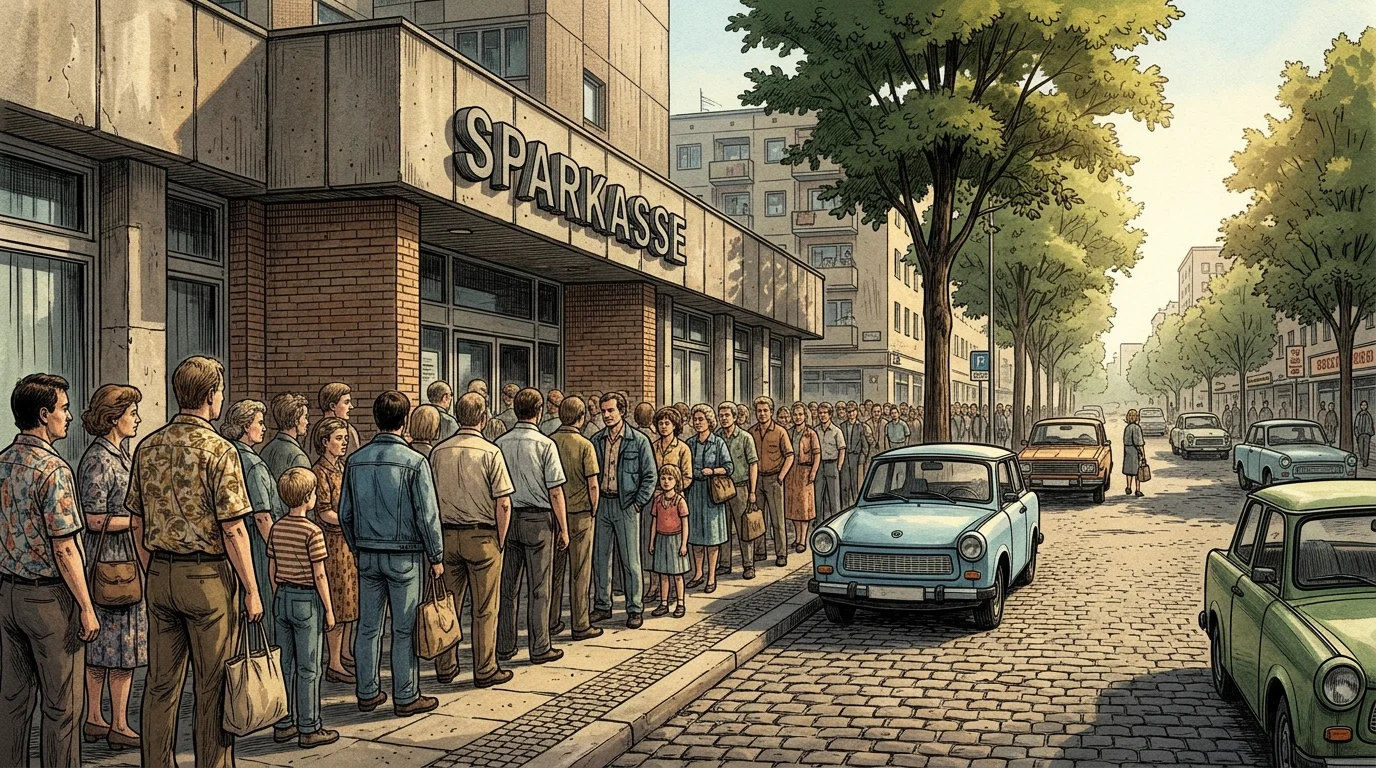
In the weeks preceding July 1, the Bundesbank established 15 provisional branches across the GDR staffed largely by former employees of the East German Staatsbank. Under heavy security, convoys of armored trucks and cargo aircraft transported roughly 440 million banknotes and 102 million coins—weighing more than 1,000 metric tons and valued at approximately DM 28 billion—into East German vaults. On Sunday morning, July 1, 1990, tens of thousands of East Germans queued outside savings banks (Sparkassen), schools, and town halls to withdraw their initial cash payouts in crisp Deutsche Mark notes.
The 300–400% Real Appreciation Shock and the Treuhandanstalt
For East German consumers and retirees, the 1:1 conversion delivered an immediate windfall in purchasing power, as Western automobiles, electronics, food, and travel became instantly accessible in hard currency. For East German producers, however, the monetary union triggered an unprecedented cost and competitiveness collapse.
As economist Hans-Werner Sinn documented, converting East German wages and domestic costs at 1:1—compared with the pre-unification implicit trade exchange rate of roughly 4.3 Ostmarks per Deutsche Mark—amounted to an overnight real appreciation of 300 to 400 percent for East German tradable goods. Simultaneously, East German households abandoned domestically produced goods in favor of Western imports, while traditional export markets in the Soviet Union and Eastern Europe disintegrated as COMECON trade shifted to hard-currency settlement.
Making matters worse for industrial viability, West German trade unions and employer associations rapidly negotiated multi-year collective bargaining agreements in 1990–1991 aimed at equalizing East and West German nominal wages regardless of underlying productivity. Industrial output in eastern Germany plunged by more than 60 percent within a year, and open and hidden unemployment soared into the millions. The burden of managing the insolvent state-owned combines (Kombinate) fell to the Treuhandanstalt, the public privatization agency charged with restructuring, selling, or liquidating roughly 8,000 to 12,000 East German enterprises. Rather than generating the privatization surpluses initially envisioned by policymakers, the Treuhandanstalt had to subsidize restructured firms and environmental cleanups, ultimately winding down in 1994 with a cumulative deficit exceeding DM 250 billion.
Fiscal Transfers, Bundesbank Tightening, and the 1992–1993 ERM Crisis
Because the 1:1 conversion and subsequent wage convergence destroyed the eastern tax base while entitling East German workers to West German unemployment benefits and pensions, Bonn financed reunification through massive public borrowing—beginning with the credit-financed “German Unity Fund” (Fonds Deutsche Einheit) and annual West-to-East fiscal transfers exceeding DM 140 billion per year.
This deficit-financed demand boom pushed unified German inflation above 4 percent by 1991–1992. Determined to defend the internal stability of the Deutsche Mark, the Bundesbank raised its discount rate to a post-war high of 8.75 percent (and the Lombard rate to 9.75 percent) in July 1992. Because the Deutsche Mark served as the anchor currency of the European Monetary System, the Bundesbank’s high interest rates forced partner countries in the European Exchange Rate Mechanism (ERM) to choose between crippling domestic interest rates during a recession or abandoning their currency pegs. The resulting pressure culminated in the September 1992 “Black Wednesday” exit of the British pound and Italian lira from the ERM and the August 1993 widening of ERM fluctuation bands—accelerating European leaders’ political determination under the Maastricht Treaty to replace national currencies, including the Deutsche Mark itself, with the euro.
Theoretical & Balance-Sheet Transmission Mechanism
In the Kindleberger–Minsky taxonomy of financial instability (Kindleberger, 1978; Minsky, 1986) and Irving Fisher’s (1933) debt-deflation framework, speculative asset booms become systemic crises when credit expansion shifts balance sheets from hedge finance (cash flows covering principal and interest) to speculative and Ponzi finance (relying on rising asset prices and short-term margin roll-overs).
Once monetary tightening or an exogenous shock halts price appreciation, forced margin liquidations trigger Fisherian debt-deflation: fire-sale asset discounts erode bank collateral values, contracting credit supply across the real economy.
Sources and Further Reading
- Deutsche Bundesbank, “ German Monetary Union: Historical Background,” Deutsche Bundesbank, 2015-07-01. Central Bank / Monetary Authority
- Deutsche Bundesbank, “ Circulation of the Deutsche Mark – From Currency Reform to European Monetary Union,” Deutsche Bundesbank Monthly Report, 2002-03. Central Bank / Monetary Authority
- Jens Weidmann, “ Von der Mark der DDR über die D-Mark zum Euro – der 1. Juli 1990,” Deutsche Bundesbank / Der Tagesspiegel, 2015-06-28. Central Bank / Monetary Authority
- Hans-Werner Sinn, “ International Implications of German Unification,” Center for Economic Studies (CES) Working Paper No. 117, University of Munich, 1996-08. Peer-Reviewed / Academic Research
- Deutsches Historisches Museum, “ The Monetary and Economic Union,” Deutsches Historisches Museum Berlin, 1990. Historical & Financial Reference
- German Historical Institute, “ Monetary Union: Waiting to Exchange Money (July 1, 1990),” German History in Documents and Images (GHDI), 1990-07-01. Historical & Financial Reference
- Irving Fisher — "The Debt-Deflation Theory of Great Depressions," Econometrica 1, no. 4 (FRASER Federal Reserve Archive, 1933): 337–357 Central Bank / Monetary Authority
- Charles P. Kindleberger & Robert Z. Aliber — Manias, Panics, and Crashes: A History of Financial Crises (Palgrave Macmillan) Peer-Reviewed / Academic Research
Cite This Historical Dossier (APA / Chicago)
APA (7th ed.): Ç., S. (Ed.). (2026). The 1990 German Monetary Union and the 1:1 Ostmark–Deutsche Mark Conversion. In Forgotten Fortunes Historical Monograph Series (Forgotten Fortunes Editorial Desk). https://forgottenfortunes.net/1990-german-monetary-union/
MLA (9th ed.): Ç., Soner, ed. "The 1990 German Monetary Union and the 1:1 Ostmark–Deutsche Mark Conversion." Forgotten Fortunes: Financial & Monetary History Archive, 2026, https://forgottenfortunes.net/1990-german-monetary-union/.
Chicago (17th ed.): Ç., Soner, ed. "The 1990 German Monetary Union and the 1:1 Ostmark–Deutsche Mark Conversion." Forgotten Fortunes Historical Monograph Series (Forgotten Fortunes Editorial Desk), September 9, 2026. https://forgottenfortunes.net/1990-german-monetary-union/.
Have an idea for another financial history documentary or article? Request a story →