In This Article
During the summer of 1992, the Italian Republic confronted the most acute monetary and fiscal emergency of its postwar history. Caught between a public debt exceeding 100 percent of gross domestic product, dwindling foreign exchange reserves at the Banca d’Italia, and relentless speculative pressure within the European Exchange Rate Mechanism (ERM), the newly installed government of Prime Minister Giuliano Amato resorted to extraordinary measures. On the night of July 9–10, 1992, the Cabinet approved an emergency decree that retroactively confiscated 0.6 percent—six parts per thousand, or sei per mille—from the balance of every bank and postal account in the country. Weeks later, the government secured the definitive abolition of the scala mobile, Italy’s forty-six-year-old automatic wage-indexation system. Yet even these unprecedented domestic sacrifices could not save the currency peg: in September 1992, after a 7 percent realignment failed to stem the tide, the lira was forced out of the ERM altogether, inaugurating a turbulent four-year float that only ended when Romano Prodi and Carlo Azeglio Ciampi engineered Italy’s return to the exchange rate mechanism at 990 lire per Deutsche Mark and locked the currency into the euro at 1,936.27 lire. [1]
The Fragile Architecture of the Narrow Band (1990–1992)
Italy had been a founding member of the European Monetary System (EMS) in March 1979, initially negotiating a wide fluctuation band of plus or minus 6 percent around its central bilateral parities. That wider cushion accommodated an economy whose inflation rate and fiscal deficits consistently exceeded those of West Germany. Throughout the 1980s, Italian policymakers used periodic negotiated realignments to offset cumulative losses in export competitiveness while relying on the external discipline of the EMS—what Governor Carlo Azeglio Ciampi and Treasury officials called the vincolo esterno, or external constraint—to modernize domestic industry. [2]
In January 1990, seeking to anchor inflation expectations ahead of the negotiations for Economic and Monetary Union (EMU), Italy voluntarily relinquished its 6 percent margin and entered the standard narrow ERM fluctuation band of plus or minus 2.25 percent, with a central parity fixed at 748.217 lire per Deutsche Mark. Within months, Italy also completed the abolition of its remaining controls on cross-border capital movements. The combination of full capital mobility, a narrow exchange-rate band, and persistent structural imbalances left the lira acutely exposed. Between 1989 and 1992, Italian consumer price inflation averaged more than 6 percent annually—roughly double the German rate—causing a pronounced real appreciation of the lira and a deteriorating current account balance. [3]
At the same time, Italian public finances were spiraling toward unsustainable territory. Driven by high nominal interest rates on short-term Treasury bills (Buoni Ordinari del Tesoro, or BOT) and chronic primary deficits, general government debt crossed 100 percent of GDP in 1991, while the annual budget deficit remained above 10 percent of GDP. When the Maastricht Treaty was signed in February 1992, establishing strict convergence thresholds of a 3 percent deficit-to-GDP ratio and a 60 percent debt-to-GDP ratio for entry into the single currency, currency traders immediately questioned how Italy could sustain its ERM parity without a punitive recession. [4]
Two external shocks in mid-1992 turned structural vulnerability into an immediate crisis. First, on June 2, 1992, Danish voters rejected the Maastricht Treaty in a national referendum, shattering market assumptions that European monetary union was an inevitable, seamless process. Second, the Deutsche Bundesbank, confronting inflationary pressures stemming from the massive fiscal transfers of German reunification, tightened monetary policy relentlessly, raising its discount rate to a postwar peak of 8.75 percent on July 16, 1992. As capital flowed into Frankfurt and the US dollar weakened, high-debt European economies pegged to the Deutsche Mark faced a brutal monetary squeeze. [5]
| Documented Figure / Metric | Historical Significance & Archival Context |
|---|---|
| 8.75 percent | Second, the Deutsche Bundesbank, confronting inflationary pressures stemming from the massive fiscal transfers of German reunification, tightened monetary policy relentlessly, raising its discount rate to a postwar peak of 8.75 percent on July 16, 1992. |
| 5.2 trillion lire | Italian banks and the postal system automatically debited 6,000 lire for every million lire on deposit and remitted the proceeds to the Treasury, yielding roughly 5.2 trillion lire in immediate cash revenue. |
| 2.25 percent | Under ERM rules, when the lira hit the floor of its 2.25 percent fluctuation band at roughly 765.40 lire per mark, both the Banca d'Italia and the Bundesbank were obligated to intervene. |
| 15 percent | On September 4, 1992, the Banca d'Italia raised its official discount rate by 1.75 percentage points to 15 percent and pushed the fixed-term advance rate to 16.5 percent, driving overnight interbank rates past 30 percent. |
The Night of July 9–10, 1992: The 0.6% Levy and the End of the Scala Mobile
Giuliano Amato, a Socialist constitutional scholar and former Treasury undersecretary known as the Dottor Sottile for his analytical precision, was sworn in as Prime Minister on June 28, 1992, at the head of a fragile four-party coalition. Simultaneously, the Mani Pulite (Clean Hands) anti-corruption investigations in Milan were dismantling Italy’s traditional political establishment, while Mafia bombings in Sicily—which claimed the lives of anti-Mafia magistrates Giovanni Falcone in May and Paolo Borsellino in July—deepened the sense of national siege. [6]
Presented with confidential Banca d’Italia projections showing that foreign reserves were hemorrhaging and that Treasury bond auctions risked failing to find buyers, Amato convened an emergency late-night Cabinet meeting on July 9–10, 1992. The resulting Decree-Law No. 333 of July 11, 1992 (Misure urgenti per il risanamento della finanza pubblica) enacted an immediate 30-trillion-lira fiscal correction. Its most shocking provision, Article 7, imposed a one-off extraordinary tax of 6 per mille (0.6 percent) on all bank checking accounts, savings passbooks, and postal deposits held across Italy. [7]
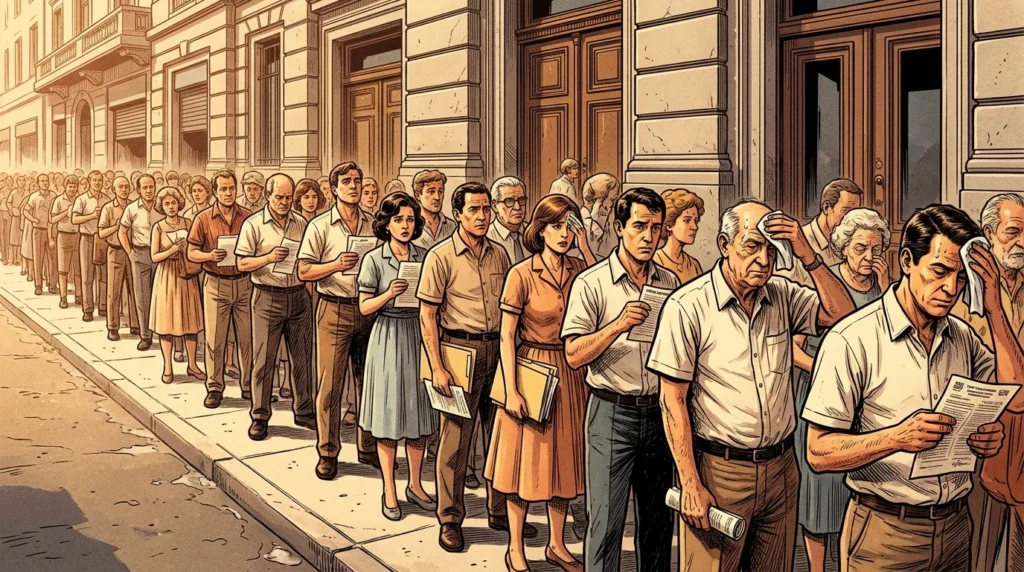
To prevent a panicked midnight run on automated teller machines or morning bank counters, the levy was made retroactive to the accounting balances recorded at the close of business on July 9, 1992. Italian banks and the postal system automatically debited 6,000 lire for every million lire on deposit and remitted the proceeds to the Treasury, yielding roughly 5.2 trillion lire in immediate cash revenue. The same decree introduced an extraordinary real estate tax (Imposta Straordinaria Immobiliare, or ISI) equal to 2 to 3 per mille of cadastral property values—the direct precursor to Italy’s permanent municipal property tax—raised pension contribution rates, froze public-sector hiring, and launched the transformation of major state holding conglomerates, including IRI, ENI, INA, and ENEL, into joint-stock companies slated for privatization. [8]
Three weeks after the overnight deposit tax, Amato achieved a second historic breakthrough. Since 1946, Italian wages had been automatically adjusted to consumer price increases through the scala mobile, an indexation mechanism that had been reinforced in 1975 by an egalitarian flat-point agreement between Confindustria and the labor unions, embedding a self-perpetuating wage-price spiral into the Italian economy. Following a 1984 referendum that had partially curbed indexation points under Bettino Craxi, the system had remained a potent driver of inflation differentials with Germany. On July 31, 1992, Amato, employers’ federation Confindustria, and the three major trade union confederations—CGIL, CISL, and UIL, led in dramatic negotiations by CGIL general secretary Bruno Trentin—signed a landmark tripartite protocol that permanently abolished the scala mobile and suspended firm-level wage bargaining through 1993.
Black Wednesday and the September 1992 ERM Suspension
Despite the political audacity of the July fiscal decree and the abolition of wage indexation, international currency markets remained convinced that the lira’s central rate of 748.217 per Deutsche Mark was indefensible. Throughout August 1992, as tensions built ahead of France’s September 20 referendum on the Maastricht Treaty, hedge funds and institutional desks sold lire heavily against the Deutsche Mark. Under ERM rules, when the lira hit the floor of its 2.25 percent fluctuation band at roughly 765.40 lire per mark, both the Banca d’Italia and the Bundesbank were obligated to intervene.
Governor Carlo Azeglio Ciampi mounted a fierce defense. On September 4, 1992, the Banca d’Italia raised its official discount rate by 1.75 percentage points to 15 percent and pushed the fixed-term advance rate to 16.5 percent, driving overnight interbank rates past 30 percent. Over the summer and early autumn of 1992, the Italian central bank expended roughly $24 billion—equivalent to more than 40 trillion lire—in foreign currency reserves and short-term ERM financing lines to prop up the currency. Yet higher interest rates directly worsened Italy’s fiscal arithmetic: because the bulk of Italy’s 1,600-trillion-lira public debt rolled over within twelve months, every percentage-point hike in BOT yields added over 13 trillion lire to annual debt-service costs, convincing speculators that the defense was self-defeating.
Over the weekend of September 12–13, 1992, follow-up negotiations between Italian and German monetary authorities produced a bilateral ERM realignment: effective Monday, September 14, the lira’s central parity was devalued by 7 percent—structured technically as a 3.5 percent devaluation of the lira and a 3.5 percent revaluation of the other ERM currencies—accompanied by a modest 0.25 percentage-point cut in the Bundesbank’s discount rate. Far from calming the markets, the 7 percent adjustment signaled that the decades-old parity grid had cracked. Within forty-eight hours, the lira plunged straight to the floor of its new band while George Soros’s Quantum Fund and global macro traders turned their full firepower on the British pound and the Italian lira.
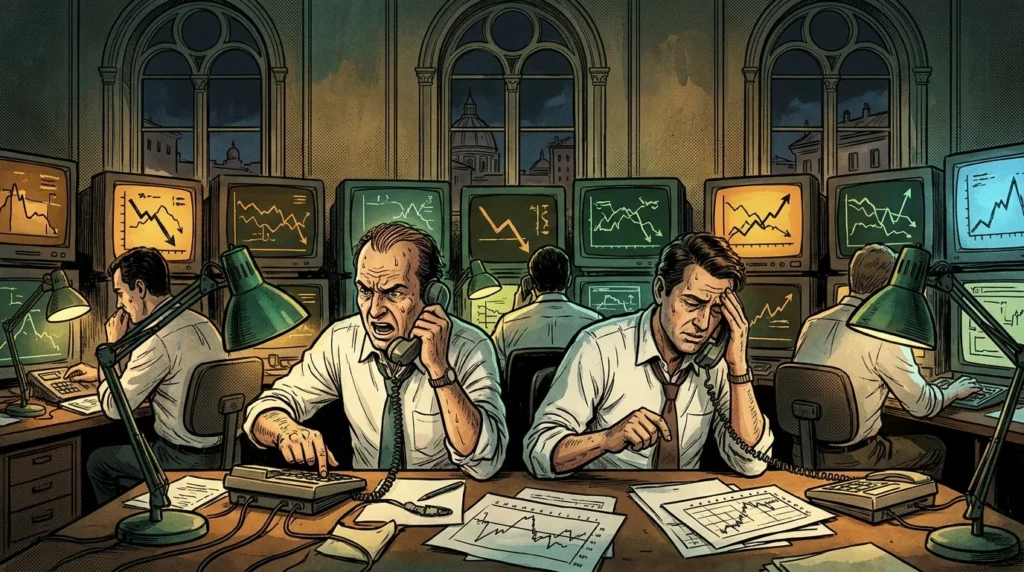
On the night of September 16–17, 1992—remembered across Europe as Black Wednesday—the Monetary Committee of the European Community met in emergency session in Brussels. Hours after UK Chancellor of the Exchequer Norman Lamont pulled sterling out of the ERM, Italy formally suspended the lira’s participation in the exchange rate mechanism and allowed the currency to float freely. The next day, Amato returned to Parliament with an unprecedented 93-trillion-lira (roughly 5.8 percent of GDP) structural budget correction for 1993, combining sweeping pension age increases, healthcare co-payments, local tax autonomy, and steep spending cuts to prevent the currency devaluation from degenerating into a sovereign debt default.
The Floating Lira and the Ciampi Incomes Policy (1993–1995)
Freed from its ERM peg, the lira depreciated sharply, falling by roughly 20 percent against the Deutsche Mark by the end of 1992 and sliding past 1,200 lire per mark during the Mexican peso shock and Italian political turbulence of early 1995. In previous decades, a devaluation of that magnitude would have ignited double-digit domestic inflation through automatic wage adjustments. Instead, the institutional reforms of 1992–1993 transformed the devaluation into an export-led stabilization.
In April 1993, following Amato’s resignation, President Oscar Luigi Scalfaro appointed Bank of Italy Governor Carlo Azeglio Ciampi as the first non-parliamentarian Prime Minister in modern Italian history. On July 23, 1993, Ciampi’s government concluded a permanent tripartite social pact with Confindustria and the labor unions that replaced the defunct scala mobile with a two-tier collective bargaining framework anchored to official target inflation rates, while establishing the independence of the Banca d’Italia by abolishing the Treasury’s overdraft facility. Because nominal wage growth remained disciplined even as the lira fell, Italian consumer price inflation actually declined from 5.3 percent in 1992 to 4.0 percent in 1994, while booming manufacturing exports turned a chronic current account deficit into a surplus exceeding 2.5 percent of GDP by 1995.
Prodi, Ciampi, the 1996 ERM Re-Entry, and the 1,936.27 Euro Lock
When Romano Prodi took office as Prime Minister in May 1996 with Ciampi serving as Minister of the Treasury and Budget, Italy’s exclusion from the first wave of the single currency appeared virtually certain to northern European governments. Italy’s budget deficit still stood at 6.7 percent of GDP in 1996, and the lira remained outside the ERM—whereas the Maastricht Treaty required at least two years of stable ERM participation and a deficit at or below 3.0 percent of GDP in the 1997 reference year.
After Spanish Prime Minister José María Aznar rejected Prodi’s September 1996 proposal for a coordinated Southern European postponement during a meeting in Valencia, Prodi and Ciampi committed Italy to an all-out fiscal sprint to qualify for the euro from day one. First, during a marathon negotiation in Brussels on November 24–25, 1996, Ciampi and Bank of Italy Governor Antonio Fazio secured the lira’s formal re-entry into the ERM after a fifty-month absence. Resisting French and German pressure for a punitive parity around 940 to 950 lire, Ciampi negotiated a central rate of exactly 990 lire per Deutsche Mark, striking a sustainable balance between export competitiveness and disinflation.
Second, in late December 1996, the Prodi government supplemented its 1997 Finance Law with an emergency 25-trillion-lira fiscal package aimed squarely at hitting the 3.0 percent Maastricht deficit limit. Its centerpiece was the Contributo straordinario per l’Europa—universally dubbed the “Eurotax” (Eurotassa)—a progressive one-off income tax surcharge ranging from 1.5 percent to 3.5 percent on 1996 personal incomes, paired with a pledge configured by the government to partially refund the levy once entry was secured. As market confidence surged in 1997, the yield spread between ten-year Italian Buoni del Tesoro Poliennali (BTPs) and German Bunds collapsed from more than 600 basis points in 1995 to under 40 basis points by early 1998, slashing Treasury interest expenditures and compressing Italy’s 1997 fiscal deficit to precisely 2.7 percent of GDP.
In May 1998, the European Council confirmed Italy among the eleven founding members of Economic and Monetary Union. On December 31, 1998, consistent with the 990 lire per Deutsche Mark central parity, the Council of the European Union fixed the irrevocable conversion rate between the euro and the Italian lira at 1,936.27 lire per euro, effective January 1, 1999. The traumas of July and September 1992—from the midnight 0.6 percent bank levy to the humiliation of Black Wednesday—had ultimately dismantled Italy’s postwar inflationary regime and forged the fiscal and institutional architecture that carried the lira into the single European currency.
Theoretical & Balance-Sheet Transmission Mechanism
In the Kindleberger–Minsky taxonomy of financial instability (Kindleberger, 1978; Minsky, 1986) and Irving Fisher’s (1933) debt-deflation framework, speculative asset booms become systemic crises when credit expansion shifts balance sheets from hedge finance (cash flows covering principal and interest) to speculative and Ponzi finance (relying on rising asset prices and short-term margin roll-overs).
Once monetary tightening or an exogenous shock halts price appreciation, forced margin liquidations trigger Fisherian debt-deflation: fire-sale asset discounts erode bank collateral values, contracting credit supply across the real economy.
Sources and Further Reading
- Marco Bassetto, “ Fiscal Policy and Price Stability: The Case of Italy, 1992–98,” Federal Reserve Bank of Chicago (Chicago Fed Letter No. 233), December 2006. Central Bank / Monetary Authority
- Jakub Szabó, “ A choice for European monetary integration: politics of exchange rates between EMS and EMU,” Review of Evolutionary Political Economy, 2026. Peer-Reviewed / Academic Research
- Agenzia delle Entrate, “ Le imposte patrimoniali in Italia. Un secolo di prelievi intermittenti,” Fisco Oggi, 2020. Historical & Financial Reference
- Confederazione Generale Italiana del Lavoro (CGIL), “ 1992, gli accordi sulla scala mobile e la svolta delle relazioni industriali,” Archivio Storico CGIL, 2026. Historical & Financial Reference
- Il Sole 24 Ore, “ Firenze, 21-22 giugno 1996: Prodi e Ciampi preparano l’entrata dell’Italia nell’euro,” Il Sole 24 Ore, 2014-05-05. Historical & Financial Reference
- Ministero dell’Economia e delle Finanze (MEF), “ Tasso di conversione in euro della lira italiana,” Ministero dell’Economia e delle Finanze, 1998-12-31. Official / State Archive
- Irving Fisher — "The Debt-Deflation Theory of Great Depressions," Econometrica 1, no. 4 (FRASER Federal Reserve Archive, 1933): 337–357 Central Bank / Monetary Authority
- Charles P. Kindleberger & Robert Z. Aliber — Manias, Panics, and Crashes: A History of Financial Crises (Palgrave Macmillan) Peer-Reviewed / Academic Research
Cite This Historical Dossier (APA / Chicago)
APA (7th ed.): Ç., S. (Ed.). (2026). Italy's 1992 Lira ERM Crisis, the Amato 0.6% Deposit Levy, and the Road to the Euro. In Forgotten Fortunes Historical Monograph Series (Forgotten Fortunes Editorial Desk). https://forgottenfortunes.net/italy-1992-lira-erm-crisis/
MLA (9th ed.): Ç., Soner, ed. "Italy's 1992 Lira ERM Crisis, the Amato 0.6% Deposit Levy, and the Road to the Euro." Forgotten Fortunes: Financial & Monetary History Archive, 2026, https://forgottenfortunes.net/italy-1992-lira-erm-crisis/.
Chicago (17th ed.): Ç., Soner, ed. "Italy's 1992 Lira ERM Crisis, the Amato 0.6% Deposit Levy, and the Road to the Euro." Forgotten Fortunes Historical Monograph Series (Forgotten Fortunes Editorial Desk), September 9, 2026. https://forgottenfortunes.net/italy-1992-lira-erm-crisis/.
Have an idea for another financial history documentary or article? Request a story →