In This Article
In early 215 CE, facing soaring military expenditures along the northern and eastern frontiers, the Severan Emperor Caracalla (Marcus Aurelius Antoninus, r. 211–217 CE) introduced a new silver denomination into the Roman monetary system. Known to modern numismatists as the antoninianus—and visually distinguished by the radiate solar crown atop the emperor’s portrait—the coin was tariffed by the state at two denarii despite weighing only about one-and-a-half times a single denarius. Over the next six decades of political fragmentation and foreign invasions known as the Crisis of the Third Century, successive emperors used the antoninianus to stretch dwindling bullion reserves until Roman silver currency collapsed into a copper-core billon token containing less than 2 percent silver—a spiral that culminated in the bloody Rome mint workers’ rebellion and Emperor Aurelian’s sweeping monetary reform of 274 CE. [1]

Severan Military Finance and the Birth of the Antoninianus (215 CE)
The structural roots of the antoninianus lay in the fiscal compact between the Severan dynasty and the Roman legions. When Septimius Severus (r. 193–211 CE) seized the throne after the civil wars of 193–197 CE, he expanded the standing army to thirty-three legions and raised base legionary pay for the first time since Domitian, increasing the annual stipend from 300 to roughly 400 or 500 denarii. To fund these commitments without exhausting the treasury, Septimius Severus in 194 CE debased the silver denarius from roughly 68–75 percent down to approximately 46–50 percent pure silver. [2]
After murdering his brother Geta in late 211 CE, Caracalla secured the loyalty of the troops by raising legionary pay by a further 50 percent—to around 600 or 750 denarii per year—while showering the Praetorian Guard and frontier armies with extravagant cash donatives (donativa). Rather than immediately cutting the silver fineness of the denarius below the psychologically sensitive 50 percent threshold, Caracalla’s treasury officials devised a subtler fiscal mechanism in 215 CE: [3]
- Visual and statutory design: The new coin featured the emperor wearing a radiate crown (the traditional Roman numismatic symbol for a double denomination, just as the radiate brass dupondius equaled two copper asses), or an empress’s bust resting on a crescent moon.
- The weight-to-value gap: While a contemporary Severan denarius weighed roughly 3.1 to 3.2 grams at ~50 percent silver fineness (~1.55 g fine silver), Caracalla’s new radiate coin was struck at approximately 1/64 of a Roman pound, or 5.0 to 5.1 grams (~4.85 g in surviving worn specimens), with the same ~50 percent silver purity (~2.5 g fine silver).
- Built-in fiduciary seigniorage: Tariffed officially at 2 denarii while containing the silver of only 1.5 denarii, every antoninianus paid out to soldiers gave the Roman state a 25 percent discount on its silver bullion obligation compared to striking two separate denarii.
Public and market resistance to the overvalued coin was immediate. After Caracalla’s assassination in 217 CE, his successor Macrinus quickly curtailed production, and Elagabalus demonetized and discontinued the antoninianus in 219 CE, returning briefly to the traditional single denarius for nearly two decades under Severus Alexander. [4]
| Documented Figure / Metric | Historical Significance & Archival Context |
|---|---|
| 25 denarii | Meanwhile, the gold aureus was struck at erratic, constantly shifting weights so that the state and military officers treated gold strictly as uncoined bullion by weight rather than at the old Augustan ratio of 25 denarii. |
| 5 percent | Paradoxically, however, the sudden replacement or official retariffing of old debased coins with the new XXI aurelianianus coincided with an acute jump in recorded nominal prices across Egyptian papyri around 274–275 CE, as markets repriced goods in terms of the explicitly fiduciary 5 percent silver radiate. |
Gresham’s Law and the Death of the Denarius (238–253 CE)
The assassination of Severus Alexander in 235 CE plunged the Roman Empire into the Crisis of the Third Century—a fifty-year maelstrom of simultaneous Germanic invasions across the Rhine and Danube, Sasanian Persian offensives in Mesopotamia and Syria, and rapid barracks-emperor usurpations. In 238 CE, the senatorial co-emperors Balbinus and Pupienus—followed immediately by the young Emperor Gordian III (r. 238–244 CE)—reintroduced the radiate antoninianus to finance emergency war mobilization. [5]
Once reintroduced in massive volume, the antoninianus triggered an irreversible Gresham’s Law cascade. Because two single denarii contained roughly 3.0 grams of fine silver whereas one antoninianus of equal legal face value contained only about 2.1 to 2.4 grams of silver (at a reduced weight of ~4.4 g and ~48% fineness under Gordian III), citizens, merchants, and soldiers hoarded or melted single denarii while passing the overvalued radiate coins in commerce and tax payments. By the early 240s CE under Gordian III and Philip the Arab (r. 244–249 CE), regular minting of the denarius ceased altogether after more than four and a half centuries as Rome’s foundational silver coin. Meanwhile, the large orichalcum sestertius—still legally tariffed at one-eighth of an antoninianus—became worth more as scrap brass than its face value and vanished from circulation by the 260s CE. [6]
The Great Debasement Under Valerian, Gallienus, and Claudius II (253–270 CE)
With the denarius extinct and the antoninianus serving as the empire’s sole working silver denomination, the fiscal pressures of the 250s and 260s CE destroyed the coin’s remaining intrinsic value. Under Trajan Decius (r. 249–251 CE) and Trebonianus Gallus (r. 251–253 CE), the weight of the antoninianus fell to around 3.5–4.0 grams and its silver fineness dropped to roughly 35–40 percent. [7]
The collapse accelerated dramatically during the joint reign of Valerian (r. 253–260 CE) and his son Gallienus (sole emperor 260–268 CE). In 260 CE, Valerian was captured in battle by the Sasanian King Shapur I; simultaneously, the western provinces (Gaul, Britain, and Spain) broke away under the usurper Postumus to form the Gallic Empire, while Palmyra assumed de facto control of the Roman East. Deprived of Spanish and Balkan mine revenues yet forced to maintain mobile field armies and cavalry corps across northern Italy and the Balkans, Gallienus flooded the empire with debased currency from multiple branch mints: [8]
- Between 253 and 260 CE, the silver content of the antoninianus fell from ~35 percent to roughly 15–18 percent.
- During Gallienus’s sole reign (260–268 CE), fineness plunged below 10 percent and by 267–268 CE reached just 2.5 to 5 percent silver in a shrunk coin weighing less than 3.0 grams.
- Under Claudius II Gothicus (r. 268–270 CE) and the posthumous Divus Claudius issues, the antoninianus reached its nadir: a small, poorly struck copper-tin-lead billon blank weighing 2.5 to 3.0 grams with only 1.5 to 2.5 percent silver, blanched in weak acid before striking so that a microscopic film of silver rose to the surface—a thin silvery wash that wore away within days of handling.
Meanwhile, the gold aureus was struck at erratic, constantly shifting weights so that the state and military officers treated gold strictly as uncoined bullion by weight rather than at the old Augustan ratio of 25 denarii. In Roman Egypt—where papyri preserve continuous price series for wheat, wine, and donkeys—and across the Mediterranean, the destruction of the antoninianus eventually shattered long-standing nominal price stability, driving severe late-260s and 270s price surges and prompting bankers in cities like Oxyrhynchus to refuse official billon coins or discount them heavily against gold and older silver.
The Felicissimus Mint Rebellion and Aurelian’s 274 CE Reform
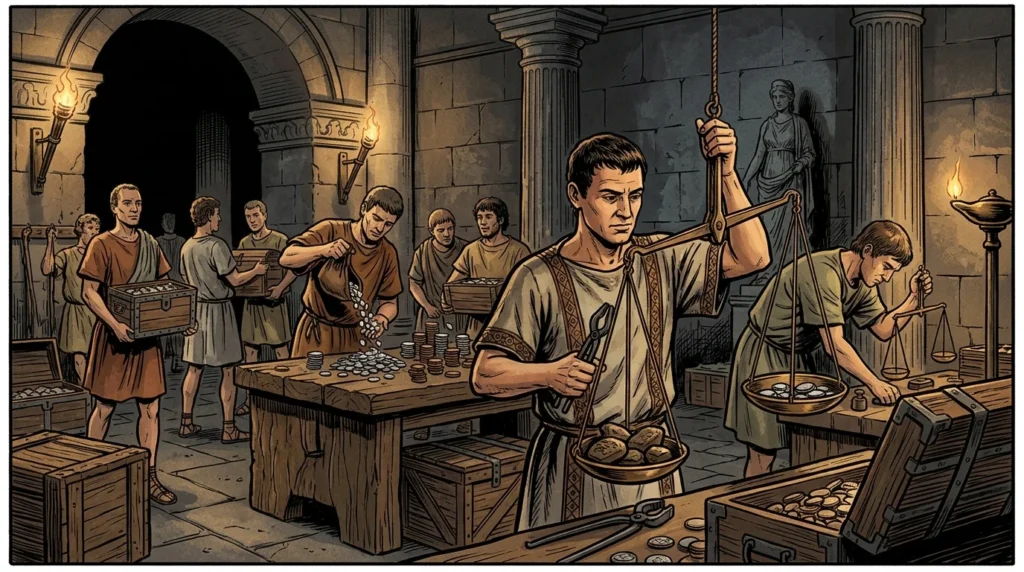
When the Illyrian commander Aurelian (r. 270–275 CE) ascended the throne in autumn 270 CE, he inherited both a fractured empire and an thoroughly corrupted minting apparatus. At the central mint in Rome, the rationalis (chief fiscal administrator) Felicissimus and the guild of imperial mint workers (familia monetalis) had been systematically skimming the remaining trace silver from official coin production and issuing underweight, counterfeit-grade coins to enrich themselves.
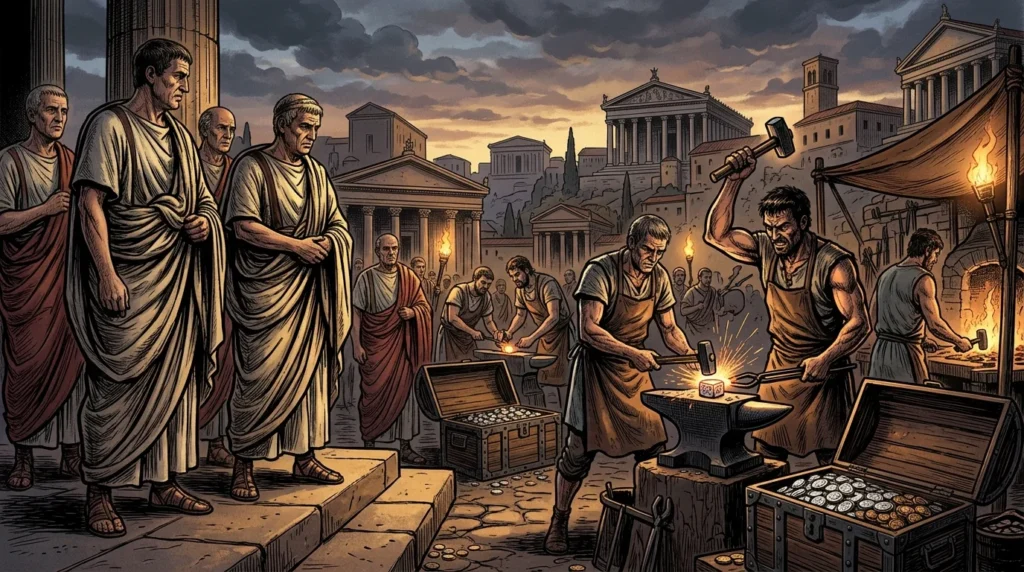
When Aurelian moved in 271 CE to prosecute Felicissimus and audit the Rome mint, the rationalis incited the mint workers—joined by disaffected urban plebs and senatorial opponents—into an armed insurrection known in Roman historical accounts (including Aurelius Victor and the Historia Augusta) as the bellum monetariorum. Pitched urban warfare erupted on the Caelian Hill in Rome; ancient chroniclers recorded that roughly 7,000 soldiers and rebels died before Aurelian’s forces crushed the uprising, executed Felicissimus, and shut down the Rome mint for several years.
After reconquering the Palmyrene East (272–273 CE) and the Gallic Empire (274 CE), Aurelian enacted his comprehensive imperial coinage reform in spring 274 CE:
- The aurelianianus and the XXI / KA mark: Aurelian recalled the worst of the debased pre-reform coins and introduced a heavier, broader, neatly struck radiate coin (~3.85 to 4.0 grams, struck at roughly 80 to 84 to the Roman pound). In the exergue on the reverse, Western mints stamped the Latin numerals XXI and Eastern mints stamped the Greek equivalent KA (20 = K, 1 = A)—signifying a guaranteed statutory proportion of twenty parts copper to one part pure silver (~4.76 to 5 percent silver content, or alternatively a tariff equivalence of twenty smaller accounting units to one silver unit).
- Decentralized imperial mint governance: To prevent any single urban guild from holding the empire’s money supply hostage as Felicissimus had done, Aurelian permanently distributed coin production across a network of tightly supervised regional mints near the frontier armies—including Mediolanum/Ticinum (Pavia), Siscia, Serdica, Cyzicus, Antioch, and Lugdunum—marking each coin with explicit mint and workshop (officina) control letters.
From Fiduciary Radiates to Diocletian’s Tetrarchic Overhaul
Aurelian’s 274 CE reform halted the physical disintegration of Roman billon coinage and restored uniform metallurgical standards from Britain to Syria. Paradoxically, however, the sudden replacement or official retariffing of old debased coins with the new XXI aurelianianus coincided with an acute jump in recorded nominal prices across Egyptian papyri around 274–275 CE, as markets repriced goods in terms of the explicitly fiduciary 5 percent silver radiate.
The aurelianianus served as the backbone of Roman commerce for another twenty years until Emperor Diocletian (r. 284–305 CE) launched his Tetrarchic currency reform around 294–295 CE—reintroducing a pure silver coin (the argenteus at 1/96 of a pound, Nero’s old 64 CE weight standard) alongside a larger silver-washed billon nummus, and ultimately attempting in 301 CE to cap runaway nominal prices through his famous Edict on Maximum Prices.
Theoretical & Balance-Sheet Transmission Mechanism
In the Kindleberger–Minsky taxonomy of financial instability (Kindleberger, 1978; Minsky, 1986) and Irving Fisher’s (1933) debt-deflation framework, speculative asset booms become systemic crises when credit expansion shifts balance sheets from hedge finance (cash flows covering principal and interest) to speculative and Ponzi finance (relying on rising asset prices and short-term margin roll-overs).
Once monetary tightening or an exogenous shock halts price appreciation, forced margin liquidations trigger Fisherian debt-deflation: fire-sale asset discounts erode bank collateral values, contracting credit supply across the real economy.
Sources and Further Reading
- American Numismatic Society, “ Rome: A Thousand Years of Monetary History,” American Numismatic Society, 2020. Historical & Financial Reference
- Kevin Butcher, “ Debasement and the Decline of Rome,” University of Warwick Department of Classics and Ancient History, 2015. Peer-Reviewed / Academic Research
- Kevin Butcher and Matthew Ponting, “ Roman Silver Coinage and Monetary Stability in The Metallurgy of Roman Silver Coinage,” Cambridge University Press, 2015. Peer-Reviewed / Academic Research
- Kyle Harper, “ People, Plagues, and Prices in the Roman World: The Evidence from Egypt,” The Journal of Economic History (Cambridge University Press), 2016. Peer-Reviewed / Academic Research
- Kenneth W. Harl, “ From Aurelian to Diocletian: Financing Imperial Recovery by Coinage Debasements and Fiduciary Currencies,” Cambridge University Press, 2012. Peer-Reviewed / Academic Research
- Andrew Monson and Walter Scheidel (eds.), “ The Later Roman Empire in Fiscal Regimes and the Political Economy of Premodern States,” Cambridge University Press, 2015. Peer-Reviewed / Academic Research
- Irving Fisher — "The Debt-Deflation Theory of Great Depressions," Econometrica 1, no. 4 (FRASER Federal Reserve Archive, 1933): 337–357 Central Bank / Monetary Authority
- Charles P. Kindleberger & Robert Z. Aliber — Manias, Panics, and Crashes: A History of Financial Crises (Palgrave Macmillan) Peer-Reviewed / Academic Research
Cite This Historical Dossier (APA / Chicago)
APA (7th ed.): Ç., S. (Ed.). (2026). Caracalla's Antoninianus and the Third-Century Collapse of Roman Silver Coinage (215–274 CE). In Forgotten Fortunes Historical Monograph Series (Forgotten Fortunes Editorial Desk). https://forgottenfortunes.net/caracalla-antoninianus-coinage/
MLA (9th ed.): Ç., Soner, ed. "Caracalla's Antoninianus and the Third-Century Collapse of Roman Silver Coinage (215–274 CE)." Forgotten Fortunes: Financial & Monetary History Archive, 2026, https://forgottenfortunes.net/caracalla-antoninianus-coinage/.
Chicago (17th ed.): Ç., Soner, ed. "Caracalla's Antoninianus and the Third-Century Collapse of Roman Silver Coinage (215–274 CE)." Forgotten Fortunes Historical Monograph Series (Forgotten Fortunes Editorial Desk), September 12, 2026. https://forgottenfortunes.net/caracalla-antoninianus-coinage/.
Have an idea for another financial history documentary or article? Request a story →